
Screen-Printed Electrodes Modified with Fe3O4-Activated Carbon Derived from Spent Coffee Grounds for Dopamine Detection in the Presence of Ascorbic Acid and Uric Acid
DOI:
https://doi.org/10.48048/tis.2026.11907Keywords:
Dopamine, Activated carbon, Spent coffee ground, Screen-printed electrode, Magnetic carbon, Square wave voltammetry, Electrochemical analysis, NafionAbstract
Dopamine, a critical neurotransmitter involved in regulating nervous and immune system responses, is essential for maintaining overall health. Abnormal dopamine levels are linked to neurodegenerative diseases such as Alzheimer’s and Parkinson’s. Accurate measurement of dopamine, particularly in blood where other interfering substances like uric acid and ascorbic acid are present, is crucial. This study focuses on developing a selective and sensitive electrochemical method for dopamine detection using Fe3O4-activated carbon electrodes derived from pyrolyzed spent coffee grounds. The prepared electrodes exhibit enhanced stability and electrocatalytic properties due to the synergistic effects of high surface area, oxygen-containing species, and the catalytic properties of Fe3O4. Detailed characterization of the Fe3O4-activated carbon composite was conducted using XRD, SEM, FTIR, and cyclic voltammetry, confirming the successful incorporation of Fe3O4 and the presence of functional groups essential for redox reactions. The modified electrodes demonstrated significant improvements in dopamine detection, achieving a detection limit of 0.92 µM with a linear range of 1 - 1,325 µM, and effectively minimizing interference from ascorbic acid and uric acid. The practicality of the developed method was validated through successful dopamine detection in a human serum sample, highlighting its potential for real-world applications in clinical diagnostics.
HIGHLIGHTS
- The study presents a sustainable method for creating a sensitive and selective electrode for dopamine detection by using Fe3O4-activated carbon derived from spent coffee grounds. The use of coffee grounds adds value to a waste material and supports sustainable practices.
- The composite of magnetic activated carbon derived from coffee grounds was characterized using FE-SEM, FTIR, XRD, and electrochemical techniques.
- The electrode demonstrated excellent performance in dopamine detection. It achieved a low detection limit of 0.92 µM and a wide linear detection range of 1 - 1,325 µM. These values are comparable to those of other modified electrodes.
- Electrochemical characterization of the Nafion coating on the electrode revealed that it slightly slowed the diffusion of the detecting species but did not significantly hinder the electrode response. The use of Nafion also helped to reduce interference from ascorbic acid and uric acid.
GRAPHICAL ABSTRACT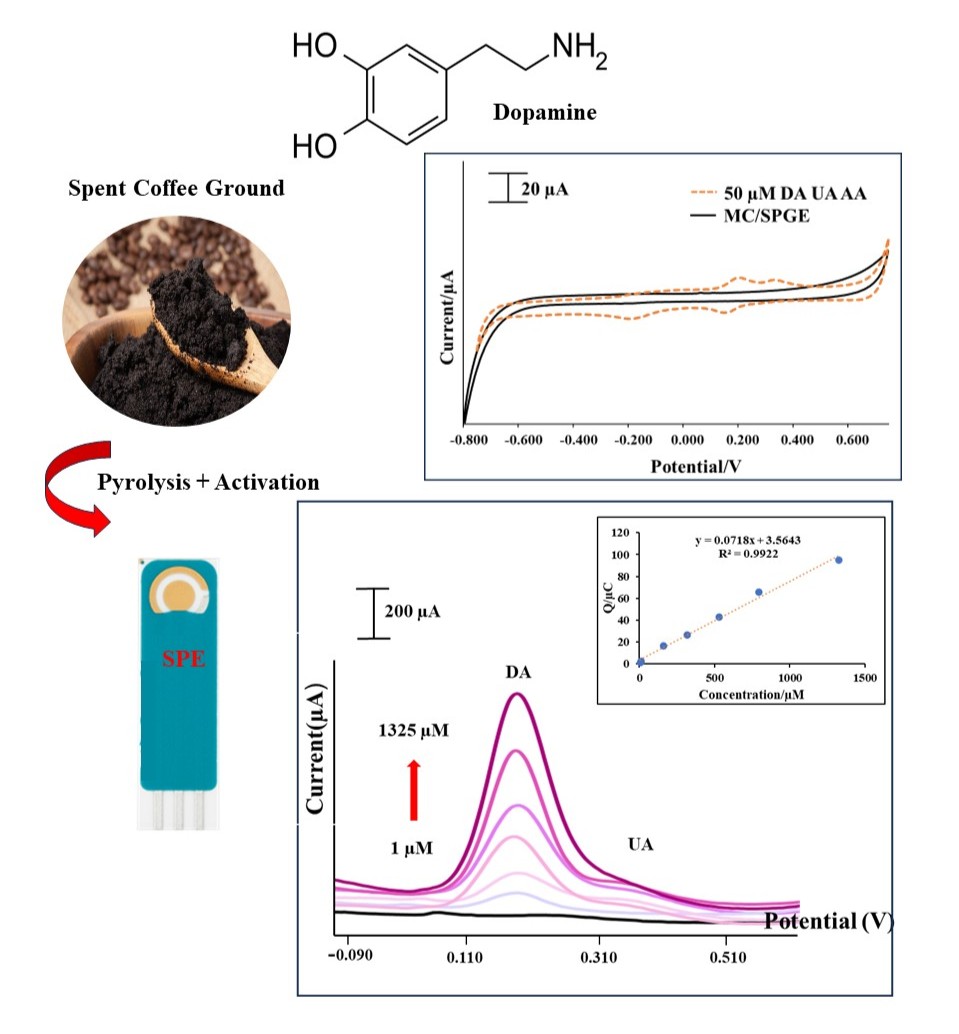
Downloads
References
B Ferry, EP Gifu, I Sandu, L Denoroy and S Parrot. Analysis of microdialysate monoamines, including noradrenaline, dopamine and serotonin, using capillary ultra-high performance liquid chromatography and electrochemical detection. Journal of Chromatography B 2014; 951, 52-57.
J Wen, L Zhou, L Jin, X Cao and BC Ye. Overoxidized polypyrrole/multi-walled carbon nanotubes composite modified electrode for in vivo liquid chromatography - electrochemical detection of dopamine. Journal of Chromatography B 2009; 877(20-21), 1793-1798.
T Yoshitake, J Kehr, S Yoshitake, K Fujino, H Nohta and M Yamaguchi, Determination of serotonin, noradrenaline, dopamine and their metabolites in rat brain extracts and microdialysis samples by column liquid chromatography with fluorescence detection following derivatization with benzylamine and 1,2-diphenylethylenediamine. Journal of Chromatography B 2004; 807, 177.
N Alizadeh and A Salimi. Polymer dots as a novel probe for fluorescence sensing of dopamine and imaging in single living cell using droplet microfluidic platform. Analytica Chimica Acta 2019; 1091, 40-49.
X Liu, X Hou, Z Li, J Li, X Ran and L Yang. Water-soluble amino pillar[5]arene functionalized gold nanoclusters as fluorescence probes for the sensitive determination of dopamine. Microchemical Journal 2019; 150, 104084.
X Wei, Z Zhang and Z Wang. A simple dopamine detection method based on fluorescence analysis and dopamine polymerization. Microchemical Journal 2019; 145, 55.
J JH An, DK Choi, KJ Lee and JW Choi. Surface-enhanced Raman spectroscopy detection of dopamine by DNA targeting amplification assay in Parkisons’s model. Biosensors and Bioelectronics 2015; 67, 739-746.
S Baluchova, A Taylor, V Mortet, S Sedlakova, L Klimša, J Kopeček, O Hák and K Schwarzová-Pecková. Porous boron doped diamond for dopamine sensing: Effect of boron doping level on morphology and electrochemical performance. Electrochimica Acta 2019; 327, 135025.
MLB Figueiredo, CS Martin, LN Furini, RJG Rubira, A Batagin-Neto, P Alessio and CJL Constantino. Surface-enhanced Raman scattering for dopamine in Ag colloid: Adsorption mechanism and detection in the presence of interfering species. Applied Surface Science 2020; 522, 146466.
CX Shi, ZP Chen, Y Chen, Q Liu and RQ Yu. Quantification of dopamine in biological samples by surface-enhanced Raman spectroscopy: Comparison of different calibration models. Chemometrics and Intelligent Laboratory Systems 2017; 169, 87.
G Sridharan, RV Murugan, R Atchudan, S Arya and AK Sundramoorthy. Electrochemical detection of dopamine using green synthesized gold nanoparticles from strobilanthes Kunthiana’s leaf extract. Nano LIFE 2024; 15, 2450015.
X Xu, X Liu, K Wang, Y Tang and P Miao. Electrochemical detection of dopamine based on hydrogen-bonded organic frameworks modified interface. Langmuir 2025; 41(21), 13523.
S Korkmaz and AD Mülazımoğlu. Highly sensitive square wave adsorptive stripping voltammetric determination of dopamine in human plasma using a cytosine-modified pencil graphite electrode. ACS Omega 2025; 10, 23461.
M Amiri, S Dadfarnia, AMH Shabani and S Sadjadi. Non-enzymatic sensing of dopamine by localized surface plasmon resonance using carbon dots-functionalized gold nanoparticles. Journal of Pharmaceutical and Biomedical Analysis 2019; 172, 223.
TS Anirudhan, S Alexander and A Lilly. Surface modified multiwalled carbon nanotube based molecularly imprinted polymer for the sensing of dopamine in real samples using potentiometric method. Polymer 2014; 55, 4820.
G Eom, C Oh, J Moon, H Kim, MK Kim, K Kim, JW Seo, T Kang and HJ Lee. Highly sensitive and selective detection of dopamine using overoxidized polypyrrole/sodium dodecyl sulfate-modified carbon nanotube electrodes. Journal of Electroanalytical Chemistry 2019; 848, 113295.
G Wang, T Tang, R Liu, J Li, Y Xu and S Liao. Novel electrochemical sensor based on Cu-MOF/MWCNT-COOH for the simultaneous detection of ascorbic acid and dopamine. Langmuir 2025; 41, 4102.
N Dükar, S Tunç, K Öztürk, S Demirci, M Dumangöz, MS Çelebi and F Kuralay. Highly sensitive and selective dopamine sensing in biological fluids with one-pot prepared graphene/poly(o-phenylenediamine) modified electrodes, Materials Chemistry and Physics 2019; 228, 357.
X Hui, X Xuan, J Kim and JY Park. A highly flexible and selective dopamine sensor based on Pt-Au nanoparticle-modified laser-induced graphene. Electrochimica Acta 2019; 328, 135066.
X Yuan, XW Wu, S Li, R Liu and Y Ling. A portable microelectrochemical sensor based on potentiostatic polarization-treated and laser-induced graphene for the simultaneous determination of ascorbic acid, dopamine, and uric acid. Langmuir 2024; 40, 25529.
S Lisnund, V Blay, K Chansaenpak, J Monkrathok and P Pinyou. Simultaneous electrochemical determination of dopamine, acetaminophen, and caffeine with a PVP/rGO-modified electrode. ACS Omega 2025; 10(28), 30717.
K Tyszczuk-Rotko, I Jaworska and K Jędruchniewicz. Application of unmodified boron-doped diamond electrode for determination of dopamine and paracetamol. Microchemical Journal 2019; 146, 664.
C Li, X Chen, Z Zhang, J Tang and B Zhang. Gold nanoparticle-DNA conjugates enhanced determination of dopamine by aptamer-based microcantilever array sensor. Sensors and Actuators B: Chemical 2018; 275, 25.
DK Nguyen and CH Jang. Label-free liquid crystal-based biosensor for detection of dopamine using DNA aptamer as a recognition probe. Analytical Biochemistry 2020; 605, 113807.
H Wu, X Ding, W Li, H Liu, M Duan, Y Lei, G Wei and L Guo. Nitrogen pyrolysis-induced enhancement of active sites in an algae residue for an electrochemical dopamine biosensor. Langmuir 2025; 41(13), 8842-8852.
RL McCreery. Advanced carbon electrode materials for molecular electrochemistry. Chemical Reviews 2008; 108(7), 2646-2687.
Y Li, J Zhou, J Song, X Liang, Z Zhang, D Men, D Wang and XE Zhang. Chemical nature of electrochemical activation of carbon electrodes. Biosensors and Bioelectronics 2019; 144, 111534.
X Li, Y Jiang, P Wang, Y Mo, W Lai, Z Li, R Yu, Y Du, X Zhang an Y Chen. Effect of the oxygen functional groups of activated carbon on its electrochemical performance for supercapacitors. New Carbon Materials 2020; 35, 232.
J Wang. Analytical electrochemistry. John Wiley & Sons, New Jersey, Unite States, 2006, p. 91-92.
C Song, X Liu, M Xu, D Masi, Y Wang, Y Deng, M Zhang, X Qin, K Feng, J Yan, J Leng, Z Wang, Y Xu, B Yan, S Jin, D Xu, Z Yin, D Xiao and D Ma. Photothermal conversion of CO2 with tunable selectivity using Fe-based catalysts: From oxide to carbide. ACS Catalysis 2020; 10(18), 10364.
F Pincella, K Isozaki, R Sato, T Teranishi, H Takaya and M Nakamura. Reusable magnetite nanoparticle (Fe3O4 NP) catalyst for selective oxidation of alcohols under microwave irradiation. ACS Omega 2024; 9(23), 24477.
L Hu, A Khaniya, J Wang, G Chen, WE Kaden and X Feng. Ambient electrochemical ammonia synthesis with high selectivity on Fe/Fe oxide catalyst. ACS Catalysis 2018; 8, 9312.
Z Chen, R Patel, J Berry, C Keyes, C Satterfield, C Simmons, A Neeson, X Cao and Q Wu. Development of screen-printable nafion dispersion for electrochemical sensor. Applied Sciences 2022; 12, 6533.
J Lu, LT Drzal, RM Worden and I Lee. Simple fabrication of a highly sensitive glucose biosensor using enzymes immobilized in exfoliated graphite nanoplatelets nafion membrane. Chemistry of Materials 2007; 19, 6240.
OJ Curnick, BG Pollet and PM Mendes. Nafion®-stabilised Pt/C electrocatalysts with efficient catalyst layer ionomer distribution for proton exchange membrane fuel cells. RSC Advances 2012; 2(22), 8368-8374.
NK Kalagatur, K Karthick, JA Allen, OSN Ghosh, S Chandranayaka, VK Gupta, K Krishna and V Mudili. Application of activated carbon derived from seed shells of Jatropha curcas for decontamination of zearalenone mycotoxin. Frontiers in Pharmacology 2017; 8, 760 .
X Xiubo. Dielectric parameters of activated carbon derived from rosewood and corncob. Journal of Materials Science Materials in Electronics 2020; 31(20), 19927-18084.
KS Loh, YH Lee, A Musa, AA Salmah and I Zamri. Use of Fe3O4 nanoparticles for enhancement of biosensor response to the herbicide 2,4-dichlorophenoxyacetic acid. Sensors 2008; 8, 5775.
TKH Ta, MT Trinh, NV Long, TTM Nguyen, TLT Nguyen, TL Thuoc, BT Phan, D Mott, S Maenosono, H Tran-Van and VH Le. Synthesis and surface functionalization of Fe3O4-SiO2 core-shell nanoparticles with 3-glycidoxypropyltrimethoxysilane and 1,1-carbonyldiimidazole for bio-applications. Colloids and Surfaces A: Physicochemical and Engineering Aspects 2016; 504, 376.
L Nalbandian, E Patrikiadou, V Zaspalis, A Patrikidou, E Hatzidaki and CN Papandreou. Magnetic nanoparticles in medical diagnostic applications: synthesis, characterization and proteins conjugation. Current Nanoscience 2015; 12(4), 455-468.
L Zhao, M Gao, W Yue, Y Jiang, Y Wang, Y Ren and F Hu. Sandwich-structured graphene-Fe3O4@carbon nanocomposites for high-performance lithium-ion batteries. ACS Applied Materials & Interfaces 2015; 7(18), 9709.
N Luo, Z Yang, F Tang, D Wang, M Feng, X Liao and X Yang. Fe3O4/carbon nanodot hybrid nanoparticles for the indirect colorimetric detection of glutathione. ACS Applied Nano Materials 2019; 2(6), 3951.
MJ Bleda-Martínez, JA Maciá-Agulló, D Lozano-Castelló, E Morallon, D Cazorla-Amorós and A Linares-Solano. Role of surface chemistry on electric double layer capacitance of carbon materials. Carbon 2005; 43(13), 2677-2684.
CG Zoski. Handbook of electrochemistry. Elsevier, Amsterdam, Netherlands, 2007.
S Tanimoto and A Ichimura. Discrimination of inner- and outer-sphere electrode reactions by cyclic voltammetry experiments. Journal of Chemical Education 2013; 90(6), 778-781.
DC Harris. Quantitative chemical analysis. 7 th ed. Craig Bleyer, Missouri, United States, 2007.
D Li, M Liu, Y Zhan, Q Su, Y Zhang and D Zhang. Electrodeposited poly(3,4-ethylenedioxythiophene) doped with graphene oxide for the simultaneous voltammetric determination of ascorbic acid, dopamine and uric acid. Microchimica Acta 2020; 187(1), 94.
TK Aparna, R Sivasubramanian and MA Dar. One-pot synthesis of Au-Cu2O/rGO nanocomposite based electrochemical sensor for selective and simultaneous detection of dopamine and uric acid. Journal of Alloys and Compounds 2018; 741, 1130-1141.
P Wiench, Z González, R Menéndez, B Grzyb and G Gryglewicz. Beneficial impact of oxygen on the electrochemical performance of dopamine sensors based on N-doped reduced graphene oxides. Sensors and Actuators B: Chemical 2018; 257, 143-153.
S Gao, X Bian, H Bi, WQ Xing, R Su, M Liang, T Li and R You. You, Kraft-based femtosecond laser-induced graphene for electrochemical dopamine sensing. Langmuir 2025; 41(4), 2744-2752.
Published
How to Cite
Issue
Section
License
Copyright (c) 2025 Walailak University

This work is licensed under a Creative Commons Attribution-NonCommercial-NoDerivatives 4.0 International License.





