
Development of pH-Sensitive Intelligent Indicator Film Based on Cassava Flour /Polyvinyl Alcohol Incorporated with Turmeric Powder (Curcuma longa L.) for Pork Freshness Monitoring
DOI:
https://doi.org/10.48048/tis.2026.11783Keywords:
Intelligent indicator film, Cassava flour, Polyvinyl alcohol, Curcumin, Turmeric, Pork spoilageAbstract
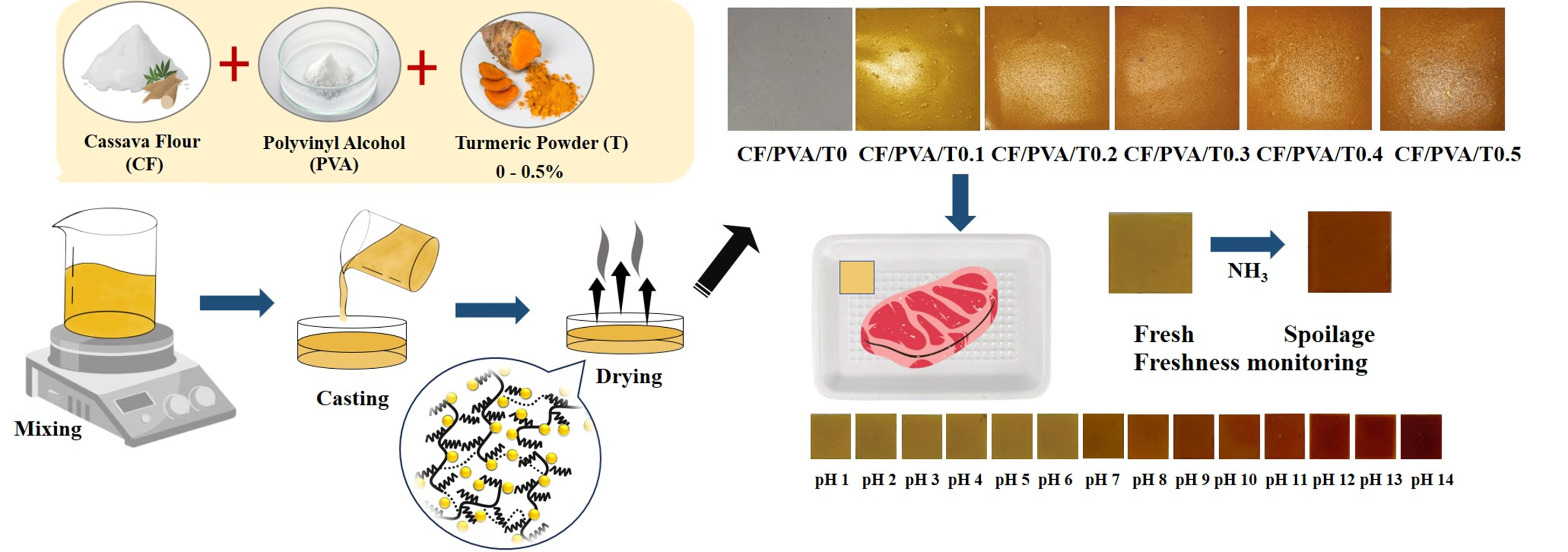
This study aimed to develop a biodegradable intelligent indicator film based on cassava flour and polyvinyl alcohol incorporated with turmeric powder for real-time monitoring of pork freshness. The cassava flour (CF) and polyvinyl alcohol (PVA) film were prepared using solution casting with glycerol as a plasticizer and varying turmeric contents (0% - 0.5% (based on the dry weight of CF). The films were evaluated for their physicochemical and functional properties. Results showed that increasing turmeric content slightly increased film thickness (0.19 - 0.29 mm) while decreasing moisture absorption (1.62% - 47.28%), water solubility (6.72% - 44.16%), and water vapor permeability (0.0043 - 0.0293 g/(m2·kPa·h)), indicating enhanced barrier performance. FTIR spectra suggested possible hydrogen bonding interactions between curcumin and the polymer matrix. The films exhibited a distinct, reversible color transitions in response to pH variation, especially under ammonia exposure and during pork storage at 4 ± 1 °C. The 0.4% turmeric film demonstrated the greatest sensitivity, maintaining structural stability and showing the most pronounced color change. Biodegradability tests revealed 91% - 100% weight loss within 4 weeks, underscoring the films’ environmental compatibility. Overall, turmeric-incorporated CF/PVA films represent a promising, eco-friendly alternative for smart packaging, linking biodegradability with pH-sensitivity to enhance food safety and reduce environmental impacts.
HIGHLIGHTS
- An intelligent pH-sensitive indicator film was successfully developed using cassava flour/PVA incorporated with turmeric powder.
- The addition of turmeric improved the film’s barrier properties and enabled distinct color changes in response to pork freshness.
- FTIR confirmed hydrogen bonding interactions between curcumin molecules and the polymer matrix.
- The film showed high biodegradability (91% - 100%) weight loss within 4 weeks), highlighting its eco-friendly potential.
- The 0.4% turmeric-incorporated film exhibited the most distinct color response, making it suitable for real-time pork freshness monitoring.
GRAPHICAL ABSTRACT
Downloads
References
A Sobhan, K Muthukumarappan and L Wei. A biopolymer-based pH indicator film for visually monitoring beef and fish spoilage. Food Bioscience 2022; 46, 101523.
X Zhang, Y Liu, H Yong, Y Qin, J Liu and J Liu. Development of multifunctional food packaging films based on chitosan, TiO2 nanoparticles and anthocyanin-rich black plum peel extract. Food Hydrocolloids 2019; 94, 80-92.
E Taherkhani, M Moradi, H Tajik, R Molaei and P Ezati. Preparation of on-package halochromic freshness/spoilage nanocellulose label for the visual shelf life estimation of meat. International Journal of Biological Macromolecules 2020; 164, 2632-2640.
DR Barleany, DK Sari, RSD Lestari, Y Raharja and A Gunawan. Biopolymer-based film preparation for potential smart food packaging material application. International Journal of Innovation in Mechanical Engineering & Advanced Materials 2023; 5(3), 109-117.
M Tavassoli, M Alizadeh Sani, A Khezerlou, A Ehsani, G Jahed-Khaniki and DJ McClements. Smart biopolymer-based nanocomposite materials containing pH-sensing colorimetric indicators for food freshness monitoring. Molecules 2022; 27, 3168.
LS Devi, AK Jaiswal and S Jaiswal. Lipid incorporated biopolymer based edible films and coatings in food packaging: A review. Current Research in Food Science 2024; 8, 100720.
ED Tsochatzis, NP Vidal, W Bai, D Diamantidou, G Theodoridis and MM Martinez. Untargeted screening and in silico toxicity assessment of semi- and non-volatile compounds migrating from polysaccharide-based food contact materials. Food Chemistry 2023; 425, 136499.
A Ounkaew, P Kasemsiri, U Pongsa, S Hiziroglu, P Pasuwan, Y Boonlai and S Theerakulpisut. Multiple response optimization of poly(vinyl alcohol)/starch based bioactive composite films for antimicrobial packaging applications. Journal of Polymers and the Environment 2022; 30(5), 1787-1802.
M-A Berthet, H Angellier-Coussy, V Guillard and N Gontard. Vegetal fiber-based biocomposites: Which stakes for food packaging applications? Journal of Applied Polymer Science 2016; 133(2), 1-12.
NP Vidal, W Bai, M Geng and MM Martinez. Organocatalytic acetylation of pea starch: Effect of alkanoyl and tartaryl groups on starch acetate performance. Carbohydrate Polymers 2022; 294, 119780.
DI Dăescu, DM Dreavă, A Todea, F Peter and I Păușescu. Intelligent biopolymer-based films: Promising new solutions for food packaging applications. Polymers 2024; 16, 2256.
VG Bhat, SP Masti, SS Narasagoudr, RB Chougale, PK Sk, NP Dalbanjan and RB Malabadi. Chitosan, poly(vinyl alcohol) and chitosan/poly(vinyl alcohol) based active films loaded with white turmeric powder for food packaging applications. Food Bioscience 2024; 60, 104402.
A Abdullahi, T Korumilli and KJ Rao. Revolutionizing food packaging with biobased polymers, active and intelligent materials for enhanced food safety and sustainability. Food and Bioprocess Technology 2025; 18, 6836-6868.
Z Yu, V Boyarkina, Z Liao, M Lin, W Zeng and X Lu. Boosting food system sustainability through intelligent packaging: Application of biodegradable freshness indicators. ACF Food Science & Technology 2023; 3(1), 199-212.
J Liu, H Wang, P Wang, M Guo, S Jiang, X Li and S Jiang. Films based on κ-carrageenan incorporated with curcumin for freshness monitoring. Food Hydrocolloids 2018; 83, 134-142.
P Ezati and JW Rhim. pH-responsive pectin-based multifunctional films incorporated with curcumin and sulfur nanoparticles. Carbohydrate Polymers 2020; 230, 115638.
I Choi, JY Lee, M Lacroix and J Han. Intelligent pH indicator film composed of agar/potato starch and anthocyanin extracts from purple sweet potato. Food Chemistry 2017; 218, 122-128.
D Yonata, P Triwitono, LA Lestari and Y Pranoto. Physicochemical and structural properties of resistant starch prepared from Tacca tuber starch using autoclaving-cooling and acid hydrolysis treatments. Trends in Sciences 2025; 22(1), 8822.
X Wu, X Yan, J Zhang, X Wu, M Luan and Q Zhang. Preparation and characterization of pH-sensitive intelligent packaging films based on cassava flour/polyvinyl alcohol matrices containing Aronia melanocarpa anthocyanins. LWT 2024; 194, 115818.
W Song, N Wu, Y He, H Zhao, J Xu and L Ren. Intelligent color changing packaging film based on esterified starch and black rice anthocyanins. Food Chemistry: X 2024; 24, 101930.
JA Araujo, M Azeem, C Venkatesh, M Mojicevic, MB Fournet and OA Attallah. Color stability enhancement of curcumin bioplastic films using natural hybrid fillers of montmorillonite and revalorized cellulose. ACF Sustainable Chemistry & Engineering 2023; 11(26), 9696-9710.
MP Martins, JLA Dagostin, TS Franco, GIB de Muñiz and ML Masson. Application of cellulose nanofibrils isolated from an agroindustrial residue of peach palm in cassava flour films. Food Biophysics 2020; 15(3), 323-334.
ASTM Standard E96/E96M. Standard test methods for water vapor transmission of materials. ASTM International, Pennsylvania, United States, 2013, p. 1-24.
M Shakouri, M Salami, LT Lim, M Ekrami, M Mohammadian, G Askari and DJ McClements. Development of active and intelligent colorimetric biopolymer indicator: Anthocyanin-loaded gelatin-basil seed gum films. Journal of Food Measurement and Characterization 2023; 17(1), 472-484.
E Malekzadeh, A Tatari and MD Firouzabadi. Effects of biodegradation of starch-nanocellulose films incorporated with black tea extract on soil quality. Scientific Reports 2024; 14(1), 18817.
H Yong, X Wang, R Bai, Z Miao, X Zhang and J Liu. Development of antioxidant and intelligent pH-sensing packaging films by incorporating purple-fleshed sweet potato extract into chitosan matrix. Food Hydrocolloids 2019; 90, 216-224.
Y Wang, J Zhong, D J McClements, Z Zhang, R Zhang, Z Jin and L Chen. Stability enhancement methods for natural pigments in intelligent packaging: A review. Critical Reviews in Food Science and Nutrition 2024. https://doi.org/10.1080/10408398.2024.2437570
L Woszczak, K Khachatryan, M Krystyjan, T Witczak, M Witczak, D Gałkowska and G Khachatryan. Physicochemical and functional properties and storage stability of chitosan-starch films containing micellar nano/microstructures with turmeric and hibiscus extracts. International Journal of Molecular Sciences 2023; 24(15), 12218.
A Etxabide, JI Maté and PA Kilmartin. Effect of curcumin, betanin and anthocyanin containing colourants addition on gelatin films properties for intelligent films development. Food Hydrocolloids 2021; 115, 106593.
JM Castro, MG Montalbán, N Martínez-Pérez, D Domene-López, JM Pérez, FM Arrabal-Campos and JC García-Quesada. Thermoplastic starch/polyvinyl alcohol blends modification by citric acid-glycerol polyesters. International Journal of Biological Macromolecules 2023; 244, 125478.
YS Musso, PR Salgado and AN Mauri. Smart edible films based on gelatin and curcumin. Food Hydrocolloids 2017; 66, 8-15.
AF Chamorro, M Palencia and EM Combatt. Biodegradable cassava flour/phosphorite/citric acid based hydrogel for slow release of phosphorus: In vitro study. Gels 2024; 10(7), 431.
H Alhussain, AM Alghamdi, NY Elamin and A Rajeh. Recent progress in enhanced optical, mechanical, thermal properties, and antibacterial activity of the chitosan/polyvinyl alcohol/Co3O4 nanocomposites for optoelectronic and biological applications. Journal of Polymers and the Environment 2024; 32(8), 3735-3748.
RA Syahputra, R Fajrina, Z Rani and A Rahmadani. Producing polyurethane as wound plaster using glycerol transesterified of waste cooking oil with Moringa leaf extract (Moringa Oleifera Lam.) as an antimicrobial. Trends in Sciences 2023; 20(12), 6963.
A Ali and S Ahmed. Eco-friendly natural extract loaded antioxidative chitosan/polyvinyl alcohol based active films for food packaging. Heliyon 2021; 7(3), e06550.
FS Mohseni‐Shahri and F Moeinpour. Development of a pH‐sensing indicator for shrimp freshness monitoring: Curcumin and anthocyanin‐loaded gelatin films. Food Science & Nutrition 2023; 11(7), 3898-3910.
D Salarbashi, M Tafaghodi, BSF Bazzaz, SM Aboutorabzade and M Fathi. pH‐sensitive soluble soybean polysaccharide/SiO2 incorporated with curcumin for intelligent packaging applications. Food Science & Nutrition 2021; 9(4), 2169-2179.
S Zhou, N Li, H Peng, X Yang and D Lin. The development of highly pH-sensitive bacterial cellulose nanofibers/gelatin-based intelligent films loaded with anthocyanin/curcumin for the fresh-keeping and freshness detection of fresh pork. Foods 2023; 12(20), 3719.
FS Mohseni-Shahri and F Moeinpour. Development of a pH-sensing indicator for shrimp freshness monitoring: Curcumin and anthocyanin-loaded gelatin films. Food Science & Nutrition 2023; 11(7), 3898-3910.
H Tambawala, S Batra, Y Shirapure and AP More. Curcumin-A bio-based precursor for smart and active food packaging systems: A review. Journal of Polymers and the Environment 2022; 30(6), 2177-2208.
Published
How to Cite
Issue
Section
License
Copyright (c) 2025 Walailak University

This work is licensed under a Creative Commons Attribution-NonCommercial-NoDerivatives 4.0 International License.





