
Potential of Bacillus sp. SNRUSA9 for Suppressing Anthracnose and Promoting Growth in Chili
DOI:
https://doi.org/10.48048/tis.2026.11729Keywords:
Biological control, Antagonistic bacteria, Plant growth promoting bacteria, Biocontrol agent, Bacillus, Colletotrichum acutatum, Colletotrichum capsici, Colletotrichum gloeosporioidesAbstract
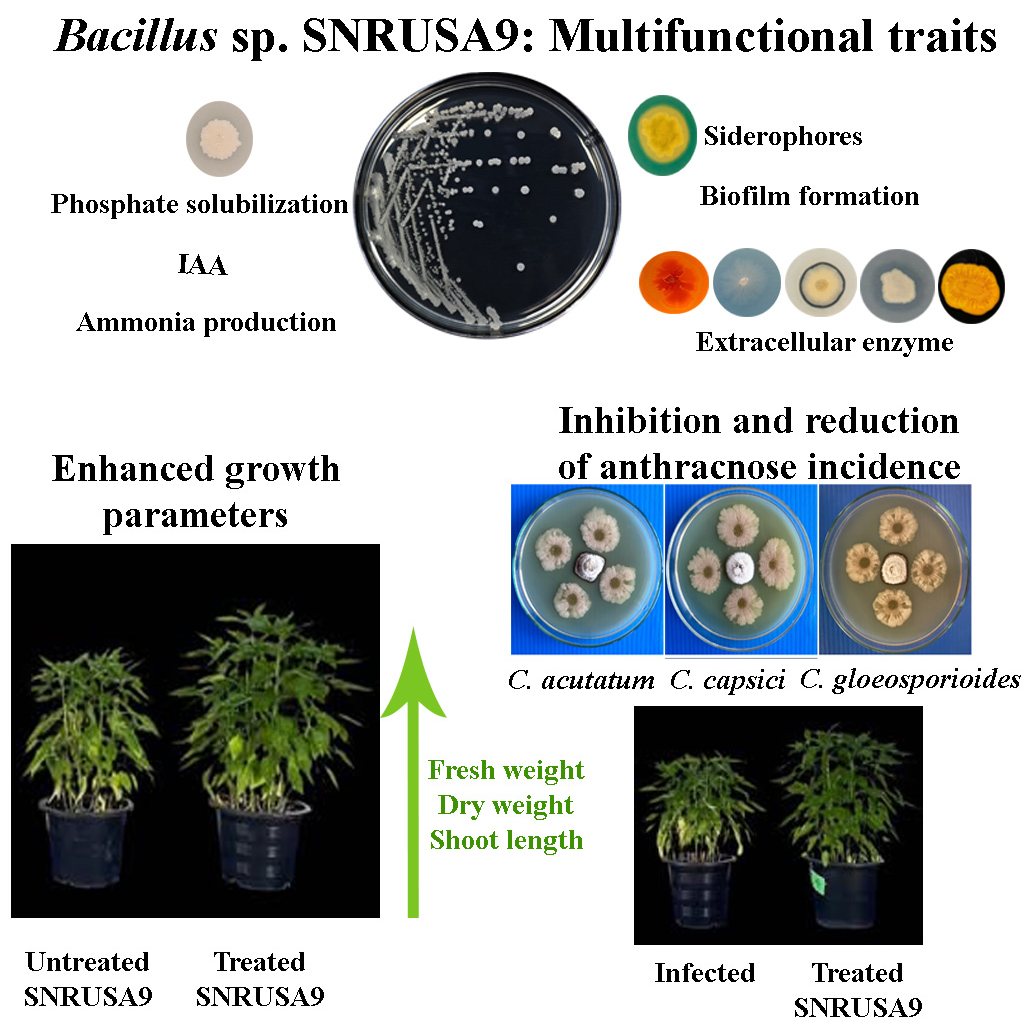
Anthracnose is a major disease affecting chili production and leads to a decrease in crop yield. Farmers have increased their use of chemical agents to agricultural problems. However, the rising use of agricultural chemicals poses risks to human health and the environment. This research focused on assessing the efficacy of the bacterial isolate SNRUSA9 in controlling Colletotrichum acutatum, C. capsici, and C. gloeosporioides, responsible for anthracnose, and to assess its plant growth-promoting traits. SNRUSA9 exhibited strong antagonistic activity against all three pathogens and produced disease-suppressing compounds, including amylase, cellulase, chitinase, lipase, protease, siderophores, and biofilm. It also exhibited plant growth-promoting properties through ammonia production, indole-3-acetic acid synthesis, and phosphate solubilization. SNRUSA9 was identified as a Bacillus species, and designated Bacillus sp. SNRUSA9. Pot experiments confirmed its effectiveness in significantly reducing anthracnose incidence and enhancing chili growth, fresh weight, dry weight, and shoot length, compared to the control. The study highlights the potential of Bacillus sp. SNRUSA9 for disease suppression and chili growth promotion.
HIGHLIGHTS
- A novel Bacillus strain, SNRUSA9, capable of successfully controlling anthracnose diseases and promoting chili growth, was discovered.
- Bacillus SNRUSA9 exhibits multifunctional biocontrol traits, including the production of siderophores, extracellular lytic enzymes, and biofilms, which inhibit the growth of C. acutatum, C. capsici, and C. gloeosporioides, and reduce anthracnose incidence under pot conditions.
- Bacillus SNRUSA9 has multiple growth-promoting traits, including ammonia production, IAA synthesis, and phosphate solubilization, which enhance growth parameters in chili under pot conditions.
GRAPHICAL ABSTRACT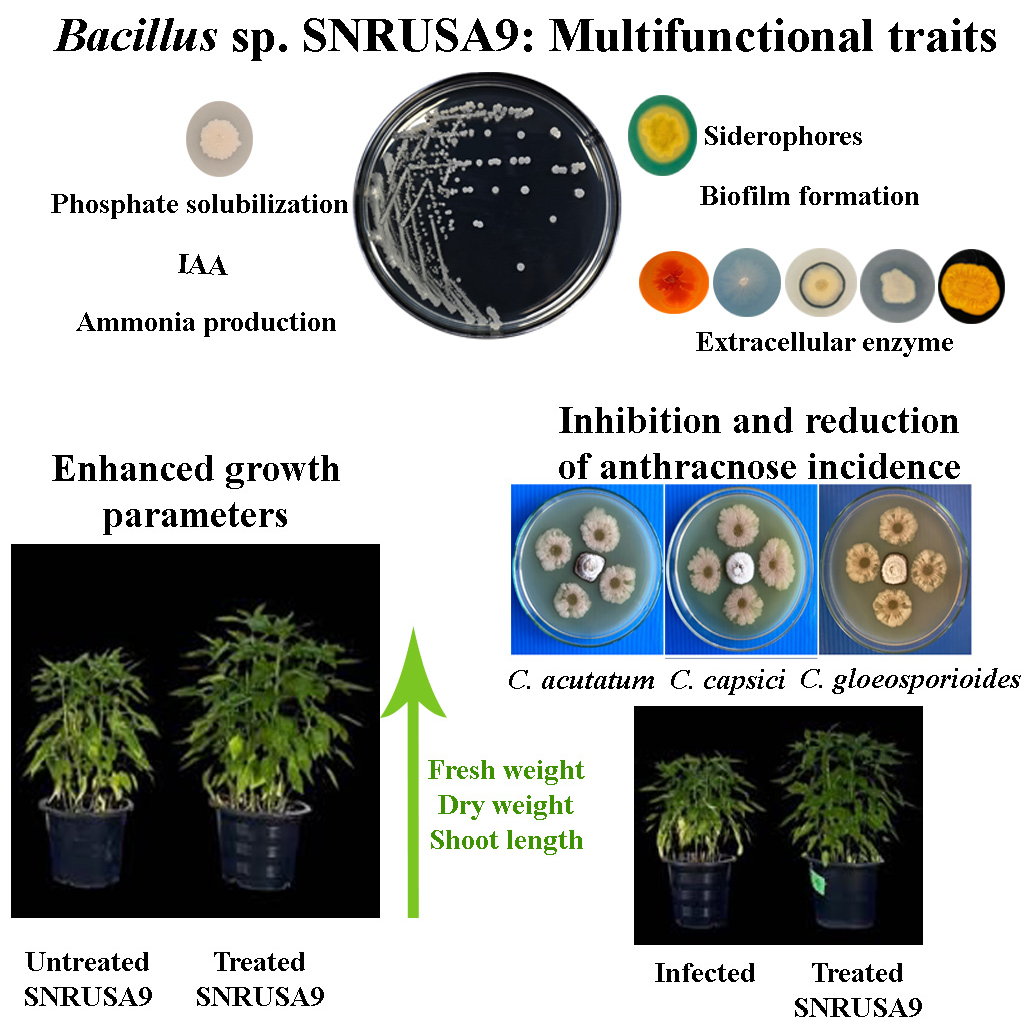
Downloads
References
Y Peng, SJ Li, J Yan, Y Tang, JP Cheng, AJ Gao, X Yao, JJ Ruan and BL Xu. Research progress on phytopathogenic fungi and their role as biocontrol agents. Frontiers in Microbiology 2021; 12, 670135.
E Fiallo-Olive, A Palacio-Bielsa and S Sacristan. Plant pathogenic microorganisms: State-of-the-art research in Spain. Microorganisms 2023; 11(3), 816.
G Hariharan and K Prasannath. Recent advances in molecular diagnostics of fungal plant pathogens: A mini review. Frontiers in Cellular and Infection Microbiology 2021; 10, 600234.
W Zhou, M Li and V Achal. A comprehensive review on environmental and human health impacts of chemical pesticide usage. Emerging Contaminants 2025; 11(1), 100410.
NY Ro, R Sebastin, OS Hur, GT Cho, B Geum, YJ Lee and BC Kang. Evaluation of anthracnose resistance in pepper (Capsicum spp.) genetic resources. Horticulturae 2021; 7(11), 460.
TL Thanh, VK Cong, R Sangpueak, P Numparditsub, NK Papathoti, T Machikowa and K Buensanteai. Efficacy of Bacillus subtilis for controlling anthracnose in chilli. Agriculture and Natural Resources 2023; 57(2), 223-232.
V Puripunyavanich, TN Nan, N Suwan, P Orpong, R Picha, L Maikaeo, A Tamman and T Bhasabuttra. Breeding for anthracnose disease resistance in chili pepper (Capsicum annum L.) using gamma irradiation. Trends in Sciences 2024; 21(8), 7709.
BD Aljawasim, JB Samtani and M Rahman. New insights in the detection and management of anthracnose diseases in strawberries. Plants 2023; 12(21), 3704.
M Villavicencio-Vasquez, F Espinoza-Lozano, L Espinoza-Lozano and J Coronel-Leon. Biological control agents: Mechanisms of action, selection, formulation and challenges in agriculture. Frontiers in Agronomy 2025; 7, 1578915.
N Zhang, Z Wang, J Shao, Z Xu, Y Liu, W Xun, Y Miao, Q Shen and R Zhang. Biocontrol mechanisms of Bacillus: Improving the efficiency of green agriculture. Microbial Biotechnology 2023; 16(1), 2250-2263.
D Miljakovic, J Marinkovic and S Balesevic-Tubic. The significance of Bacillus spp. in disease suppression and growth promotion of field and vegetable crops. Microorganisms 2020; 8(7), 1037.
T Tsotetsi, L Nephali, M Malebe and F Tugizimana. Bacillus for plant growth promotion and stress resilience: What have we learned? Plants 2022; 11(19), 2482.
H Etesami, BR Jeong and BR Glick. Potential use of Bacillus spp. as an effective biostimulant against abiotic stresses in crops—A review. Current Research in Biotechnology 2023; 5, 100128.
N Shen, S Li, S Li, H Zhang and M Jiang. The siderophore-producing bacterium, Bacillus siamensis Gxun-6, has an antifungal activity against Fusarium oxysporum and promotes the growth of banana. Egyptian Journal of Biological Pest Control 2022; 32, 34.
HT Kwon, Y Lee, J Kim, K Balaraju, HT Kim and Y Jeon. Identification and characterization of Bacillus tequilensis GYUN-300: An antagonistic bacterium against red pepper anthracnose caused by Colletotrichum acutatum in Korea. Frontiers in Microbiology 2022; 13, 826827.
S Nair, N Kwatra and J Abraham. Isolation and characterization of biofilm producing bacteria from water treatment tank. Current Trends in Biotechnology and Pharmacy 2021; 15(6), 34-39.
N Fahsi, I Mahdi, A Mesfioui, L Biskri and A Allaoui. Plant growth-promoting rhizobacteria isolated from the jujube (Ziziphus lotus) plant enhance wheat growth, Zn uptake, and heavy metal tolerance. Agriculture 2021; 11(4), 316.
S Soponputtaporn, M Srithaworn, Y Promnuan, P Srirat and O Chunhachart. Indole-3-acetic acid producing yeasts in the phyllosphere of legumes: Benefits for chili growth. Trends in Sciences 2024; 21(3), 7335.
R Mazylyte, J Kaziuniene, L Orola, V Valkovska, E Lastauskiene and A Gegeckas. Phosphate solubilizing microorganism Bacillus sp. MVY-004 and its significance for biomineral fertilizers’ development in agrobiotechnology. Biology 2022; 11(2), 254.
S Sawiphak and A Wongjiratthiti. Optimisation of culture conditions for PLA-food-packaging degradation by Bacillus sp. SNRUSA4. Pertanika Journal of Science & Technology 2021; 29(1), 407-425.
A Kumar, J Rabha and DK Jha. Antagonistic activity of lipopeptide-biosurfactant producing Bacillus subtilis AKP against Colletotrichum capsici, the causal organism of anthracnose disease of chilli. Biocatalysis and Agricultural Biotechnology 2021; 36, 102133.
H Huang, C Tian, Y Huang and H Huang. Biological control of poplar anthracnose caused by Colletotrichum gloeosporioides (Penz.) Penz. & Sacc. Egyptian Journal of Biological Pest Control 2020; 30, 104.
Y Yanti, H Hamid, Reflin and Yaherwandi. The ability of chitinolytic bacteria to control Colletotrichum capsici in chili plants. IOP Conference Series: Earth and Environmental Science 2023; 1228(1), 012020.
HB Ajuna, HI Lim, JH Moon, SJ Won, V Choub, SI Choi, JY Yun and YS Ahn. The prospect of hydrolytic enzymes from Bacillus species in the biological control of pests and diseases in forest and fruit tree production. International Journal of Molecular Sciences 2023; 24(23), 16889.
N Ajijah, A Fiodor, AK Pandey, A Rana and K Pranaw. Plant growth-promoting bacteria (PGPB) with biofilm-forming ability: A multifaceted agent for sustainable agriculture. Diversity 2023; 15(1), 112.
A Fanai, B Bohia, F Lalremruati, N Lalhriatpuii, L Lalrokimi, R Lalmuanpuii, PK Singh and Zothanpuia. Plant growth promoting bacteria (PGPB)-induced plant adaptations to stresses: An updated review. PeerJ 2024; 12, 17882.
H Etesami and BR Glick. Bacterial indole-3-acetic acid: A key regulator for plant growth, plant-microbe interactions, and agricultural adaptive resilience. Microbiological Research 2024; 281, 127602.
L Pan and B Cai. Phosphate-solubilizing bacteria: Advances in their physiology, molecular mechanisms and microbial community effects. Microorganisms 2023; 11(12), 2904.
C Wang, G Pan, X Lu and W Qi. Phosphorus solubilizing microorganisms: Potential promoters of agricultural and environmental engineering. Frontiers in Bioengineering and Biotechnology 2023; 11, 1181078.
V Karacic, D Miljakovic, J Marinkovic, M Ignjatov, D Milosevic, G Tamindzic and M Ivanovic. Bacillus species: Excellent biocontrol agents against tomato diseases. Microorganisms 2024; 12(3), 457.
J Detka, M Jafari, M Gomez and GS Gilbert. Machine learning vs. empirical models: Estimating leaf wetness patterns in a wildland landscape for plant disease management. Agricultural and Forest Meteorology 2025; 362, 110392.
MM Hossain, F Sultana, M Mostafa, H Ferdus, M Rahman, JA Rana, SS Islam, S Adhikary, A Sannal, MAE Hosen, J Nayeema, NJ Emu, M Kundu, SK Biswas, L Farzana and MAA Sabbir. Plant disease dynamics in a changing climate: Impacts, molecular mechanisms, and climate informed strategies for sustainable management. Discover Agriculture 2024; 2, 132.
JM Woo, HS Kim, IK Lee, EJ Byeon, WJ Chang and YS Lee. Potentiality of beneficial microbe Bacillus siamensis GP-P8 for the suppression of anthracnose pathogens and pepper plant growth promotion. Plant Pathology Journal 2024; 40(4), 346-357.
A Zhang and Q Shang. Transcriptome analysis of early lateral root formation in tomato. Plants 2024; 13(12), 1620.
Published
How to Cite
Issue
Section
License
Copyright (c) 2025 Walailak University

This work is licensed under a Creative Commons Attribution-NonCommercial-NoDerivatives 4.0 International License.





