
Valorization of Gelidium corneum Industrial Residue as a Source of Antioxidant and Antifungal Agents
DOI:
https://doi.org/10.48048/tis.2026.11707Keywords:
G. corneum alga, By-products, Antioxidant, Antifungal, Phytopigment, Total phenolic content, Total flavonoid contentAbstract
The industrial agar extraction of the red alga Gelidium corneum generates substantial residue, a biomass with considerable potential for valorization into a sustainable bioproduct. This investigation aimed to characterize the phytochemical composition and bioactivities of extracts from the residue in comparison to the whole alga. For this purpose, extracts were prepared from both the residue and whole alga using various solvents. The antioxidant capacity of the extracts was then evaluated using DPPH, ABTS, and total antioxidant capacity assays. Additionally, their antifungal activity was tested against 4 storage fungi (Fusarium graminearum, Fusarium oxysporum, Aspergillus flavus and Penicillium chrysogenum), with efficacy compared to the commercial fungicide Azoxystrobin. Our analysis revealed that the 90% methanolic extracts were particularly effective, as they were rich in total phenolic compounds (TPC: 13 mg GAEs/g in residue and 14.9 mg GAEs/g in whole alga), total flavonoid content (TFC: 5.90 mg QEs/g in residue and 7.07 mg QEs/g in whole alga), and condensed tannins (CTC: 2.90 mg CEs/g in residue and 5.92 mg CEs/g in whole alga). These extracts exhibited potent antioxidant activity and their notable antifungal activity was comparable to Azoxystrobin. The observed bioactivities were consistently correlated with the high phenolic content. These findings suggest that G. corneum industrial residue is a promising and sustainable source of natural antioxidant and antifungal agents for applications in food preservation and related industries.
HIGHLIGHTS
- Agar extraction residue from corneum offers significant potential for valorization as a sustainable bioproduct.
- corneum residue is a rich natural source of valuable bioactive compounds.
- Its phytochemical profile, including phenolic compounds, is comparable to that of the whole alga.
- Both the whole alga and its residue exhibit potent antioxidant and antifungal properties, especially in methanolic extracts.
- The observed bioactivities are strongly correlated with the high content of phenolic compounds.
GRAPHICAL ABSTRACT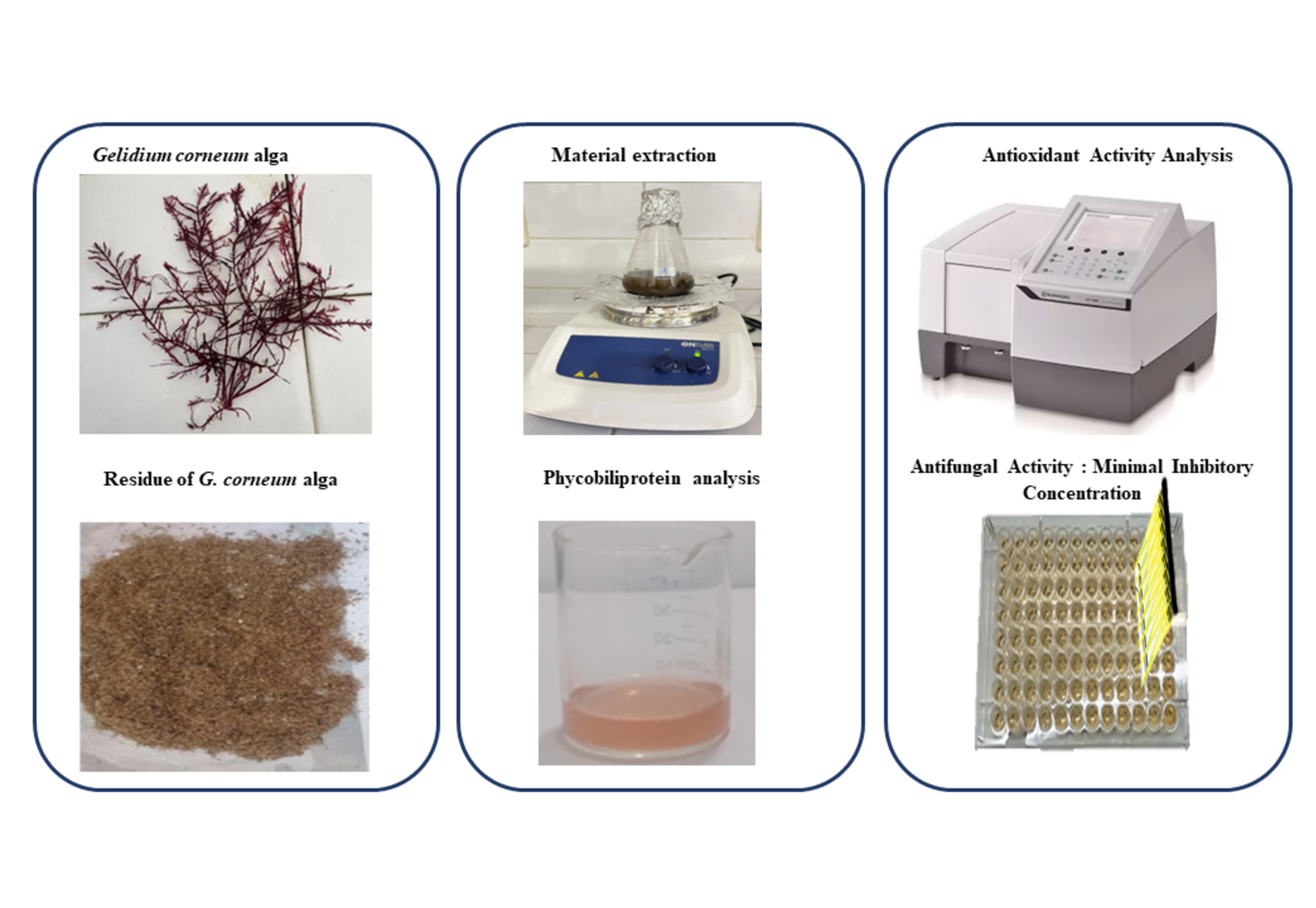
Downloads
References
S Cox, G Hamilton Turley, G Rajauria, N Abu-Ghannam and AK Jaiswal. Antioxidant potential and antimicrobial efficacy of seaweed (Himanthalia Elongata) extract in model food systems. Journal of Applied Phycology 2014; 26, 1823-1831.
F Fleurat-Lessard. Integrated management of the Risks of stored grain spoilage by seedborne fungi and contamination by storage mould mycotoxins - an update. Journal of Stored Products Research 2017; 71, 22-40.
B Prakash, A Kedia, PK Mishra and NK Dubey. Plant essential oils as food preservatives to control moulds, mycotoxin contamination and oxidative deterioration of agri-food commodities - potentials and challenges. Food Control 2015; 47, 381-391.
SM Abdel-Aziz, A Aeron and TA Kahil. Health benefits and possible risks of herbal medicine. In: N Garg, S Abdel-Aziz and A Aeron (Eds.). Microbes in food and health. Springer, Cham, Switzerland, 2016, p. 97-116.
D Surendhiran, C Li, H Cui and L Lin. Marine algae as efficacious bioresources housing antimicrobial compounds for preserving foods - a review. International Journal of Food Microbiology 2021; 358, 109416.
F Afrin, T Ahsan, MN Mondal, MG Rasul, M Afrin, AA Silva, C Yuan and A Shah. Evaluation of antioxidant and antibacterial activities of some selected seaweeds from Saint Martin’s Island of Bangladesh. Food Chemistry Advances 2023; 3, 100393.
S Polat, M Trif, A Rusu, V Šimat, M Čagalj, G Alak, R Meral, Y Özogul, A Polat and F Özogul. Recent advances in industrial applications of seaweeds. Critical Reviews in Food Science and Nutrition 2023; 63, 4979-5008.
S Tayibi, F Monlau, N Fayoud, A Oukarroum, Y Zeroual, H Hannache and A Barakat. One-pot activation and pyrolysis of Moroccan gelidium sesquipedale red macroalgae residue: Production of an efficient adsorbent biochar. Biochar 2019; 1(4), 401-412.
A Aboulkas, H Hammani, M El Achaby, E Bilal and A Barakat. Valorization of algal waste via pyrolysis in a fixed-bed reactor: Production and characterization of bio-oil and bio-char. Bioresource Technology 2017; 243, 400-408.
S Tůma, JK Izaguirre, M Bondar, MM Marques, P Fernandes, MMR da Fonseca and MT Cesário. Upgrading end-of-line residues of the red seaweed Gelidium Sesquipedale to polyhydroxyalkanoates using Halomonas boliviensis. Biotechnology Reports 2020; 27, e00491.
S Lebbar, M Fanuel, S Le Gall, X Falourd, D Ropartz, P Bressollier, V Gloague and C Faugeron-Girard. Agar extraction by-products from Gelidium sesquipedale as a source of glycerol-galactosides. Molecules 2018; 23, 3364.
S Suganya, R Ishwarya, R Jayakumar, M Govindarajan, NS Alharbi, S Kadaikunnan, JM Khaled, MN Al-Anbr and B Vaseeharan. New insecticides and antimicrobials derived from Sargassum wightii and Halimeda gracillis seaweeds: Toxicity against mosquito vectors and antibiofilm activity against microbial pathogens. South African Journal of Botany 2019; 125, 466-480.
SMM El-Din and AMD El-Ahwany. Bioactivity and phytochemical constituents of marine red seaweeds (Jania Rubens, Corallina Mediterranea and Pterocladia Capillacea). Journal of Taibah University for Science 2016; 10(4), 471-484.
N Castejón, M Parailloux, A Izdebska, R Lobinski and SCM Fernandes. Valorization of the red algae gelidium sesquipedale by extracting a broad spectrum of minor compounds using green approaches. Marine Drugs 2021; 19(10), 574.
T Norikura, A Kojima-Yuasa, M Shimizu, X Huang, S Xu, S Kametani, SN Rho, DO Kennedy and I Matsui-Yuasa. Anticancer activities and mechanisms of Blumea Balsamifera extract in hepatocellular carcinoma cells. The American Journal of Chinese Medicine 2008; 36, 411-424.
CC Chang, MH Yang, HM Wen and JC Chern. Estimation of total flavonoid content in propolis by 2 complementary colorimetric methods. Journal of Food and Drug Analysis 2002; 10(3), 3.
RB Broadhurst and WT Jones. Analysis of condensed tannins using acidified vanillin. Journal of the Science of Food and Agriculture 1978; 29, 788-794.
J Nehete, M Bhatia and M Narkhede. In-vitro evaluation of antioxidant activity and phenolic content of Costus Speciosus (Koen) JE Sm. Iranian Journal of Pharmaceutical Research 2010; 9(3), 271.
R Re, N Pellegrini, A Proteggente, A Pannala, M Yang and C Rice-Evans. Antioxidant activity applying an improved ABTS radical cation decolorization assay. Free Radical Biology and Medicine 1999; 26(9-10), 1231-1237.
P Prieto, M Pineda and M Aguilar. Spectrophotometric quantitation of antioxidant capacity through the formation of a phosphomolybdenum complex: Specific application to the determination of vitamin E. Analytical Biochemistry 1999; 269, 337-341.
HL Barnett and BB Hunter. Illustrated genera of imperfect fungi. American Phytopathological Society Press, Minnesota, United States, 2003.
A Bouaziz, D Mhalla, I Zouari, L Jlaiel, S Tounsi, R Jarraya and M Trigui. Antibacterial and antioxidant activities of hammada scoparia extracts and its major purified alkaloids. South African Journal of Botany 2016; 105, 89-96.
A Vercesi, SL Toffolatti, G Venturini, P Campia and SAA Scagnelli. Characterization of botrytis cinerea populations associated with treated and untreated cv. moscato vineyards. Phytopathologia Mediterranea 2014; 53(1), 108-123.
D Silva, H Diniz-Neto, L Cordeiro, M Silva-Neta, S Silva, F Andrade-Júnior, M Leite, J Nóbrega, M Morais, J Souza, L Rosa, T Melo, H Souza, A Sousa, G Rodrigues, A Oliveira-Filho and E Lima. (R)-(+)-β-citronellol and (S)-(−)-β-citronellol in combination with amphotericin B against Candida spp. International Journal of Molecular Sciences 2020; 21, 1785.
A Vimont, B Fernandez, G Ahmed, HP Fortin and I Fliss. Quantitative antifungal activity of reuterin against food isolates of yeasts and moulds and its potential application in yogurt. International Journal of Food Microbiology 2019; 289, 182-188.
P Ganesan, CS Kumar and N Bhaskar. Antioxidant properties of methanol extract and its solvent fractions obtained from selected Indian red seaweeds. Bioresource Technology 2008; 99(8), 2717-2723.
DB Rodrigues, CR Menezes, AZ Mercadante, E Jacob-Lopes and LQ Zepka. Bioactive pigments from microalgae Phormidium autumnale. Food Research International 2015; 77, 273-279.
KS Kumar, K Ganesan and PVS Rao. Antioxidant potential of solvent extracts of Kappaphycus alvarezii (Doty) doty - an edible seaweed. Food Chemistry 2008; 107, 289-295.
IPS Fernando, M Kim, KT Son, Y Jeong and YJ Jeon. Antioxidant activity of marine algal polyphenolic compounds: A mechanistic approach. Journal of Medicinal Food 2016; 19(7), 615-628.
YS Mostafa, SA Alamri, SA Alrumman, M Hashem, MA Taher and ZA Baka. In vitro and in vivo biocontrol of tomato fusarium wilt by extracts from brown, red, and green macroalgae. Agriculture 2022; 12(3), 345.
MM Beya, ME Netzel, Y Sultanbawa, H Smyth and LC Hoffman. Plant-based phenolic molecules as natural preservatives in comminuted meats: A review. Antioxidants 2021; 10(2), 263.
AM Abd El-Aty, AA Mohamed and FA Samhan. In vitro antioxidant and antibacterial activities of 2 fresh water cyanobacterial species, Oscillatoria agardhii and Anabaena sphaerica. Journal of Applied Pharmaceutical Science 2014; 4(7), 069-075.
N Bahammou, R Raja, IS Carvalho, K Cherifi, H Bouamama and O Cherifi. Assessment of the antifungal and antioxidant activities of the seaweeds collected from the coast of Atlantic Ocean, Morocco. Moroccan Journal of Chemistry 2021; 9(4), 639-648.
L Pourakbar, SS Moghaddam, HAE Enshasy and RZ Sayyed. Antifungal activity of the extract of a macroalgae, Gracilariopsis persica, against 4 plant pathogenic fungi. Plants 2021; 10(9), 1781.
L Fayzi, L Askarne, EH Boufous, O Cherifi and K Cherifi. Antioxidant and antifungal activity of some Moroccan seaweeds against 3 postharvest fungal pathogens. Asian Journal of Plant Sciences 2022; 21(2), 328-338.
Published
How to Cite
Issue
Section
License
Copyright (c) 2025 Walailak University

This work is licensed under a Creative Commons Attribution-NonCommercial-NoDerivatives 4.0 International License.





