
Optimization of Polysaccharides Matrix for Enhancing Physicochemical Properties and Stability of Synbiotic Encapsulation
DOI:
https://doi.org/10.48048/tis.2026.11649Keywords:
Encapsulation, Synbiotic, Probiotic, Prebiotic, Viability, Efficiency of encapsulation, Viscosity, Gel strength, Alginate, Carrageenan, Encapsulation, Synbiotic, Probiotic, Prebiotic, Viability, Efficiency of encapsulation, Viscosity, Gel strength, Alginate, CarrageenanAbstract
Encapsulation techniques can prevent the decrease in viability and maintain stability in the digestive tract. To support the success of encapsulation application, the matrix material must be selected with an appropriate composition to support the protection of the core material in the capsule. This study evaluates the matrix composition of the synbiotics’ encapsulation characteristics and viability during the processing period. An experimental method was used in this study with a complete randomized design with 2 factors: The first factor is the type of matrix, including Sodium Alginate (SA), Carrageenan (CG) and a combination of both (SC), and the second factor is the dose used, including 1.25%, 1.75% and 2.25%. The results showed that SA with a dose of 2.25% was the best treatment with a viscosity value of 3,260 cp, gel strength of 14.6 N, viability of 1.45 Log CFU mL−1, and microcapsule efficiency of 97.61%. The quality of capsules is strongly influenced by viscosity and gel strength parameters. The higher the viscosity, the faster the gel formation process, and the stronger the resulting gel, the better it maintains the stability of bacteria in the capsule. Functional group analysis showed similar results, with carboxyl and hydroxyl groups in sodium alginate and sulphate ester groups in carrageenan detected in the IR spectrum absorption. The main groups in each structure play a role in the cross-linking process. The surface characteristics of the capsules also showed drier, rougher, and stronger conditions in alginate. Based on the data obtained, using SA at a dose of 2.25% is the appropriate composition that can be used.
HIGHLIGHTS
- Alginate and carrageenan were compared to determine the best matrix for protecting synbiotics in encapsulation
- Alginate has a higher gel strength value than carrageenan
- The use of an alginate matrix provides higher encapsulation viability and efficiency compared to carrageenan
- The high gel strength of the alginate matrix provides good protection from environmental factors during the encapsulation process
GRAPHICAL ABSTRACT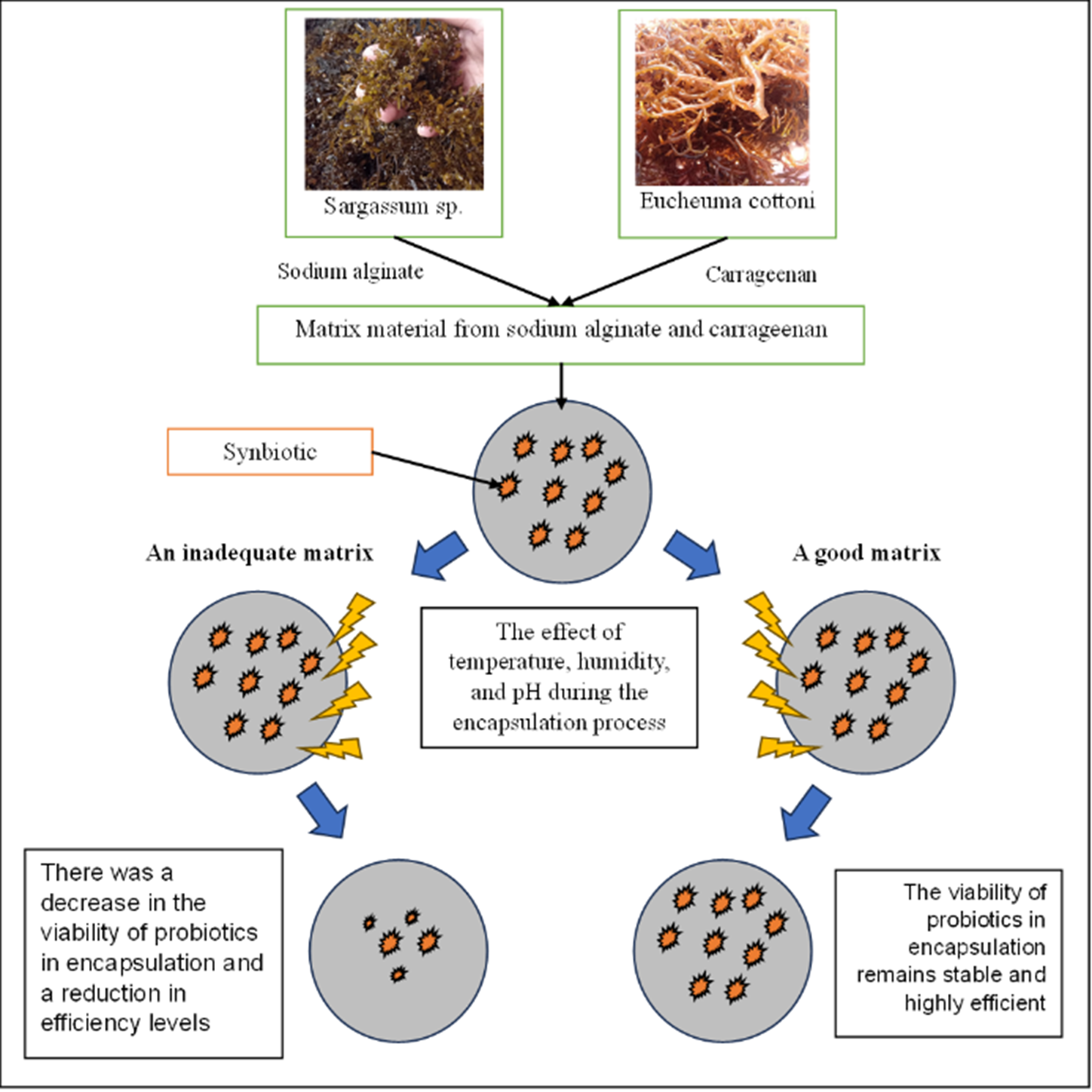
Downloads
References
AM Tangko, A Mansyur and R Reski. Use of probiotics in milkfish cultivation feed in floating net cages in the sea. Jurnal Riset Akuakultur 2016; 2(1), 33-40.
YB Wang, JR Li and J Lin. Probiotics in aquaculture: Challenges and outlook. Aquaculture 2008; 281(1-4), 1-4.
G De Marco, T Cappello and M Maisano. Histomorphological changes in fish gut in response to prebiotics and probiotics treatment to improve their health status: A Review. Animals 2023; 13(18), 2860.
M Mohamadzadeh, A Fazeli and SA Shojaosadati. Polysaccharides and proteins-based bionanocomposites for microencapsulation of probiotics to improve stability and viability in the gastrointestinal tract: A review. International Journal of Biological Macromolecules 2024; 259, 129287.
MK Tripathi and SK Giri. Probiotic functional foods: Survival of probiotics during processing and storage. Journal of Functional Foods 2014; 9, 225-241.
N Aini, DSYR Putri, DH Achhlam, F Fatimah, S Andriyono, D Hariani, HDK Do and SPA Wahyuningsih. Supplementation of Bacillus subtilis and Lactobacillus casei to increase growth performance and immune system of catfish (Clarias gariepinus) due to Aeromonas hydrophila infection. Veterinary World 2024; 17(3), 602.
MN Monier, H Kabary, A Elfeky, S Saadony, NNB Abd El Hamed, MEH Eissa and ESH Eissa. The effects of Bacillus species probiotics (Bacillus subtilis and B. licheniformis) on the water quality, immune responses, and resistance of whiteleg shrimp (Litopenaeus vannamei) against Fusarium solani infection. Aquaculture International 2023; 31(6), 3437-3455.
N Sutthi and W Thaimuangphol. Effects of yeast (Saccharomyces cerevisiae) on growth performances, body composition and blood chemistry of Nile tilapia (Oreochromis niloticus Linnaeus, 1758) under different salinity conditions. Iranian journal of Fisheries Sciences 2020; 19(3), 1428-1446.
KH Dwiardani, Prayogo and BS Rahardja. Utilization of Nitrosomonas sp and Nitrobacter sp probiotic towards total suspended solid and ammonia level in nile tilapia culturing using aquaponic system. IOP Conference Series: Earth and Environmental Science 2021; 679(1), 012067.
DL Merrifield, A Dimitroglou, A Foey, SJ Davies, RTM Baker, J Bøgwald, M Castex and E Ringø. The current status and future focus of probiotic and prebiotic applications for salmonids. Aquaculture 2010; 302(1-2), 1-18.
IMD Mahariawan, NB Ariffin, WE Kusuma, A Yuniarti, MAG Beltran and AM Hariati. Effect of different carbon doses of tapioca (Manihot esculenta) flour on vegetative cells and spore production of Bacillus megaterium. IOP Conference Series: Earth and Environmental Science 2020; 441(1), 012106.
WY Koh, XX Lim, TC Tan, R Kobun and B Rasti. Encapsulated probiotics: Potential techniques and coating materials for non-dairy food applications. Applied Sciences 2022; 12(19), 10005.
S Razavi, S Janfaza, N Tasnim, DL Gibson and M Hoorfar. Microencapsulating polymers for probiotics delivery systems: Preparation, characterization, and applications. Food Hydrocolloids 2020; 120, 106882.
AD Diwan, SN Harke and AN Panche. Host-microbiome interaction in fish and shellfish: An overview. Fish and Shellfish Immunology Reports 2023; 4, 100091.
S Iravani, H Korbekandi and SV Mirmohammadi. Technology and potential applications of probiotic encapsulation in fermented milk products. Journal of Food Science and Technology 2015; 52(8), 4679-4696.
AP do Carmo Alves, A do Carmo Alves, RA Ferreira Rodrigues, B da Silva Cerozi and JE Possebon Cyrino. Microencapsulation of Bacillus subtilis and oat β-glucan and their application as a synbiotic in fish feed. Journal of Microencapsulation 2023; 40(7), 491-501.
MP Silva, FL Tulini, E Martins, M Penning, CS Fávaro-Trindade and D Poncelet. Comparison of extrusion and co-extrusion encapsulation techniques to protect Lactobacillus acidophilus LA3 in simulated gastrointestinal fluids. LWT 2018; 89, 392-399.
M Yin, L Chen, M Chen, Y Yuan, F Liu and F Zhong. Encapsulation of Lactobacillus rhamnosus GG in double emulsions: Role of prebiotics in improving probiotics survival during spray drying and storage. Food Hydrocolloids 2024; 151, 109792.
A Al-Hamayda, B Abu-Jdayil, M Ayash and J Tannous. Advances in microencapsulation techniques using Arabic gum: A comprehensive review. Industrial Crops and Products 2023; 205, 117556.
H Liu, M Xie and S Nie. Recent trends and applications of polysaccharides for microencapsulation of probiotics. Food Frontiers 2020; 1(1), 45-59.
V Derosya and A Kasim. Optimization of maltodextrin production based on sago starch using α-amylase and spray drying method. Jurnal Teknologi Pertanian Andalas 2017; 21(1), 28-32.
LP Ta, E Bujna, O Antal, M Ladányi, R Juhász, A Szécsi, S Kun, S Sudheer, VK Gupta and QD Nguyen. Effects of various polysaccharides (alginate, carrageenan, gums, chitosan) and their combination with prebiotic saccharides (resistant starch, lactosucrose, lactulose) on the encapsulation of probiotic bacteria Lactobacillus casei 01 strain. International Journal of Biological Macromolecules 2021; 183, 1136-1144.
J Lai, AK Azad, WMAW Sulaiman, V Kumarasamy, V Subramaniyan and SA Alshehade. Alginate-Based Encapsulation fabrication technique for drug delivery: an updated review of particle type, formulation technique, pharmaceutical ingredient, and targeted delivery system. multidisciplinary digital publishing institute (MDPI). Pharmaceutics 2024; 16(3), 370.
Z Cheng, B Zhang, D Qiao, X Yan, S Zhao, C Jia, M Niu and Y Xu. Addition of κ-carrageenan increases the strength and chewiness of gelatin-based composite gel. Food Hydrocolloids 2022; 128, 107565.
A Diharmi, Rusnawati and N Irasari. Characteristic of carrageenan Eucheuma cottonii collected from the coast of Tanjung Medang Village and Jaga Island, Riau. IOP Conference Series: Earth and Environmental Science 2019; 404(1), 012049.
TA Fenoradosoa, G Ali, C Delattre, C Laroche, E Petit, A Wadouachi and P Michaud. Extraction and characterization of an alginate from the brown seaweed Sargassum turbinarioides Grunow. Journal of Applied Phycology 2010; 22(2), 131-137.
SH Rashedy, MSM Abd El Hafez, MA Dar, J Cotas and L Pereira. Evaluation and characterization of alginate extracted from brown seaweed collected in the red sea. Applied Sciences 2021; 11(14), 6290.
DA Fernanda and D Hariani. The effect of administration of synbiotic and enzyme with various concentrations on feed to the growth of GIFT tilapia seeds (Oreochromis sp.). LenteraBio: Berkala Ilmiah Biologi 2021; 23(2), 113-118.
S Moumita, K Goderska, EM Johnson, B Das, D Indira, R Yadav, S Kumar and R Jayabalan. Evaluation of the viability of free and encapsulated lactic acid bacteria using in-vitro gastro intestinal model and survivability studies of synbiotic microcapsules in dry food matrix during storage. LWT 2017; 77, 460-467.
DC Campos, F Acevedo, E Morales, J Aravena, V Amiard, MA Jorquera, NG Inostroza and M Rubilar. Microencapsulation by spray drying of nitrogen-fixing bacteria associated with lupin nodules. World Journal of Microbiology and Biotechnology 2014; 30(9), 2371-2378.
P Pupa, P Apiwatsiri, W Sirichokchatchawan, N Pirarat, N Muangsin, AA Shah and N Prapasarakul. The efficacy of three double-microencapsulation methods for preservation of probiotic bacteria. Scientific Reports 2021; 11(1), 13753.
W Sun, QD Nguyen, G Sipiczki, SR Ziane, K Hristovski, L Friedrich, A Visy, G Hitka, A Gere and E Bujna. Microencapsulation of Lactobacillus plantarum 299v strain with whey proteins by lyophilization and its application in production of probiotic apple juices. Applied Sciences 2023; 13(1), 318.
RA Rather, MA Bhat and AH Shalla. Multicomponent interpenetrating metal based Alginate-Carrageenan biopolymer hydrogel beads substantiated by graphene oxide for efficient removal of methylene blue from waste water. Chemical Engineering Research and Design 2022; 182, 604-615.
DM Sumanti, I Lanti, II Hanidah, E Sukarminah and A Giovanni. The effect ofskim milk and maltodextrin concentration as coating agent towards viability and characteristics of Lactobacillus plantarum bacteria microencapsulated suspension using freeze drying method. Jurnal Penelitian Pangan 2016; 1, 7-13.
G Kavoosi, M Derakhshan, M Salehi and L Rahmati. Microencapsulation of zataria essential oil in agar, alginate and carrageenan. Innovative Food Science and Emerging Technologies 2018; 45, 418-425.
MP Silva, IJ Badruddin, T Tonon, S Rahatekar and LD Gomez. Environmentally benign alginate extraction and fibres spinning from different European Brown algae species. International Journal of Biological Macromolecules 2023; 226, 434-442.
M Khorshidi, A Heshmati, M Taheri, M Karami and R Mahjub. Effect of whey protein- and xanthan-based coating on the viability of microencapsulated Lactobacillus acidophilus and physiochemical, textural, and sensorial properties of yogurt. Food Science & Nutrition 2021; 9(7), 3942-3953.
NMY Jacobsen, I Caglayan, A Caglayan, D Bar-Shalom and A Müllertz. Achieving delayed release of freeze-dried probiotic strains by extrusion, spheronization and fluid bed coating - evaluated using a three-step in vitro model. International Journal of Pharmaceutics 2020; 591, 120022.
L Shoukat, S Javed, M Afzaal, N Akhter and YA Shah. Starch-based encapsulation to enhance probiotic viability in simulated digestion conditions. International Journal of Biological Macromolecules 2024; 283, 137606.
R González-Cuello, J Hernández-Fernández and R Ortega-Toro. Optimization of the viability of microencapsulated Lactobacillus reuteri in gellan gum-based composites using a box-behnken design. Journal of Composites Science 2025; 9(8), 419.
R Kamwa, B Khurajog, N Muangsin, P Pupa, DJ Hampson and N Prapasarakul. Water-soluble microencapsulation using gum Arabic and skim milk enhances viability and efficacy of Pediococcus acidilactici probiotic strains for application in broiler chickens. Animal Bioscience 2024; 37(8), 1440.
MM Saputra, Y Wuryandari and N Ramadhini. Analysis of encapsulation efficiency Bacillus sp. based variations in sodium alginate concentration in the beads. NST Proceeding 2024; 2024, 7-14.
Y Zhou, D Xu, H Yu, J Han, W Liu and D Qu. Encapsulation of Salmonella phage SL01 in alginate/carrageenan microcapsules as a delivery system and its application in vitro. Frontiers in Microbiology 2022; 13, 906103.
F Yu, T Cui, C Yang, X Dai and J Ma. Κ-Carrageenan/sodium alginate double-network hydrogel with enhanced mechanical properties, anti-swelling, and adsorption capacity. Chemosphere 2019; 237, 124417.
TN Hidayah, D Djaenudin and N Lubis. Encapsulation of probiotic Lactobacillus sp. using alginate and chitosan biopolymers with one-step method. Jurnal Serambi Engineering 2021; 6(2), 1814-1825.
S Akshaya and AJ Nathanael. A review on hydrophobically associated alginates: Approaches and applications. American Chemical Society 2024; 9(4), 4246-4262.
SM Shahrbabak, SM Jalali, MF Fathabadi, V Tayebi-Khorrami, M Amirinejad, S Forootan, M Saberifar, MR Fadaei, Z Najafi and VR Askari. Modified alginates for precision drug delivery: Advances in controlled-release and targeting systems. International Journal of Pharmaceutics: X 2025; 10, 100381.
MH Kim, YW Lee, WK Jung, J Oh and SY Nam. Enhanced rheological behaviors of alginate hydrogels with carrageenan for extrusion-based bioprinting. Journal of the Mechanical Behavior of Biomedical Materials 2019; 98, 187-194.
L Cunha and A Grenha. Sulfated seaweed polysaccharides as multifunctional materials in drug delivery applications. Marine drugs 2016; 14(3), 42.
M Ciancia, MC Matulewicz and R Tuvikene. Structural diversity in galactans from red seaweeds and its influence on rheological properties. Frontier in Plant Science 2020; 11, 559986.
R Rajam, SB Kumar, P Prabhasankar and C Anandharamakrishnan. Microencapsulation of Lactobacillus plantarum MTCC 5422 in fructooligosaccharide and whey protein wall systems and its impact on noodle quality. Journal of Food Science and Technology 2015; 52(7), 4029-4041.
S Pandey, Y Premjit, A Khuntia, A Kadival and J Mitra. Development of probiotic-loaded calcium alginate-maltodextrin microparticles based on electrohydrodynamic technique. Powder Technology 2023; 428, 118808.
LD Pangestu, IMD Mahariawan, A Yuniarti and AM Hariati. Optimization of temperature and drying time of encapsulated synbiotic powder on the characteristics and viability of microcapsules. Jurnal Penelitian Pendidikan 2025; 11(1), 1049-1056.
ES Chan, SL Wong, PP Lee, JS Lee, TB Ti, Z Zhang, D Poncelet, P Ravindra, SH Phan and ZH Yim. Effects of starch filler on the physical properties of lyophilized calcium-alginate beads and the viability of encapsulated cells. Carbohydrate Polymers 2011; 83(1), 225-232.
B Németh, A Ujhidy, J Tóth, L Trif, T Feczkó and R Rauch. Gelation elimination in eco-friendly preparation of double-layered calcium alginate-coconut oil latent heat energy storing microcapsules. Materials Chemistry and Physics 2023; 293, 126889.
Y Premjit and J Mitra. Optimization of electrospray-assisted microencapsulation of probiotics (Leuconostoc lactis) in soy protein isolate-oil particles using box-behnken experimental design. Food and Bioprocess Technology 2021; 14(9), 1712-1729.
KCG Silva and ACK Sato. Biopolymer gels containing fructooligosaccharides. Food Research International 2017; 101, 88-95.
Published
How to Cite
Issue
Section
License
Copyright (c) 2025 Walailak University

This work is licensed under a Creative Commons Attribution-NonCommercial-NoDerivatives 4.0 International License.





