
Approach Towards Sustainable Synthesis of Silver Nanoparticles by Electrolysis Method Using Asian Pennywort Extract and Their Anti-Inflammatory Activity
DOI:
https://doi.org/10.48048/tis.2026.11629Keywords:
Silver nanoparticle, Electrolysis method, Asian pennywort extract, Anti-inflammatory activityAbstract
Biogenic metal nanoparticles continue gaining popularity due to their low production costs, biocompatibility, and several environmental and biological benefits. In this work, Asian pennywort extract (APE) will be electrolysed to produce biogenic silver nanoparticles (AgNPs) sustainably. This study also aims to improve APE’s in vitro anti-inflammatory properties. The extract solution acts as an electrolyte in the system, facilitating the formation of AgNPs via electrochemical synthesis, as shown by the appearance of a peak at 430 nm. In accordance with the FTIR spectra, the phytochemical screening findings of the extract showed a preponderance of phenols, flavonoids, and triterpenes. It suggests that the biomolecules in the extract serve as both stabilising and reducing agents, playing a role in the synthesis process. TEM micrographs demonstrate that AgNPs have a uniform spherical shape and are surrounded by a thin biomolecular layer with diameters of 32.62 ± 10.53 nm. The light scattering pattern of colloidal AgNPs also exhibits a particle size distribution of 32.50 ± 5.68 nm. The approach generates polycrystalline nanoparticles ranging in size from 17.55 to 32.26 nm. AgNPs outperformed APE in terms of anti-inflammatory action, with IC50 values of 523.40 ± 7.85 and 960.29 ± 16.81 µg/mL, as determined by the BSA protein denaturation procedure. The electrosynthesis approach using APE biomolecules suggests a novel strategy for producing AgNPs with superior anti-inflammatory capabilities, leading to promising future applications for large-scale production in the pharmaceutical and cosmetics industries.
HIGHLIGHTS
- The facile, inexpensive, fast, sustainable, and environmentally friendly synthesis of silver nanoparticles.
- Asian pennywort extract as an electrolyte, bioreductor, and stabilising agent in electrosynthesis.
- The produced AgNPs are polycrystals with a spherical shape of approximately 32.62 nm with high purity.
- The produced AgNPs have strong anti-inflammatory activity.
GRAPHICAL ABSTRACT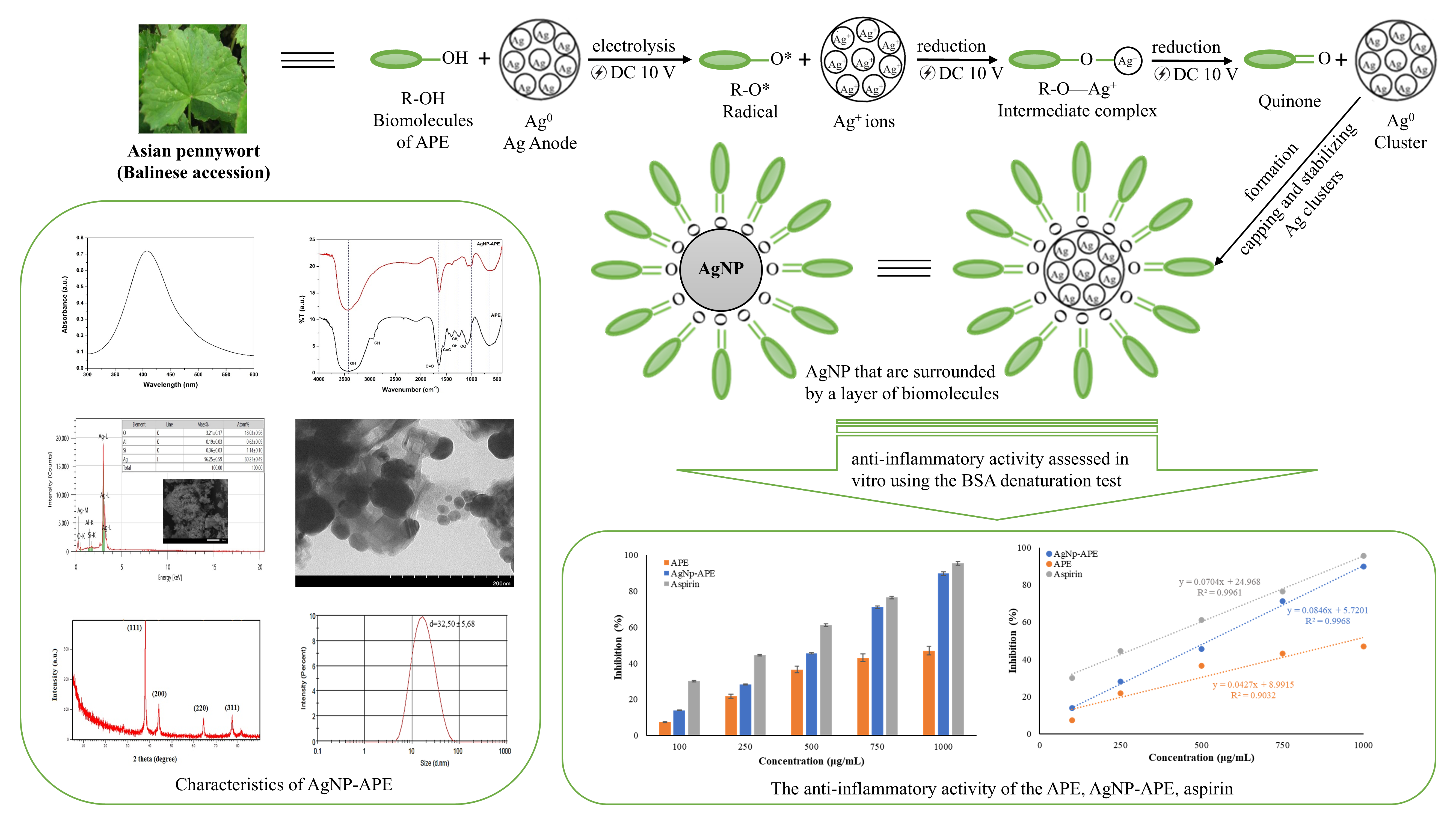
Downloads
References
E Auriel, K Regev and AD Korczyn. Nonsteroidal anti-inflammatory drugs exposure and the central nervous system. In: A Quartarone, MF Ghilardi and F Boller (Eds.). Handbook of clinical neurology. Elsevier, Amsterdam, Netherlands, 2014, p. 577-584.
FWD Tai and ME McAlindon. Non-steroidal anti-inflammatory drugs and the gastrointestinal tract. Clinical Medicine, Journal of the Royal College of Physicians of London 2021; 21(2), 131-134.
ZS Ololade, SE Kuyooro, OO Ogunmola and OO Abiona. Phytochemical, antioxidant, anti-arthritic, anti-inflammatory and bactericidal potentials of the leaf extract of lactuca teraxacifolia. Global Journal of Medical Research B: Pharma, Drug Discovery 2017; 17(2), 19-28.
M Qureshi, N Jahan, S Muhammad, N Mohani, A Wazir, IA Baig and M Ahmad. Evaluation of neuropharmacological, analgesic and anti-inflammatory effects of the extract of Centella asiatica (Gotu kola) in mice. African Journal of Pharmacy and Pharmacology 2015; 9(41), 995-1001.
HY Shin, H Kim, S Jung, EJ Jeong, KH Lee, YJ Bae, HJ Suh, KI Jang and KW Yu. Interrelationship between secondary metabolites and antioxidant capacities of Centella asiatica using bivariate and multivariate correlation analyses. Applied Biological Chemistry 2021; 64(82), 1-10.
I Ahmad, MN Khan, K Hayat, T Ahmad, DF Shams, W Khan, V Tirth, G Rehman, W Muhammad, MElhadi, A. Alotaibi and SK Shah. Investigating the antibacterial and anti-inflammatory potential of polyol-synthesized silver nanoparticles. ACS Omega 2023; 9(11), 13208-13216.
NTL Chi, M Narayanan, A Chinnathambi, C Govindasamy, B Subramani, K Brindhadevi, T Pimpimon and S Pikulkaew. Fabrication, characterization, anti-inflammatory, and anti-diabetic activity of silver nanoparticles synthesized from Azadirachta indica kernel aqueous extract. Environmental Research 2022; 208, 112684.
RM Varghese, A Kumar and R Shanmugam. Comparative Anti-inflammatory activity of silver and zinc oxide nanoparticles synthesized using Ocimum tenuiflorum and Ocimum gratissimum herbal formulations. Cureus 2024; 16(1), e52995.
N Ismillayli, S Suprapto, E Santoso, RE Nugraha, H Holilah, H Bahruji, AA Jalil, D Hermanto and D Prasetyoko. The role of pH-induced tautomerism of polyvinylpyrrolidone on the size, stability, and antioxidant and antibacterial activities of silver nanoparticles synthesized using microwave radiation. RSC Advance 2024; 14(7), 4509-4517.
I Fatimah, H Hidayat, BH Nugroho and S Husein. Ultrasound-assisted biosynthesis of silver and gold nanoparticles using Clitoria ternatea flower. South African Journal of Chemical Engineering 2020; 34, 97-106.
S Kaabipour and S Hemmati. A review on the green and sustainable synthesis of silver nanoparticles and one-dimensional silver nanostructures. Beilstein Journal of Nanotechnology 2021; 12, 102-136.
Q Sun, X Cai, J Li, M Zheng, Z Chen and CP Yu. Green synthesis of silver nanoparticles using tea leaf extract and evaluation of their stability and antibacterial activity. Colloids and Surfaces A: Physicochemical and Engineering Aspects 2014; 444, 226-231.
D Hermanto, N Ismillayli, I Irmawanti, I Fathulloh, D Nila, UK Zuryati, H Muliasari and R Wirawan. Electrochemically synthesized biogenic silver nanoparticles using green tea extract as a promising antioxidant. Karbala International Journal of Modern Science 2023; 9(1), 80-88.
D Hermanto, N Ismillayli, DH Fatwa, UK Zuryati, H Muliasari, R Wirawan, D Prasetyoko and S Suprapto. Bio-mediated electrochemically synthesis of silver nanoparticles using green tea (Camellia sinensis) leaves extract and their antibacterial activity. South African Journal of Chemical Engineering 2024; 47(1), 136-141.
E Daun, BK Siswanta, S Siswoyo, S Suprapto and D Prasetyoko. Electrosynthesis of anisotropic biogenic silver nanoparticles as a promising antibacterial agent using Stachytarpheta jamaicensis leaf extract. Sains Malaysiana 2024; 53(9), 3113-3123.
Z Huang, H Jiang, P Liu, J Sun, D Guo, J Shan and N Gu. Continuous synthesis of size-tunable silver nanoparticles by a green electrolysis method and multi-electrode design for high yield. Journal of Materials Chemistry A 2015; 3(5), 1925-1929.
VT Hoang, NX Dinh, TN Pham, TV Hoang, PA Tuan, TQ Huy and AT Le. Scalable electrochemical synthesis of novel biogenic silver nanoparticles and its application to high-sensitive detection of 4-nitrophenol in an aqueous system. Advances in Polymer Technology 2021; 2021, 664219.
C Tsou and R Yang. Low cost green synthesis of silver nanoparticles using taiwan oolong tea extract. In: RJ Yang (Ed.). Importance & applications of nanotechnology. MedDocs, Nevada, United States, 2020, p. 1-5.
YY Loo, BW Chieng, M Nishibuchi and S Radu. Synthesis of silver nanoparticles by using tea leaf extract from Camellia Sinensis. International Journal of Nanomedicine 2012; 7, 4263-4267.
BN Ramesh, TK Girish, RH Raghavendra, KA Naidu, UJSP Rao and KS Rao. Comparative study on anti-oxidant and anti-inflammatory activities of Caesalpinia crista and Centella asiatica leaf extracts. Journal of Pharmacy and Bioallied Sciences 2014; 6(2), 86-91.
A Kandasamy, K Aruchamy, P Rangasamy, D Varadhaiyan, C Gowri, TH Oh, S Ramasundaram and B Athinarayanan. Phytochemical analysis and antioxidant activity of Centella asiatica extracts: An experimental and theoretical investigation of flavonoids. Plants 2023; 12(20), 13547.
P Salve, A Vinchurkar, R Raut, R Chondekar, J Lakkakula, A Roy, MJ Hossain, S Alghamdi, MAlmehmadi, O Abdulaziz, M Allahyani, AS Dablool, MR Sarker and MFN Azlina. An evaluation of antimicrobial, anticancer, anti-inflammatory, and antioxidant activities of silver nanoparticles synthesized from leaf extract of Madhuca longifolia utilizing quantitative and qualitative methods. Molecules 2022; 27(19), 6404.
RA Pratiwi and ABD Nandiyanto. How to read and interpret uv-vis spectrophotometric results in determining the structure of chemical compounds. Indonesian Journal of Educational Research and Technology 2022; 2(1), 1-20.
TK Patle, K Shrivas, R Kurrey, S Upadhyay, R Jangde and R Chauhan. Phytochemical screening and determination of phenolics and flavonoids in Dillenia pentagyna using UV-Vis and FTIR spectroscopy. Spectrochimica Acta - Part A: Molecular and Biomolecular Spectroscopy 2020; 242, 118717.
VV Yanilkin, RR Fazleeva, GR Nasretdinova, NV Nastapova and YN Osin. Methylviologen-mediated electrosynthesis of silver nanoparticles in a water medium. Effect of chain length and concentration of poly(n-vinylpyrrolidone) on particle size. New Materials, Compounds and Applications 2018; 2(1), 28-41.
WA Shaikh, S Chakraborty, G Owens and RU Islam. A review of the phytochemical mediated synthesis of AgNP (silver nanoparticle): the wonder particle of the past decade. Applied Nanoscience 2021; 11, 2625-2660.
JM Cheon, JH Lee, Y Song and J Kim. Synthesis of Ag nanoparticles using an electrolysis method and application to inkjet printing. Colloids and Surfaces A: Physicochemical and Engineering Aspects 2011; 389(1-3), 175-179.
R Roto, M Marcelina, NH Aprilita, M Mudasir, TA Natsir and B Mellisani. Investigation on the effect of the addition of Fe3+ ion into the colloidal AgNPs in PVA solution and understanding its reaction mechanism. Indonesian Journal of Chemistry 2017; 17(3), 439-445.
S Muthaiah, A Bhatia and M Kannan. Stability of metal complexes. In: AN Srivastva (Ed.). Stability and applications of coordination compounds. Intechopen, London, 2020, p. 1-18.
IIK Siakavella, F Lamari, D Papoulis, M Orkoula, P Gkolfi, M Lykouras, K Avgoustakis and S Hatziantoniou. Effect of plant extracts on the characteristics of silver nanoparticles for topical application. Pharmaceutics 2020; 12(12), 1244.
A Wirwis and Z Sadowski. Green synthesis of silver nanoparticles: Optimizing green tea leaf extraction for enhanced physicochemical properties. ACS Omega 2023; 8(33), 30532-30549.
N Agasti and NK Kaushik. One-pot synthesis of crystalline silver nanoparticles. American Journal of Nanomaterials 2014; 2(1), 4-7.
SE Arland and J Kumar. Green and chemical syntheses of silver nanoparticles: Comparative and comprehensive study on characterization, therapeutic potential, and cytotoxicity. European Journal of Medicinal Chemistry Reports 2024; 11, 100168.
K Ali, S Kumar and MF Khan. A concise review on bioactive pentacyclic triterpenoids of Centella asiatica (Gotu Kola). Discover Chemistry 2025; 2(1), 1-21.
JM Carvalho-Silva and ACD Reis. Anti-inflammatory action of silver nanoparticles in vivo: systematic review and meta-analysis. Heliyon 2024; 10(14), 34564.
CN Roy, S Maiti, TK Das, S Kundu, S Karmakar and A Saha. Investigation on silver nanocrystals induced structural modulation of biomarker alkaline phosphatase through spectroscopic and thermodynamic assessment. Journal of Molecular Structure 2024; 1315, 138792.
MS Akhter, A Rahman, RK Ripon, M Mubarak, M Akter, S Mahbub, FA Mamun and T Sikder. A systematic review on green synthesis of silver nanoparticles using plants extract and their bio-medical applications. Heliyon 2024; 10, 29766.
YH Gonfa, FB Tessema, A Bachheti, N Rai, MG Tadesse, AN Singab, KK Chaubey and RK Bachheti. Anti-inflammatory activity of phytochemicals from medicinal plants and their nanoparticles: A review. Current Research in Biotechnology 2023; 6, 100152.
Published
How to Cite
Issue
Section
License
Copyright (c) 2025 Walailak University

This work is licensed under a Creative Commons Attribution-NonCommercial-NoDerivatives 4.0 International License.





