
Enhanced Mercury (Hg2+) Adsorption from Aqueous Solutions Using Bentonite-Coconut Shell Monolith Composites
DOI:
https://doi.org/10.48048/tis.2026.11611Keywords:
Adsorption, Bentonite, Coconut shell, Mercury ion, MonolithAbstract
Mercury pollution from artisanal mining and industry poses severe environmental risks. This contamination can be addressed using a low-cost monolith adsorbent. Therefore, this study develops a sustainable bentonite-coconut shell monolith as a low-cost adsorbent for mercury (Hg2+) removal. The monoliths were prepared using bentonite, coconut shell charcoal and molasses as a binder and subsequently activated physically and chemically using HNO3 (0.5 N and 1 N). Characterized by Fourier Transform Infrared Spectroscopy (FTIR), Scanning Electron Microscopy (SEM), Brunauer–Emmett–Teller (BET) and X-ray Diffraction (XRD) confirmed the presence of functional groups, heterogeneous porous structure and the absence of mercury impurities in the raw materials. Adsorption investigations were conducted at Hg2+ concentrations of 2 - 8 mg/L to evaluate removal efficiency, kinetics, and isotherm behavior. Results showed that HNO3 activation enhanced functionality and porosity, with 1 N HNO3-treated monoliths achieving 7.23 mg/g capacity and 90.16% removal efficiency. Kinetic data fitted the pseudo-first-order model best (R2 = 0.997), with intraparticle diffusion as a secondary mechanism. Isotherm analysis revealed that physically activated bentonite-coconut shell monolith followed the Freundlich model (R2 = 1.000), whereas chemical activation shifted the behavior toward the Langmuir model (R2 = 0.999). With a production cost of only $0.76 - 1.36/kg, well below commercial activated carbon, the monolith offers an efficient, affordable and sustainable option for mercury remediation.
HIGHLIGHTS
- Bentonite-coconut shell monolith, produced at < $1.5/kg, offers an efficient and sustainable alternative to commercial activated carbon for mercury removal from water.
- FTIR, SEM, BET and XRD confirmed functional groups, porous structure, and absence of Hg impurities.
- The 1 N HNO3-activated monolith achieved the highest Hg2+ removal (90.16%, 7.23 mg/g).
- Physically activated bentonite-coconut shell monolith shows Freundlich multilayer adsorption, while acid activation produces uniform surface favoring Langmuir monolayer behavior; both follow pseudo-first-order kinetics.
- Low production cost ($0.76 - 1.36/kg) highlights strong economic feasibility compared to activated carbon.
GRAPHICAL ABSTRACT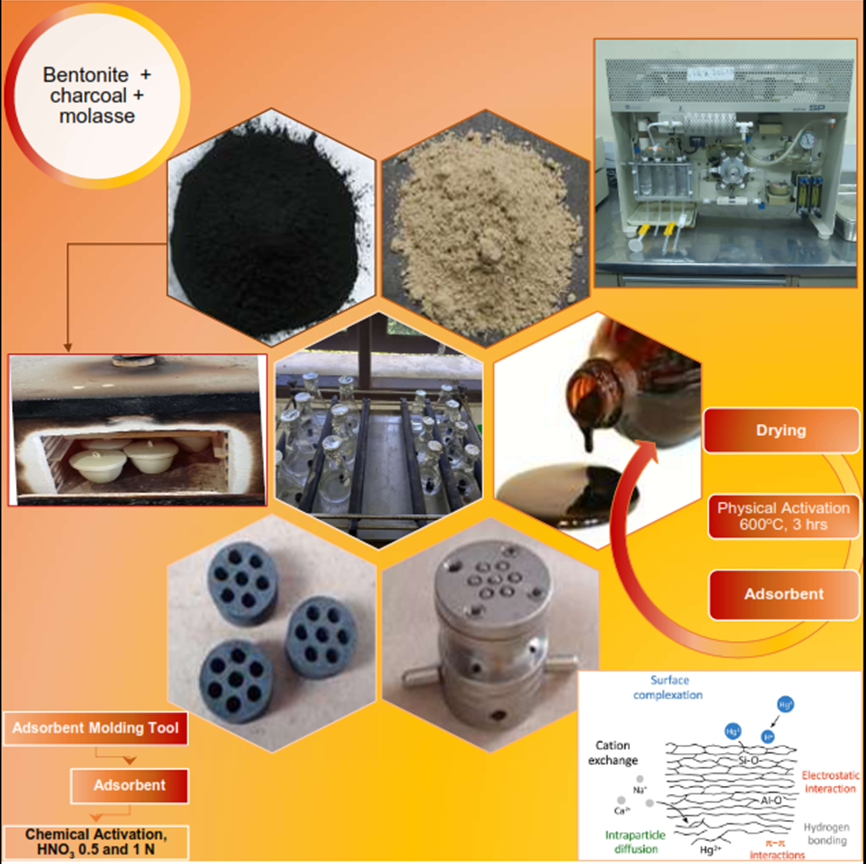
Downloads
References
H Jeong, W Ali, P Zinck, S Souissi and JS Lee. Toxicity of methylmercury in aquatic organisms and interaction with environmental factors and coexisting pollutants: A review. Science of The Total Environment 2024; 943, 173574
GP Yoga, AA Sari, IS Nurhati, Yustiawati, Andreas and D Hindarti. Mercury contamination on aquatic organisms in related to artisanal small-scale gold mining activity in Indonesia: A mini review. IOP Conference Series: Earth and Environmental Science 2022; 1062, 012023.
N Aflah, Mulkal, H Sentiya, F Yunining, IN Aslam, Muchlis and H Harisman. Mapping the spread of mercury from artisanal mining activities in Aceh Jaya through geochemical surveys. Journal of Chemical Engineering & Environment 2023; 18(1), 9-18.
KG Pavithra, P Sundarrajan, PS Kumar and G Rangasamy. Mercury sources, contaminations, mercury cycle, detection and treatment techniques: A review. Chemosphere 2023; 312(P1), 137314.
S Satyam and S Patra. Innovations and challenges in adsorption-based wastewater remediation: A comprehensive review. Heliyon 2024; 10(9), e29573.
EPA. Mercury: Human Exposure and Health Effects 2020. U.S. Environmental Protection Agency.
TE Oladimeji, M Oyedemi, ME Emetere, O Agboola, JB Adeoye and OA Odunlami. Review of the impact of heavy metals from industrial wastewater effluent and removal capacities. Heliyon 2024; 10(23), e40370.
SE Pour, AH Mamaghani and Z Hashisho. Modeling of adsorption process on monolith adsorbent: A mini-review. Separation and Purification Technology 2025; 354(P2), 128846.
MI Shaukat, NRB Rosli, R Wahi, SMAA Abdullah and Z Ngaini. Chemically modified coconut shell biochar for removal of heavy metals from aqueous solution. Defect and Diffusion Forum 2021; 411, 79-91.
S Zahra, Z Mahmood, F Deeba, A Sheikh, H Bukhari and H Mehtab. Modifications of coconut shell charcoal for metal removal from aqueous solutions. European Journal of Chemistry 2022; 13(3), 259-266.
P Kumar and JK Srivastav. Comparative analysis of coconut shell and iron-impregnated activated carbon for heavy metal removal form aqueous solutions. International Journal for Scientific Research & Development 2025; 12(12), 63-67.
Y Xu, Y Qu, Y Yang, B Qu, R Shan, H Yuan and Y Sun. Study of efficient adsorption mechanism of Pb2+ by magnetic coconut biochar. International Journal of Molecular Sciences 2022; 23(22), 14053.
L Ni’mah, Mahfud and SR Juliastuti. Study of activated carbon from coconut shell waste to adsorb Cu and Mn metals in acid mine drainage. Journal of Fibers and Polymers Composites 2022; 1(1), 34-42.
N Wahab, M Saeed, M Ibrahim, A Munir, M Saleem, M Zahra and A Waseem. Synthesis, Characterization, and applications of silk/bentonite clay composite for heavy metal removal from aqueous solution. Frontiers in Chemistry 2019; 7, 00654.
PN Daigboya, BIO Owolabi, FM Mtunzi and KO Adebowale. Clay-carbonaceous material composites: Towards a new class of functional adsorbents for water treatment. Surfaces and Interfaces 2020; 19, 100506.
SM Abegunde, KS Idowu, OM Adejuwon and T Adeyemi-Adejolu. A review on the influence of chemical modification on the performance of adsorbents. Resources, Environment and Sustainability 2020; 1, 100001.
R Ghibate, M Chrachmy, M Kerrou, M Ben Baaziz, M Alaqarbeh, A Amechrouq, R Taouil and O Senhaji. Eco-friendly adsorption of rhodamine B dye using punica granatum peel from an aqueous medium. Green Analytical Chemistry 2025; 12, 100201.
NB Allou, MA Tigori, AA Koffi, M Halidou, NS Eroi, P Atheba and A Trokourey. Methylene blue magnetic adsorption separation process from aqueous solution using corn cob. Scientific African 2023; 21, e01828.
J Serafin and B Dziejarski. Application of isotherms models and error functions in activated carbon CO2 adsorption process. Microporous and Mesoporous Materials 2023; 354, 112513.
SM Mahgoub, MR Mahmoud, SHM Hafez, AA Allam, HE Alfassam, EE Abdel-Hady, AAA Anwar and R Mahmoud. Green chemistry approach for the removal of delafloxacin from aqueous solutions using calcinated layered double hydroxide: Adsorption mechanism and material characterization. Scientific African 2025; 27, e02535.
M Kerrou, S Raada, D Mrani and A Elanssari. A comparative study of the adsorption of a cationic dye on three substrates. Desalination and Water Treatment 2023; 311, 135-143.
T Koroleva, B Pokidko, I Morozov, A Nesterenko, S Kortunkova, M Chernov, D Ksenofontov and V Krupskaya. Hydrothermal synthesis of kaolinite group minerals. Materials 2025; 18(3), 472.
BM Saeed and MB Abdul-Kareem. Preparation and performance of a modified Iraqi red kaolin clay-based sorbent for methylene blue removal in acidic and basic solutions. International Journal of Design and Nature Ecodynamics 2025; 20(2), 241-249.
M El-Habacha, A Dabagh, S Lagdali, Y Miyah, G Mahmoudy, F Sinan, M Chiban, S Iaich and M Zerbet. An efficient and adsorption of methylene blue dye on a natural clay surface: Modeling and equilibrium studies. Environmental Science and Pollution Research 2023; 31(53), 62065-62079.
K Kalpana, S Arivoli and K Veeravelan. Activated carbon merremia emarginata adsorption capacities of low-cost adsorbent for removal of methylene blue. Ecology Environment and Conservation 2022; 22(08), S425-S430.
CJ Hsu, YH Cheng, YP Huang, JD Atkinson and HC Hsi. A novel synthesis of sulfurized magnetic biochar for aqueous Hg(II) capture as a potential method for environmental remediation in water. Science of the Total Environment 2021; 784, 147240.
Darmadi, Mahidin, SS Azzahra and M Masrura. Adsorption of mercury(II) ion in aqueous solution by using bentonite-based monolith. Key Engineering Materials 2021; 885, 77-84.
HPI Indra, Darmadi, Adisalamun, A Chairunnisak and RCL Nasrullah. Removal of lead ion (Pb2+) in water using modified clay-carbon-manganese monolith: Characterization and adsorption studies. Elkawnie: Journal of Islamic Science and Technology 2023; 9(2), 188-203.
C Garcia-Carvajal, J Villaroel-Rocha, VCD Souza and K Sapag. Development of ceramic honeycomb monolith from natural zeolite tested as adsorbent to remove methylene blue in aqueous media. Environmental Science and Pollution Research 2022; 29, 79890-79902.
Activated carbon price kg powder, Available at: https://www.alibaba.com/showroom/activated-carbon-price-kg-pow¬der.html?utm_source= chatgpt.com, accessed Sep¬tember 2025.
Published
How to Cite
Issue
Section
License
Copyright (c) 2025 Walailak University

This work is licensed under a Creative Commons Attribution-NonCommercial-NoDerivatives 4.0 International License.





