
Targeting Inflammatory Pathways via Molecular Docking and In vivo Assessment of Prunus amygdalus Stem Bark-Derived Flavonoids and Rutin
DOI:
https://doi.org/10.48048/tis.2026.11542Keywords:
Prunus amygdalus, Almond bark, Flavonoids, Rutin, Anti-inflammatory, Molecular docking, Carrageenan-induced paw edema, Acute toxicityAbstract
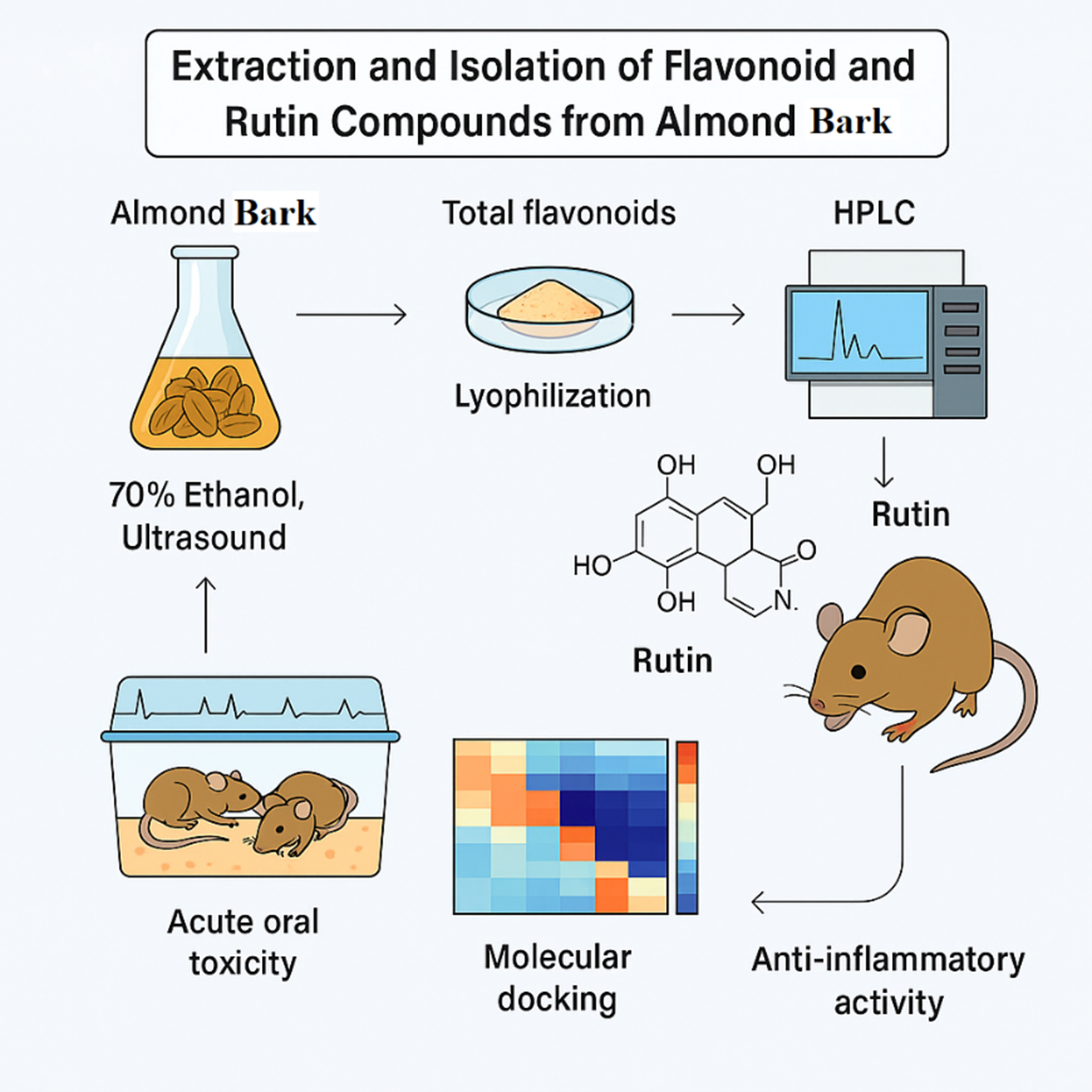
Almond (Prunus amygdalus) steam bark, an agro-industrial by-product rich in polyphenolic compounds, represents a sustainable source of bioactive flavonoids, particularly rutin, with potential pharmacological applications. In this study, total flavonoids were extracted using ethanol-based maceration combined with ultrasonic treatment and vacuum concentration, yielding a high-purity fraction (98.0 ± 0.8%), while rutin was isolated through semi-preparative HPLC. Acute oral toxicity assessment in male mice at a limit dose of 5,000 mg/kg revealed no mortality, no significant changes in body weight (p > 0.05), and only mild transient behavioral alterations, indicating an LD50 > 5,000 mg/kg and classification under GHS Category 5 (low toxicity). In the carrageenan-induced paw edema model, the flavonoid fraction at 100 mg/kg and rutin at 25 mg/kg exhibited the highest anti-inflammatory activity, with 61.6% and 55.6% inhibition of edema formation at the third hour, respectively, while higher doses showed moderate but sustained effects, suggesting a non-linear dose-response relationship. Molecular docking studies demonstrated strong binding affinities of rutin to inflammation-related protein targets, including TNF-α (–7.8 kcal/mol, Ki = 1.92 µM), AKT1 (–8.8 kcal/mol, Ki = 0.36 µM), and ESR1 (–8.5 kcal/mol, Ki = 0.61 µM), as well as high-affinity binding to serum albumin (–10.4 kcal/mol, Ki = 23.2 nM). These findings indicate that almond steam bark-derived flavonoids and rutin are safe at high oral doses, exert potent anti-inflammatory effects, and act via multi-target modulation of inflammatory pathways, supporting their potential as natural therapeutic or nutraceutical agents.
HIGHLIGHTS
- Almond (Prunus amygdalus) steam bark is a rich source of bioactive flavonoids and rutin
- Optimized ethanol-ultrasound extraction yielded 98% pure total flavonoid fraction
- Semi-preparative HPLC enabled efficient isolation of high-purity rutin
- Both compounds showed LD50 > 5,000 mg/kg in acute oral toxicity tests (GHS Category 5)
- Strong anti-inflammatory effects observed in carrageenan-induced paw edema model
- Molecular docking revealed multi-target modulation of inflammatory pathways
GRAPHICAL ABSTRACT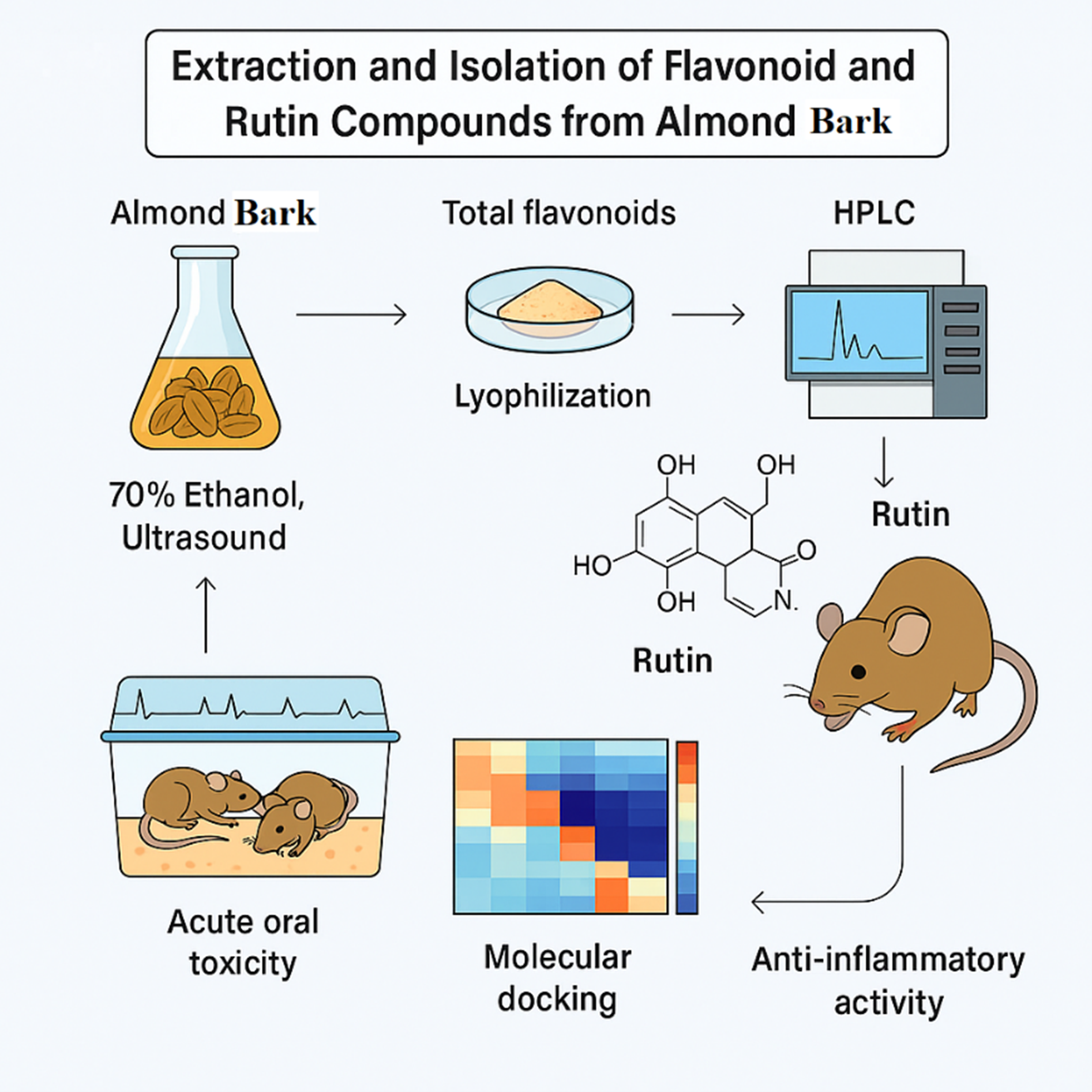
Downloads
References
I Garrido, M Monagas, C Gómez-Cordovés and B Bartolomé. Almond (Prunus dulcis (Mill.) D.A. Webb) skins as a potential source of bioactive polyphenols. Journal of Agricultural and Food Chemistry 2007; 56(23), 10198-10205
T Ben Khadher, S Sassi-Aydi, S Aydi, M Mars and J Bouajila. Phytochemical profiling and biological potential of Prunus dulcis shell extracts. Plants 2023; 12(14), 2733.
G Ulugbek, A Izzatullo, S Fotima, O Sirojiddin, A Azizbek, G Sabina and T Aripov. Plant derived and synthetical antihypoxic agents in cardiovascular diseases: Mechanisms, key pathways and therapeutic potential. Plant Science Today 2025; 12(4), 1-10.
N Dhingra, A Kar, R Sharma and S Bhasin. In-vitro antioxidative potential of different fractions from Prunus dulcis seed extract. Industrial Crops and Products 2017; 74, 427-433.
S Yada, K Lapsley and G Huang. A review of the composition and health benefits of almonds. Journal of Food Science 2011; 76(9), C773-C783.
I Abdullaev, U Gayibov, S Omonturdiev, S Fotima, S Gayibova and T Aripov. Molecular pathways in cardiovascular disease under hypoxia: Mechanisms, biomarkers, and therapeutic target. The Journal of Biomedical Research 2025; 39(3), 254-269.
A Abdullaev, I Abdullaev, A Bogbekov, U Gayibov, S Omonturdiev, S Gayibova, M Turahodjayev, K Ruziboev and T Aripov. Antioxidant potential of Rhodiola heterodonta extract: Activation of Nrf2 pathway via integrative in vivo and in silico studies. Trends in Sciences 2025; 22(5), 9521.
S Sodiqova, S Kadirova, A Zaynabiddinov, I Abdullaev, L Makhmudov, U Gayibov, M Yuldasheva, M Xolmirzayeva, R Rakhimov, A Mutalibov and H Karimjonov. Channelopathy activity of a-41(propyl ester of gallic acid): Experimental and computational study of antihypertensive activity. Trends in Sciences 2025; 22(9), 10496.
AB Enogieru, W Haylett, DC Hiss, S Bardien and OE Ekpo. Rutin as a potent antioxidant: Implications for neurodegenerative disorders. Oxidative Medicine and Cellular Longevity 2018; 2018(1), 6241017.
PAV Freitas, L Martín-Pérez, I Gil-Guillén, C González-Martínez and A Chiralt. Subcritical water extraction for valorisation of almond skin from almond industrial processing. Foods 2023; 12(20), 3759.
D Barreca, SM Nabavi, A Sureda, M Rasekhian, R Raciti, AS Silva, G Annunziata, A Arnone, GC Tenore, I Süntar and G Mandalari. Almonds (Prunus dulcis Mill. D. A. Webb): A source of nutrients and health-promoting compounds. Nutrients 2020; 12(3), 672.
JO Chaves, MCA De Souza, LC Da Silva, D Lachos-Perez, PC Torres-Mayanga, APDF Machado, T Forster-Carneiro, M Vázquez-Espinosa, AV González-de-Peredo, GF Barbero and MA Rostagno. Extraction of flavonoids from natural sources using modern techniques. Frontiers in Chemistry 2020; 25(8), 507887.
SE Bianchi, S Kaiser, V Pittol, E Doneda, KCB De Souza and VL Bassani. Semi‐preparative isolation and purification of phenolic compounds from Achyrocline satureioides (Lam) D.C. by high‐performance counter‐current chromatography. Phytochemical Analysis 2018; 30(2), 182-192.
O Gaibullayeva, A Islomov, D Abdugafurova, B Elmurodov, B Mirsalixov, L Mahmudov, I Adullaev, K Baratov, S Omonturdiev and S Sa’dullayeva. Inula helenium L. root extract in sunflower oil: Determination of its content of water-soluble vitamins and immunity-promoting effect. Biomedical and Pharmacology Journal 2024; 17(4), 2729-2737.
I Abdurazakova, A Zaynabiddinov, I Abdullaev, L Makhmudov, U Gayibov, S Omonturdiev, G Abdullayev, M Xolmirzayeva and S Zhurakulov. Pharmacological Evaluation of F45 on the Cardiovascular System using In Vitro, In Vivo Models and Molecular Dockings. Trends in Sciences 2025; 22(12), 10924.
A Khasanov, I Abdullaev, S Kadirova, M Mamajanov, A Zaynabiddinov, S Omonturdiev, L Makhmudov, D Inomjonov, U Gayibov, R Esanov and A Matchanov. N-2 Polyphenol Targets Vascular Calcium Channels to Exert Antihypertensive Effects: In Vitro and In Vivo Evaluation. Trends in Sciences 2025; 22(12), 10782.
R Sayidaliyeva, S Kadirova, A Zaynabiddinov, I Abdullaev, L Makhmudov, U Gayibov, M Yuldasheva, M Kholmirzayeva, R Rakhimov, A Mutalibov and H Karimjonov. A-51 as A Natural Calcium Channel Blocker: An Integrative Study Targeting Hypertension. Trends in Sciences 2025; 22(11), 10760.
MT Mansouri, AA Hemmati, B Naghizadeh, SA Mard, A Rezaie and B Ghorbanzadeh. A study of the mechanisms underlying the anti-inflammatory effect of ellagic acid in carrageenan-induced paw edema in rats. Indian Journal of Pharmacology 2015; 47(3), 292-298.
S Amdekar, P Roy, V Singh, A Kumar, R Singh and P Sharma. Anti-inflammatory activity of lactobacillus on carrageenan-induced paw edema in male wistar rats. International Journal of Inflammation 2012; 2012, 752015.
M Zaripova, I Abdullaev, A Bogbekov, U Gayibov, S Omonturdiev, R Makhmudov, N Ergashev, G Jabbarova, S Gayibova and T Aripov. In vitro and in silico studies of Gnaphalium U. extract: Inhibition of α-amylase and α-glucosidase as a potential strategy for metabolic syndrome regulation. Trends in Sciences 2025; 22(8), 10098.
XY Meng, HX Zhang, M Mezei and M Cui. Molecular docking: A powerful approach for structure-based drug discovery. Current Computer-Aided Drug Design 2011; 7(2), 146-157.
EC Aytar, EI Torunoglu, A Gümrükçüoğlu, A Durmaz, S Al-Farraj and M Sillanpää. Molecular docking analyses on the chemical profile and antioxidant potential of Cakile maritima using GC-MS and HPLC. Scientific Reports 2025; 15(1), 1-22.
MV Alvarez, S Cabred, CL Ramirez and MA Fanovich. Fluids valorization of an agroindustrial soybean residue by supercritical fluid extraction of phytochemical compounds. The Journal of Supercritical Fluids 2019; 143, 90-96.
M Bimakr, RA Rahman, FS Taip, A Ganjloo, L Salleh, J Selamat, A Hamid and ISM Zaidul. Comparison of different extraction methods for the extraction of major bioactive flavonoid compounds from spearmint (Mentha spicata L.) leaves. Food and Bioproducts Processing 2011; 89(1), 67-72.
I Susanti, R Pratiwi, Y Rosandi and AN Hasanah. Separation methods of phenolic compounds from plant extract as antioxidant agents candidate. Plants 2024; 13(7), 965.
T Ben Khadher, S Sassi-Aydi, S Aydi, M Mars and J Bouajila. Phytochemical profiling and biological potential of Prunus dulcis shell extracts. Plants 2023; 12(14), 2733.
S Sang, K Lapsley, WS Jeong, PA Lachance, CT Ho and RT Rosen. Antioxidative phenolic compounds isolated from almond skins (Prunus amygdalus Batsch). Journal of Agricultural and Food Chemistry 2002; 50(8), 2459-2463.
Toxicological Profile for Endosulfan. Public health statement for endosulfan. Agency for Toxic Substances and Disease Registry, Atlanta, Georgia, 2015.
L Wang, Z Guo, D Cui, S Ul Haq, W Guo, F Yang and H Zhang. Toxicological evaluation of the ultrasonic extract from Dichroae radix in mice and wistar rats. Scientific Reports 2020; 10, 18206.
MP Motwani, JD Flint, RPH De Maeyer, JN Fullerton, AM Smith, DJB Marks and DW Gilroy. Novel translational model of resolving inflammation triggered by UV-killed E. coli. The Journal of Pathology: Clinical Research 2016; 2(3), 154-165.
Y Du, Y Dou, M Wang, Y Wang, Y Yan, H Fan, N Fan, X Yang and X Ma. Efficacy and acceptability of anti-inflammatory agents in major depressive disorder: A systematic review and meta-analysis. Frontiers in Psychiatry 2024; 15, 1407529.
AQQ Azimova, AX Islomov, SA Maulyanov, DG Abdugafurova, LU Mahmudov, IZ Abdullaev, AS Ishmuratova, SQ Siddikova and IR Askarov. Determination of vitamins and pharmacological properties of Vitis vinifera L. plant fruit part (mixed varieties) syrup-honey. Biomedical and Pharmacology Journal 2024; 17(4), 2779-2786.
M Mamajanov, I Abdullaev, G Sotimov, S Mavlanova, Q Niyozov, M Mirzaolimov, A Najimov, E Mirzaolimov, M Raximberganov and U Abdullayev. Mitochondrial and Pharmacokinetic Insights into 3,5,7,2’,6’-Pentahydroxyflavanone: Respiratory Modulation, Calcium Handling, and Membrane Stability. Trends in Sciences 2025; 22(12), 10984.
AG Vakhobjonovna, KE Jurayevich, AIZ Ogli, EN Azamovich, MR Rasuljonovich and AM Islomovich. Tannins as modulators in the prevention of mitochondrial dysfunction. Trends in Sciences 2025; 22(8), 10436.
Published
How to Cite
Issue
Section
License
Copyright (c) 2025 Walailak University

This work is licensed under a Creative Commons Attribution-NonCommercial-NoDerivatives 4.0 International License.





