
Sustainable Bio-Based Composites from Termite Mound Soil and Agro-Waste for Lightweight and Acoustic Applications
DOI:
https://doi.org/10.48048/tis.2026.11507Keywords:
Termite Mound Soil, Rice husk, Eggshell, Bio-based materials, Acoustic properties, Termite mound soil, Rice husk, Eggshell, Bio-based materials, Acoustic propertiesAbstract
This study explores the use of termite mound soil (TMS) as a partial cement replacement in lightweight composites, with emphasis on physical and acoustic performance. Four formulations were prepared: CT (cement + TMS), CTR (cement + TMS + rice husk), CTE (cement + TMS + eggshell) and CTRE (cement + TMS + rice husk + eggshell), cured in water for 7, 14 and 28 days. Bulk density, compressive strength and noise reduction coefficient (NRC) were evaluated. CT composites showed the highest density and strength but did not significantly differ in NRC from the modified formulations. The incorporation of rice husk and eggshell increased water absorption while reducing mechanical performance. ANOVA confirmed significant effects of formulation and curing duration on density and mechanical strength, while NRC remained largely unaffected. TMS-based composites show strong potential as eco-friendly, non-load-bearing construction materials, although the incorporation of agricultural by-products requires further study to clarify their effects.
HIGHLIGHTS
- Termite mound soil (TMS) was used to develop sustainable lightweight materials.
- CT (50% TMS and 50% cement) bricks exhibited the highest density, compressive strength, and lowest water absorption.
- Incorporation of rice husk and eggshells decrease density, with rice husk showing a marginal trend toward higher NRC, but overall sound absorption was not significantly improved, while strength was reduced.
- Brick formulation and curing time significantly influenced density and compressive strength.
- TMS-based bricks—especially the unmodified formulation—demonstrate potential as eco-friendly, non-load-bearing construction materials.
GRAPHICAL ABSTRACT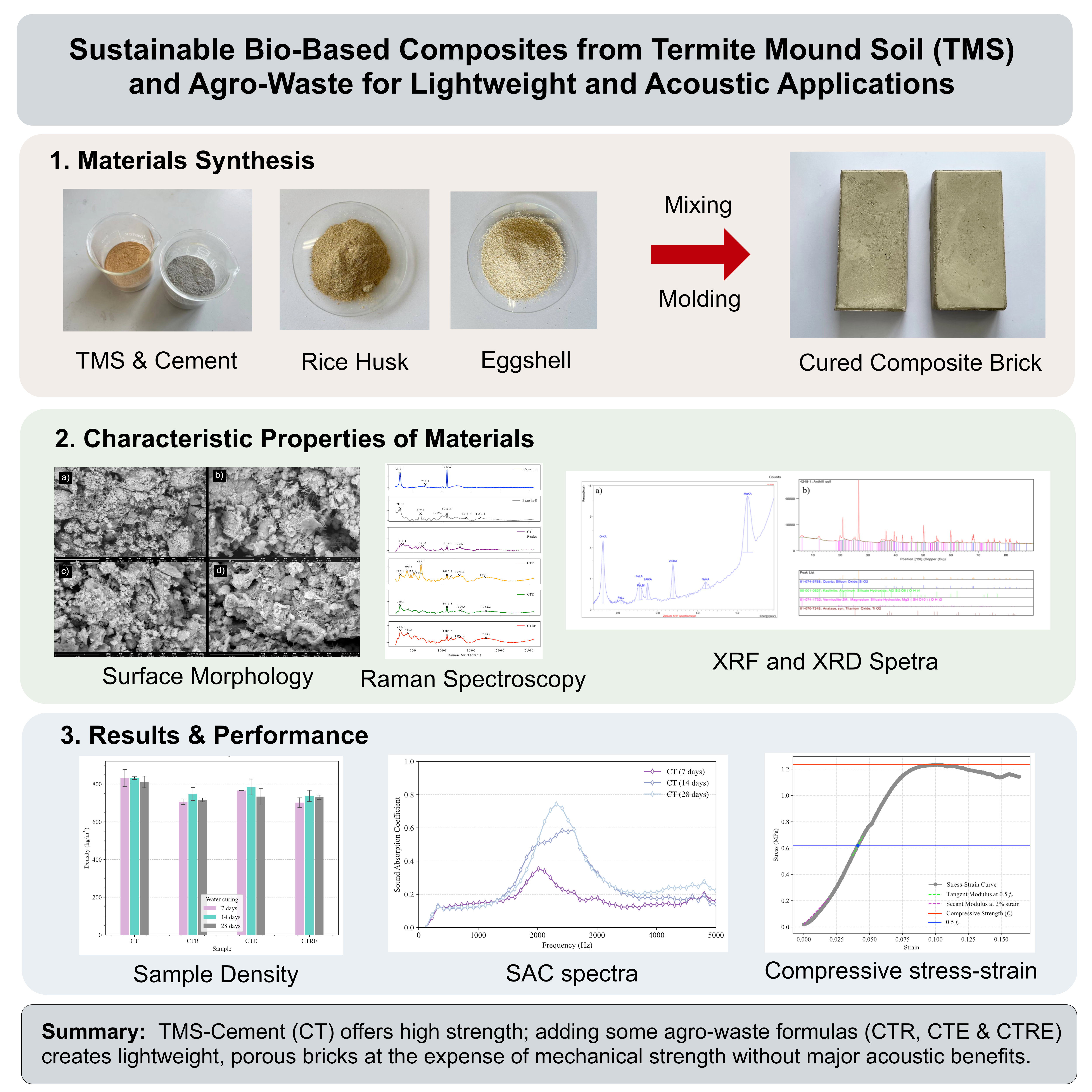
Downloads
References
AP Fantilli, O Mancinelli and B Chiaia. The carbon footprint of normal and high-strength concrete used in low-rise and high-rise buildings. Case Studies in Construction Materials 2019; 11, e00296.
N Mohamad, K Muthusamy, R Embong, A Kusbiantoro and MH Hashim. Environmental impact of cement production and solutions: A review. Materials Today: Proceedings 2022; 48(4), 741-746.
D Muheise-Araalia and S Pavia. Properties of unfired, illitic-clay bricks for sustainable construction. Construction and Building Materials 2021; 268, 121118.
T Astrauskas, T Januševičius and R Grubliauskas. Acoustic panels made of paper sludge and clay composites. Sustainability 2021; 13(2), 637.
S Janbuala and T Wasanapiarnpong. Effect of rice husk and rice husk ash on properties of lightweight clay bricks. Key Engineering Materials 2015; 659, 74-79.
KCP Faria, RF Gurgel and JNF Holanda. Recycling of sugarcane bagasse ash waste in the production of clay bricks. Journal of Environmental Management 2012; 101, 7-12.
JM Onchieku, BN Chikamai and MS Rao. Optimum parameters for the formulation of charcoal briquettes using bagasse and clay as binder. European Journal of Sustainable Development 2012; 1(3), 477-492.
C Galán-Marín, C Rivera-Gómez and J Petric. Clay-based composite stabilized with natural polymer and fibre. Construction and Building Materials 2010; 24(8), 1462-1468.
EDJ Jiménez-García, DA Arellano-Vazquez, S Titotto, AR Vilchis-Nestor, M Mayorga, L Romero-Salazar and JC Arteaga-Arcos. A low environmental impact admixture for the elaboration of unfired clay building bricks. Construction and Building Materials 2023; 407, 133470.
F Alharbi, M Almoshaogeh, M Shafiquzzaman, H Haider, M Rafiquzzaman, A Alragi, S ElKholy, EA Bayoumi and Y EL-Ghoul. Development of rice bran mixed porous clay bricks for permeable pavements: A sustainable lid technique for arid regions. Sustainability 2021; 13(3), 1443.
A El-yahyaoui, I Manssouri, Y Lehleh, H Sahbi and H Limami. Enhancing the mechanical and thermal insulation properties of clay-based construction materials with neutral carbon footprint through the use of Doum fibers. Materials Chemistry and Physics 2024; 314(11), 128774.
S Ozturk. Optimization of thermal conductivity and lightweight properties of clay bricks. Engineering Science and Technology, an International Journal 2023; 48, 101566.
M Lashgari, E Taban, MJ SheikhMozafari, P Soltani, K Attenborough and A Khavanin. Wood chip sound absorbers: Measurements and models. Applied Acoustics 2024; 220, 109963.
P Chanlert, P Ruamcharoen and T Kerdkaew. Exploring the sound absorption and sound insulation capabilities of natural fiber composites: Nipa palm peduncle fiber. Chiang Mai Journal of Science 2024; 51(3), e2024034.
M Fattahi, E Taban, P Soltani, U Berardi, A Khavanin and V Zaroushani. Waste corn husk fibers for sound absorption and thermal insulation applications: A step towards sustainable buildings. Journal of Building Engineering 2023; 77, 107468.
AL Almutairi, BA Tayeh, A Adesina, HF Isleem and AM Zeyad. Potential applications of geopolymer concrete in construction: A review. Case Studies in Construction Materials 2021; 15, e00733.
Y Chen, K Klima, HJH Brouwers and Q Yu. Effect of silica aerogel on thermal insulation and acoustic absorption of geopolymer foam composites: The role of aerogel particle size. Composites Part B: Engineering 2022; 242, 110048.
N Gupta, A Gupta, KK Saxena, A Shukla and S Goyal. Mechanical and durability properties of geopolymer concrete composite at varying superplasticizer dosage. Materials Today: Proceedings 2021; 44(1), 12-16.
T Jami, SR Karade and LP Singh. A review of the properties of hemp concrete for green building applications. Journal of Cleaner Production 2019; 239, 117852.
H Wang, H Zhao, Z Lian, B Tan, Y Zheng and E E. An optimized neural network acoustic model for porous hemp plastic composite sound-absorbing board. Symmetry 2022; 14(5), 863.
KK Alaneme, JU Anaele, TM Oke, SA Kareem, M Adediran, OA Ajibuwa and YO Anabaranze. Mycelium based composites: A review of their bio-fabrication procedures, material properties and potential for green building and construction applications. Alexandria Engineering Journal 2023; 83, 234-250.
AU Elinwa. Strength development of termite mound cement paste and concrete. Construction and Building Materials 2018; 184, 143-150.
AA Mahamat, NL Bih, O Ayeni, PA Onwualu, H Savastano and WO Soboyejo. Development of sustainable and eco-friendly materials from termite hill soil stabilized with cement for low-cost housing in Chad. Buildings 2021; 11(3), 86.
BB Mujinya, F Mees, H Erens, M Dumon, G Baert, P Boeckx, M Ngongo and EV Ranst. Clay composition and properties in termite mounds of the Lubumbashi area, D.R. Congo. Geoderma 2013; 192, 304-315.
Y Millogo, M Hajjaji and JC Morel. Physical properties, microstructure and mineralogy of termite mound material considered as construction materials. Applied Clay Science 2011; 52(1-2), 160-164.
BA Akinyemi, A Bamidele and A Oluwanifemi. Influence of water repellent chemical additive and different curing regimes on dimensional stability and strength of earth bricks from termite mound-clay. Heliyon 2019; 5(1), e01182.
CM Ikumapayi, C Arum, OA Olaseinde, OO Omotayo and EO Oniwide. Potential of calcined and uncalcined termite mounds as pozzolans in concrete mix. FUOYE Journal of Engineering and Technology 2023; 8(3), 371-376.
F Muleya, CK Tembo, AS Lungu and N Muwila. Partial replacement of cement with rice husk ash in concrete production: An exploratory cost-benefit analysis for low-income communities. Engineering Management in Production and Services 2021; 13(3), 127-141.
SA Endale, WZ Taffese, DH Vo and MD Yehualaw. Rice husk ash in concrete. Sustainability 2022; 15(1), 137.
BW Chong, R Othman, PJ Ramadhansyah, SI Doh and X Li. Properties of concrete with eggshell powder: A review. Physics and Chemistry of the Earth, Parts A/B/C 2020; 120, 102951.
GY Zhang, S Oh, Y Han, LY Meng, R Lin and XY Wang. Influence of eggshell powder on the properties of cement-based materials. Materials 2024; 17(7), 1705.
S Paruthi, AH Khan, A Kumar, F Kumar, MA Hasan, HM Magbool and MS Manzar. Sustainable cement replacement using waste eggshells: A review on mechanical properties of eggshell concrete and strength prediction using artificial neural network. Case Studies in Construction Materials 2023; 18, e02160.
AO Hussein, RJ Ghayyib, FM Radi, ZF Jawad, MS Nasr and A Shubbar. Recycling of eggshell powder and wheat straw ash as cement replacement materials in mortar. Civil Engineering Journal 2024; 10(1), 83-99.
ASTM E1050. Standard test method for impedance and absorption of acoustical materials using a tube, two microphones and a digital frequency analysis system. American Society for Testing and Materials, West Conshohocken, 1990, p. 1 - 11.
ISO 10534-2. Determination of sound absorption coefficient and impedance in impedance tubes: Part 2: Transfer-function method. International Organization for Standardization, Geneva, 1998, p. 1-27
P Chanlert, A Jintara and W Manoma. Comparison of the sound absorption properties of acoustic absorbers made from used copy paper and corrugated board. BioResources 2022; 17(4), 5612-5621.
E Güneyisi, M Gesoǧlu and K Mermerdaş. Improving strength, drying shrinkage, and pore structure of concrete using metakaolin. Materials and Structures 2008; 41(5), 937-949.
P Dinakar, PK Sahoo and G Sriram. Effect of metakaolin content on the properties of high strength concrete. International Journal of Concrete Structures and Materials 2013; 7(3), 215-223.
G Nakkeeran and L Krishnaraj. Developing lightweight concrete bricks by replacing fine aggregate with vermiculite: A regression analysis prediction approach. Asian Journal of Civil Engineering 2023; 24, 1529-1537.
TA Khezhev, GN Khadzhishalapov, FM Shogenova, AK Artabaev, MK Mashukova. Properties of fire-retardant vermiculite-concrete composite and fine-grained concrete for two-layer reinforced cement structures. Technical Sciences 2022; 49(2), 165-176.
S Ishida, S Kudo, S Asano, and J Hayashi. Multi-step pre-treatment of rice husk for fractionation of components including silica. Frontiers in Chemistry 2025; 13, 1538797.
JL Parracha, AS Pereira, RVD Silva, V Silva and P Faria. Effect of innovative bioproducts on the performance of bioformulated earthen plasters. Construction and Building Materials 2021; 277, 122261.
O Ifetayo, A Clinton and JH Pretorius. A study of engineering properties of cement modified termitarium soil found within ado- ekiti metropolis for bricks production. In: Proceedings of the International Conference on Industrial Engineering and Operations Management, Washington DC, USA. 2018, p. 567-577.
BA Alabadan, KA Adekola and TJ Esumobi. Compressive strength of rice husk stabilized termite hill soil. CIGR Journal 2016; 18(1), 41-47.
MG Tebabal, BW Yifru, EM Getachew and MD Yehualaw. Influence of termite hill soil as a partial cement replacement in mortar production. Journal of Infrastructure Preservation and Resilience 2025; 6, 8.
MM Ahmad, F Ahmad, M Azmi and MZAM Zahid. Properties of cement mortar consisting raw rice husk. Applied Mechanics and Materials 2015; 802, 267-271.
KS Lokesh, KS Kumar, N Keerthan, R Revanth, S Sandeep, SB Lakkundi, V Bharath, H Hanumanthappa, PC Durga and BK Shanmugam. Experimental analysis of the rice husk and eggshell powder-based natural fibre composite. Journal of The Institution of Engineers (India): Series D 2023; 105, 1801-1808.
K Khan, W Ahmad, MN Amin and AF Deifalla. Investigating the feasibility of using waste eggshells in cement-based materials for sustainable construction. Journal of Materials Research and Technology 2023; 23, 4059-4074.
TS Bozkurt and SY Demirkale. The experimental research of sound absorption in plasters produced with perlite aggregate and natural hydraulic lime binder. Acoustics Australia 2020; 48(3), 375-393.
Z Ghizdăveț, BM Ștefan, D Nastac, O Vasile and M Bratu. Sound absorbing materials made by embedding crumb rubber waste in a concrete matrix. Construction and Building Materials 2016; 124, 755-763.
Y Zhang, H Li, A Abdelhady and J Yang. Effect of different factors on sound absorption property of porous concrete. Transportation Research Part D: Transport and Environment 2020; 87, 102532.
ASTM-C423. Standard Test Method for Sound Absorption and Sound Absorption Coefficients by the Reverberation Room Method. ASTM International, West Conshohocken, 2009, p. 11.
H Kim, J Hong and S Pyo. Acoustic characteristics of sound absorbable high performance concrete. Applied Acoustics 2018; 138, 171-178.
P Chanlert, S Tongyoo and C Rordrak. Effects of urea–formaldehyde and polyvinyl acetate adhesive on sound absorption coefficient and sound transmission loss of palmyra palm fruit fiber composites. Applied Acoustics 2022; 198, 108984.
P Chanlert, W Manoma, A Jintara, T Kerdkaew and T Sutthibutpong. Experimental and semi-phenomenological investigation on sound absorption performance of natural granular sound absorber: A case study on rice bran composites. Chiang Mai Journal of Science 2023; 50(2), 1-17.
AM Legese, TG Kenate and FF Feyessa. Termite mound soils for sustainable production of bricks. Studia geotechnica et mechanica 2021; 43(2), 142-154.
I Johari, S Said, B Hisham, A Bakar and ZA Ahmad. Effect of the change of firing temperature on microstructure and physical properties of clay bricks from Beruas (Malaysia). Science of Sintering 2010; 42(2), 245-254.
BA Akinyemi, BO Orogbade and CW Okoro. The potential of calcium carbide waste and termite mound soil as materials in the production of unfired clay bricks. Journal of Cleaner Production 2021; 279, 123693.
AA Mahamat, MM Boukar, NM Ibrahim, TT Stanislas, NL Bih, II Obianyo and JH Savastano. Machine learning approaches for prediction of the compressive strength of alkali activated termite mound soil. Applied Sciences 2021; 11(11), 4754.
A El-Yahyaoui, I Manssouri, Y Lehleh, H Sahbi and H Limami. Enhancing the mechanical and thermal insulation properties of clay-based construction materials with neutral carbon footprint through the use of Doum fibers. Materials Chemistry and Physics 2024; 314, 128774.
A El-Yahyaoui, I Manssouri, Y Lehleh, H Sahbi and H Limami. Effect of diss fibers on the mechanical and thermophysical characteristics of unfired clay bricks for use as construction material. Innovative Infrastructure Solutions 2023; 8(7), 196.

Published
How to Cite
Issue
Section
License
Copyright (c) 2025 Walailak University

This work is licensed under a Creative Commons Attribution-NonCommercial-NoDerivatives 4.0 International License.





