
Heavy-Quark Spin Symmetry Violation Effects in Charmed Baryon Production
DOI:
https://doi.org/10.48048/tis.2026.11487Keywords:
Charmed baryon production, Heavy-Quark Spin Symmetry, Effective LagrangianAbstract
In this work, we investigate an effective Lagrangian that describes the interactions between mesons, charmed baryons () and nucleons within the framework of Heavy-Quark Spin Symmetry (HQSS). Using the super-multiplet formalism, we systematically construct the three-point interaction terms. As a result, by considering the minimal sets of the effective Lagrangian in the HQSS construction, there are two effective Lagrangians that are invariant under HQSS whereas we find two minimum terms of the Lagrangian that violate the HQSS transformation. To reveal the phenomenological consequences of HQSS-breaking pattern, we compute the differential cross-sections for exclusive charmed baryon pair production in proton-antiproton collisions, , with . We demonstrate that the production rates of these channels can be used as a sensitive probe of the HQSS-violating dynamics. Our framework provides predictions for these observables, which are of crucial importance for the upcoming PANDA experiment at the Facility for Antiproton and Ion Research (FAIR).
HIGHLIGHTS
- Constructed the minimal three-point HQSS-conserving (CHQSS) and HQSS-violating (VHQSS) effective Lagrangian for interactions among D* mesons, nucleons, and charmed baryons using the super-multiplet formalism providing a new HQSS framework for these production reactions beyond earlier four-point treatments.
- Derived systematic relations among coupling constants, showing explicit suppression patterns of HQSS-violating couplings relative to conserving ones, and demonstrated how HQSS sharply reduces the number of independent low-energy constants to be fixed.
- Fixed remaining LECs by matching to standard SU(3)/SU(4) effective Lagrangian approaches and incorporating ~20% SU(4) breaking guided by quark-model inputs, enabling realistic phenomenological predictions.
- Computed spin-averaged differential and total cross sections for multiple exclusive channels in from threshold up to =15 GeV/c, finding partner final states dominated by HQSS-conserving pieces (typically 66–98%), while non-partner channels show comparable conserving/violating contributions.
- Provided experiment-ready predictions and diagnostics for PANDA/FAIR: cross-section magnitudes and conserving and violating fractions vary characteristically by channel and form factor, so measured production rates can serve as sensitive probes of HQSS breaking dynamics in charm production.
GRAPHICAL ABSTRACT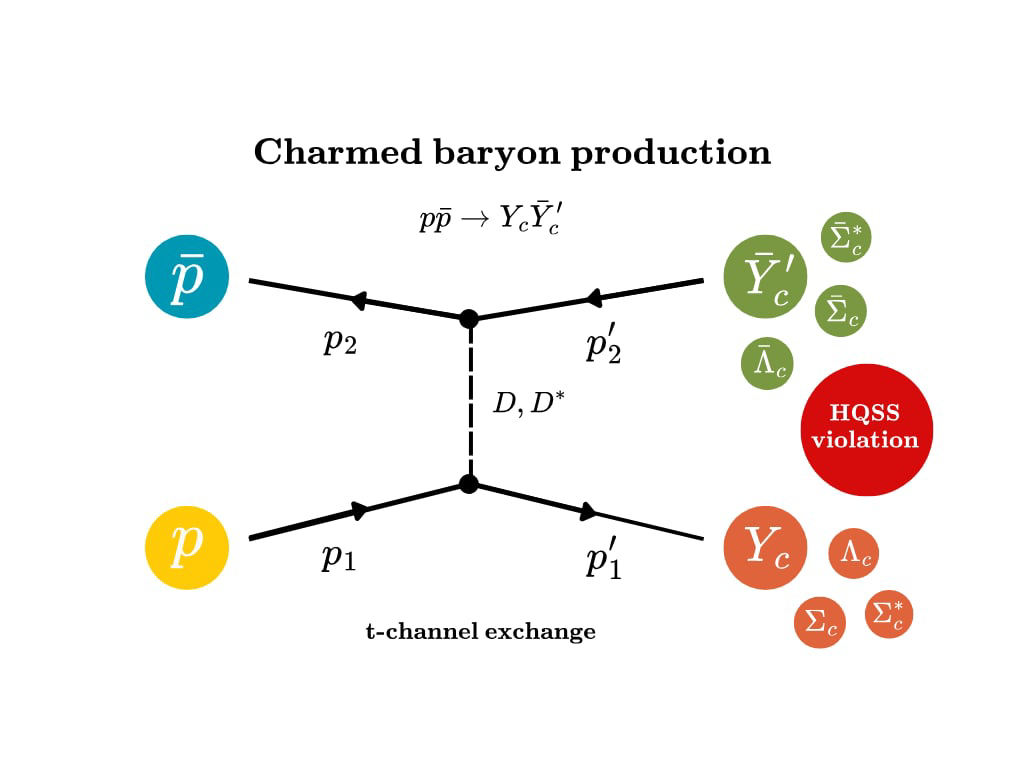
Downloads
References
EG Cazzoli, AM Cnops, PL Connolly, RI Louttit, MJ Murtagh, RB Palmer, NP Samios, TT Tso and HH William. Evidence for ΔS=-ΔQ Currents or Charmed Baryon Production by Neutrinos. Physical Review Letters 1975; 34, 1125.
W Chen, J Ho, TG Steele, RT Kleiv, B Bulthuis, D Harnett, T Richards and SL Zhu. Exotic hadron states. In: Proceedings of the 30th International Workshop on High Energy Physics: Particle and Astroparticle Physics, Gravitation and Cosmology: Predictions, Observations and New Projects, Protvino, Russia. 2014, p. 137-143.
B Aubert, R Barate, D Boutigny, F Couderc, JM Gaillard, A Hicheur, Y Karyotakis, JP Lees, V Tisserand, A Zghiche, A Palano, A Pompili, JC Chen, ND Qi, G Rong, P Wang, YS Zhu, G Eigen, I Ofte, B Stugu, …, H Neal. Study of the B→J/ψK^- π^+ π^-decay and measurement of the B→X(3872)K^- branching fraction. Physical Review Journals 2005; 71, 071103.
B. Aubert, R Barate, D Boutigny, F Couderc1, Y Karyotakis1, JP Lees, V Poireau, V Tisserand, A Zghiche, E Grauges, A Palano, M Pappagallo, A Pompili, JC Chen, ND Qi, G Rong, P Wang, YS Zhu, G Eigen, I Ofte, B Stugu, GS Abrams, M Battaglia, AB Breon, DN Brown, J Button-Shafer, RN Cahn, E Charles, CT Day, …, H Neal. Observation of a broad structure in the π^+ π^- J/ψ mass spectrum around 4.26GeV/c^2. Physical Review Letters 2005; 95, 142001.
K Abe, I Adachi, H Aihara, K Arinstein, Y Asano, V Aulchenko, T Aushev, T Aziz, AM Bakich, V Balagura, M Barbero, I Bedny, U Bitenc, I Bizjak, A Bondar, M Bracko, J Brodzicka, TE Browder, Y Chao, A Chen, BG Cheon, R Chistov, SK Choi, Y Choi, YK Choi, A Chuvikov, S Cole, …, J Dalseno. Observation of a new charmonium state in double charmonium production in e^+ e^-annihilation at √s≈10.6-GeV. Physical Review Letters 2007; 98, 082001.
SK Choi, SL Olsen, K Abe, T Abe, I Adachi, BS Ahn, H Aihara, K Akai, M Akatsu, M Akemoto, Y Asano, T Aso, V Aulchenko, T Aushev, AM Bakich, Y Ban, S Banerjee, A Bondar, A Bozek, M Bračko, …, J Brodzicka. Observation of a narrow charmonium-like state in exclusive B^±→K^± π^+ π^- J/ψ decays. Physical Review Letters 2003; 91, 262001.
SK Choi, SL Olsen, I Adachi, H Aihara, V Aulchenko, T Aushev, T Aziz, AM Bakich, V Balagura, I Bedny, U Bitenc, A Bondar, A Bozek, M Bračko, J Brodzicka, TE Browder, P Chang, Y Chao, A Chen, KF Chen, …, WT Chen. Observation of a resonance-like structure in the π^± ψ^' mass distribution in exclusive B→Kπ^± ψ^' decays. Physical Review Letters 2008; 100, 142001.
R Aaij, CA Beteta, B Adeva, M Adinolfi, C Adrover, A Affolder, Z Ajaltouni, J Albrecht, F Alessio, M Alexander, S Ali, G Alkhazov, PA Cartelle, AA Alves, S Amato, S Amerio, Y Amhis, L Anderlini, J Anderson, R Andreassen, …, RB Appleby. Determination of the X (3872) meson quantum numbers. Physical Review Letters 2013; 110, 222001.
R Aaij, B Adeva, M Adinolfi, A Affolder, Z Ajaltouni, J Albrecht, F Alessio, M Alexander, S Al, G Alkhazov, PA Cartelle, AA Alves, S Amato, S Amerio, Y Amhis, L An, L Anderlini, J Anderson, R Andreassen, M Andreotti, …, A Zvyagin. Observation of the resonant character of the Z(4430)^-state. Physical Review Letters 2014; 112, 222002.
AB Kaidalov and PE Volkovitsky. Binary reactions in p ‾p collisions at intermediateenergies. Zeitschrift für Physik C Particles and Fields 1994; 63, 517-524.
AI Titov and B Kampfer. Exclusive charm production in p ‾p collisions at √s≲15 GeV. Physical Review C 2008; 78, 025201.
A Khodjamirian, C Klein, T Mannel,and YM Wang. How much charm can PANDA produce? The European Physical Journal A 2012; 48, 31.
J Haidenbauer and G Krein. Charm production in antiproton-proton annihilation. Few-Body Systems 2011; 50, 183-186.
J Haidenbauer and G Krein. The Reaction pp ‾→Λ ‾_c Λ_c^+close to threshold. Physics Letters B 2010; 687(4-5), 314-319.
J Haidenbauer and G Krein. Production of charmed baryons in p ‾p collisions close to their thresholds. Physical Review D 2017; 95, 014017.
R Shyam and H Lenske. Reaction p ‾p→Λ ‾_c^- Λ_c^+within an effective lagrangian model. Physical Review D 2014; 90, 014017.
T Sangkhakrit, SI Shim, Y Yan and A Hosaka. Charmed baryon pair production in proton-antiproton collisions in effective Lagrangian and Regge approaches. The European Physical Journal A 2022; 58, 32.
ML Du, E Hernández and J Nieves. Is the Λ_c (2625)^+the heavy quark spin symmetry partner of the Λ_c (2595)^+?. Physical Review D 2022; 106(11), 114020.
V Baru, E Epelbaum, AA Filin, C Hanhart and AV Nefediev. Emergence of heavy quark spin symmetry breaking in heavy quarkonium decays. Physical Review D 2023; 107, 014027.
D Samart, C Nualchimplee and Y Yan. Combined heavy-quark symmetry and largeN_c operator analysis for 2-body counterterms in the chiral Lagrangian with D mesons and charmed baryons. Physical Review D 2016; 93, 116004.
V Baru, E Epelbaum, AA Filin, C Hanhart and AV Nefediev. Heavy-quark spin symmetry partners of the X(3872) molecule. JPS Conference Proceedings 2017; 13, 020023.
O Romanets, L Tolos, C García-Recio, J Nieves, LL Salcedo and R Timmermans. Heavy-quark spin symmetry for charmed and strange baryon resonances. Nuclear Physics A 2013; 914, 488-493.
MFM Lutz, D Samart and A Semke. Combined large- N_c and heavy-quark operator analysis of 2-body meson-baryon counterterms in the chiral Lagrangian with charmed mesons. Physical Review D 2011; 84, 096015.
JM Suh and HC Kim. Axial-vector transition form factors of the singly heavy baryons. Physical Review D 2022; 106, 094028.
JY Kim and HC Kim. Electromagnetic form factors of singly heavy baryons in the self-consistent SU(3) chiral quark-soliton model. Physical Review D 2018; 97(11), 114009.
F Hussain and G Thompson. An Introduction to the heavy quark effective theory. In: E Gava, A Masiero, KS Narain, S Randjbar-Daemi and Q Shafi (Eds.). Proceedings, summer school in high-energy physics and cosmology: Trieste, Italy, June 13-July 29, 1994. ICTP Summer School in High-energy Physics and Cosmology, Trieste, 1995, p. 0045-0115.
A Belyaev. Nuclei and particles. University of Southampton, Southampton, United Kingdom.
DR Entem, PG Ortega and F Fernandez. Partners of the X(3872) and HQSS breaking. In: MR Pennington (Ed.). Proceedings, 16th International conference on hadron spectroscopy (Hadron 2015): Newport News, Virginia, USA, September 13-18, 2015. AIP Conference Proceedings, New York, 2016, p. 060006.
W Qin, SR Xue and Q Zhao. Production of Y(4260) as a hadronic molecule state of D ‾D_1+ c.c. in e^+ e^-annihilations. Physical Review D 2016; 94, 054035.
D Skoupil and Y Yamaguchi. Photoproduction of D ‾^0 Λ_c^+within the Regge-plusresonance model. Physical Review D 2020; 102, 074009.
G Krein. SU(4)-flavor symmetry breaking in hadron couplings. In: Proceedings of science, Trieste, Italy. 2012, p. 144.
CE Fontoura, J Haidenbauer and G Krein. SU(4) flavor symmetry breaking in D meson couplings to light hadrons. The European Physical Journal A 2017; 53, 92.
W Erni, I Keshelashvili, B Krusche, M Steinacher, Y Heng, Z Liu, H Liu, X Shen, O Wang, H Xu, J Becker, F Feldbauer, FH Heinsius, T Held, H Koch, B Kopf, C Motzko, M Peliz¨aus, B Roth, T Schr¨oder, …, R Timmermans. Physics performance report for PANDA: Strong interaction studies with antiprotons. 2009.
S Sakai, HJ Jing and FK Guo. Decays of P_c into J/ψN and η_c N with heavy quark spin symmetry. Physical Review D 2019; 100, 074007.
J Haidenbauer and G Krein. Production of charmed pseudoscalar mesons in antiproton-proton annihilation. Physical Review D 2014; 89, 114003.
R Shyam and K Tsushima. Production of Λ_c^+hypernuclei in antiproton - nucleus collisions. Physics Letters B 2017; 770, 236-241.
R Shyam. Charmed-baryon production in antiproton-proton collisions within an effective Lagrangian model. Physical Review D 2017; 96, 116019.
AT Goritschnig, P Kroll and W Schweiger. Proton-antiproton annihilation into a Λ_c^+ Λ ‾_c^-Pair. The European Physical Journal A 2009; 42, 43-62.
D Iglesias-Ferrero, DR Entem, F Fernández and PG Ortega. Production of singlecharmed baryons in a quark model approach. Physical Review D 2022; 106, 094027.
L Frankfurt, M Strikman, A Larionov, A Lehrach, R Maier, HV Hees, C Spieles, V Vovchenko and H Stoecker. PANDA as midrapidity detector for a future HESR collider at FAIR. The European Physical Journal A 2020; 56, 171.

Published
How to Cite
Issue
Section
License
Copyright (c) 2025 Walailak University

This work is licensed under a Creative Commons Attribution-NonCommercial-NoDerivatives 4.0 International License.





