
Allelic Variation and Haplotype Diversity of the badh2 Gene in Thai Aromatic Landrace Rice Varieties
DOI:
https://doi.org/10.48048/tis.2026.11476Keywords:
Aromatic rice, Genetic diversity, badh2 gene, Haplotype, Landrace rice, KDML105, Allelic variationAbstract
Thai aromatic landrace rice varieties are vital reservoirs of genetic diversity for fragrance traits, offering valuable potential for rice breeding. This study characterized grain morphology, aroma, and the badh2 gene variation in aromatic and non-aromatic rice varieties. Most aromatic varieties featured slender grains, typically with white pericarps. Sensory evaluation revealed varying aroma intensities across the panel. Badh2 gene sequences were analyzed for 14 allelic variations across introns and exons. Six exonic variations defined 4 haplotypes. Haplotype 1, including KDML105 and 17 others, shared an 8-bp deletion in exon 7. Haplotype 2, found only in Hawm Hua Bawm, had the same alleles as Haplotype 1 but a unique SNP (G > A) in exon 13, a novel allele associated with aroma expression. Haplotype 3 consisted of 8 varieties, lacking the 8-bp deletion in exon 7 and carrying the new allele in exon 13. Haplotype 4 was found in Hawm Gra Dang Ngah 59. All the alleles resembled non-aromatic rice, suggesting that aroma may result from functional mutations elsewhere in the badh2 gene or be influenced by different genes. Predicted functional impacts of exonic variants support the role of badh2 gene diversity in shaping aroma. These findings enhance our understanding of aroma genetics in rice and provide useful markers for breeding fragrant cultivars.
HIGHLIGHTS
- The complete coding sequence of the fragrant gene (badh2) was characterized for haplotype diversity in 24 Thai aromatic rice landraces and three improved aromatic rice varieties.
- Fourteen allelic variations were detected in the badh2 gene, with four haplotypes identified using six alleles in the exon regions of the aromatic varieties.
- A new functional allele, SNP (G>A), was detected in exon 13 of the badh2
GRAPHICAL ABSTRACT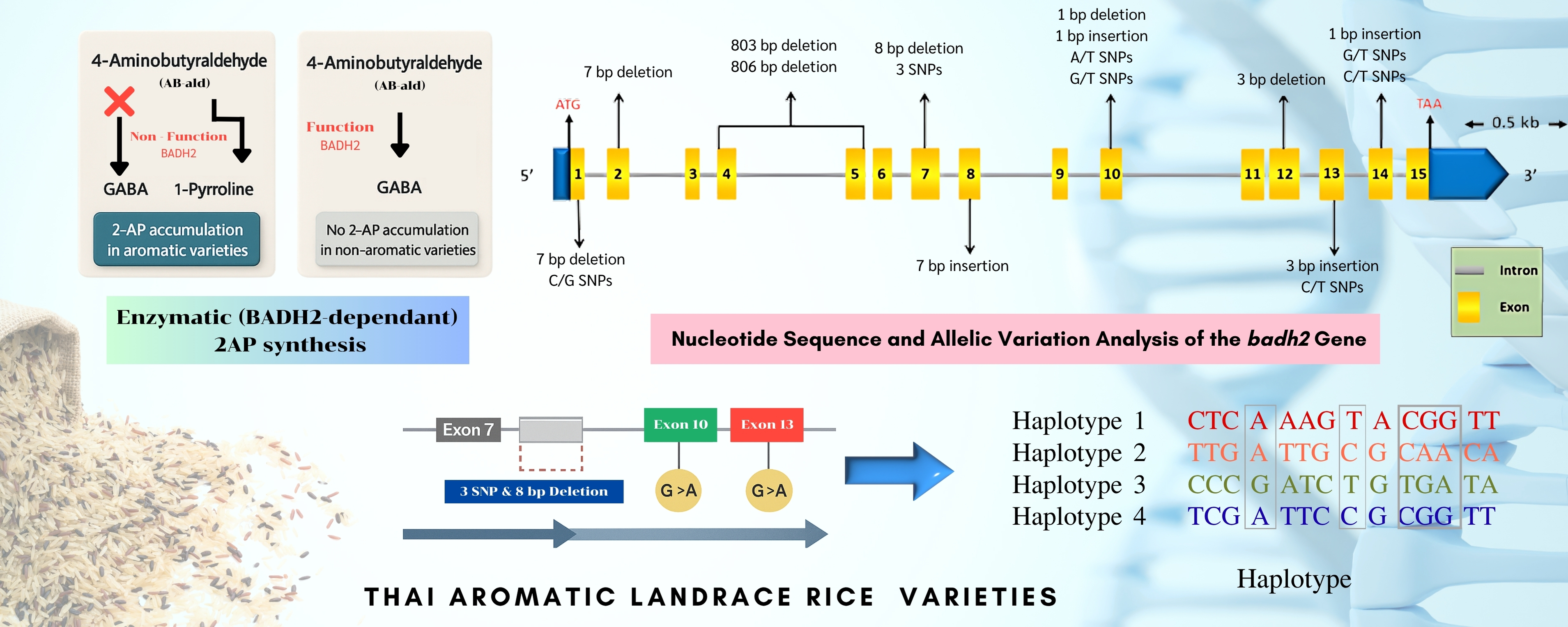
Downloads
References
R Phitaktansakul, KW Kim, KM Aung, TZ Maung, MH Min and A Somsri. Multi-omics analysis reveals the genetic basis of rice fragrance mediated by betaine aldehyde dehydrogenase 2. Journal of Advanced Research 2022; 42, 303-314.
National Bureau of Agricultural Commodity and Food Standards. Thai agricultural standard: Thai Hom Mali rice (TAS 4000-2003). Ministry of Agriculture and Cooperatives, Bangkok, Thailand, 2003.
K Mahattanatawee and RL Rouseff. Comparison of aroma active and sulfur volatiles in 3 fragrant rice cultivars using GC-Olfactometry and GC-PFPD. Food Chemistry 2014; 154, 1-6.
S Mathure, K Wakte, N Jawali and A Nadaf. Breeding Science 2014; 64(1), 9-17.
LMT Bradbury, RJ Henry, Q Jin, RF Reinke and DLE Waters. A perfect marker for fragrance genotyping in rice. Molecular Breeding 2005; 16(4), 279-283.
F Liu, W Wang, F Sun, W Liu and D Liang. Detection of 2-acetyl-1-pyrroline in fragrant rice by KOH immersion method. Journal of Northeast Agricultural University 2014; 21(4), 25-30.
S Sood and EA Siddiq. A rapid technique for scent determination in rice. Indian Journal of Genetics and Plant Breeding 1978; 38(2), 268-271.
CH Yeh, YS Lee, HL Chen and TP Huang. Post-harvest changes in aroma compounds of aromatic rice during storage. Journal of Food Composition and Analysis 2024; 125, 105652.
NL Hien. Aroma characterization in rice using gas chromatography - mass spectrometry. Plant Breeding and Biotechnology 2006; 47, 351-357.
R Widjaja, JD Craske and M Wootton. Comparative studies on volatile components of non-fragrant and fragrant rices. Journal of the Science of Food and Agriculture 1996; 70(2), 151-161.
T Yoshihashi, NTT Huong and TTC Hoa. Method for quantification of 2-acetyl-1-pyrroline, a potent flavor compound of aromatic rice, using stable isotope dilution and gas chromatography/mass spectrometry. Journal of Agricultural and Food Chemistry 2004; 52(20), 6047-6051.
LMT Bradbury, TL Fitzgerald, RJ Henry, Q Jin and DLE Waters. The gene for fragrance in rice. Plant Biotechnology Journal 2005; 3(3), 363-370.
SN Ahn, SK Bajaj, SR McCouch, H Dulay, JS Lob Fernando and FG Gamas. Inheritance of aroma in rice: Identification of a gene for fragrance. Journal of Genetics and Breeding 1992; 46(2), 123-128.
MJ Kovach, MN Calingacion, MA Fitzgerald and SR McCouch. The origin and evolution of fragrance in rice (Oryza sativa L.). Proceedings of the National Academy of Sciences 2009; 106(34), 14444-14449.
S Chen, Y Yang, W Shi, Q Ji, F He, Z Zhang, Z Cheng, X Liu and M Xu. Badh2, encoding betaine aldehyde dehydrogenase, inhibits the biosynthesis of 2-acetyl-1-pyrroline, a major component in rice fragrance. Plant Cell 2008; 20(7), 1850-1861.
K Sakthivel, RM Sundaram, N Shobha Rani, SM Balachandran and CN Neeraja. Genetic and molecular basis of fragrance in rice. Biotechnology Advances 2009; 27(4), 468-473.
H Shi, DS Tan, WB Tang and QQ Liu. Development of a functional marker for fragrance gene in rice. Rice Science 2013; 20(1), 21-28.
F Bourgis, R Guyot, H Gherbi, E Tailliez, I Amabile, J Salse, M Lorieux and A Ghesquière. Characterization of the major fragrance gene from an aromatic japonica rice and analysis of its diversity in Asian cultivated rice. Theoretical and Applied Genetics 2008; 117(3), 353-368.
M Amarawathi, R Singh, AK Singh, VP Singh, T Mohapatra, TR Sharma and NK Singh. Mapping of quantitative trait loci for basmati quality traits in rice (Oryza sativa L.). Indian Journal of Genetics and Plant Breeding 2008; 68(2), 120-126.
G Shao, S Tang, M Luo, M Li, P Hu and W Zhai. A novel deletion mutation of the BADH2 gene in fragrant rice. Plant Molecular Biology Reporter 2011; 29, 471-476.
X He, Z Lin, D Zhang and Q Zhang. Identification of 3 bp deletion in Exon 12 of badh2. Molecular Breeding 2015; 35, 161.
R Roy, VK Singh, AK Shukla, P Sood and AK Singh. Allelic diversity of BADH2 gene in aromatic rice cultivars including KDML105 and Basmati. Journal of Plant Biochemistry and Biotechnology 2020; 29(4), 742-750.
P Chan-in, S Jamjod, N Yimyam, B Rerkasem and T Pusadee. Grain quality and allelic variation of the Badh2 gene in Thai fragrant rice landraces. Agronomy 2020; 10(6), 779.
MA Care, CJ Needham and AJ Bulpitt. Deleterious SNP prediction: Methods and resources. Briefings in Functional Genomics 2007; 6(5), 367-380.
Z Wang, T Mou, Y Tan and J Zhang. Development of functional markers for BADH2 gene and fragrance analysis in rice. Breeding Science 2016; 66(1), 90-96.
PC Ng and S Henik off. Predicting the effects of amino acid substitutions on protein function. Annual Review of Genomics and Human Genetics 2006; 7, 61-80.
AV Kovalev, J Li, W Zhou and J Guo. PPVED: Prediction of the effect of single amino acid substitution on protein function in plants. Frontiers in Plant Science 2018; 9, 1403.
JJ Doyle and JL Doyle. Isolation of plant DNA from fresh tissue. Focus 1990; 12(1), 13-15.
W Punfa, S Wongpornchai and S Siriamornpun. Pigmented rice pericarp: A potential source of phenolic compounds and functional properties. The Journal of Cereal Science 2024; 113, 105009.
O Kongpun, S Wanchana, T Toojinda and A Vanavichit. Environmental and genetic influence on rice grain aroma variation in Thailand. Rice Science 2024; 31(2), 157-167.
MA Fitzgerald, NR Sackville Hamilton, MN Calingacion, HA Verhoeven and VM Butardo. Is there a second fragrance gene in rice? Plant Biotechnology Journal 2008; 6(4), 416-423.
W Shi, X Zhao, J Rong and BR Lu. Genetic diversity of fragrant rice (Oryza sativa L.) germplasm investigated by microsatellite markers. Genetic Resources and Crop Evolution 2008; 55(4), 497-506.
A Songkairat. 2019, Genetic diversity and aromatic characteristics of Thai local rice varieties. Master’s Thesis. Kasetsart University, Bangkok Thailand.
S Laksanalamai and S Ilangantileke. Pandanus amaryllifolius: A source of aroma compound in rice. International Rice Research Notes 1993; 18(1), 15-16.
S Chaithong, P Sukkarn, C Aenglong, W Woonnoi, W Klaypradit, W Suttithumsatid, N Chinfak, J Seatan, S Tanasawet and W Sukketsiri. Biological activities and phytochemical profile of Hawm Gra Dang Ngah rice: Water and ethanolic extracts. Foods 2025; 14(7), 1119.
KD Wakte, PR Zanan, VC Hinge, SB Khandagale, R Nadaf and RA Henry. Genetic diversity analysis and identification of aroma gene in Indian aromatic rice accessions using BADH2 gene specific markers. Physiology and Molecular Biology of Plants 2016; 22(4), 551-563.
Y Li, Y Huang, J Bergelson, M Nordborg and JO Borevitz. Association mapping of local climate-sensitive quantitative trait loci in Arabidopsis thaliana. Proceedings of the National Academy of Sciences 2012; 107(49), 21199-21204.
Y Xu, R Wang, Y Tong, H Zhao, Q Xie and Y Liu. Mapping of QTLs for grain shape and size using a high-density SNP map in rice. PLoS One 2018; 13(5), e0196962.
X Gou, X Feng, H Shi, T Guo, R Xie, Y Liu, Q Wang, H Li, B Yang, L Chen and Y Lu. PPVED: A machine learning tool for predicting the effect of single amino acid substitution on protein function in plants. Plant Biotechnology Journal 2022; 20, 2128-2143.
A Vanavichit. Exploration and utilization of rice landrace genes for rice improvement in Thailand. Rice Science 2018; 25(3), 119-124.

Published
How to Cite
Issue
Section
License
Copyright (c) 2025 Walailak University

This work is licensed under a Creative Commons Attribution-NonCommercial-NoDerivatives 4.0 International License.





