
Machine Learning for Biomarker-Based Tuberculosis Diagnosis: A Systematic Review and Meta-Analysis
DOI:
https://doi.org/10.48048/tis.2026.11390Keywords:
Tuberculosis, Machine learning, Biomarker-based diagnosis, Early detection, Diagnostic accuracy, Communicable diseases, Hospital management, Artificial intelligenceAbstract
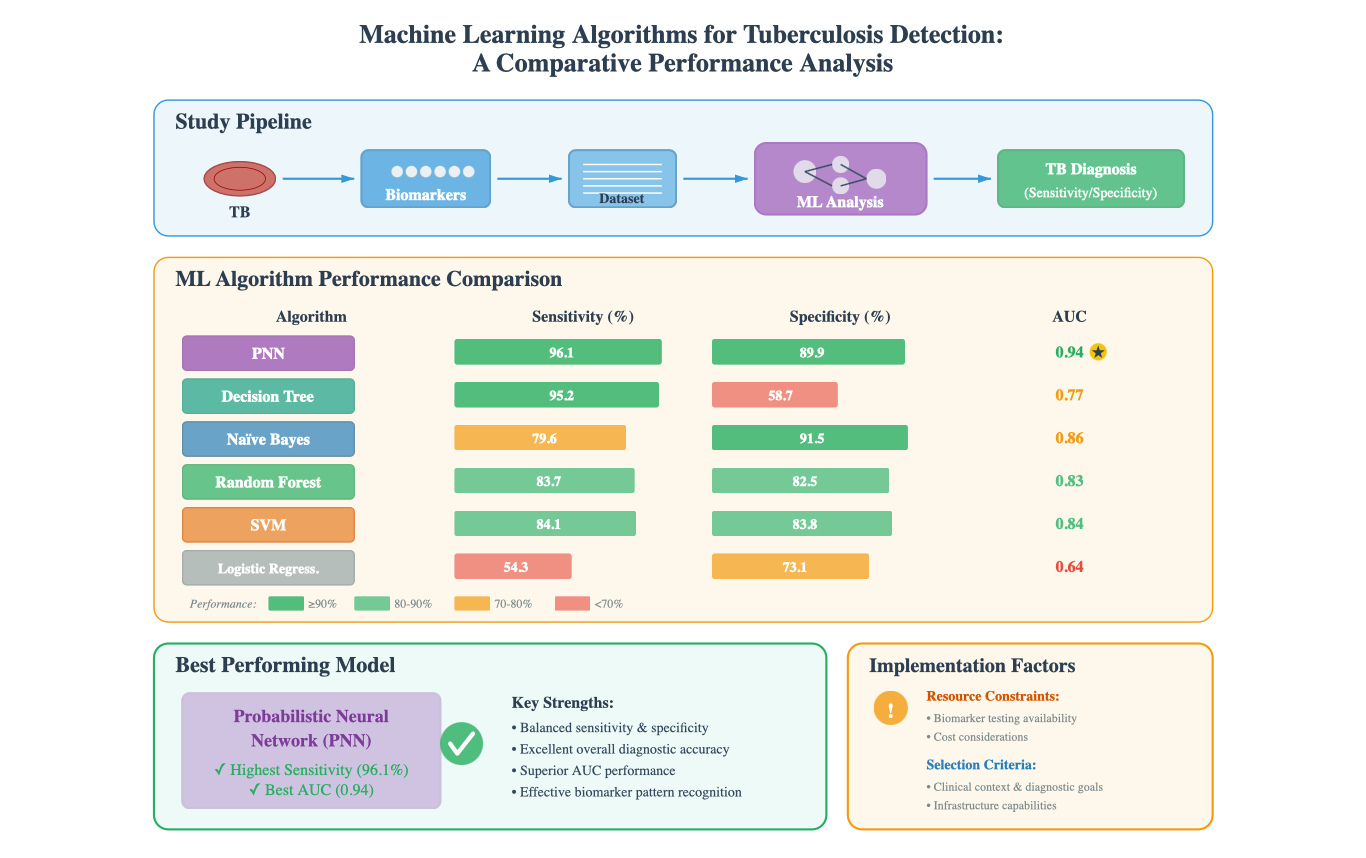
Tuberculosis (TB) is a serious worldwide health concern, demanding reliable and efficient diagnostic techniques. Machine learning (ML) techniques have emerged as viable ways to enhance tuberculosis detection through the analysis of complicated biomarker data. However, the comparative effectiveness of various ML models is unclear, emphasizing the need for a thorough assessment. This study evaluates the diagnostic accuracy of ML algorithms for tuberculosis detection, outlining their strengths, limitations, and clinical applications. A comprehensive search of 6 databases identified studies using biomarker-based ML approaches for TB diagnosis. A 2-level mixed-effects logistic regression model was used to assess pooled sensitivity, specificity, and AUC. The RoB 2.0 tool was used to evaluate quality, whereas RevMan 5.4 was used for meta-analysis. Among the algorithms tested, the Probabilistic Neural Network (PNN) had the greatest pooled sensitivity (96.1%), specificity (89.9%), and AUC (0.94). Decision Tree (DT) models have great sensitivity (95.2%), but poor specificity (58.7%). Naïve Bayes (NB) had the greatest specificity (91.5%) and sensitivity (79.6%), while Random Forest (RF) and Support Vector Machine (SVM) performed similarly, with sensitivities of 83.7% and 84.1%, and accuracies of 82.5% and 83.8%, respectively. Logistic regression (LR) had the lowest sensitivity (54.3%) and accuracy (73.1%). ML algorithms have great potential for improving TB diagnosis using biomarker data, with PNN appearing as the best-performing model in terms of sensitivity, specificity, and AUC. However, the availability and expense of biomarker testing may limit the use of such strategies in resource-constrained environments. The clinical context, diagnostic goals, and infrastructure capabilities should all be considered while selecting algorithms.
HIGHLIGHTS
- Machine learning (ML) algorithms show strong potential for biomarker-based tuberculosis (TB) diagnosis.
- The Probabilistic Neural Network (PNN) achieved the highest diagnostic accuracy among all models.
- Decision Tree and Naïve Bayes demonstrated strengths in sensitivity and specificity, respectively.
- Random Forest and Support Vector Machine offered balanced diagnostic performance.
- ML-assisted biomarker analysis could enhance TB detection, especially when optimized for clinical context.
GRAPHICAL ABSTRACT
Downloads
References
World Health Organization. Global tuberculosis report 2024. World Health Organization, Geneva, Switzerland, 2024.
DN Ardiansyah, C Suryawati and MS Adi. Provision of resources in the implementation of tuberculosis-multi drug resistance treatment service in “X” Hospital. Jurnal Medicoeticolegal dan Manajemen Rumah Sakit 2019; 8(3), 123-130.
Kementerian Kesehatan Republik Indonesia. Laporan unit pelayanan Kesehatan (in Indonesian). Kementerian Kesehatan RI Jakarta, Jakarta, Indonesia, 2021.
R Guo, K Passi and CK Jain. Tuberculosis diagnostics and localization in chest X-rays via deep learning models. Frontiers in Artificial Intelligence 2020; 3, 583427.
B Wijiseno, M Arini and E Listiowati. Healthcare workers’ acceptance of the integrated tuberculosis-COVID-19 screening in central Java Private Hospitals, Indonesia. Journal of Taibah University Medical Sciences 2023; 18(6), 1311-1320.
DA Prakoso, W Istiono, Y Mahendradhata and M Arini. Acceptability and feasibility of tuberculosis-diabetes mellitus screening implementation in private primary care clinics in Yogyakarta, Indonesia: A qualitative study. BMC Public Health 2023; 23(1), 1908.
K Murphy, SS Habib, SMA Zaidi, S Khowaja, A Khan, J Melendez, ET Scholten, F Amad, S Schalekamp, M Verhagen, RHHM Philipsen, A Meijers and BV Ginneken. Computer aided detection of tuberculosis on chest radiographs: An evaluation of the CAD4TB v6 system. Scientific Reports 2020; 10(1), 5492.
N Tang, M Yuan, Z Chen, J Ma, R Sun, Y Yang, Q He, X Guo, S Hu and J Zhou. Machine learning prediction model of tuberculosis incidence based on meteorological factors and air pollutants. International Journal of Environmental Research and Public Health 2023; 20(5), 3910.
S Memon, S Bibi and G He. Integration of AI and ML in tuberculosis (TB) management: From diagnosis to drug discovery. Diseases 2025; 13(6), 184.
J Salcedo, M Rosales, JS Kim, D Nuno, S Suen and AH Chang. Cost-effectiveness of artificial intelligence monitoring for active tuberculosis treatment: A modeling study. Plos One 2021; 16(7), e0254950.
MMS Rodrigues, B Barreto-Duarte, CL Vinhaes, M Araújo-Pereira, ER Fukutani, KB Bergamaschi, A Kristki, M Cordeiro-Santos, VC Rolla, TR Sterling, ATL Queiroz and BB Andrade. Machine learning algorithms using national registry data to predict loss to follow-up during tuberculosis treatment. BMC Public Health 2024; 24(1), 1385.
DS Reddy and HN Abeygunaratne. Experimental and clinical biomarkers for progressive evaluation of neuropathology and therapeutic interventions for acute and chronic neurological disorders. International Journal of Molecular Sciences 2022; 23(19), 11734.
V Kulkarni, ATL Queiroz, S Sangle, A Kagal, S Salvi, A Gupta, J Ellner, D Kadam, VC Rolla, BB Andrade, P Salgame and V Mave. A 2-gene signature for tuberculosis diagnosis in persons with advanced HIV. Frontiers in Immunology 2021; 12, 631165.
MJ Page, JE McKenzie, PM Bossuyt, I Boutron, TC Hoffmann, CD Mulrow, L Shamseer, JM Tetzlaff, EA Akl, SE Brennan, R Chou, J Glanville, JM Grimshaw, A Hróbjartsson, MM Lalu, T Li, EW Loder, E Mayo-Wilson, S McDonald, …, D Moher. The PRISMA 2020 statement: An updated guideline for reporting systematic reviews. The BMJ 2021; 372, n71.
PF Whiting. QUADAS-2: A revised tool for the quality assessment of diagnostic accuracy studies. Annals of Internal Medicine 2011; 155(8), 529-536.
The Cochrane Collaboration. Review manager (RevMan). The Cochrane Collaboration, London, 2020.
AD Orjuela-Cañón, AL Jutinico, C Awad, E Vergara and A Palencia. Machine learning in the loop for tuberculosis diagnosis support. Frontiers in Public Health 2022; 10, 876949.
A Garcia-Zamalloa, D Vicente, R Arnay, A Arrospide, J Taboada, I Castilla-Rodríguez, U Aguirre, N Múgica, L Aldama, B Aguinagalde, M Jimenez, E Bikuña, MB Basauri, M Alonso and E Perez-Trallero. Diagnostic accuracy of adenosine deaminase for pleural tuberculosis in a low prevalence setting: A machine learning approach within a 7-year prospective multi-center study. Plos One 2021; 16(11), e0259203.
M Ghermi, M Messedi, C Adida, K Belarbi, MEA Djazouli, ZI Berrazeg, M Kallel Sellami, Y Ghezini and M Louati. TubIAgnosis: A machine learning-based web application for active tuberculosis diagnosis using complete blood count data. Digital Health 2024; 10, 1-12.
JP Smith, K Milligan, KD McCarthy, W Mchembere, E Okeyo, SK Musau, A Okumu, R Song, ES Click and KP Cain. Machine learning to predict bacteriologic confirmation of Mycobacterium tuberculosis in infants and very young children. Plos Digital Health 2023; 2(5), e0000249.
S Ahmed, M Kabir, M Arif, Z Ali, F Ali and ZNK Swati. Improving secretory proteins prediction in Mycobacterium tuberculosis using the unbiased dipeptide composition with support vector machine. International Journal of Data Mining and Bioinformatics 2018; 21(3), 212-229.
S Akbar, A Ahmad, M Hayat, AU Rehman, S Khan and F Ali. iAtbP-Hyb-EnC: Prediction of antitubercular peptides via heterogeneous feature representation and genetic algorithm based ensemble learning model. Computers in Biology and Medicine 2021; 137, 104778.
S Mei, EK Flemington and K Zhang. Transferring knowledge of bacterial protein interaction networks to predict pathogen targeted human genes and immune signaling pathways: A case study on M. tuberculosis. BMC Genomics 2018; 19(1), 505.
A Peng, XH Kong, S Liu, H Zhang, L Xie, L Ma, Q Zhang and Y Chen. Explainable machine learning for early predicting treatment failure risk among patients with TB-diabetes comorbidity. Scientific Reports 2024; 14(1), 6814.
X Hu, J Wang, Y Ju, X Zhang, W Qimanguli, C Li, L Yue, B Tuohetaerbaike, Y Li, H Wen, W Zhang, C Chen, Y Yang, J Wang and F Chen. Combining metabolome and clinical indicators with machine learning provides some promising diagnostic markers to precisely detect smear-positive/negative pulmonary tuberculosis. BMC Infectious Diseases 2022; 22(1), 707.
VC Osamor and AF Okezie. Enhancing the weighted voting ensemble algorithm for tuberculosis predictive diagnosis. Scientific Reports 2021; 11(1), 14806.
CF Chen, CH Hsu, YC Jiang, WR Lin, WC Hong, IY Chen, MH Lin, KA Chu, CH Lee, DL Lee and PF Chen. A deep learning-based algorithm for pulmonary tuberculosis detection in chest radiography. Scientific Reports 2024; 14(1), 14917.
D Khanna and PS Rana. Ensemble technique for prediction of T-cell Mycobacterium tuberculosis epitopes. Interdisciplinary Sciences: Computational Life Sciences 2019; 11(4), 611-627.
J Peurifoy, Y Shen, L Jing, Y Yang, F Cano-Renteria, BG DeLacy, JD Joannopoulos, M Tegmark and M Soljačić. Nanophotonic particle simulation and inverse design using artificial neural networks. Science Advances 2018; 4(6), eaar4206.
A Paszke, S Gross, F Massa, A Lerer, J Bradbury and G Chanan. PyTorch: An imperative style, high-performance deep learning library. In: H Wallach, H Larochelle, A Beygelzimer, F D’Alché-Buc, E Fox and R Garnett (Eds.). Advances in neural information processing systems. Curran Associates, New York, 2019.
H Blockeel, L Devos, B Frénay, G Nanfack and S Nijssen. Decision trees: From efficient prediction to responsible AI. Frontiers in Artificial Intelligence 2023; 6, 1223426.
R Ahmad, L Xie, M Pyle, MF Suarez, T Broger, D Steinberg, SM Ame, MG Lucero, MJ Szucs, M MacMullan, FS Berven, A Dutta, DM Sanvictores, VL Tallo, R Bencher, DP Eisinger, U Dhingra, S Deb, SM Ali, …, MA Gillette. A rapid triage test for active pulmonary tuberculosis in adult patients with persistent cough. Science Translational Medicine 2019; 11(515), eaaw8287.
O Estévez, L Anibarro, E Garet, Á Pallares, L Barcia, L Calviño, C Maueia, T Mussá, F Fdez-Riverola, D Glez-Peña, M Reboiro-Jato, H López-Fernández, NA Fonseca, R Reljic and Á González-Fernández. An RNA-seq based machine learning approach identifies latent tuberculosis patients with an active tuberculosis profile. Frontiers in Immunology 2020; 11, 1470.
T Domaszewska, J Zyla, R Otto, SHE Kaufmann and J Weiner. Gene set enrichment analysis reveals individual variability in host responses in tuberculosis patients. Frontiers in Immunology 2021; 12, 703941.
K Zou, W Ren, S Huang, J Jiang, H Xu, X Zeng, H Zhang, Y Peng, M Lü and X Tang. The role of artificial neural networks in prediction of severe acute pancreatitis associated acute respiratory distress syndrome: A retrospective study. Medicine 2023; 102(29), e34399.
R Sutradhar and L Barbera. Comparing an artificial neural network to logistic regression for predicting ED visit risk among patients with cancer: A population-based cohort study. Journal of Pain and Symptom Management 2020; 60(1), 1-9.
Y Xiao, Y Chen, R Huang, F Jiang, J Zhou and T Yang. Interpretable machine learning in predicting drug-induced liver injury among tuberculosis patients: Model development and validation study. BMC Medical Research Methodology 2024; 24(1), 92.
RM Carrillo-Larco, LT Car, J Pearson-Stuttard, T Panch, JJ Miranda and R Atun. Machine learning health-related applications in low-income and middle-income countries: A scoping review protocol. BMJ Open 2020; 10(5), e035983.
B Wahl, A Cossy-Gantner, S Germann and NR Schwalbe. Artificial intelligence and global health: How can AI contribute to health in resource-poor settings? BMJ Global Health 2018; 3(4), e000798.
J Wu and Y Zhao. Machine learning technology in the application of genome analysis: A systematic review. Gene 2019; 705, 149-156.
H Habehh and S Gohel. Machine learning in healthcare. Current Genomics 2021; 22(4), 291-300.
E Johns, A Alkanj, M Beck, L Dal Mas, B Gourieux, EA Sauleau and B Michel. Using machine learning or deep learning models in a hospital setting to detect inappropriate prescriptions: A systematic review. European Journal of Hospital Pharmacy 2024; 31(4), 289-294.
S Ahamed Fayaz, L Babu, L Paridayal, M Vasantha, P Paramasivam, K Sundarakumar and C Ponnuraja. Machine learning algorithms to predict treatment success for patients with pulmonary tuberculosis. Plos One 2024; 19(10), e0309151.
IH Sarker. Machine learning: Algorithms, real-world applications and research directions. SN Computer Science 2021; 2(3), 160.
W Li, Q Zhou, W Liu, C Xu, ZR Tang, S Dong, H Wang, W Li, K Zhang, R Li, W Zhang, Z Hu, S Shibin, Q Liu, S Kuang and C Yin. A machine learning-based predictive model for predicting lymph node metastasis in patients with ewing’s sarcoma. Frontiers in Medicine 2022; 9, 832108.
M Arini, D Sugiyo and I Permana. Challenges, opportunities, and potential roles of the private primary care providers in tuberculosis and diabetes mellitus collaborative care and control: A qualitative study. BMC Health Services Research 2022; 22(1), 215.
Published
How to Cite
Issue
Section
License
Copyright (c) 2025 Walailak University

This work is licensed under a Creative Commons Attribution-NonCommercial-NoDerivatives 4.0 International License.





