
Physiochemical Characteristics and Antioxidant Properties of Red Rice (Tubtim Chum Phae) Vinegar with a Two-Step Fermentation Process
DOI:
https://doi.org/10.48048/tis.2026.11157Keywords:
Rice vinegar, Tubtim Chum Phae rice, Rice fermentation, Functional foodAbstract
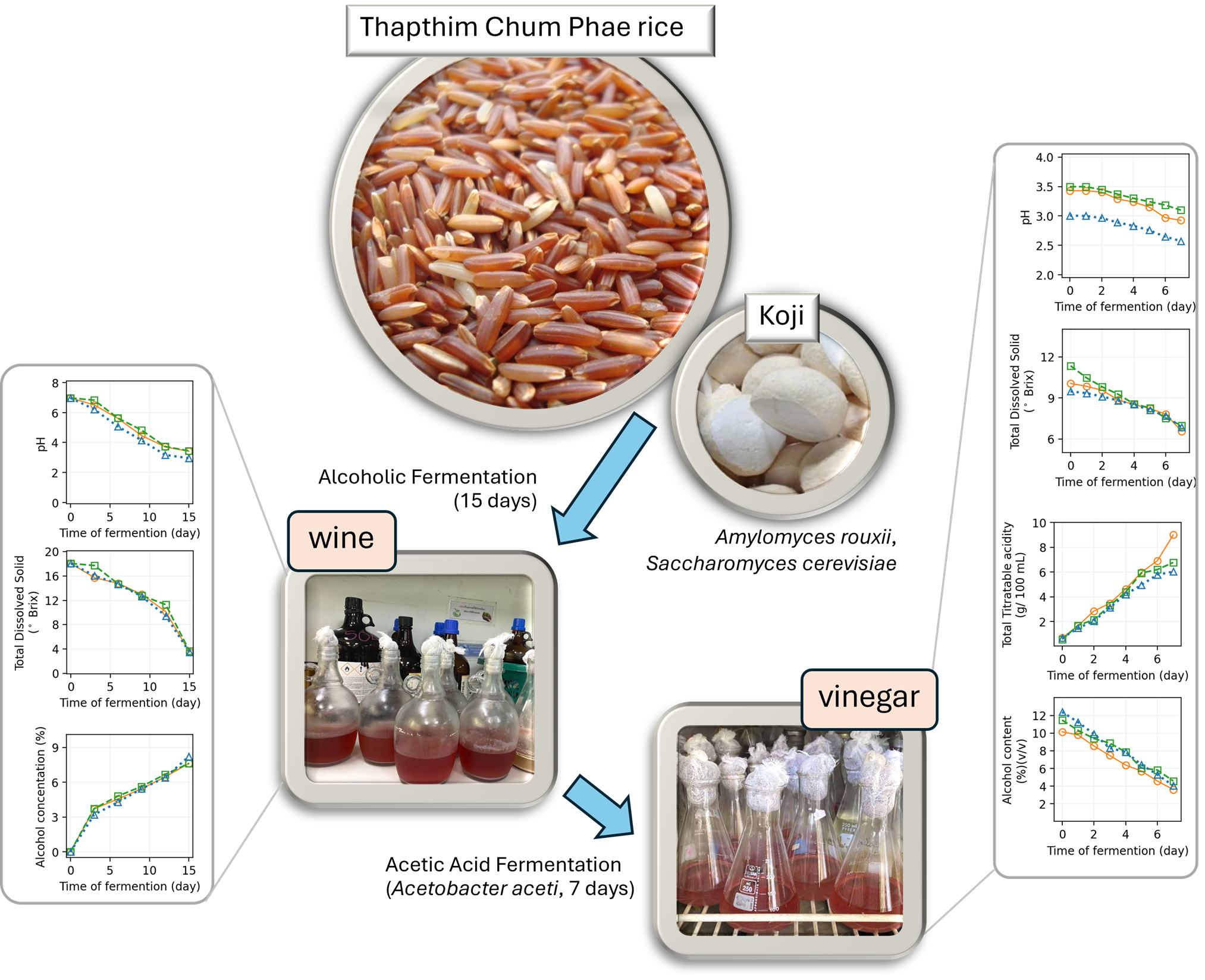
This study aimed to develop a functional fermented vinegar using Tubtim Chum Phae rice, a red rice hybrid of white Jasmine and Sangyod Phatthalung rice, known for its high antioxidant activity, phenolic content (4,661.05 mg/100 g), and flavonoid content (2,989.21 mg/100 g). Three mixed-culture fermentation formulas, comprising Amylomyces rouxii TISTR 3182 and Saccharomyces cerevisiae TISTR 5013 at ratios of 1:1, 2:1 and 3:1 (g/mL), were used to ferment the rice over 15 days for alcohol production. Acetobacter aceti was added to vinegar production for 7 days. The resulting vinegar showed a pH at 3.03, an alcohol content of 4.1% and an acetic acid concentration of 6.03 g/L. Notably, it exhibited strong antioxidant activity, with DPPH and FRAP values of 46.80 μg TE/mL and 164.50 μg Fe(II)/mL, respectively. The total phenolic content was 187.54 μg GAE/mL, flavonoid content was 87.10 μg RE/mL and total anthocyanin content was 4.10 g/L. Comprehensive profiling revealed the presence of various organic acids and volatile compounds, including acetic acid, ethyl acetate, lactic acid, benzyl alcohol and phenyl ethanol, which contribute to the vinegar’s characteristic aroma and flavor. These findings, which highlight the presence of bioactive components, underscore the potential of Tubtim Chum Phae rice vinegar as a natural product with significant nutritional and antioxidant benefits.
HIGHLIGHTS
- Development of functional vinegar using Tubtim Chum Phae red rice through a 2-step fermentation involving Amylomyces rouxii, Saccharomyces cerevisiae and Acetobacter aceti.
- Formula 1 (Fungus:Yeast = 1:1) exhibited the highest antioxidant activities (DPPH = 55.44 µg TE/mL, FRAP = 174.54 µg FeSO4/mL) and bioactive contents (TPC = 219.47 µg GAE/mL, TFC = 99.77 µg RE/mL).
- Comprehensive profiling of organic acids and volatiles revealed acetic, lactic, citric and succinic acids, and key aroma compounds like ethyl acetate and phenyl ethanol.
- Controlled microbial fermentation enhanced the release and biosynthesis of phenolic acids (e.g., gallic acid) and flavonoids (e.g., rutin).
- This study provides a sustainable model for value-added vinegar production using Thai pigmented rice with significant nutritional and sensory quality.
GRAPHICAL ABSTRACT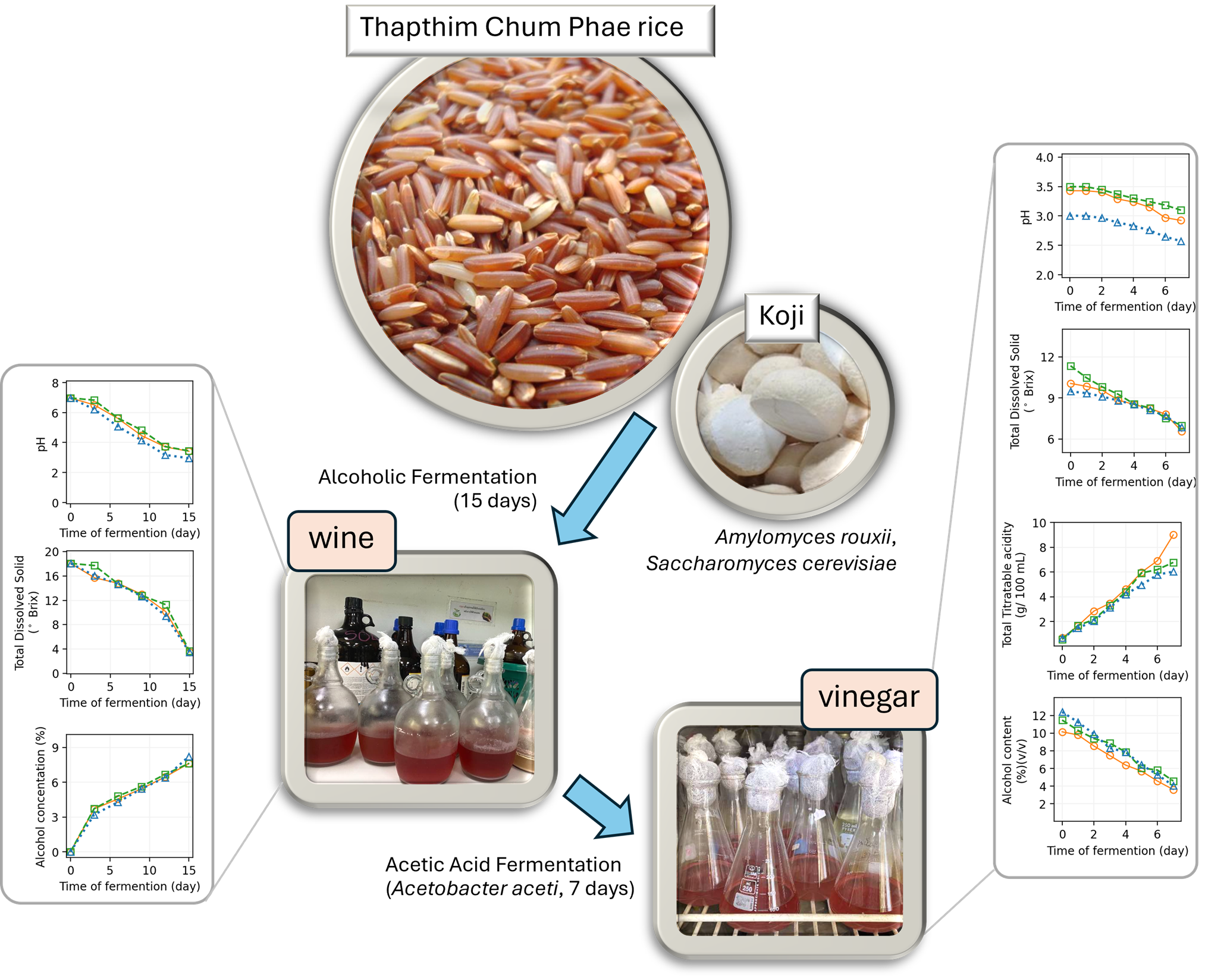
Downloads
References
M Zhao, X Xiao, D Jin, L Zhai, Y Li, Q Yang, F Xing, W Qiao, X Yan and Q Tang. Composition and biological activity of colored rice - A comprehensive review. Foods 2025; 14(8), 1394.
P Goufo and H Trindade. Rice antioxidants: Phenolic acids, flavonoids, anthocyanins, proanthocyanidins, tocopherols, tocotrienols, γ-oryzanol and phytic acid. Food Science & Nutrition 2014; 2(2), 75-104.
S Deeseenthum, V Luang-In and S Chunchom. Characteristics of Thai pigmented rice milk kefirs with potential as antioxidant and anti-inflammatory foods. Pharmacognosy Journal 2018; 10(1), 154-161.
T Laokuldilok, CF Shoemaker, S Jongkaewwattana and V Tulyathan. Antioxidants and antioxidant activity of several pigmented rice brans. Journal of Agricultural and Food Chemistry 2011; 59(1), 193-199.
T Pattananandecha, S Apichai, S Sirilun, J Julsrigival, K Sawangrat, F Ogata, N Kawasaki, B Sirithunyalug and C Saenjum. Anthocyanin profile, antioxidant, anti‑inflammatory and antimicrobial against foodborne pathogens activities of purple rice cultivars in Northern Thailand. Molecules 2021; 26(17), 5234.
SH Nam, SP Choi, MY Kang, HJ Koh, N Kozukue and M Friedman. Antioxidative activities of bran extracts from twenty-one pigmented rice cultivars. Food Chemistry 2006; 94(4), 613-620.
RC Chaudhary, DV Tran and R Duffy. Speciality rices of the world: Breeding, production and marketing. FAO & Science Publishers, Rome, Italy, 2013, p. 358.
S Chumjit, W Sangartit, U Kukongviriyapan, P Pakdeechote, V Kukongviriyapan and S Thawornchinsombat. Effects of Tubtim Chum Phae Rice Bran Hydrolysates on blood pressure and oxidative stress in L-NAME-induced hypertensive rats. KKU Research Journal (Graduate Studies) 2017; 17(3), 19-29.
S Taweekasemsombut, J Tinoi, P Mungkornasawakul and N Chandet. Thai rice vinegars: Production and biological properties. Applied Sciences 2021; 11(13), 5929.
S Li, P Li, F Feng and LX Luo. Microbial diversity and their roles in the vinegar fermentation process. Applied Microbiology and Biotechnology 2015; 99(12), 4997-5024.
D Ousaaid, H Mechchate, H Laaroussi, C Hano, M Bakour, A El-Ghouizi, B Lyoussi and I El-Arabi. Fruits vinegar: Quality characteristics, phytochemistry and functionality. Molecules 2021; 27(1), 222.
L Zhang, ZC Tu, T Yuan, H Wang, X Xie and ZF Fu. Antioxidants and α-glucosidase inhibitors from Ipomoea batatas leaves identified by bioassay guided approach and structure-activity relationships. Food Chemistry 2016; 208, 61-67.
LS Wei, W Wee, JYF Siong and DF Syamsumir. Characterization of anticancer, antimicrobial, antioxidant properties and chemical compositions of Peperomia pellucida leaf extract. Acta Medica Iranica 2011; 49(10), 670-674.
K Radošević, VG Srček, MC Bubalo, SR Brnčić, K Takács and IR Redovniković. Assessment of glucosinolates, antioxidative and antiproliferative activity of broccoli and collard extracts. Journal of Food Composition and Analysis 2017; 61, 59-66.
M Thomas, A Badr, Y Desjardins, A Gosselin and P Angers. Characterization of industrial broccoli discards (Brassica oleracea var. italica) for their glucosinolate, polyphenol and flavonoid contents using UPLC MS/MS and spectrophotometric methods. Food Chemistry 2018; 245, 1204-1211.
M Tian, X Xu, Y Liu, L Xie and S Pan. Effect of Se treatment on glucosinolate metabolism and health-promoting compounds in the broccoli sprouts of 3 cultivars. Food Chemistry 2016; 190, 374-380.
T Chumroenphat, S Saensouk and P Saensouk. Chemical composition and antioxidant activity of 3 species of Cornukaempferia in Thailand. Biodiversitas Journal of Biological Diversity 2021; 22(9), 4036-4044.
Shimadzu Corporation. Shimadzu analysis guidebook - food product analyses. Shimadzu Instrumentation, Kyoto, Japan, 2014, p. C180-E059C.
A Hijazi, I Pisano, P Illek and JJ Leahy. A rapid HPLC method for the simultaneous determination of organic acids and furans: Food applications. Beverages 2022; 8(1), 6.
H Gao, W Wang, D Xu, P Wang, Y Zhao, G Mazza and X Zhang. Taste-active indicators and their correlation with antioxidant ability during the Monascus rice vinegar solid-state fermentation process. Journal of Food Composition and Analysis 2021; 104, 104133.
DLA Razak, NYA Rashid, A Jamaluddin, AA Ghani and MA Manan. Antioxidant activities, tyrosinase inhibition activity and bioactive compounds content of broken rice fermented with Amylomyces rouxii. Food Research 2021; 5(S1), 65-72.
JP Tamang, K Watanabe and WH Holzapfel. Diversity of microorganisms in global fermented foods and beverages. Frontiers in Microbiology 2016; 7, 377.
P Tian, J Wan, T Yin, L Liu, H Ren, H Cai, X Liu and H Zhang. Acidity, sugar and alcohol contents during the fermentation of Osmanthus-flavored sweet rice wine and microbial community dynamics. PeerJ 2025; 13, e18826.
IS Pretorius. Tailoring wine yeast for the new millennium: Novel approaches to the ancient art of winemaking. Yeast 2000; 16(8), 675-729.
S Li, P Li, X Liu, L Luo and W Lin. Bacterial dynamics and metabolite changes in solid-state acetic acid fermentation of Shanxi aged vinegar. Applied Microbiology and Biotechnology 2016; 100(10), 4395-4411.
WL Park, HD Cho, JH Kim, HJ Min and KI Seo. Antioxidant activity and blood alcohol concentration lowering effect of fermented Hovenia dulcis fruit vinegar. Food Science and Biotechnology 2022; 32(3), 299-308.
P Saithong, J Permpool and S Nitipan. Antioxidant and anthocyanin-rich vinegar fermented from Thai colored rice varieties. Trends in Sciences 2024; 21(6), 7532.
N Balasundram, K Sundram and S Samman. Phenolic compounds in plants and agri-industrial by-products: Antioxidant activity, occurrence and potential uses. Food Chemistry 2006; 99(1), 191-203.
Q Liu, GY Tang, CN Zhao, RY Gan and HB Li. Antioxidant activities, phenolic profiles and organic acid contents of fruit vinegars. Antioxidants 2019; 8(4), 78.
IY Sengun and S Karabiyikli. Importance of acetic acid bacteria in food industry. Food Control 2011; 22(5), 647-656.
A Ganeshpurkar and AK Saluja. The pharmacological potential of rutin. Saudi Pharmaceutical Journal 2017; 25(2), 149-164.
E Yildiz. Characterization of fruit vinegars via bioactive and organic acid profile using chemometrics. Foods 2023; 12(20), 3769.
NH Budak, E Aykin, AC Seydim, AK Greene and ZB Guzel-Seydim. Functional properties of vinegar. Journal of Food Science 2014; 79(5), R757-R764.
Y Wu, M Xia, X Zhang, X Li, R Zhang, Y Yan, F Lang, Y Zheng and M Wang. Unraveling the metabolic network of organic acids in solid‐state fermentation of Chinese cereal vinegar. Food Science & Nutrition 2021; 9(8), 4375-4384.
L Solieri and P Giudici. Vinegars of the world. Springer, Milano, Italy, 2009, p. 1-16.
Z Xie, C Koysomboon, H Zhang, Z Lu, X Zhang and F Chen. Vinegar volatile organic compounds: Analytical methods, constituents and formation processes. Frontiers in Microbiology 2022; 13, 907883.
H Zhu, J Zhu, L Wang and Z Li. Development of a SPME-GC-MS method for the determination of volatile compounds in Shanxi aged vinegar and its analytical characterization by aroma wheel. Journal of Food Science and Technology 2016; 53(1), 171-183.
AG Cordente, S Schmidt, G Beltran, MJ Torija and CD Curtin. Harnessing yeast metabolism of aromatic amino acids for fermented beverage bioflavouring and bioproduction. Applied Microbiology and Biotechnology 2019; 103(11), 4325-4336.
Y Ge, Y Wu, A Aihaiti, L Wang, Y Wang, J Xing, M Zhu and J Hong. The metabolic pathways of yeast and acetic acid bacteria during fruit vinegar fermentation and their influence on flavor development. Microorganisms 2025; 13(3), 477.
Published
How to Cite
Issue
Section
License
Copyright (c) 2025 Walailak University

This work is licensed under a Creative Commons Attribution-NonCommercial-NoDerivatives 4.0 International License.





