
Unvealing the Electrokinetic Behavior of Nopal Mucilage Versus Polygalacturonic Acid for Multivalent Metal Interactions in Aqueous Systems
DOI:
https://doi.org/10.48048/tis.2026.11122Keywords:
Opuntia ficus-indica, Nopal mucilage, Polygalacturonic acid, Zeta potential, Metal ion-polyelectrolyte interaction, Water treatmentAbstract
Natural polysaccharides have emerged as promising alternatives to synthetic polymers in wastewater treatment because of their functional versatility, environmental compatibility, and cost-effectiveness. In this study, mucilage extracted from Opuntia ficus-indica (MNE) and commercial polygalacturonic acid (PGA) were investigated for their structural and electrokinetic behavior during interactions with multivalent metal ions. The biopolymers were characterized by FTIR spectroscopy, which revealed fundamental differences in the functional group composition, mainly in terms of the esterification and ionization of the carboxyl groups. Zeta potential (ζ) measurements were performed over a pH range and under titration with selected metal ions (Ca2+, Cr3+, Cu2+, Pb2+, Zn2+, Ni2+ and Cd2+), which provided information on their dose‒response and affinity profiles. MNE showed moderate surface charge variability and progressive shifts in ζ, implying heterogeneous binding interactions; PGA presented more abrupt and stronger electrostatic changes owing to its linear uniform structure. This study revealed that both substances could be good for removing heavy metals, which is important for the creation of eco-friendly clumping agents and sticky substances. This study aids in understanding how the form and purpose of these substances are related to naturally charged polymers and backs their use in eco-friendly purification methods.
HIGHLIGHTS
- Nopal mucilage exhibits heterogeneous and multifunctional metal binding.
- FTIR–ζ analysis revealed distinct esterification and charge behaviors.
- Metal titrations confirmed selective affinity for Cu²⁺, Zn²⁺ and Cr³⁺.
- Polygalacturonic acid showed stable, uniform electrostatic interactions.
- Results advance bio-based coagulants for sustainable water treatment.
GRAPHICAL ABSTRACT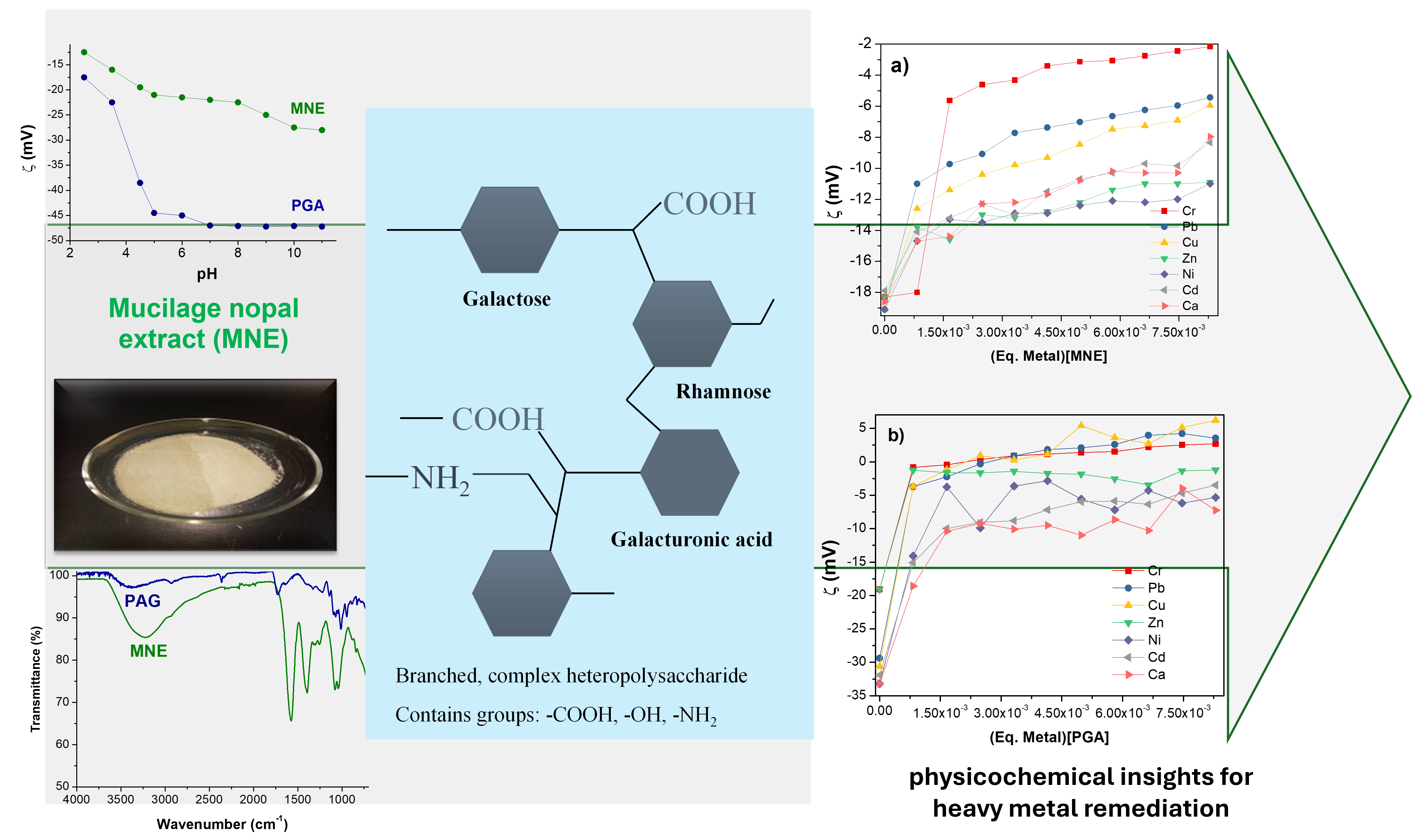
Downloads
References
Y Choque-Quispe, AM Solano-Reynoso, D Choque-Quispe, CA Ligarda-Samanez, BS Ramos-Pacheco, Y Flores-Ccorisapra and YF Carhuarupay-Molleda. Optimization of the flocculating capacity of a new microatomization extract from a Nostoc cyanobacterium species from the High Andes. Chemical Engineering Journal Advances 2025; 23, 100777.
R Kamel, SM Afifi, IAA Kassem, NA Elkasabgy and MA Farag. Arabinoxylan and rhamnogalacturonan mucilage: Outgoing and potential trends of pharmaceutical, environmental, and medicinal merits. International Journal of Biological Macromolecules 2020; 165, 2550-2564.
N Sultana. Biological properties and biomedical applications of pectin and pectin-based composites: A review. Molecules 2023; 28(24), 7974.
M Pierdomenico, P Giardullo, G Bruno, L Bacchetta, O Maccioni, OC Demurtas, M Sulli, C Arcangeli, F Colini, S Chiavarini and B Benassi. The mucilage from the Opuntia ficus-indica (L.) Mill. cladodes plays an anti-inflammatory role in the lps-stimulated HepG2 cells: A combined in vitro and in silico approach. Molecular Nutrition & Food Research 2025; 69(3), e202400479.
S Trachtenberg and AM Mayer. Composition and properties of Opuntia ficus-indica mucilage. Phytochemistry 1981; 20(12), 2665-2668.
C Sáenz, E Sepúlveda and B Matsuhiro. Opuntia spp mucilage’s: A functional component with industrial perspectives. Journal of Arid Environments 2004; 57(3), 275-290.
L Medina-Torres, ELF Brito-De, B Torrestiana-Sanchez and R Katthain. Rheological properties of the mucilage gum (Opuntia ficus indica). Food Hydrocolloids 2000; 14(5), 417-424.
E Sepúlveda, C Sáenz, E Aliaga and C Aceituno. Extraction and characterization of mucilage in Opuntia spp. Journal of Arid Environments 2007; 68(4), 534-545.
LMDC Coelho, BF Veloso, VDL Silva, LS Assunção, CDF Ribeiro and DM Otero. Innovations and challenges in the use of cactus mucilage: A technological analysis. International Journal of Biological Macromolecules 2025; 316, 144792.
AL García, CMP Zamora, AG Michaluk, MB Nuñez, AM González and CA Torres. Physicochemical and functional characterization of the mucilage obtained from cladodes of 2ss Opuntia species. International Journal of Biological Macromolecules 2024; 283, 137802.
EA López-Maldonado, Y Abdellaoui, MHA Elella, HM Abdallah, M Pandey, ET Anthony, L Ghimici, S Álvarez-Torrellas, V Pinos-Vélez and NA Oladoja. Innovative biopolyelectrolytes-based technologies for wastewater treatment. International Journal of Biological Macromolecules 2024; 273(2), 132895.
D Ibarra-Rodríguez, J Lizardi-Mendoza, EA López-Maldonado and MT Oropeza-Guzmán. Capacity of ‘nopal’ pectin as a dual coagulant-flocculant agent for heavy metals removal. Chemical Engineering Journal 2017; 323, 19-28.
LEA López-Maldonado, H Hernández-García, MAM Zamudio-Aguilar, MT Oropeza-Guzmán, A Ochoa-Terán, LM López-Martínez, M Martinez-Quiroz, R Valdez and A Olivas. Chemical issues of coffee and Tule lignins as ecofriendly materials for the effective removal of hazardous metal ions contained in metal finishing wastewater. Chemical Engineering Journal 2020; 397, 125384.
EA López-Maldonado and MT Oropeza-Guzmán. Nejayote biopolyelectrolytes multifunctionality (glucurono ferulauted arabinoxylans) in the separation of hazardous metal ions from industrial wastewater. Chemical Engineering Journal 2021; 423, 130210.
A Martínez-Cruz, MNR Valencia, JA Araiza-Aguilar, HA Nájera-Aguilar and RF Gutiérrez-Hernández. Leachate treatment: Comparison of a biocoagulant (Opuntia ficus mucilage) and conventional coagulants using multicriteria decision analysis. Heliyon 2021; 7(7), e07510.
EA López-Maldonado, MT Oropeza-Guzman, JL Jurado-Baizaval and A Ochoa-Terãn. Coagulation-flocculation mechanisms in wastewater treatment plants through zeta potential measurements. Journal of Hazardous Materials 2014; 279, 1-10.
H Alkhaldi, S Alharthi, S Alharthi, HA AlGhamdi, YM AlZahrani, SA Mahmoud, LG Amin, NH Al-Shaalan, WE Boraie, MS Attia, SA Al-Gahtany, N Aldaleeli, MM Ghobashy, AI Sharshir, M Madani, R Darwesh and SF Abaza. Sustainable polymeric adsorbents for adsorption-based water remediation and pathogen deactivation: A review. RSC Advances 2024; 14, 33143-33190.
EA López-Maldonado, OGZ García, KC Escobedo and MT Oropeza-Guzman. Evaluation of the chelating performance of biopolyelectrolyte green complexes (NIBPEGCs) for wastewater treatment from the metal finishing industry. Journal of Hazardous Materials 2017; 335, 18-27.
OGZ García, MT Oropeza-Guzmán, WMA Monal and EA López-Maldonado. Design and mechanism of action of multifunctional BPE’s with high performance in the separation of hazardous metal ions from polluted water Part I: Chitosan-poly(N-vinylcaprolactam) and its derivatives. Chemical Engineering Journal 2019; 359, 840-851.
R Wang, R Liang, T Dai, J Chen, X Shuai and C Liu. Pectin-based adsorbents for heavy metal ions: A review. Trends in Food Science & Technology 2019; 91, 319-329.
M Quintero-García, E Gutiérrez-Cortez, M Bah, A Rojas-Molina, MA Cornejo-Villegas, AD Real and I Rojas-Molina. Comparative analysis of the chemical composition and physicochemical properties of the mucilage extracted from fresh and dehydrated Opuntia ficus indica cladodes. Foods 2021; 10(9), 2137.
S Javed, Z Zulfiqar, Z Fatima, G Muhammad, MA Hussain, M Mushtaq and MT Haseeb. A comprehensive review of plant-based mucilages as promising candidates for water remediation. Journal of Environmental Chemical Engineering 2024; 12(5), 114035.
CU Montaño-Medina, LM Lopéz-Martínez, A Ochoa-Terán, EA López-Maldonado, MI Salazar-Gastelum, B Trujillo-Navarrete, S Pérez-Sicairos and JM Cornejo-Bravo. New pyridyl and aniline-functionalized carbamoylcarboxylic acids for removal of metal ions from water by coagulation-flocculation process. Chemical Engineering Journal 2023; 451, 138396.
C Negro, WD Guerra, D Armentano, J Ferrando-Soria, T Grancha and E Pardo. Bioinspired metal-organic frameworks for aqueous environment decontamination: from laboratory scale to real-world technologies. Chemical Communications 2024; 60(100), 14935-14951.
KM Wani and RVS Uppaluri. Characterization of pectin extracted from pomelo peel using pulsed ultrasound assisted extraction and acidic hot water extraction process. Applied Food Research 2023; 3(2), 100345.
LS Brenda, GCG Martinez-Avila, H Rodriguez-Fuentes, LM Pastrana, AG Azevedo, DC González-Sandoval, MA Cerqueira and R Rojas. Extraction and characterization of mucilage from Opuntia ficus-indica cultivated on hydroponic system. Notulae Botanicae Horti Agrobotanici Cluj-Napoca 2022; 50(1), 12460.
FM León-Martínez, PFJ Cano-Barrita, F Castellanos, KB Luna-Vicente, S Ramírez-Arellanes and C Gómez-Yáñez. Carbonation of high-calcium lime mortars containing cactus mucilage as additive: A spectroscopic approach. Journal of Materials Science 2021; 56(5), 3778-3789.
I Donati and BE Christensen. Alginate-metal cation interactions: Macromolecular approach. Carbohydrate Polymers 2023; 321, 121280.
P Thordarson. Determining association constants from titration experiments in supramolecular chemistry. Chemical Society Reviews 2011; 40, 1305-1323.
R Liang, Y Li, L Huang, X Wang, X Hu, C Liu, M Chen and J Chen. Pb2+ adsorption by ethylenediamine-modified pectins and their adsorption mechanisms. Carbohydrate Polymers 2020; 234, 115911.
S Deiana, L Erre, G Micera, P Piu and C Gessa. Coordination of transition-metal ions by polygalacturonic acid: A spectroscopic study. Inorganica Chimica Acta 1980; 46, 249-253.
X Yang, B Feng, Z Wang, L Jiang and J Bayoundoula. Aggregation relations and flotation behavior of the depressant pectin on talc, chlorite, and serpentine and its mechanism of action. Minerals Engineering 2025; 233, 109637.
HE Al-Hazmi, J Łuczak, S Habibzadeh, MS Hasanin, A Mohammadi, A Esmaeili, SJ Kim, MK Yazdi, N Rabiee, M Badawi and MR Saeb. Polysaccharide nanocomposites in wastewater treatment: A review. Chemosphere 2024; 347, 140578.
EA López-Maldonado, M Mavaei, S Dan, SN Banitaba, M Gholamhosseinpour, S Hamedi, LJ Villarreal-Gómez, GL Pérez-González, S Mashkouri, S Khademolqorani and AM Elgarahy. Diverse applications of versatile quaternized chitosan salts: A review. International Journal of Biological Macromolecules 2024; 281, 136276.
OGZ García, MT Oropeza-Guzmán, WMA Monal and EA López-Maldonado. Design and mechanism of action of multifunctional BPE’s with high performance in the separation of hazardous metal ions from polluted water Part I: Chitosan-poly(N-vinylcaprolactam) and its derivatives. Chemical Engineering Journal 2019; 359, 840-851.
R Yang, H Li, M Huang, H Yang and A Li. A review on chitosan-based flocculants and their applications in water treatment. Water Research 2016; 95, 59-89.
H Salehizadeh, N Yan and R Farnood. Recent advances in polysaccharide biobased flocculants. Biotechnology Advances 2018; 36(1), 92-119.

Published
How to Cite
Issue
Section
License
Copyright (c) 2025 Walailak University

This work is licensed under a Creative Commons Attribution-NonCommercial-NoDerivatives 4.0 International License.





