
A Comparative Analysis of the Physical, Mechanical, and Morphological Properties of Industrial vs. Green Polyurethane as Grouting Materials
DOI:
https://doi.org/10.48048/tis.2026.11121Keywords:
Industry Polyurethane, Green Polyurethane, Blowing Agents, Grouting Applications, Physical Properties, Mechanical Properties, Morphology Analysis, Industry polyurethane, Green polyurethane, Blowing agents, Grouting applications, Physical properties, Mechanical properties, Morphology analysisAbstract
Polyurethane has become an essential material in the construction industry, particularly in grouting applications, due to its strong adhesive and sealing properties. Traditionally, industrial polyurethanes derived from petrochemical sources have been widely used. However, the current formulation in production of polyurethane suffers from semantic ambiguity and inconsistent terminology also growing environmental concerns have prompted to develop of greener alternatives made from renewable sources. This study compares the physical, mechanical, and morphological properties of 3 types of polyurethane: industrial polyurethanes (PI), castor oil PU with 1,1-dichloro-1-fluoroethane (HCFC 141b) blowing agent (PCH), and castor oil PU polyurethanes with water as the blowing agent (PCW). The foam reaction times of all types of polyurethane met standard benchmarks for grouting materials, with cream times ranging from 10 to 20 s and rise times exceeding 48 s. The PCW exhibited the lowest apparent density while maintaining significant mechanical strength compared to PI. All polyurethane samples demonstrated compression strengths and moduli above the standard values for grouting materials (compression strength: 30 - 150 kPa; modulus: 150 - 500 kPa). Fourier Transform Infrared Spectroscopy (FTIR) analysis confirmed completed curing process across all samples, with the expected including N-H, C=O and C-O stretches, as well as C-N stretches associated with the urethane linkage. Morphological analysis revealed a uniform cell structure in all types, despite variations in cell size, resulting in no gaps between cells. PCW has the best cell arrangement after compress as the size of the remain the same, contributing to their strong mechanical performance. This study identifies green polyurethane (castor oil) with water as the blowing agent can offering superior performance for the grouting industry, presenting it as a viable replacement material with reduced environmental impact.
HIGHLIGHTS
- The novelty of this paper is the alternative ways of producing green polyurethane by using water as the blowing agent.
- Comparison of the physical, mechanical and morphological properties between the industry polyurethane green polyurethane based castor oil polyol.
- Comparison of the properties green polyurethane based polyol between physical blowing agent (HCFC-141b) and chemical blowing agent (water).
- To use water in the production of castor oil based polyurethane as alternative for grouting application.
GRAPHICAL ABSTRACT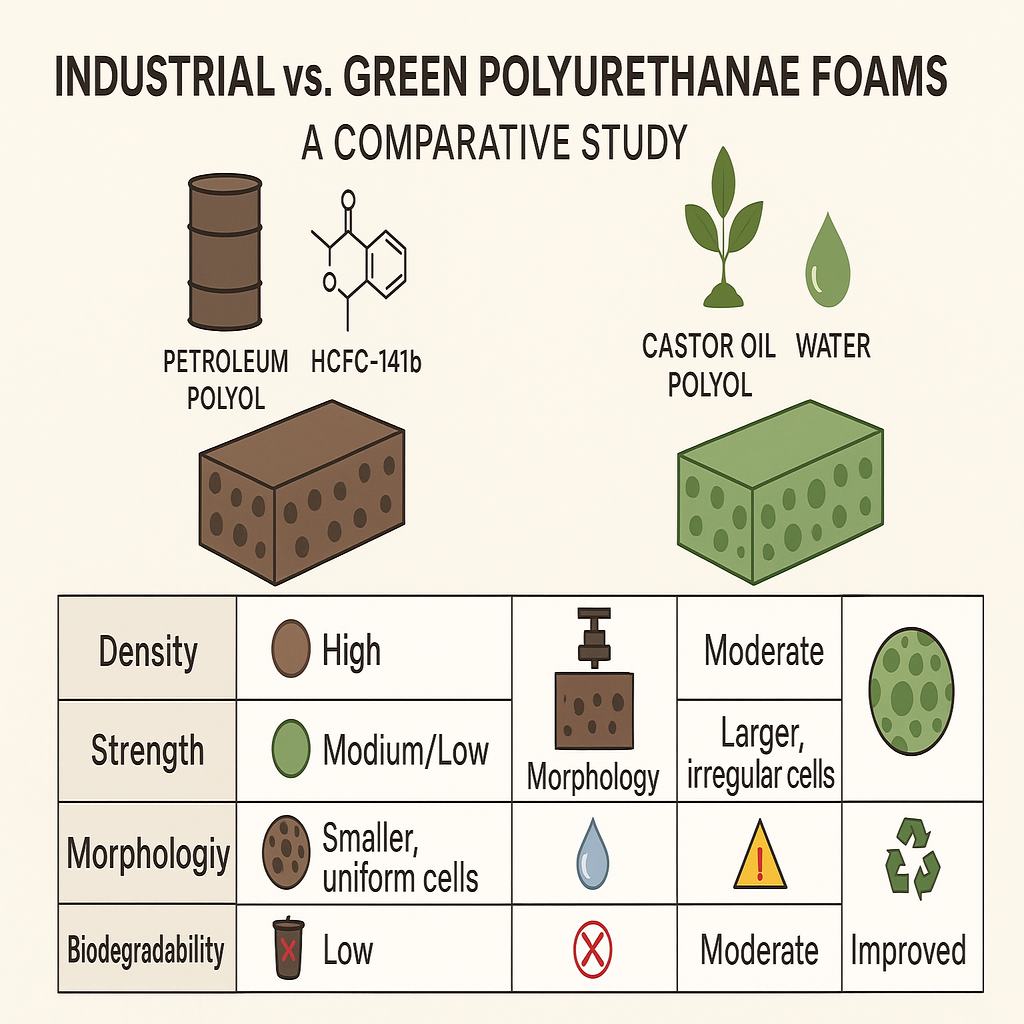
Downloads
References
H Somarathna, S Raman, D Mohotti, A Mutalib and K Badri. The use of polyurethane for structural and infrastructural engineering applications: A state of the art review. Con-Struction and Building Materials 2018; 190(4), 995-1014.
J Brzeska and A Piotrowska-Kirschling. A brief introduction to the polyurethanes according to the principles of green chemistry. Processes 2021; 9(11), 1929.
A Yeboah, S Ying, J Lu, Y Xie, H Amoanimaa-Dede, KGA Boateng, M Chen and X Yin. Castor oil (Ricinus communis): A review on the chemical composition and physicochemical properties. Food Science and Technology 2021; 41, 399-413.
KD Poopalam, TNMT Ismail, NA Hanzah, AH Alias, NA Wahab, Z Ibrahim, V Subramaniam, AHN Armylisas and Z Idris. Utilization of oil palm biomass and Polyurethanes as sustainable construction materials: A review. Developments in the Built Environment 2024; 17, 100380.
AS Dutta. Polyurethane foam chemistry. Elsevier eBooks, Amsterdam, Netherlands, 2018, p. 17-27.
L Wianowski, A Bialkowska, L Dobrowolski and I Zarzyka. Physical blowing agents for polyurethanes. Polimery 2020; 65(2), 83-94.
JP Carroll, MR Smith and LA Johnson. Advances in polyurethane foam production: Chemical and mechanical perspectives. Polymer Chemistry Journal 2018; 45(3), 12-18.
G Wypych. Handbook of blowing and foaming agents. ChemTech Publishing, Canada, 2023.
Z Wang, C Wang, Y Gao, Z Li, Y Shang and H Li. Porous thermal insulation polyurethane foam materials. Polymers 2023; 15(18), 3818.
BJ Rashmi, D Rusu, K Prashantha, MF Lacrampe and P Krawczak. Develop-ment of water‐blown bio‐based thermoplastic polyurethane foams using bio‐derived chain ex-tender. Journal of Applied Polymer Science 2012; 128(1), 292-303.
A Delavarde, G Savin, P Derkenne, M Boursier, R Morales-Cerrada, B Nottelet, J Pinaud and S Caillol. Sustainable polyurethanes: Toward new cutting-edge opportunities. Progress in Polymer Science 2024; 151, 101805.
S Li, P Wang, C Yuan, J Li, P Ma, B Zhi, H Zhou and Y Tian. Adaptability of polyurethane/water glass grouting reinforcement to subsea tunnels. Construction and Building Materials 2021; 311(2), 125354.
S Saleh, NZM Yunus, K Ahmad and N Ali. Improving the strength of weak soil using polyurethane grouts: A review. Construction and Building Materials 2019; 202, 738-752.
M Mahmoud, M Ramadan, K Pullen, MA Abdelkareem, T Wilberforce, A Olabi and S Naher. A review of grout materials in geothermal energy applications. International Journal of Thermofluids 2021; 10(5), 100070.
N Gama, A Ferreira and A Barros-Timmons. Polyurethane foams: Past, present, and future. Materials 2018; 11(10), 1841.
H Lim, SH Kim and BK Kim. Effects of the functionality of polyol in rigid poly-urethane foams. Journal of Applied Polymer Science 2008; 110(1), 49-54.
C Todaro, S Saltarin and M Cardu. Bentonite in two-component grout applications. Case Studies in Construction Materials 2022; 16(3), e00901.
J Wang, C Zhang, Y Deng and P Zhang. A review of research on the effect of temperature on the properties of polyurethane foams. Polymers 2022; 14(21), 4586.
S Sahoo, H Kalita, S Mohanty and SK Nayak. Synthesis and characterization of vegetable oil based polyurethane derived from low viscous bio aliphatic isocyanate: Adhesion strength to wood-wood substrate bonding. Macromolecular Research 2017; 25(8), 772-778
Y Su, S Ma, B Wang, X Xu, H Feng, K Hu, W Zhang, S Zhou, G Weng and J Zhu. High-performance castor oil-based polyurethane thermosets: Facile synthesis and properties. Reactive and Functional Polymers 2022; 183(7633), 105496.
R Boonachathong, B Kaewnok, H Widjaja and S Amornraksa. Development of rigid polyurethane foam (RPUF) for imitation wood blown by distilled water and cyclopentane (CP). MATEC Web of Conferences 2018; 187(1), 02001.
M Modesti, V Adriani and F Simioni. Chemical and physical blowing agents in structural polyurethane foams: Simulation and characterization. Polymer Engineering and Science 2000; 40(9), 2046-2057.
H Wang, X Yang, Y Liu and L Lin. Changes and trends efficiency of physical blowing agents in polyurethane foam materials. Materials 2023; 16(8), 3186.
K Kamińska, M Barczewski, M Kurańska, E Malewska, K Polaczek and A Prociak. The effect of a chemical foaming agent and the isocyanate index on the properties of Open-Cell polyurethane foams. Materials 2022; 15(17), 6087.
M Ionescu, D Radojčić, X Wan, ML Shrestha, ZS Petrović and TA Upshaw. Highly functional polyols from castor oil for rigid polyurethanes. European Polymer Journal 2016; 84(3), 736-749.
MRD Caprio, C Brondi, ED Maio, T Mosciatti, S Cavalca, V Parenti, S Iannace, G Mensitieri and P Musto. Polyurethane synthesis under high-pressure CO2, a FT-NIR study. European Polymer Journal 2019; 115, 364-374.
P Cimavilla-Román, M Santiago-Calvo and MÁ Rodríguez-Pérez. Dynamic mechanical analysis during polyurethane foaming: Relationship between modulus build-up and reaction kinetics. Polymer Testing 2021; 103, 107336.
Q Zaman. Properties of fluid-exploring their characteristics and behaviors. EDUInput, Available at: https://eduinput.com/ properties-of-fluid/, accessed March 2024.
M Zieleniewska, MK Leszczyński, M Kurańska, A Prociak, L Szczepkowski, M Krzyżowska and J Ryszkowska. Preparation and characterisation of rigid polyurethane foams using a rapeseed oil-based polyol. Industrial Crops and Products 2015; 74, 887-897.
Q Chen, Z Gao, L Bai, Z Xu and J Gu. Water-dispersible isocyanate modified using plant-based castor oil: Synthesis and application as crosslinking agent. Industrial Crops and Products 2021; 171(1), 113845.
A Cifarelli, L Boggioni, A Vignali, I Tritto, F Bertini and S Losio. Flexible polyurethane foams from epoxidized vegetable oils and a bio-based diisocyanate. Polymers 2021; 13(4), 612.
DS Kaikade and AS Sabnis. Polyurethane foams from vegetable oil-based polyols: A review. Polymer Bulletin 2023; 80(3), 2239-2261.
B Jiang, KH Oh, SY Kim, X He and SK Oh. Technical evaluation method for physical property changes due to environmental degradation of grout-injection repair materials for water-leakage cracks. Applied Sciences 2019; 9(9), 1740.
S Zhan, H Liu, Y Bo, R Yuan, Y Zhang, D Zhang, H Yang, X Tian, S Wang and M Zhang. Preparation and application of high strength, high transparency, and high impact resistance polyurethane elastomers by controlled cross-linking. Polymer 2024, 318, 128002.
Y Chen, N Wang, O Ola, Y Xia and Y Zhu. Porous ceramics: Light in weight but heavy in energy and environment technologies. Materials Science and Engineering R Reports 2020; 143, 100589.
H Münstedt. Rheological measurements and structural analysis of polymeric materials. Polymers 2021; 13(7), 1123.
KB Park, HT Kim, NY Her and JM Lee. Variation of mechanical characteristics of polyurethane foam: Effect of test method. Materials 2019; 12(17), 2672.
I Izarra, AM Borreguero, I Garrido, JF Rodríguez and M Carmona. Comparison of flexible polyurethane foams properties from different polymer polyether polyols. Polymer Testing 2021; 100, 107268
Y Chen and W Tai. Castor oil-based polyurethane resin for low-density composites with bamboo charcoal. Polymers 2018; 10(10), 1100.
J Lavazza, Q Zhang, CD Kergariou, G Comandini, WH Briscoe, JL Rowlandson, TH Panzera and F Scarpa. Rigid polyurethane foams from commercial castor oil resins. Polymer Testing 2024; 135, 108457.
S Ibrahim, A Ahmad and NS Mohamed. Characterization of novel castor oil-based polyurethane polymer electrolytes. Polymers 2015; 7(4), 747-759.
J Bernardini, D Licursi, I Anguillesi, P Cinelli, MB Coltelli, C Antonetti, AMR Galletti and A Lazzeri. Exploitation of Arundo donax L. hydrolysis residue for the green synthesis of flexible polyurethane foams. BioResources 2017; 12(2), 3630-3655.
Biopdi. Compression Testing: Methods, Applications, and Benefits, Available at: https://biopdi.com/compression-testing/, accessed September 2023.
F Rahimidehgolan and W Altenhof. Compressive behavior and deformation mechanisms of rigid polymeric foams: A review. Composites Part B: Engineering 2023; 253(1), 110513.
Y Ma, Y Wang, Y Zhang, H Wang, J Gu, N Li and Y Zhang. Preparation of isocyanate virtual “core-shell” and its application in wood adhesive. International Journal of Adhesion and Adhesives 2023; 124(1), 103379-103379.
J Wang, K Fan, J Du, J Xu, X Dong, X Li and Y Ding. Effect of organosilicon modified epoxy resin on slurry viscosity and mechanical properties of polyurethane grouting materials. Construction and Building Materials 2023; 387, 131585.
M Benedetti, AD Plessis, RO Ritchie, M Dallago, N Razavi and F Berto. Architected cellular materials: A review on their mechanical properties towards fatigue-tolerant de-sign and fabrication. Materials Science and Engineering: R: Reports 2021; 144, 100606.
F Zhao, L Wu, Z Lu, J Lin and Q Jiang. Design of shear thickening fluid/polyurethane foam skeleton sandwich composite based on non-Newtonian fluid solid inter-action under low-velocity impact. Materials & Design 2022; 213(3-4), 110375.
M Albozahid, HZ Naji, ZK Alobad, JK Wychowaniec and A Saiani. Thermal, mechanical, and morphological characterisations of graphene nanoplatelet/graphene Oxide/high-hard-segment polyurethane nanocomposite: A comparative study. Polymers 2022; 14(19), 4224.
M Pu, C Fang, X Zhou, D Wang, Y Lin, W Lei and L Li. Recent advances in environment-friendly polyurethanes from polyols recovered from the recycling and renewable resources: A review. Polymers 2024; 16(13), 1889.
K Liu, W Liang, F Ren, J Ren, F Wang and H Ding. The study on compressive mechanical properties of rigid polyurethane grout materials with different densities. Construction and Building Materials 2019; 206(4), 270-278.
U Berardi and J Madzarevic. Microstructural analysis and blowing agent concentration in aged polyurethane and polyisocyanurate foams. Applied Thermal Engineering 2020; 164, 114440.
FL Jin, M Zhao, M Park and SJ Park. Recent trends of foaming in polymer processing: A review. Polymers 2019; 11(6), 953.

Published
How to Cite
Issue
Section
License
Copyright (c) 2025 Walailak University

This work is licensed under a Creative Commons Attribution-NonCommercial-NoDerivatives 4.0 International License.





