
Effect of Differential Oxidation of LDL on Foam Cell Formation and Expression of MMP-9 and CD147 in PMA-Derived Macrophage Foam Cells
DOI:
https://doi.org/10.48048/tis.2026.11091Keywords:
Minimally modified-LDL (mm-LDL), Fully oxidized-LDL (ox-LDL), Foam cell, MMP-9, CD36, CD147Abstract
High plasma low-density lipoprotein (LDL) levels can trigger phagocytosis of macrophages to become foam cells that can initiate atherosclerosis progression. LDL undergoes stepwise oxidation to minimally modified LDL (mm-LDL) and fully oxidized LDL (ox-LDL). This study investigated the effect of LDL with different degrees of oxidation, including LDL, mm-LDL and ox-LDL, on foam cell formation and expression of MMP-9 and CD147 in macrophages. Phorbol 12-myristate 13-acetate-derived macrophages from U937 cells were used as the study model. Cells were co-cultivated with or without different types of LDL at various concentrations and times before characterization. The results revealed that LDL induced the strongest intracellular lipid response, with conversion of macrophages to foam cells. Upregulation of CD36, but not of LDL receptors, was observed on incubation with all types of LDL, suggesting its role in the endocytosis of the studied LDLs. Upregulation of MMP-9 in foam cells was observed both in cell lysates and in the secreted form after 48 h of cultivation. MMP-9 conversion from pro-form to active form was detected after 72 h of cultivation with all types of LDL, but most strongly with LDL and ox-LDL, and was correlated with the upregulation of membrane-bound CD147 (mCD147). In summary, this study indicates that different degrees of LDL oxidation induced different severities of foam cell formation, induction of MMP-9 and mCD147.
HIGHLIGHTS
- Cell surface CD36 was upregulated on PMA-derived macrophages from U937 cells.
- LDL, mm-LDL and ox-LDL produced different extents of foam cell formation.
- LDL induced higher intracellular cholesterol concentrations than mm-LDL and ox-LDL.
- Upregulation of MMP-9 and mCD147 in macrophage foam cells was stronger by LDL than by ox-LDL.
GRAPHICAL ABSTRACT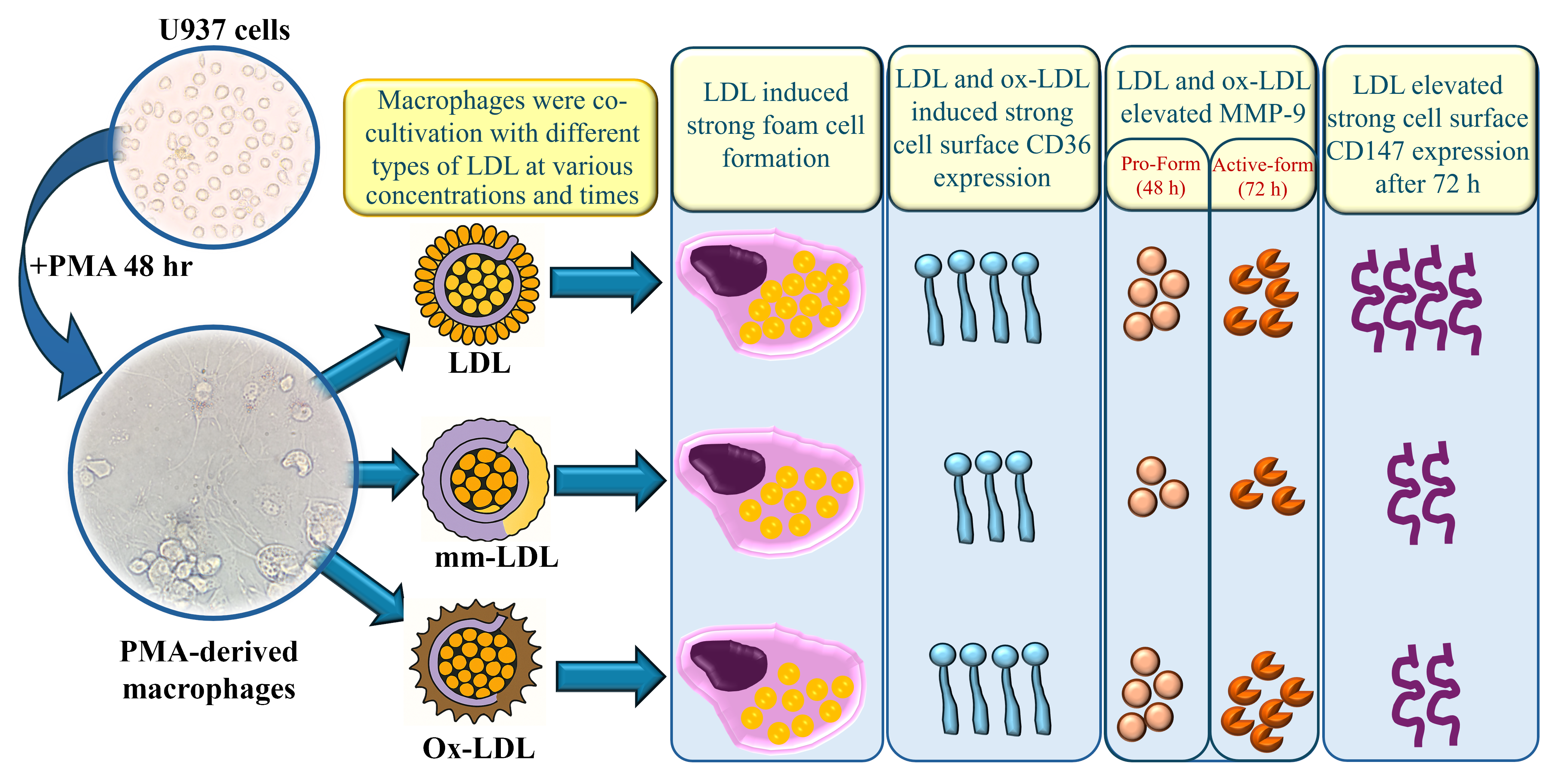
Downloads
References
AV Poznyak, NG Nikiforov, AM Markin, DA Kashirskikh, VA Myasoedova, EV Gerasimova and AN Orekhov. Overview of OxLDL and its impact on cardiovascular health: Focus on atherosclerosis. Frontiers in Pharmacology 2020; 11, 613780.
A Ijaz, B Yarlagadda and M Orecchioni. Foamy macrophages in atherosclerosis: Unraveling the balance between pro- and anti-inflammatory roles in disease progression. Frontiers in Cardiovascular Medicine 2025; 12, 1589629.
JLM Björkegren and AJ Lusis. Atherosclerosis: Recent developments. Cell 2022; 185(10), 1630-1645.
H Itabe, T Obama and R Kato. The dynamics of oxidized LDL during atherogenesis. Journal of Lipids 2011; 2011, 418313.
K Lowhalidanon and P Khunkaewla. Discrimination between minimally modified LDL and fully oxidized LDL using monoclonal antibodies. Analytical Biochemistry 2021; 619, 114103.
H Itabe, N Sawada, T Makiyama and T Obama. Structure and dynamics of oxidized lipoproteins in vivo: Roles of high-density lipoprotein. Biomedicines 2021; 9(6), 655.
JL Goldstein and MS Brown. The LDL receptor. Arteriosclerosis, Thrombosis, and Vascular Biology 2009; 29(4), 431-438.
CNJ Kzhyshkowskaa and S Gordon. Role of macrophage scavenger receptors in atherosclerosis. Immunobiology 2012; 217(5), 492-502.
H Jiang, Y Zhou, SM Nabavi, A Sahebkar, PJ Little, S Xu, J Weng and J Ge. Mechanisms of oxidized LDL-mediated endothelial dysfunction and its consequences for the development of atherosclerosis. Frontiers in Cardiovascular Medicine 2022; 9, 925923.
JFC Glatz, M Nabben and JJFP Luiken. CD36 (SR-B2) as master regulator of cellular fatty acid homeostasis. Current Opinion in Lipidology 2022; 33(2), 103-111.
E Vassiliou and R Farias-Pereira. Impact of lipid metabolism on macrophage polarization: Implications for inflammation and tumor immunity. International Journal of Molecular Sciences 2023; 24(15), 12032.
Z Song, H Xia, L Yang, S Wang and G Sun. Lowering the n-6/n-3 PUFAs ratio inhibits the formation of THP-1 macrophage-derived foam cell. Lipids in Health and Disease 2018; 17(1), 125.
MTL Lhoëst, A Martinez, L Claudi, E Garcia, A Benitez-Amaro, A Polishchuk, J Piñero, D Vilades, JM Guerra, F Sanz, N Rotllan, JC Escolà-Gil and V Llorente-Cortés. Mechanisms modulating foam cell formation in the arterial intima: Exploring new therapeutic opportunities in atherosclerosis. Frontiers in Cardiovascular Medicine 2024; 11, 1381520.
M Rac. Human CD36: Gene regulation, protein function, and its role in atherosclerosis pathogenesis. Genes 2025; 16(6), 705.
HF Bakheit, S Taurin, EM Elamin and M Bakhiet. Akt1 players promote PMA U937 cell line differentiation into macrophage-like cells. Arab Gulf Journal of Scientific Research 2024; 42(4), 1257-1270.
YG Chen, XJ Zhang, SB Huang and M Febbraio. Hidden features: CD36/SR-B2, a master regulator of macrophage phenotype/function through metabolism. Frontiers in Immunology 2024; 15, 1468957.
S Gencer, BR Evans, EPCVD Vorst, Y Döring and C Weber. Inflammatory chemokines in atherosclerosis. Cells 2021; 10(2), 226.
C Qian, X You, B Gao, Y Sun and C Liu. The role of ROS in atherosclerosis and ROS-based nanotherapeutics for atherosclerosis: Atherosclerotic lesion targeting, ROS scavenging, and ROS-responsive activity. ACS Omega 2025; 10(22), 22366-22381.
I Jansen, R Cahalane, R Hengst, A Akyildiz, E Farrell, F Gijsen, E Aikawa, KVD Heiden and T Wissing. The interplay of collagen, macrophages, and microcalcification in atherosclerotic plaque cap rupture mechanics. Basic Research in Cardiology 2024; 119(2), 193-213.
GM Sanda, M Deleanu, L Toma, CS Stancu, M Simionescu and AV Sima. Oxidized LDL-exposed human macrophages display increased MMP-9 expression and secretion mediated by endoplasmic reticulum stress. Journal of Cellular Biochemistry 2017; 118(4), 661-669.
R Asgari, A Vaisi-Raygani, MSE Aleagha, P Mohammadi, M Bakhtiari and N Arghiani. CD147 and MMPs as key factors in physiological and pathological processes. Biomedicine and Pharmacotherapy 2023; 157, 113983.
JJ Lv, H Wang, HY Cui, ZK Liu, RY Zhang, M Lu, C Li, YL Yong, M Liu, H Zhang, TJ Zhang, K Zhang, G Li, G Nan, C Zhang, SP Guo, L Wang, ZN Chen and H Bian. Blockade of macrophage CD147 protects against foam cell formation in atherosclerosis. Frontiers in Cell and Developmental Biology 2021; 8, 609090.
MG Song, IG Ryoo, HY Choi, BH Choi, ST Kim, TH Heo, JY Lee, PH Park and MK Kwak. NRF2 signaling negatively regulates Phorbol-12-Myristate-13-Acetate (PMA) induced differentiation of human monocytic U937 cells into pro-inflammatory macrophages. Plos One 2015; 10(7), e0134235.
T Sritrakarn, K Lowhalidanon and P Khunkaewla. CDR identification, epitope mapping and binding affinity determination of novel monoclonal antibodies generated against human apolipoprotein B-100. BBA: Proteins and Proteomics 2025; 1873, 141058.
T Miyazaki. Pinocytotic engulfment of lipoproteins by macrophages. Frontiers in Cardiovascular Medicine 2022; 9, 957897.
JFC Glatz and J Luiken. Dynamic role of the transmembrane glycoprotein CD36 (SR-B2) in cellular fatty acid uptake and utilization. Journal of Lipid Research 2018; 59(7), 1084-1093.
L Lu, J Huang, X Xue, T Wang, Z Huang and J Li. Berberine regulated miR150-5p to inhibit P2X7 receptor, EMMPRIN and MMP-9 expression in oxLDL induced macrophages. Frontiers in Pharmacology 2021; 12, 639558.
DM Tanase, E Valasciuc, IB Anton, EM Gosav, N Dima, AI Cucu, CF Costea, DE Floria, LL Hurjui, CC Tarniceriu, M Ciocoiu and M Floria. Matrix metalloproteinases: Pathophysiologic implications and potential therapeutic targets in cardiovascular disease. Biomolecules 2025; 15(4), 598.
T Li, X Li, Y Feng, G Dong, Y Wang and J Yang. The role of matrix metalloproteinase-9 in atherosclerotic plaque instability. Mediators of Inflammation 2020; 2020, 3872367.
HH Yue, N Leng, ZB Wu, HM Li, XY Li and P Zhu. Expression of CD147 on phorbol-12-myris-tate-13-acetate (PMA)-treated U937 cells differentiating into foam cells. Archives of Biochemistry and Biophysics 2009; 485(1), 30-34.
K Tian, Y Xu, A Sahebkar and S Xu. CD36 in atherosclerosis: Pathophysiological mechanisms and therapeutic implications. Current Atherosclerosis Reports 2020; 22(10), 5.

Published
How to Cite
Issue
Section
License
Copyright (c) 2025 Walailak University

This work is licensed under a Creative Commons Attribution-NonCommercial-NoDerivatives 4.0 International License.





