
Valorization of Moringa Oleifera Stem into Activated Carbon for Dye Removal: Coupled Effects of Lignocellulosic Composition and Pyrolysis Temperature
DOI:
https://doi.org/10.48048/tis.2026.11067Keywords:
Adsorbent, Biochar, Langmuir isotherm, Lignocellulose, Methyl violet, Tar, Wastewater treatmentAbstract
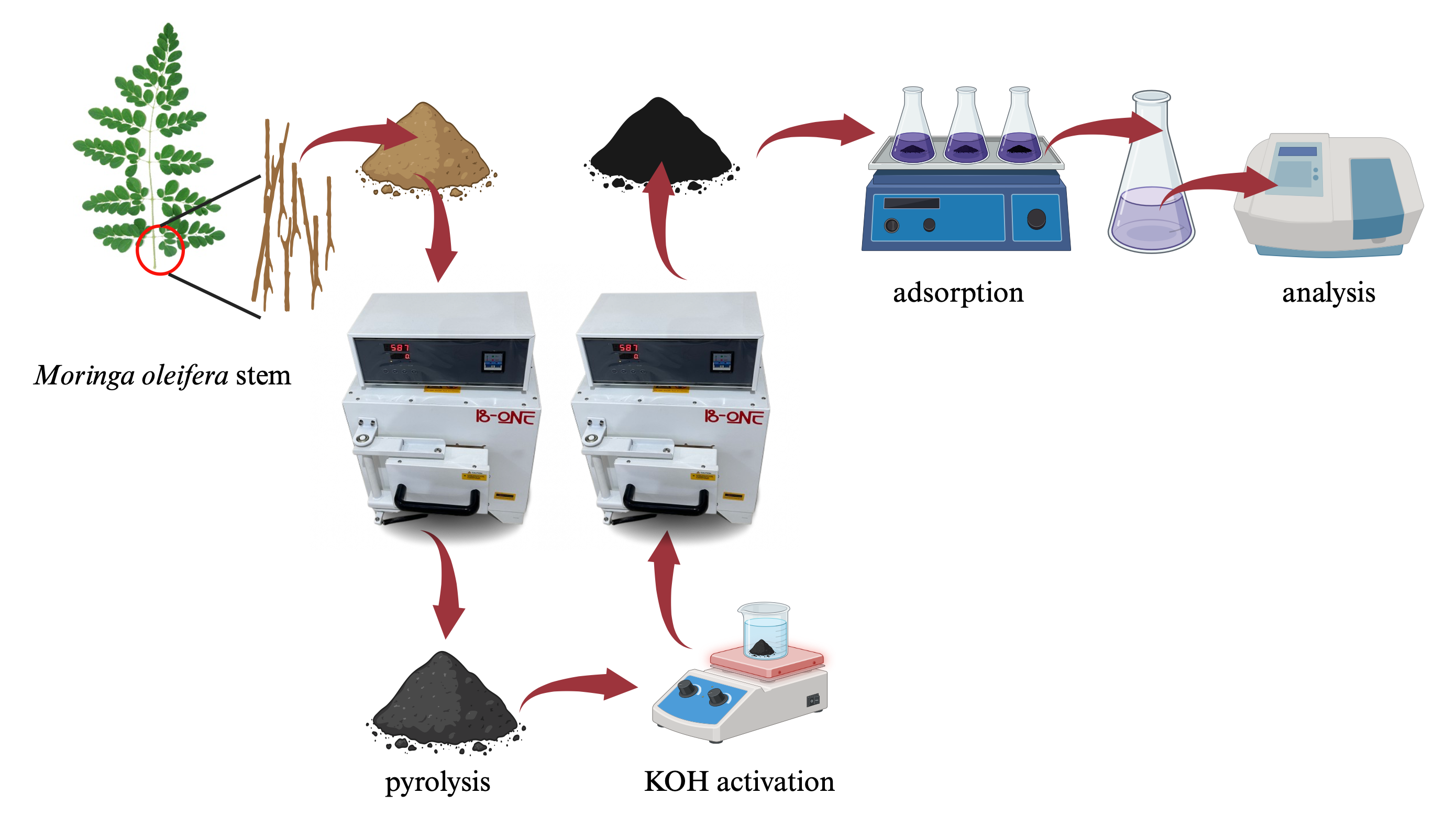
Moringa oleifera stem (MOS) waste contains 30.61% cellulose, 27.37% hemicellulose, and 20.78% lignin, making it a promising precursor for biochar and activated carbon (AC) production. However, the high lignin and cellulose contents may contribute to significant tar formation during pyrolysis, resulting in pore blockage and reduced carbon material quality. This study investigates the coupled effects of lignocellulosic composition (i.e., cellulose, hemicellulose, and lignin) and pyrolysis temperature on the surface chemistry, microstructural characteristics, and adsorption performance of the resulting AC. Pyrolysis of MOS powder was carried out in a muffle furnace under limited air conditions at 2 target temperatures: 500 °C (denoted as MOSbc-500) and 600 °C (denoted as MOSbc-600). Chemical activation was subsequently performed using potassium hydroxide (KOH) at a mass ratio of 3:1 (KOH:biochar) in a muffle furnace under limited air conditions at 800 °C. Surface morphology was examined using SEM equipped with EDX, while the surface functional groups were characterized via FTIR spectroscopy. The pore structure was analyzed through N2 adsorption-desorption measurements. The results indicate that the surface of MOSbc-600 appears cleaner than that of MOSbc-500, suggesting reduced tar deposition at the higher pyrolysis temperature. The AC derived from MOSbc-600 (denoted as MOSac-600) exhibited higher oxygen-containing functional groups compared to that derived from MOSbc-500 (denoted as MOSac-500). Moreover, MOSac-600 demonstrated a higher BET surface area (1221.56 m2/g) and an average mesopore diameter of 3.42 nm, contributing to a high methyl violet (MV) adsorption capacity of 29.94 mg/g at pH 11. Equilibrium adsorption data were best described by the Langmuir isotherm model. These findings suggest that MOS-derived AC is a low cost, high removal efficiency, and environmentally sustainable adsorbent with significant potential for wastewater treatment applications.
HIGHLIGHTS
- Moringa oleifera stem was used in the preparation of activated carbon via KOH activation.
- Coupled effects of lignocellulosic composition and pyrolysis temperature was discussed.
- Prediction of isotherm models was proposed and compared.
GRAPHICAL ABSTRACT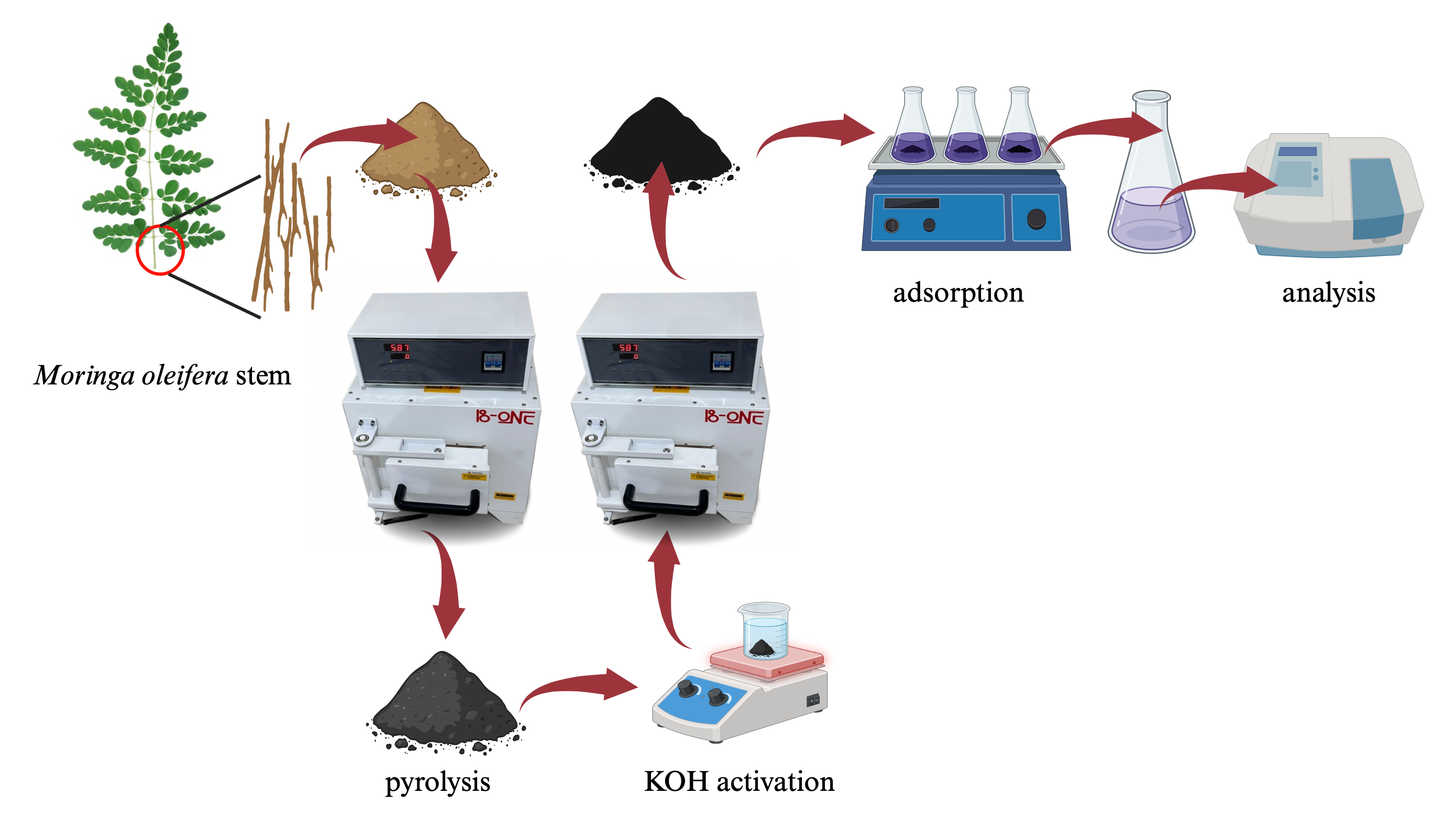
Downloads
References
R Foroutan, R Mohammadi, A Ahmadi, G Bikhabar, F Babaei and B Ramavandi. Impact of ZnO and Fe3O4 magnetic nanoscale on the methyl violet 2B removal efficiency of the activated carbon oak wood. Chemosphere 2022; 286, 131632.
M Ta, Y An, H Yang, C Bai, T Wang, T Zhang, H Cai and H Zheng. Attraction behavior induces the aggregation and precipitation of organic dyes: Improving efficiency through co-treatment strategy. Journal of Molecular Liquids 2024; 415, 126331.
VK Thammannagowda, KGG Shivanna, AK Parameshwarappa, Udayabhanu, P Hanumesh and P Kalappa. Photocatalytic degradation of methylene blue using CoFe2O4/Ag2WO4: Efficiency in degradation of methylene blue dye removal and antimicrobial activity. Next Materials 2025; 8, 100774.
X Yang, C Zhao, Z Zhang, B Zhao, W Wang, X Yang, A Shen and M Ye. Electrochemical degradation of small molecule dyes by TiO2-decorated polyacrylonitrile nanofiber membranes with superior properties. Journal of Membrane Science 2024; 709, 123132.
T Jamil. Application of ball Clay/MnO2 based catalytic ozonation process for textile wastewater treatment. Desalination and Water Treatment 2024; 318, 100394.
PR Chowdhury and SK Ray. Synthesis and characterization of polymer-clay nanocomposite membranes for micellar enhanced ultrafiltration of synthetic dyes from water. Journal of the Taiwan Institute of Chemical Engineers 2024; 165, 105768.
V Castro, MLG Fernández, RM Negri, L Lizarraga, A Cánneva, B Aráoz and LMS Medina. Waste based chitosan membranes for dye removal. International Journal of Biological Macromolecules 2025; 313, 143595.
W Astuti, IN Pradnya, R Wulansarie, D Hartanto, T Sulistyaningsih, C Kurniawan, M Hidayah, L Fitriana, MA Mahardhika and EF Irchamsyah. Preparation of magnetic activated carbons from cassava peel using H3PO4 and KOH activation by microwave heating for naphthol blue-black adsorption. Trends in Sciences 2024; 21(2), 7078.
W Astuti, T Sulistyaningsih, D Prastiyanto, Rusiyanto, Lanjar, FI Riayanti, W Astuti, WT Wibowo, AD Handayani and DA Wulandari. Influence of lignocellulosic composition in biomass waste on the microstructure and dye adsorption characteristics of microwave‑assisted ZnCl2 activated carbon. Biomass Conversion and Biorefiney 2024; 14, 16681-16697.
M Alrasheedi, TM Alresheedi, AA Algreiby, AS Alnafisah, AS Alresheedi, MAB Aissa, LS Alqarni and A Modwi. Fabrication of green Co3O4@g-C3N4 nanocomposite for MG dye adsorption. Diamond and Related Materials 2025; 157, 112532.
YAB Neolaka, AA P Riwu, UO Aigbe, KE Ukhurebor, RB Onyancha, H Darmokoesoemo and HS Kusuma. Potential of activated carbon from various sources as a low-cost adsorbent to remove heavy metals and synthetic dyes. Results in Chemistry 2023; 5, 100711.
D Ionita, M Cristea, SF Cosmulescu, G Predeanu, V Harabagiu and P Samoila. Thermal and viscoelastic responses of selected lignocellulosic wastes: Similarities and differences. Polymers 2023; 15(9), 2100.
S El Abbadi, H El Moustansiri, M Douma, A Bouazizi, M Baidou, A Elgamouz and N Tijani. Effective elimination of Congo red dye from tannery wastewater using Fe-pillared bentonite: Synthesis, adsorption isotherm, kinetics, and optimization via Box-Behnken design. Microporous and Mesoporous Materials 2025; 392, 113641.
HM Boundzanga, B Cagnon, M Roulet, SD Persis and V Christine. Contributions of hemicellulose, cellulose, and lignin to the mass and the porous characteristics of activated carbons produced from biomass residues by phosphoric acid activation. Biomass Conversion and Biorefiney 2022; 12(8), 3081-3089.
Y Xu, Y Liu, W Zhan, D Zhang, Y Liu, Y Xu and Z Wu. Enhancing CO2 capture with K2CO3-activated carbon derived from peanut shell. Biomass and Bioenergy 2024; 183, 107148.
T Alfatah, E M Mistar, M Jaber and I Surya. High surface area activated carbon derived from sustainable Kappaphycus alvarezii via 1-step NaOH activation for efficient methylene blue adsorption. Algal Research 2025; 90, 104200.
LEC Chatepa, B Mwamatope, I Chikowe, M Ntholo and KG Masamba. Extraction of phytoconstituents and antioxidant properties from Moringa oleifera L. leaves and seeds from Malawi: A comparative study using deep eutectic and conventional solvents. Food and Humanity 2025; 4, 100635.
ZA Fitri, F Ahmadi, MA Islam, EN Ponnampalam, FR Dunshea and HAR Suleria. A systematic review of extraction methods, phytochemicals, and food application of moringa oleifera leaves using PRISMA methodology. Food Science and Nutrition 2025; 13, e70138.
J Li, D Yang, X Yao, H Zhou, K Xu and L Geng. Slow pyrolysis experimental investigation of biomass tar formation and hydrogen production by tar reforming. International Journal of Hydrogen Energy 2024; 52, 74-78.
Y Zheng, F Fu, Q Liu, H Li, X Zu, X Qiu and W Zhang. Coupling chemical activation and pre-carbonization to produce lignin-derived hierarchical porous carbons with high yields for high-performance hybrid zinc-ion supercapacitors. Chemical Engineering Science 2025; 314, 121830.
D Ionita, M Cristea, SF Cosmulescu, G Predeanu, V Harabagiu and P Samoila. Thermal and viscoelastic responses of selected lignocellulosic wastes: Similarities and differences. Polymers 2023; 15(9), 2100.
Y Xu, J Wang, G Zhang, X Zhang and Y Zhang. The characteristics and mechanism for the formation of tars from low temperature pyrolysis of lignite. Journal of the Energy Institute 2021; 99, 248-255.
R Janu, V Mrlik, D Ribitsch, J Hofman, P Sedlacek, L Bielska and G Soja. Biochar surface functional groups as affected by biomass feedstock, biochar composition and pyrolysis temperature. Carbon Resource Conversion 2021; 4, 36-46.
Y Huang, E Ma and G Zhao. Thermal and structure analysis on reaction mechanisms during the preparation of activated carbon fibers by KOH activation from liquefied wood-based fibers. Industrial Crops and Products 2015; 69, 447-455.
S Acevedo, L Giraldo and JC Moreno-Pirajan. Kinetic study of CO2 adsorption of granular type activated carbons prepared from palm shells. Environmental Science and Pollution Research 2024; 31, 39839-39848.
O Oginni, K singh, G Oporto, B Dawson-Andoh, L McDonald and E Sabolsky. Influence of 1-step and 2-step KOH activation on activated carbon characteristics. Bioresource Technology Reports 2019; 7, 100266.
Z Ahamad and A Nasar. Polypyrrole-decorated bentonite magnetic nanocomposite: A green approach for adsorption of anionic methyl orange and cationic crystal violet dyes from contaminated water. Environmental Research 2024; 247, 118193.
NS Ali, NM Jabbar, SM Alardhi, HS Majdi and TM Albayati. Adsorption of methyl violet dye onto a prepared bio-adsorbent from date seeds: Isotherm, kinetics, and thermodynamic studies. Heliyon 2022; 8(8), e10276.
R Foroutan, R Mohammadi, A Ahmadi, G Bikhabar, F Babaei and B Ramavandi. Impact of ZnO and Fe3O4 magnetic nanoscale on the methyl violet 2B removal efficiency of the activated carbon oak wood. Chemosphere 2022; 286(1), 131632.
M Paredes-Laverde, M Salamanca, JD Diaz-Corrales, E Florez, J Silva-Agredo and RA Torres-Palma. Understanding the removal of an anionic dye in textile wastewaters by adsorption on ZnCl2 activated carbons from rice and coffee husk wastes: A combined experimental and theoretical study. Journal of Environmental Chemical Engineering 2021; 9(4), 105685.
SA Irwan, AH Jawad, RRR Deris, SA Musa, R Wu and ZA AlOthman. Blended mangosteen/pomegranate peels as a precursor for porous carbon material via microwave assisted-potassium carbonate activation: Box-Benken design optimization for fuchsin basic and methylene violet dyes removal. Diamond and Related Materials 2025; 151, 111846.
Published
How to Cite
Issue
Section
License
Copyright (c) 2025 Walailak University

This work is licensed under a Creative Commons Attribution-NonCommercial-NoDerivatives 4.0 International License.





