
Comparative Evaluation of the Antidiabetic Effect of Flavonoids Dihydroquercetin and Thamiflaside
DOI:
https://doi.org/10.48048/tis.2026.11059Keywords:
Alloxan diabetes, Dihydroquercetin, Thamiflaside, Blood biochemical parameters, Intestinal alpha glucosidases activityAbstract
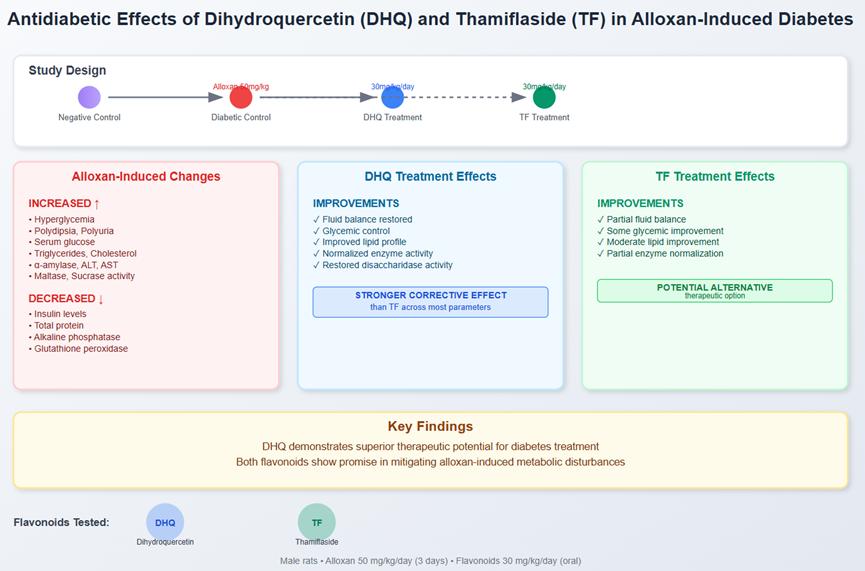
Diabetes mellitus (DM) is a major global health burden, ranking among the top three diseases leading to disability and mortality. Although some flavonoids exhibit antidiabetic properties, the effects of many remain insufficiently explored. This study investigates the potential of 2 flavonoids—dihydroquercetin (DHQ) and thamiflaside (TF)—to mitigate alloxan-induced diabetes in rats, thereby addressing an important gap in current knowledge. Male rats were divided into 4 groups: Negative control, diabetic (positive control), and two treatment groups receiving either DHQ or TF (30 mg/kg/day, per os) following alloxan induction (50 mg/kg/day, intraperitoneally for 3 days). Alloxan administration resulted in significant hyperglycemia, polydipsia, polyuria, and elevated levels of serum glucose, triglycerides, cholesterol, α-amylase, ALT, and AST, as well as increased maltase and sucrase activity in the small intestinal mucosa. Conversely, levels of insulin, total protein, alkaline phosphatase, and glutathione peroxidase were significantly reduced. DHQ treatment led to marked improvements in fluid balance, glycemic control, lipid profile, enzyme activity in serum, and disaccharidase activity in the intestinal mucosa. Notably, DHQ showed a stronger corrective effect than TF across most parameters. These findings highlight DHQ as a promising candidate for the treatment of diabetes and its associated metabolic disturbances, while also supporting TF as a potential alternative.
HIGHLIGHTS
- Dihydroquercetin (DHQ) and thamiflaside (TF) were tested in alloxan-induced diabetic rats.
- Alloxan caused hyperglycemia, dyslipidemia, enzyme imbalance, and intestinal disruption.
- DHQ improved glycemic control, lipid profile, and restored enzymatic activities.
- TF showed partial correction but weaker efficacy compared to DHQ.
- DHQ emerges as a stronger candidate for managing diabetes-related metabolic disorders.
GRAPHICAL ABSTRACT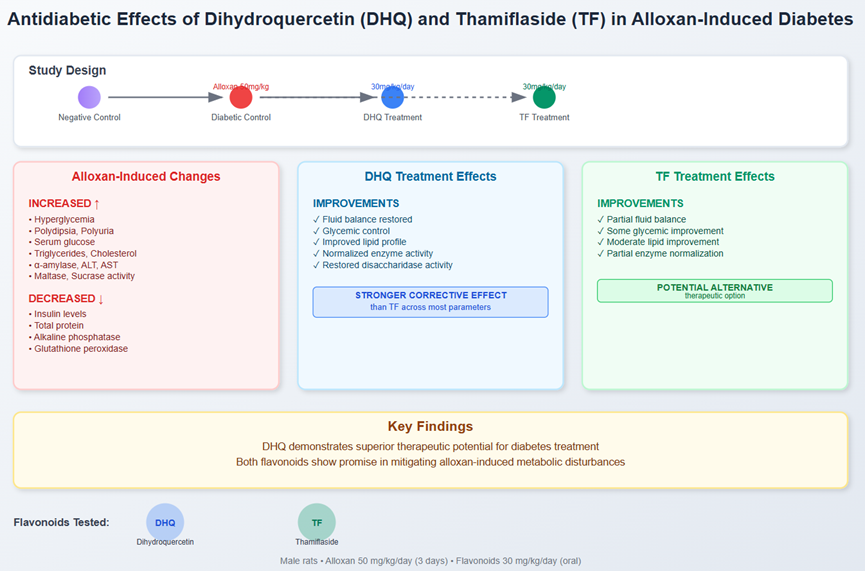
Downloads
References
DR Whiting, L Guariguata, C Weil and J Shaw. IDF diabetes atlas: Global estimates of the prevalence of diabetes for 2011 and 2030. Diabetes Res Clin Pract 2011; 94(3), 311-321.
SH Wild, G Roglic, A Green, R Sicree and H King. Global prevalence of diabetes: estimates for the year 2000 and projections for 2030. Diabetes Care 2004; 27(5), 1047-1053.
A Nagarajan, MC Petersen, AR Nasiri, G Butrico, A Fung, HB Ruan, R Kursawe, S Caprio, J Thibodeau, MC Bourgeois-Daigneault, L Sun, G Gao, S Bhanot, MJ Jurczak, MR Green, GI Shulman and N Wajapeyee. MARCH1 regulates insulin sensitivity by controlling cell surface insulin receptor levels. Nat Commun 2016; 7, 12639.
Y Wang, H Zhou, O Palyha and J Mu. Restoration of insulin receptor improves diabetic phenotype in T2DM mice. JCI Insight 2019; 4(15), e124945.
JS Bhatti, A Sehrawat, J Mishra, IS Sidhu, U Navik, N Khullar, S Kumar, GK Bhatti and PH Reddy. Oxidative stress in the pathophysiology of type 2 diabetes and related complications: Current therapeutics strategies and future perspectives. Free Radic Biol Med 2022; 184, 114-134.
P González, P Lozano, G Ros and F Solano. Hyperglycemia and Oxidative Stress: An Integral, Updated and Critical Overview of Their Metabolic Interconnections. Int J Mol Sci 2023; 24(11), 9352.
LV Gromova, AS Polozov, EV Savochkina, AS Alekseeva, YV Dmitrieva, OV Kornyushin and AA Gruzdkov. Effect of Type 2 Diabetes and Impaired Glucose Tolerance on Digestive Enzymes and Glucose Absorption in the Small Intestine of Young Rats. Nutrients 2022; 14(2), 385.
T Wu, CK Rayner, KL Jones, C Xie, C Marathe and M Horowitz. Role of intestinal glucose absorption in glucose tolerance. Curr Opin Pharmacol 2020; 55, 116-124.
A Baska, K Leis and P Gałązka. Berberine in the Treatment of Diabetes Mellitus: A Review. Endocr Metab Immune Disord Drug Targets 2021; 21(8), 1379-1386.
H Ouassou, T Zahidi, S Bouknana, M Bouhrim, H Mekhfi, A Ziyyat, A Legssyer, M Aziz and M Bnouham. Inhibition of α-Glucosidase, Intestinal Glucose Absorption, and Antidiabetic Properties by Caralluma europaea. Evid Based Complement Alternat Med 2018; 2018, 9589472.
M Zaripova, I Abdullaev, A Bogbekov, U Gayibov, S Omonturdiev, R Makhmudov, N Ergashev, G Jabbarova, S Gayibova and T Aripov. In vitro and in silico studies of gnaphalium U. extract: Inhibition of α-amylase and α-glucosidase as a potential strategy for metabolic syndrome regulation. Trends in Sciences 2025; 22(8), 10098.
M Zaripova, S Gayibova, R Makhmudov, A Mamadrahimov, N Vypova, U Gayibov, S Miralimova and T Aripov. Characterization of Rhodiola heterodonta (Crassulaceae): Phytocomposition, antioxidant and antihyperglycemic activities. Preventive Nutrition and Food Science 2024; 29(2), 135-145.
A Abdullaev, I Abdullaev, A Bogbekov, U Gayibov, S Omonturdiev, S Gayibova, M Turahodjayev, K Ruziboev and T Aripov. Antioxidant potential of rhodiola heterodonta extract: Activation of Nrf2 pathway via integrative in vivo and in silico studies. Trends in Sciences 2025; 22(5), 9521.
U Galicia-Garcia, A Benito-Vicente, S Jebari, A Larrea-Sebal, H Siddiqi, KB Uribe, H Ostolaza and C Martín. Pathophysiology of Type 2 Diabetes Mellitus. Int J Mol Sci 2020; 21(17), 6275.
C Guja, L Guja and RD Miulescu. Effect of type 2 diabetes medications on fracture risk. Ann Transl Med 2019; 7(20), 580.
WH Tsai, SK Kong, CL Lin, KH Cheng, YT Cheng, MN Chien, CC Lee and MC Tsai. Risk of fracture caused by anti-diabetic drugs in individuals with type 2 diabetes: A network meta-analysis. Diabetes Res Clin Pract 2022; 192, 110082.
YS Zhang, YD Zheng, Y Yuan, SC Chen and BC Xie. Effects of Anti-Diabetic Drugs on Fracture Risk: A Systematic Review and Network Meta-Analysis. Front Endocrinol (Lausanne) 2021; 12, 735824.
CMO Volpe, PH Villar-Delfino, PMF Dos Anjos and JA Nogueira-Machado. Cellular death, reactive oxygen species (ROS) and diabetic complications. Cell Death Dis 2018; 9(2), 119.
I Abdullaev, U Gayibov, S Omonturdiev, S Fotima, S Gayibova and T Aripov. Molecular pathways in cardiovascular disease under hypoxia: Mechanisms, biomarkers, and therapeutic targets. The Journal of Biomedical Research 2025; 39(3), 254-269.
AA Abdullaev, DR Inamjanov, DS Abduazimova, SZ Omonturdiyev, UG Gayibov, SN Gayibova and TF Aripov. Sílybum Mariánum’s impact on physiological alterations and oxidative stress in diabetic rats. Biomedical and Pharmacology Journal 2024; 17(2), 1291-1300.
A Aharaz, A Pottegård, DP Henriksen, J Hallas, H Beck-Nielsen and AT Lassen. Risk of lactic acidosis in type 2 diabetes patients using metformin: A case control study. PLoS One 2018; 13(5), e0196122.
TF Aripov, UG Gayibov, SN Gayibova, AA Abdullaev, DS Abduazimova, NS Berdiev, JF Ziyavitdinov, YI Oshchepkova and SH Salikhov. Antiradical and antioxidant activity of the preparation “Rutan” from Rhus coriaria L. Journal of Theoretical and Clinical Medicine 2023; 4, 164-170.
RK Al-Ishaq, M Abotaleb, P Kubatka, K Kajo and D Büsselberg. Flavonoids and Their Anti-Diabetic Effects: Cellular Mechanisms and Effects to Improve Blood Sugar Levels. Biomolecules 2019; 9(9), 430.
MÁ Martín and S Ramos. Dietary Flavonoids and Insulin Signaling in Diabetes and Obesity. Cells 2021; 10(6), 1474.
SV Orlova, VV Tatarinov, EA Nikitina, AV Sheremeta, VA Ivlev, VG Vasil'ev, KV Paliy and SV Goryainov. Bioavailability and Safety of Dihydroquercetin (Review). Pharm Chem J 2022; 55(11), 1133-1137.
D Inomjonov, I Abdullaev, S Omonturdiev, A Abdullaev, L Maxmudov, M Zaripova, M Abdullayeva, D Abduazimova, S Menglieva, S Gayibova, M Sadbarxon, U Gayibov and T Aripov. In vitro and in vivo studies of Crategus and Inula helenium extracts: Their effects on rat blood pressure. Trends in Sciences 2025, 22(3), 9158.
H Wei, T Zhao, X Liu, Q Ding, J Yang, X Bi, Z Cheng, C Ding and W Liu. Mechanism of Action of Dihydroquercetin in the Prevention and Therapy of Experimental Liver Injury. Molecules 2024; 29(15), 3537.
T Ding, S Wang, X Zhang, W Zai, J Fan, W Chen, Q Bian, J Luan, Y Shen, Y Zhang, D Ju and X Mei. Kidney protection effects of dihydroquercetin on diabetic nephropathy through suppressing ROS and NLRP3 inflammasome. Phytomedicine 2018; 41, 45-53.
W Zai, W Chen, J Luan, J Fan, X Zhang, Z Wu, T Ding, D Ju and H Liu. Dihydroquercetin ameliorated acetaminophen-induced hepatic cytotoxicity via activating JAK2/STAT3 pathway and autophagy. Appl Microbiol Biotechnol 2018; 102(3), 1443-1453.
O Gaibullayeva, A Islomov, D Abdugafurova, B Elmurodov, B Mirsalixov, L Mahmudov, I Adullaev, K Baratov, S Omonturdiev and S SaʼDullayeva. Inula helenium L. root extract in sunflower oil: Determination of its content of water-soluble vitamins and immunity-promoting effect. Biomedical and Pharmacology Journal 2024; 17(4), 2729-2737.
LS Kuchkarova, HYu Kayumov, NA Ergashev and KA Eshbakova. Preventive effect of some flavonoids on carbohydrate assimilation in rats. Scientific Review. Biological Sciences 2022; 3, 51-56. (in Russia).
LS Kuchkarova, ShO Rokhimova and VN Syrov. Effect of turkesterone on the pancreas histology and function in diabetic rats. Int J Cur Res Rev 2020; 12(21), 1-5.
BD Komilov, MA Agzamova, IM Isaev and KA Eshbakova. New flavonoid glycoside from Thalictrum minus. Chemistry of Natural Compounds 2020; 56(5), 814-816.
M Elsner, E Gurgul-Convey and S Lenzen. Relation between triketone structure, generation of reactive oxygen species, and selective toxicity of the diabetogenic agent alloxan. Antioxid Redox Signal 2008; 10(4), 691-699.
HS Han, G Kang, JS Kim, BH Choi and SH Koo. Regulation of glucose metabolism from a liver-centric perspective. Exp Mol Med 2016; 48(3), e218.
R Liu, Y Zhang, X Yao, Q Wu, M Wei and Z Yan. ε-Viniferin, a promising natural oligostilbene, ameliorates hyperglycemia and hyperlipidemia by activating AMPK in vivo. Food Funct 2020; 11, 10084-10093.
AK Das, S Kalra, H Punyani, S Deshmukh and S Taur. 'Oxidative stress'-A new target in the management of diabetes mellitus. J Family Med Prim Care 2023; 12(11), 2552-2557.
F Sok Yen, C Shu Qin, S Tan Shi Xuan, P Jia Ying, H Yi Le, T Darmarajan, B Gunasekaran and S Salvamani. Hypoglycemic Effects of Plant Flavonoids: A Review. Evid Based Complement Alternat Med 2021; 2021, 2057333.
P Ansari, ST Choudhury, V Seidel, AB Rahman, MA Aziz, AE Richi, A Rahman, UH Jafrin, JMA Hannan and YHA Abdel-Wahab. Therapeutic Potential of Quercetin in the Management of Type-2 Diabetes Mellitus. Life (Basel) 2022; 12(8), 1146.
S Sodiqova, S Kadirova, A Zaynabiddinov, I Abdullaev, L Makhmudov, U Gayibov, M Yuldasheva, M Xolmirzayeva, R Rakhimov, A Mutalibov and H Karimjonov. Channelopathy Activity of A-41(Propyl Ester of Gallic Acid): Experimental and Computational Study of Antihypertensive Activity. Trends in Sciences, 2025; 22(9), 10496.
Published
How to Cite
Issue
Section
License
Copyright (c) 2025 Walailak University

This work is licensed under a Creative Commons Attribution-NonCommercial-NoDerivatives 4.0 International License.





