
Nucleon Charge and Magnetization Densities in the Perturbative Chiral Quark Model
DOI:
https://doi.org/10.48048/tis.2026.11009Keywords:
Nucleon, Nucleon electromagnetic form factors, Sachs form factors, Charge and magnetization densitiesAbstract
This study investigates the distributions of charge and magnetization within the nucleon using the Perturbative Chiral Quark Model (PCQM). Nucleon charge and magnetization densities are intrinsically linked to the Sachs electromagnetic form factors. We calculated these Sachs form factors within the PCQM framework, incorporating excited-state quark propagators up to the 2nd excited state. Our findings reveal that both the influence of the meson cloud surrounding the quarks within the nucleon and the inclusion of excited-state quark propagators contribute significantly to the Sachs form factors. The definitions of the nucleon charge and magnetization densities are dependent on the chosen frame of reference. Accordingly, we calculated these densities in both the rest frame and the infinite momentum frame of the nucleon. Our results demonstrate distribution patterns consistent with those reported in previous studies. Specifically, the neutron spherical charge density in the rest frame is observed to be positive near the center and at large distances, with a negative distribution in the intermediate region. Conversely, in the infinite momentum frame, the neutron charge distribution exhibits a negative core surrounded by a positive region extending away from the center.
HIGHLIGHTS
Highlights
- The nucleon charge and magnetization densities are investigated using the Perturbative Chiral Quark Model (PCQM).
- The meson-cloud effect and the inclusion of excited-state quark propagators demonstrate significant contributions to the calculated Sachs form factors.
- The observed patterns in our results for the nucleon charge and magnetization densities align with findings from previous studies. However, the magnitudes of these densities are smaller than those reported in other approaches.
GRAPHICAL ABSTRACT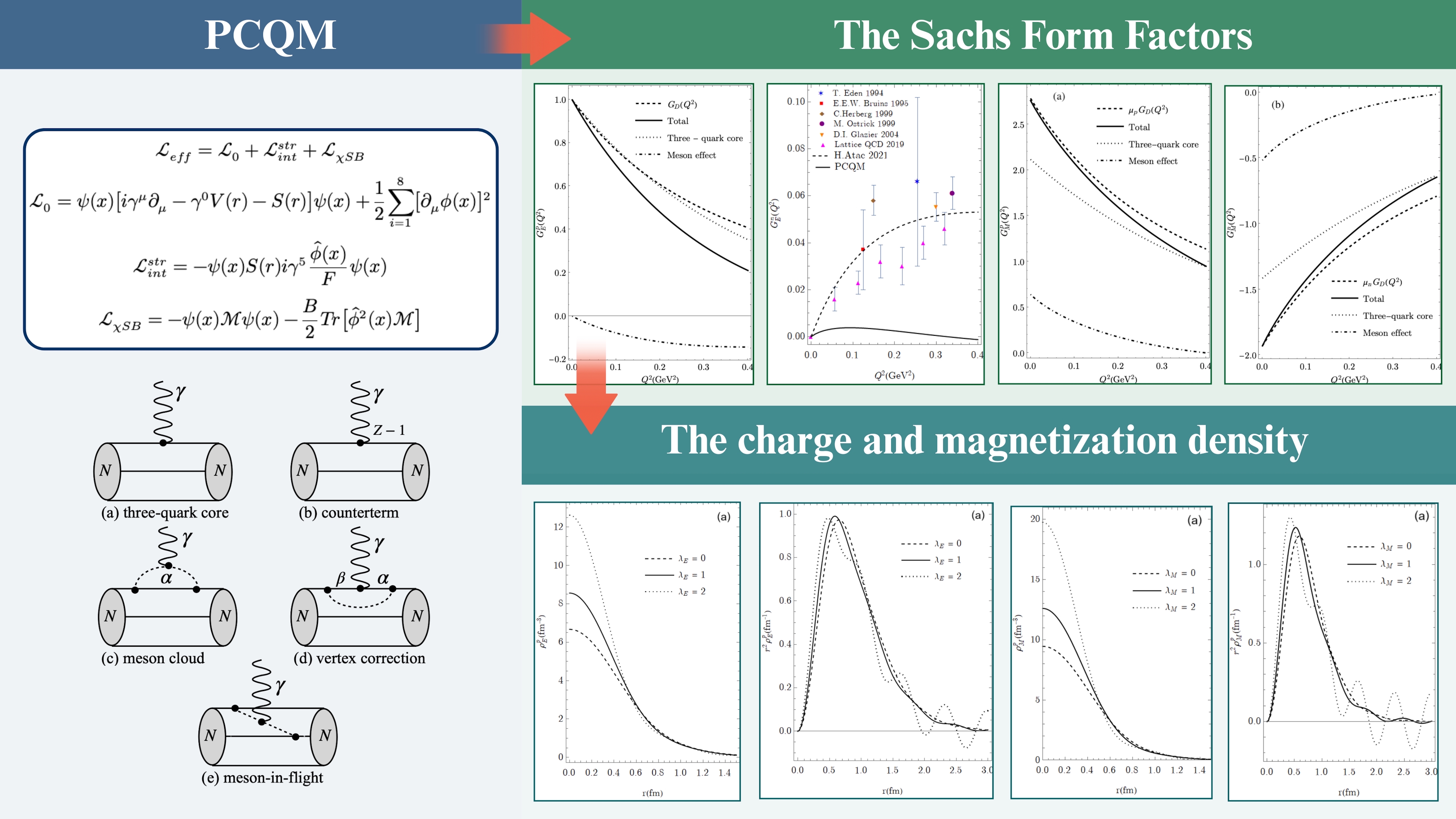
Downloads
References
H Gao, C Peng and ZW Zhao. Experimental progress and status on nucleon electromagnetic form factors. EPJ Web of Conferences 2016; 113, 1012.
G Gilfoyle. Future measurements of the nucleon elastic electromagnetic form factors at Jefferson Lab. EPJ Web of Conferences 2018; 172, 2004.
JJ Kelly. Nucleon charge and magnetization densities from Sachs form factors. Physical Review C 2002; 66, 65203.
GA Miller. Charge densities of the neutron and proton. Physical Review Letters 2007; 99, 112001.
CE Carlson and M Vanderhaeghen. Empirical transverse charge densities in the nucleon and the nucleon-to-Δ transition. Physical Review Letters 2008; 100, 32004.
H Atac, M Constantinou, ZE Meziani, M Paolone and N Sparveris. Measurement of the neutron charge radius and the role of its constituents. Nature Communications 2021; 12, 1759.
VE Lyubovitskij, T Gutsche, A Faessler and EG Drukarev. Sigma-term physics in the perturbative chiral quark model. Physical Review D 2001; 63, 54026.
T Inoue, VE Lyubovitskij, T Gutsche and A Faessler. Updated analysis of meson-nucleon σ terms in the perturbative chiral quark model. Physical Review C 2004; 69, 35207.
VE Lyubovitskij, T Gutsche and A Faessler. Electromagnetic structure of the nucleon in the perturbative chiral quark model. Physical Review C 2001; 64, 65203.
S Cheedket, VE Lyubovitskij, T Gutsche, A Faessler, K Pumsa-ard and Y Yan. Electromagnetic form factors of the baryon octet in the perturbative chiral quark model. The European Physical Journal A: Hadrons and Nuclei 2004; 20, 317-327.
XY Liu, K Khosonthongkee, A Limphirat and Y Yan. Study of baryon octet electromagnetic form factors in perturbative chiral quark model. Journal of Physics G: Nuclear and Particle Physics 2014; 41, 55008.
K Pumsa-ard, VE Lyubovitskij, T Gutsche, A Faessler and S Cheedket. Electromagnetic nucleon-delta transition in the perturbative chiral quark model. Physical Review C 2003; 68, 15205.
K Khosonthongkee, VE Lyubovitskij, T Gutsche, A Faessler, K Pumsa-ard and S Cheedket and Y Yan. Axial form factor of the nucleon in the perturbative chiral quark model. Journal of Physics G: Nuclear and Particle Physics 2004; 30, 793-810.
VE Lyubovitskij, P Wang, T Gutsche and A Faessler. Strange nucleon form factors in the perturbative chiral quark model. Physical Review C 2002; 66, 55204.
J Gasser, ME Sainio and A Švarc. Nucleons with chiral loops. Nuclear Physics B 1988; 307(4), 779-853.
J Jarassriwilai, K Pumsa-ard and P Uttayarat. Inclusion of the excited states quark propagator to the nucleon electromagnetic form factors in the perturbative chiral quark model. Results in Physics 2020; 16, 103125.
X Ji. A relativistic skyrmion and its form factors. Physics Letters B 1991; 254(3-4), 456-461.
AL Licht and A Pagnamenta. Wave functions and form factors for relativistic composite particles. II. Physical Review D 1970; 2, 1156.
AN Mitra and I Kumari. Relativistic form factors for clusters with nonrelativistic wave functions. Physical Review D 1977; 15, 261.
C Patrignani, C Schwanda, S Spanier, G Venanzoni, CZ Yuan, K Agashe, G Aielli, BC Allanach, J Alvarez-Muñiz, M Antonelli, EC Aschenauer, DM Asner, K Assamagan, H Baer, S Banerjee, RM Barnett, L Baudis, CW Bauer, JJ Beatty, J Beringer, ..., PA Zyla. Reviews of particle physics. Physical Review D 2024; 110, 30001.
T Eden, R Madey, WM Zhang, BD Anderson, AR Baldwin, JM Cameron, JM Finn, CC Foster, JJ Kelly, S Kowalski, R Lourie, P Markowitz, B Ni, PJ Pella, J Schambach, M Spraker, E Steinfelds, EJ Stephenson and JW Watson. Performance of a neutron polarimeter to measure the electric form factor of the neutron. Nuclear Instruments and Methods in Physics Research Section A 1994; 338(2-3), 432-441.
EEW Bruins, TS Bauer, HWD Bok, CP Duif, WCV Hoek, DJJD Lange, A Misiejuk, Z Papandreou, EP Sichtermann, H Reike, D Durek, F Frommberger, R Gothe, D Jakob, G Kranefeld, C Kunz, N Leiendecker, G Pfeiffer, E Jans and J Konijn, ..., H Arenhövel. Measurement of the neutron magnetic form factor. Physical Review Letters 1995; 75, 21-24.
C Herberg, M Ostrick, HG Andresen, JRM Annand, K Aulenbacher, J Becker, P Drescher, D Eyl, A Frey, P Grabmayr, SJ Hall, P Hartmann, T Hehl, W Heil, J Hoffmann, D Ireland, JD Kellie, F Klein, K Livingston, …, R Watson. Determination of the neutron electric form factor in the D(e,e^' n)p reaction and the influence of nuclear binding. The European Physical Journal A 1999; 5, 131-135.
M Ostrick, C Herberg, HG Andresen, JRM Annand, K Aulenbacher, J Becker, P Drescher, D Eyl, A Frey, P Grabmayr, P Hartmann, T Hehl, W Heil, J Hoffmann, D Ireland, JD Kellie, F Klein, K Livingston, C Nachtigall, …, R Watson. Measurement of the neutron electric form factor G_(E,n) in the quasifree (_^2)H (e ⃗,e^' n ⃗ )p reaction. Physical Review Letters 1999; 83, 276-279.
DI Glazier, M Seimetz, JRM Annand, H Arenhövel, MA Antelo, C Ayerbe, P Bartsch, D Baumann, J Bermuth, R Böhm, D Bosnar, M Ding, MO Distler, D Elsner, J Friedrich, S Hedicke, P Jennewein, GJM Nas, FH Klein, …, M Weis. Measurement of the electric form factor of the neutron at Q^2=0.3-0.8 (GeV/c)^2. The European Physical Journal A 2005; 24, 101-109.
C Alexandrou, S Bacchio, M Constantinou, J Finkenrath, K Hadjiyiannakou, K Jansen, G Koutsou and AV Aviles-Casco. Proton and neutron electromagnetic form factors from lattice QCD. Physical Review D 2019; 100, 14509.
A Faessler, T Gutsche, VE Lyubovitskij and K Pumsa-ard. Chiral dynamics of baryons in a Lorentz covariant quark model. Physical Review D 2006; 73, 114021.
JM Alarcón and C Weiss. Transverse charge and current densities in the nucleon from dispersively improved chiral effective field theory. Physical Review D 2022; 106, 54005.
T Kurai. Proton and neutron electromagnetic form factors based on bound system in 3 + 1 dimensional QCD. Journal of Modern Physics 2020; 11, 741-765.
AV Gramolin and RL Russell. Transverse charge density and the radius of the proton. Physical Review D 2020; 105, 54004.
XY Liu, A Limphirat, K Xu, D Samart, K Khosonthongkee and Y Yan. Analysis of excited quark propagator effects on neutron charge form factor. The European Physical Journal A 2019; 55, 218.
Published
How to Cite
Issue
Section
License
Copyright (c) 2025 Walailak University

This work is licensed under a Creative Commons Attribution-NonCommercial-NoDerivatives 4.0 International License.





