
Enhancing the Functional Quality of Liberica Nano-Coffee via Yeast-Lactic Fermentation and Nano-Milling Techniques
DOI:
https://doi.org/10.48048/tis.2026.11008Keywords:
Antioxidant activity, Fermentation, Physicochemical properties, Milling process, Nanotechnology, Functional food, Coffea libericaAbstract
Coffee is an essential economic commodity, with varieties such as Liberica recognized for their resilience to diverse climates, although it is less popular than Arabica and Robusta. However, its potential remains underutilized, especially in advanced food technology applications. Advances in nanotechnology offer potential improvements in coffee quality by utilizing nano-sized particles to enhance flavor, aroma, and nutrient bioavailability. This study investigates the effects of yeast-lactic acid fermentation processing techniques on the milling process and nanoparticle characteristics in the production of Liberica nano-coffee. Liberica coffee sourced from Banyuwangi, Indonesia, underwent yeast-lactic acid fermentation. After cleaning, sun-drying, and medium-level roasting, the beans were subjected to ball milling at 500 rpm for 60, 120, and 180 min, followed by sonication. The resulting coffee powder was analyzed using Particle Size Analyzer (PSA), Field Emission Scanning Electron Microscopy (FESEM), Fourier Transform Infrared Spectroscopy (FT-IR), pH and color measurement, and IC50 assessments. PSA results indicate that lactic yeast fermentation led to smaller, more uniform nanoparticles. Physicochemical analysis showed a decrease in pH in fermented (F) coffee (5.07 - 5.13) compared to non-fermented (NF) coffee (5.45 - 5.50). Fermentation also resulted in darker coloration and a reduction in antioxidant capacity as indicated by higher IC50 values for F coffee compared to NF coffee, along with alterations in chromatic parameters. The milling process resulted in approximately 10% of the coffee particles being in the nanoscale for both NF and F coffee samples. FESEM revealed rougher surfaces in the milled F coffee sample, with enhanced porosity and flake-like structures. FTIR spectra confirmed biochemical alterations in F coffee, particularly in lipid degradation, organic acid accumulation, and polyphenol breakdown. This study presents a novel focus on Liberica coffee, an underexplored species in nanotechnology applications. The combination of fermentation and nanomilling demonstrates potential in enhancing antioxidant-related properties, positioning Liberica nano-coffee as a functional ingredient.
HIGHLIGHTS
- Fermentation and milling treatments of green beans significantly affect the physicochemical properties of Liberica coffee.
- Nano-grinding enhances solubility, color intensity, and extract yield of fermented Liberica coffee beans.
- Field Emission Scanning Electron Microscopy (FESEM) revealed microstructural changes, including disrupted cell walls and increased surface area.
- FTIR analysis showed notable shifts in functional groups related to carbohydrates and proteins, indicating chemical transformations during processing.
- This study demonstrates the potential of integrating fermentation and nano-milling to improve the quality and functionality of Liberica nano-coffee.
GRAPHICAL ABSTRACT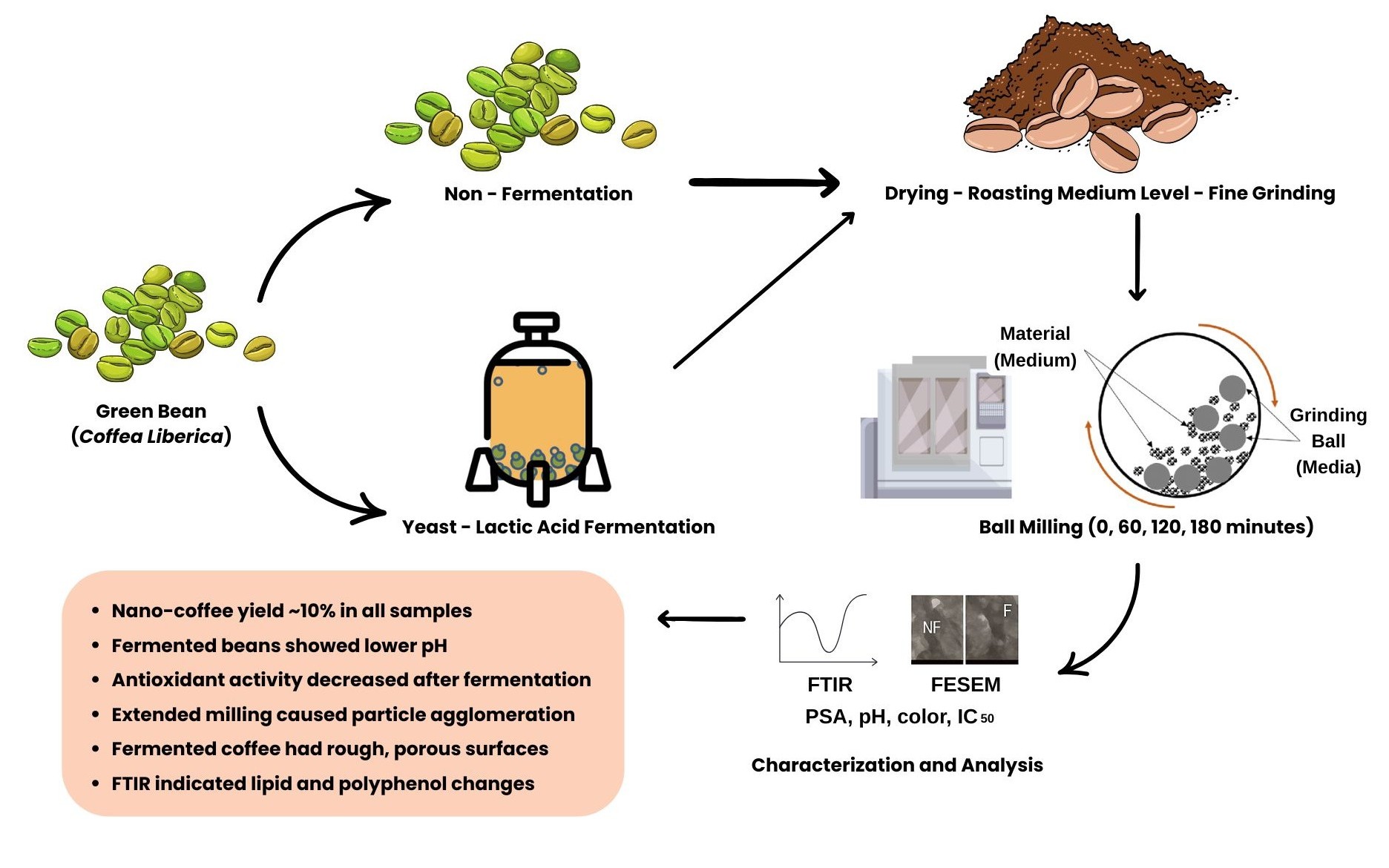
Downloads
References
WB Sunarharum, K Fibrianto, SS Yuwono and M Nur. Sains kopi Indonesia (in Indonesian). UB Press, Malang, Indonesia, 2019.
ÉB Patay, N Sali, T Koszegi, R Csepregi, VL Balázs, TS Németh, T Németh and N Papp. Antioxidant potential, tannin, and polyphenol contents of seed and pericarp of 3 Coffea species. Asian Pacific Journal of Tropical Medicine 2016; 9(4), 366-371.
NET Castillo, EM Melchor-Martínez, JSO Sierra, RA Ramirez-Mendoza, R Parra-Saldívar and HM Iqbal. Impact of climate change and early development of coffee rust - An overview of control strategies to preserve organic cultivars in Mexico. Science of the Total Environment 2020; 738, 140225.
M Insanu, I Fidrianny, NHH Imtinan and S Kusmardiyani. Liberica coffee (Coffea liberica L.) from 3 different regions: In vitro antioxidant activities. Biointerface Research in Applied Chemistry 2021; 11(5), 13031-13041.
HN Giang, CC Tran, TNA Huynh and PTM Doan. Spent coffee grounds utilization for green ultraviolet filter and nanocomposite fabrication. Express Polymer Letters 2023; 17(9), 900-912.
L Fu, Y Gong, Q Zhou, Z Ou, X Rao, S Wang and X Du. Antioxidant and ultraviolet shielding performance of lignin-polysaccharide complex isolated from spent coffee ground. International Journal of Biological Macromolecules 2023; 230, 123245.
S Nurman, R Yulia, E Noor and TC Sunarti. The potential of arabica coffee grounds nanoparticles as an active compound of pharmaceutical preparations. IOP Conference Series: Earth and Environmental Science 2020; 425(1), 012034.
H Shi, E Yang, Y Li, X Chen and J Zhang. Effect of solid-state fermentation on nutritional quality of leaf flour of the drumstick tree (Moringa oleifera Lam.). Frontiers in Bioengineering and Biotechnology 2021; 9, 626628.
G Angeloni, P Masella, A Spadi, L Guerrini, F Corti, M Bellumori and A Parenti. Using ground coffee particle size and distribution to remodel beverage properties. European Food Research and Technology 2023; 249(5), 1247-1256.
V Belchior and S Casal. Speciality coffees: Searching for the edge of beverage quality. In: JM Mérillon, C Riviere and G Lefèvre (Eds.). Natural products in beverages: Botany, phytochemistry, pharmacology and processing. Springer International Publishing, Cham, Switzerland, 2024, p. 129-155.
MCB Mota, NN Batista, MHS Rabelo, DE Ribeiro, FM Borém and RF Schwan. Influence of fermentation conditions on the sensorial quality of coffee inoculated with yeast. Food Research International 2020; 136, 109482.
WB Sunarharum, HR Umami, AA Kartika, S Septiana and T Mahatmanto. Re-fermentation of green Liberica coffee (Coffea liberica) beans: Impact on the caffeine and antioxidant content of the roasted beans. Journal of Experimental Life Science 2023; 13(2), 67-69.
F Kulapichitr, C Borompichaichartkul, M Fang, I Suppavorasatit and KR Cadwallader. Effect of post-harvest drying process on chlorogenic acids, antioxidant activities, and CIE-Lab color of Thai Arabica green coffee beans. Food Chemistry 2022; 366, 130504.
AOAC International. Official methods of analysis of Association of Official Analytical Chemist. AOAC International, Maryland, 2025.
MA Schouten, S Tappi, S Angeloni, M Cortese, G Caprioli, S Vittori and S Romani. Acrylamide formation and antioxidant activity in coffee during roasting - a systematic study. Food Chemistry 2021; 343, 128514.
I Buniyamin, NA Asli, MHF Suhaimi, KA Eswar, M Mohammad, MR Mahmood and Z Khusaimi. The photocatalytic characteristics of tin oxide nanoparticles synthesized through Aquilaria malaccensis. International Journal of Chemical and Biochemical Sciences 2023; 24(7), 63-73.
I Buniyamin, NA Asli, RM Akhir, SM Jafar, KA Eswar, MKA Mahmood and Z Khusaimi. Biofabricated SnO2 nanoparticles derived from leaves extract of Morinda citrifolia and Pandanus amaryllifolius for photocatalytic degradation. Journal of Cluster Science 2025; 36(1), 3.
A Tawali, N Abdullah and B Wiranata. Pengaruh fermentasi menggunakan bakteri asam laktat yoghurt terhadap citarasa kopi robusta (Coffea robusta) (in Indonesian). Canrea Journal: Food Technology, Nutritions, and Culinary 2018; 1(1), 90-97.
O Cwiková, T Komprda, V Šottníková, Z Svoboda, J Simonová, J Slováček and M Jůzl. Effects of different processing methods of Coffea arabica on colour, acrylamide, caffeine, chlorogenic acid, and polyphenol content. Foods 2022; 11(20), 3295.
J Gallardo-Ignacio, A Santibáñez, O Oropeza-Mariano, R Salazar, RM Montiel-Ruiz, S Cabrera-Hilerio and P Nicasio-Torres. Chemical and biological characterization of green and processed coffee beans from Coffea arabica varieties. Molecules 2023; 28(12), 4685.
CF Tsai and IPJ Jioe. The analysis of chlorogenic acid and caffeine content and its correlation with coffee bean color under different roasting degree and sources of coffee (Coffea arabica typica). Processes 2021; 9(11), 2040.
HS Kwak, Y Jeong and M Kim. Effect of yeast fermentation of green coffee beans on antioxidant activity and consumer acceptability. Journal of Food Quality 2018; 2018(1), 5967130.
OT Mahardani and L Yuanita. Efek metode pengolahan dan penyimpanan terhadap kadar senyawa fenolik dan aktivitas antioksidan (in Indonesian). Journal of Chemistry 2021; 10(1), 64-76.
K Ramachandraiah and K Chin. Evaluation of ball-milling time on the physicochemical and antioxidant properties of persimmon by-products powder. Innovative Food Science and Emerging Technologies 2016; 37, 115-124.
L Liu, J Guo, R Zhang, Z Wei, Y Deng, J Guo and M Zhang. Effect of degree of milling on phenolic profiles and cellular antioxidant activity of whole brown rice. Food Chemistry 2015; 185, 318-325.
YN Dinh, QD Nguyen and HP Le. Investigation of changes of antioxidant properties of coffee through fermentation by using Saccharomyces cerevisiae and Bacillus subtilis. Journal of Technical Education and Science 2022; 17(1), 72-79.
P Therdtatha, N Jareontanahun, W Chaisuwan, K Yakul, A Paemanee, A Manassa, C Moukamnerd, Y Phimolsiripol, S Sommano and P Seesuriyachan. Production of functional Arabica and Robusta green coffee beans: Optimization of fermentation with microbial cocktails to improve antioxidant activity and metabolomic profiles. Biocatalysis and Agricultural Biotechnology 2023; 53, 102869.
WB Sunarharum. 2016, The compositional basis of coffee flavour. Ph. D. Dissertation. The University of Queensland, Queensland Alliance for Agriculture & Food Innovation (QAAFI), Queensland, Australia.
M Ullah, ME Ali and SBA Hamid. Surfactant-assisted ball milling: A novel route to novel materials with controlled nanostructure - a review. Reviews on Advanced Materials Science 2014; 37, 1-14.
W Dong, Y Kitamura, M Kokawa, T Suzuki and RK Amini. Microstructural modification and sorption capacity of green coffee beans. Foods 2024; 13(21), 3398.
K Anam, MP Sirappa, A Meilin, AB Marda, NC Irawan, HT Handayani and NUE Masrika. Budidaya tanaman kopi dan olahannya untuk kesehatan (in Indonesian). CV Tohar Media, Makassar, Indonesia, 2023.
H Sitorus. 2019, Studi karakteristik fisikokimia biji kopi hijau Arabika, Robusta, dan Ekselsa natural pada tingkat mutu yang berbeda (in Indonesian). Bachelor Thesis. Universitas Brawijaya, Malang, Indonesia.
A Hameed, SA Hussain, MU Ijaz, S Ullah, I Pasha and HAR Suleria. Farm to consumer: Factors affecting the organoleptic characteristics of coffee. II: Postharvest processing factors. Comprehensive Reviews in Food Science and Food Safety 2018; 17(5), 1184-1237.
N Bhumiratana, K Adhikari and EC Iv. Evolution of sensory aroma attributes from coffee beans to brewed coffee. LWT - Food Science and Technology 2011; 44(10), 2185-2192.
R Shaddel, S Akbari-Alavijeh, I Cacciotti, S Yousefi, M Tomas, E Çapanoğlu, O Tarhan, A Rashidinejad, A Rezaei, M Bhia and S Jafari. Caffeine-loaded nano/micro-carriers: Techniques, bioavailability, and applications. Critical Reviews in Food Science and Nutrition 2022; 64, 4940-4965.
R Harwansh, R Deshmukh and A Rahman. Nanoemulsion: Promising nanocarrier system for delivery of herbal bioactives. Journal of Drug Delivery Science and Technology 2019; 51, 224-233.
C Chen, Z Wang, H Fu, G Yu, X Luo and K Zhu. Enhanced bioavailability of curcumin amorphous nanocomposite prepared by a green process using modified starch. International Journal of Biological Macromolecules 2024; 270, 132210.
J Ahmed, A Alazemi, P Ponnumani, B Balakrishnan, M Soliman, L Emmanuval and N Thomas. Transformation of quinoa seeds to nanoscale flour by ball milling: Influence of ball diameter and milling time on the particle sizing, microstructure, and rheology. Journal of Food Engineering 2024; 379, 112127.
M Ahmad, A Gani, A Gani, F Masoodi and S Rizvi. Influence of ball milling on the production of starch nanoparticles and its effect on structural, thermal, and functional properties. International Journal of Biological Macromolecules 2020; 151, 85-91.
S Bangar, A Singh, A Ashogbon and H Bobade. Ball-milling: A sustainable and green approach for starch modification. International Journal of Biological Macromolecules 2023; 237, 124069.
Y Meng, C Qiu, X Li, D McClements, S Sang, A Jiao and Z Jin. Polysaccharide-based nano-delivery systems for encapsulation, delivery, and pH-responsive release of bioactive ingredients. Critical Reviews in Food Science and Nutrition 2022; 64, 187-201.
S Lekmine, S Boussekine, S Akkal, A Martín-García, A Boumegoura, K Kadi, H Djeghim, N Mekersi, S Bendjedid, C Bensouici and G Nieto. Investigation of photoprotective, anti-inflammatory, antioxidant capacities and LC-ESI-MS phenolic profile of Astragalus gombiformis Pomel. Foods 2021; 10(8), 1937.
M Serra, A Casas, J Teixeira and A Barros. Revealing the beauty potential of grape stems: Harnessing phenolic compounds for cosmetics. International Journal of Molecular Sciences 2023; 24(14), 11751.
HI Syarif. 2024, Metagenomic sequencing of fungi in juice and enrichment of Liberica coffee cherry juice from Poncokusumo. Bachelor Thesis. Universitas Brawijaya, Malang, Indonesia.
ADS Vale, G Balla, LRS Rodrigues, DPDC Neto, CR Soccol and GVDM Pereira. Understanding the effects of self-induced anaerobic fermentation on coffee beans quality: Microbiological, metabolic, and sensory studies. Foods 2022; 12(1), 37.
IA Ludwig, L Sanchez, B Caemmerer, LW Kroh, MPD Peña and C Cid. Extraction of coffee antioxidants: Impact of brewing time and method. Food Research International 2012; 48(1), 57-64.
GS Duarte, AA Pereira and A Farah. Chlorogenic acids and other relevant compounds in Brazilian coffees processed by semi-dry and wet post-harvesting methods. Food Chemistry 2010; 118(3), 851-855.
I Sapna, M Kamaljit, R Priya and PA Jayadeep. Milling and thermal treatment induced changes on phenolic components and antioxidant activities of pigmented rice flours. Journal of Food Science and Technology 2019; 56, 273-280.
DW Nugroho, DA Daratika, M Kamila, L Togatorop, MA Rifada, WB Widayatno and NT Rochman. Effect of mechanical milling on the total phenolic content and antioxidant activity of Garcinia mangostana pericarp. Makara Journal of Science 2020; 24(2), 1.
W Leonard, P Zhang, D Ying, B Adhikari and Z Fang. Fermentation transforms the phenolic profiles and bioactivities of plant-based foods. Biotechnology Advances 2021; 49, 107763.
J Qu, Y Xu, X Zhang, M Sun, Y Tao, X Zhang, G Zhang, C Ge and Y Zhang. Ball milling-assisted preparation of N-doped biochar loaded with ferrous sulfide as persulfate activator for phenol degradation: Multiple active sites-triggered radical/non-radical mechanism. Applied Catalysis B: Environmental 2022; 316, 121639.

Published
How to Cite
Issue
Section
License
Copyright (c) 2025 Walailak University

This work is licensed under a Creative Commons Attribution-NonCommercial-NoDerivatives 4.0 International License.





