
Application of the Ratio Subtraction Ultraviolet Spectrophotometry Method for Simultaneous Quantification of B1, B2, B3, B6, and B12 Vitamins in Health Supplement Syrups
DOI:
https://doi.org/10.48048/tis.2025.11000Keywords:
Ratio subtraction, UV spectrophotometry, Quantification, Health supplement syrupAbstract
The present investigation aimed to simultaneously determine the concentrations of thiamine (B1), riboflavin (B2), nicotinamide (B3), pyridoxine (B6), and cobalamin (B12) in health supplement syrups, commonly used as multivitamins. Precise quantification of these vitamins is essential to guarantee product efficacy, safety, and compliance with quality standards. The analytical approach employed was based on ratio subtraction ultraviolet (UV) spectrophotometry, utilizing methanol as a solvent to resolve the overlapping UV absorption spectra of the vitamin mixture. Carefully optimized divisor concentrations 12 µg.mL–1 for B1, 22 µg.mL–1 for B2, 18 µg.mL–1 for B3, 11.5 µg.mL–1 for B6, and 25 µg.mL–1 for B12 were selected to ensure accurate spectral differentiation of each analyte. The method was rigorously validated according to standard parameters, including linearity, accuracy, precision, limit of detection (LOD), and limit of quantification (LOQ), all of which fulfilled established validation criteria. The quantified vitamin contents in health supplement syrup samples were 102.75% ± 2.20% for B1, 101.03% ± 2.17% for B2, 102.65% ± 2.21% for B3, 102.11% ± 2.16% for B6, and 101.26% ± 2.17% for B12, all of which conformed to the specifications outlined in the United States Pharmacopeia 38 and National Formulary 33. The proposed ratio subtraction ultraviolet spectrophotometry method offers a straightforward, cost-effective, and selective solution for concurrent estimation of these vitamins in complex pharmaceutical matrices, without the need for sophisticated instrumentation or elaborate procedures.
HIGHLIGHTS
- A novel ratio subtraction UV spectrophotometry method was developed for simultaneous quantification of 5 B-complex vitamins (B1, B2, B3, B6, and B12) in multivitamin syrup formulations.
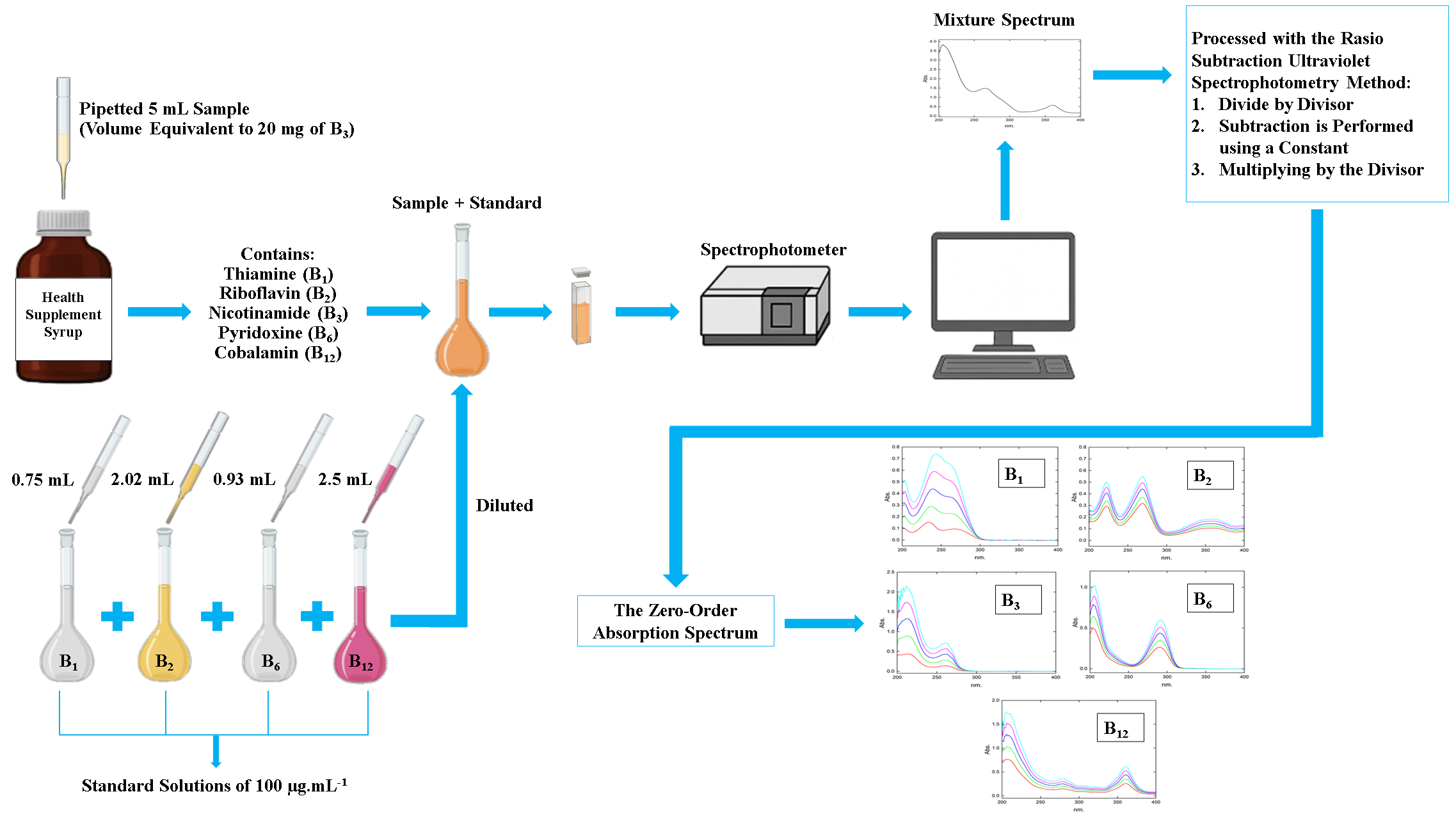
- This method involves sequential division of the spectrum using selected vitamins as divisors, followed by mathematical subtraction and multiplication to reconstruct the 0-order absorption spectrum of each compound.
- Eliminates the need for chromatographic separation, enabling selective detection despite overlapping spectra in multicomponent mixtures.
- Validated according to ICH guidelines, demonstrating excellent linearity (r ≤ 1), high accuracy (recoveries between 90% - 110%), precision (RSD ≤ 2%), and achieves low LOD and LOQ values, ensuring sensitive and reliable detection of each vitamin component.
- Offers a rapid and selective alternative to HPLC method, eliminating the need for derivatization, software modeling, or high-cost instrumentation.
GRAPHICAL ABSTRACT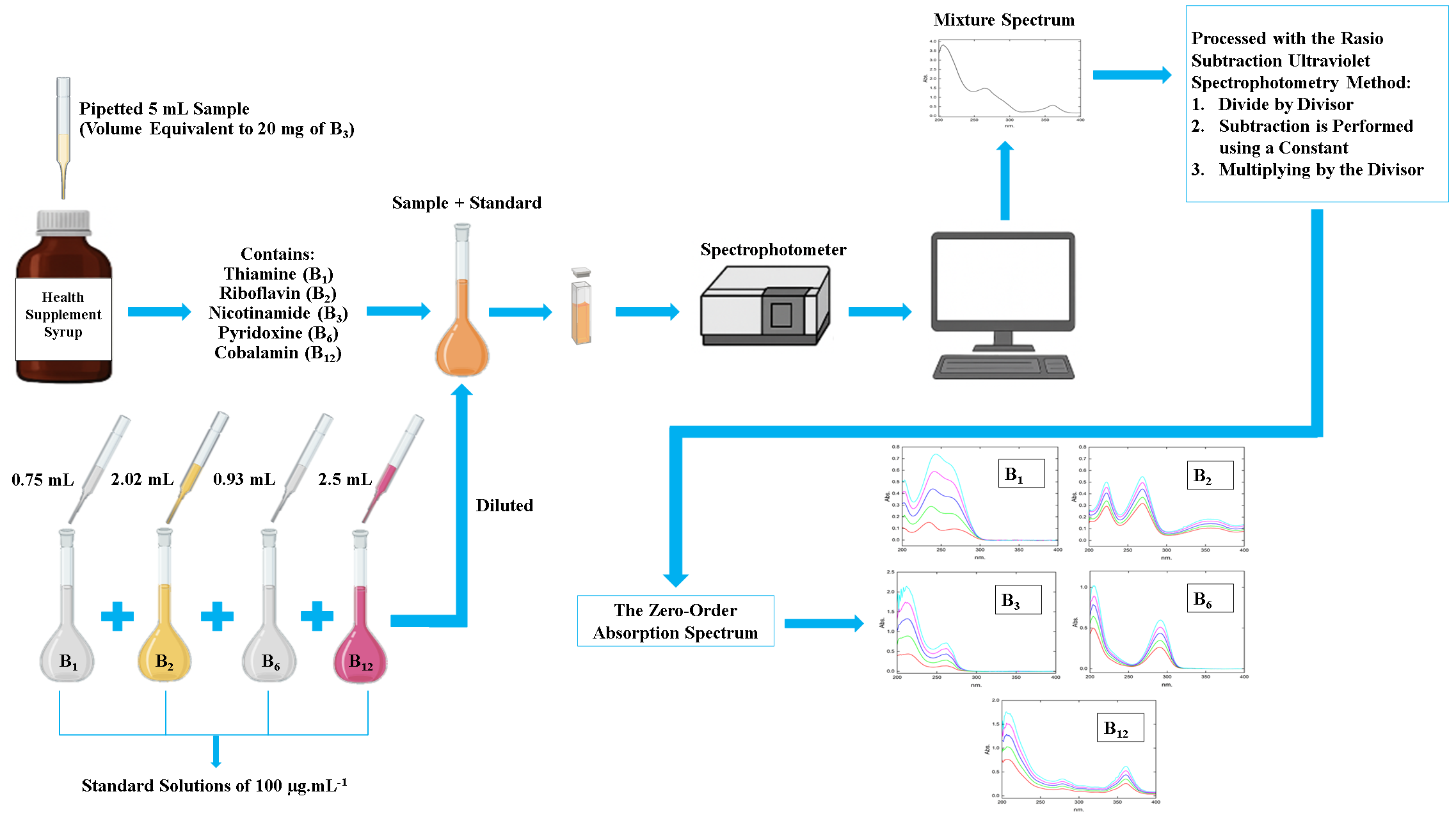
Downloads
References
ŽT Rakuša, A Grobin and R Roškar. A comprehensive approach for the simultaneous analysis of all main water-soluble vitamins in multivitamin preparations by a stability-indicating HPLC-DAD method. Food Chemistry 2021; 337, 127768.
SA Ullah, G Razaque, M Arsalan, GM Shahwani, N Ul-haq and NA Shahwani. Decomposition of vitamins in multivitamin syrups of different brands under various storage conditions. Pak-Euro Journal of Medical and Life Sciences 2022; 5(2), 229-242.
Ysphaneendramallimoggala, M Biswas, SE Anburaj, F Iqbal, A Shrikiran, VB Suryakanth and LES Lewis. Thiamine: An indispensable regulator of paediatric neuro-cardiovascular health and diseases. European Journal of Pediatrics 2024; 183(11), 4597-4610.
M Mrowicka, J Mrowicki, G Dragan and I Majsterek. The importance of thiamine (vitamin B1) in humans. Bioscience Reports 2023; 43(10), BSR20230374.
N Suwannasom, I Kao, A Pruß, R Georgieva and H Bäumler. Riboflavin: The health benefits of a forgotten natural vitamin. International Journal of Molecular Sciences 2020; 21(3), 950.
L Camillo, E Zavattaro and P Savoia. Nicotinamide: A multifaceted molecule in skin health and beyond. Medicina 2025; 61(2), 254.
P Zhang, T Suda, S Suidasari, T Kumrungsee, N Yanaka and N Kato. Novel preventive mechanisms of vitamin B6 against inflammation, inflammasome, and chronic diseases. In: VB Patel (Ed.). Molecular nutrition. Academic Press, Amsterdam, Netherlands, 2020, p. 283-299.
G Rizzo and AS Laganà. A review of vitamin B12. In: VB Patel (Ed.). Molecular nutrition. Academic Press, Amsterdam, Netherlands, 2020, p. 105-129.
RE Tarigan, ELF Mendrofa and C Surbakti. Simultaneous determination of isoniazid and pyridoxine hydrochloride in tablet dosage forms using ratio subtraction spectrophotometry. Jurnal Kimia dan Pendidikan Kimia 2024; 9(1), 1-14.
Z Anwar, A Noreen, M Usmani, Z Akram, MA Ejaz, MA Sheraz, S Ahmed, S Zahid, S Sabir and SG Musharraf. A kinetic study for the estimation of riboflavin sensitized photooxidation of pyridoxine HCl using green UV-visible spectrometric and HPLC methods. RSC Advances 2024; 14(53), 39174-39192.
ML Mia, MZ Sultan, MA Ali, HA Simol and MA Salam. Quantification of riboflavin and thiamine in GI (Geographical indication) branded yogurts collected from bogura, bangladesh using HPLC equipped with a fluorescence detector. Bangladesh Pharmaceutical Journal 2024; 27(1), 59-66.
S Saini, S Mandal and D Agarwal. Development and validation of RP-HPLC method for the simultaneous estimation of methionine, pyridoxine hydrochloride and nicotinamide in combined dosage form. Asian Journal of Pharmaceutical Research and Development 2021; 9(1), 95-101.
I Avrămia, MA Oroian and RC Oiţă. A review of current trends of vitamin identification and quantification by chromatography from food samples. Journal of Food Composition and Analysis 2024; 131(1), 106244.
W Maeaba, P Singh and S Prasad. Development of method for simultaneous determination of water-soluble vitamins (B2, B3 , B6 , B9 and C) in guava (Psidium guineense) fruit by HPLC-photodiode array detection. Journal of Food Composition and Analysis 2025; 144, 107569.
J Żandarek, Ż Binert-Kusztal, M Starek and M Dąbrowska. Development and optimization of chromatographic conditions for the determination of selected B vitamins in pharmaceutical products. Processes 2023; 11(3), 937.
M Chutkowski, P Ziobrowski, M Przywara, J Kamińska and W Zapała. Studies on the effects of process conditions on separation of B1, B2 and B3 vitamin mixture using HILIC and RPLC chromatography. AgriEngineering 2022; 4(3), 566-591.
A Moustafa, RS El-Kamel, S Abdelgawad, AM Fekry and M Shehata. Electrochemical determination of vitamin B6 (pyridoxine) by reformed carbon paste electrode with iron oxide nanoparticles. Ionics 2022; 28(2), 4471-4484.
B Polak and E Pajurek. Separation of some vitamins in reversed-phase thin-layer chromatography and pressurized planar electrochromatography with eluent containing surfactant. Scientific Reports 2021; 11(1), 21851.
K Porter and JK Lodge. Determination of selected water-soluble vitamins (thiamine, riboflavin, nicotinamide and pyridoxine) from a food matrix using hydrophilic interaction liquid chromatography coupled with mass spectroscopy. Journal of Chromatography B 2021; 1171, 122541.
LR Nasution, SE Flavia, Y Metripermata, M Bachri, H Syahputra and C Surbakti. Simultaneous analysis of isoniazid and pyridoxine hydrochloride in tablet dosage form using partial least squares based on infrared spectra profile. International Journal of Applied Pharmaceutics 2025; 17(2), 449-455.
A Todorovski, N Geskovski, M Petreska, E Deconinck, H Rebière, N Nakov, K Brezovska and J Acevska. Screening the capability of vibrational spectroscopic techniques for simultaneous quantification of vitamins B1, B6, and B12 in a powder blend. Vibrational Spectroscopy 2024; 133, 103711.
MD Harfiansyah, EDL Putra and SM Sinaga. Simultaneous determination of vitamins B1, B2, B3, B6, and B12 in tablet forms using the area under the curve ultraviolet spectrophotometry method. International Journal of Research and Review 2024; 11(12), 56-61.
AK Demirkaya, FD Miloglu and O Senol. UV-Vis spectrophotometric-assisted chemometric calibration models for simultaneous determination of thiamine and pyridoxine vitamins in powdered infant formula. Macedonian Pharmaceutical Bulletin 2021; 67(2), 33-41.
M Lohrdy, MR Sohrabi and M Davallo. A simple UV spectrophotometric method based on continuous wavelet transform and multivariate calibration model for the concurrent analysis of three water-soluble vitamins in fertility supplements. Journal of AOAC International 2024; 107(1), 164-176.
CAB Filho, RF Teixeira, JL Dias, EA Rebelatto and M Lanza. First-order derivative spectrophotometry for simultaneous determination of vitamin C and nicotinamide: Application in quantitative analysis of cocrystals. ACS Omega 2024; 9(26), 28776-28783.
Suprapto, YL Ni’Mah and RA Hisana. Robust regression analysis of full overlapping caffeine and pyridoxine HCl UV-Vis spectra in pharmaceutical tablet. Malaysian Journal of Fundamental and Applied Sciences 2023; 19(4), 539-552.
J Mendonsa, S Gandhi and A Mahajan. Quantification of ternary mixture of paracetamol, chlorzoxazone and ibuprofen present in tablet dosage form using ratio subtraction spectrophotometric approaches. Spectrochimica Acta Part A: Molecular and Biomolecular Spectroscopy 2024; 310,123891.
P Mukherjee, DD Chakraborty, P Chakraborty, B Shrestha and NR Bhuyan. Different ultraviolet spectroscopic methods: A retrospective study on its application from the viewpoint of analytical chemistry. Asian Journal of Pharmaceutical and Clinical Research 2021; 14(9), 1-11.
AK Petrides, JL Dahlin and SEF Melanson. Method validation. In: W Clarke and MA Marzinke (Eds.). Contemporary practice in clinical chemistry. Academic Press, Amsterdam, Netherlands, 2020, p. 57-72.
A Alqahtani, T Alqahtani and S Ramzy. Utilization of absorbance subtraction and ratio difference green spectrophotometric methods for the quantification of alfuzosin hydrochloride and tadalafil in their binary mixture. BMC Chemistry 2024; 18, 96.
USP Convention. The united states pharmacopeia 38 and the national formulary 33. USP Convention, Washington DC, 2015.
Published
How to Cite
Issue
Section
License
Copyright (c) 2025 Walailak University

This work is licensed under a Creative Commons Attribution-NonCommercial-NoDerivatives 4.0 International License.





