
L-Ascorbic Acid (LAA) Supplementation Enhances Proliferation and Reduces Cellular Senescence in Adipose-Tissue Mesenchymal Stem Cells (AT-MSC) Without Altering Characterization
DOI:
https://doi.org/10.48048/tis.2025.10911Keywords:
AT-MSCs, L-ascorbic acid, Proliferation, Viability, Differentiation, Characterization, Senescent cell, AT-MSCs, L-ascorbic acid, Proliferation, Viability, Differentiation, Characterization, Senescent cellAbstract
Adipose-tissue mesenchymal stem cells (AT-MSCs) and their secretome have been widely utilized in the field of anti-aging and regenerative medicine. However, the number of AT-MSCs declines during subculture due to cellular senescence. The addition of antioxidant such as L-ascorbic acid (LAA), which has been shown to promote proliferation and differentiation while reducing oxidative stress, may help mitigate cellular senescence. Nevertheless, the optimal dose of LAA supplementation for AT- MSC culture remains unclear. To identify the potential optimal dose, a cell survival assay was performed. Following the determination of the optimal dose, the morphology, proliferation, viability, differentiation, and characterization of AT-MSCs were evaluated. Additionally, a senescence-associated β-galactosidase (SA- β-Gal) assay was conducted to assess the effect of LAA on cellular aging.
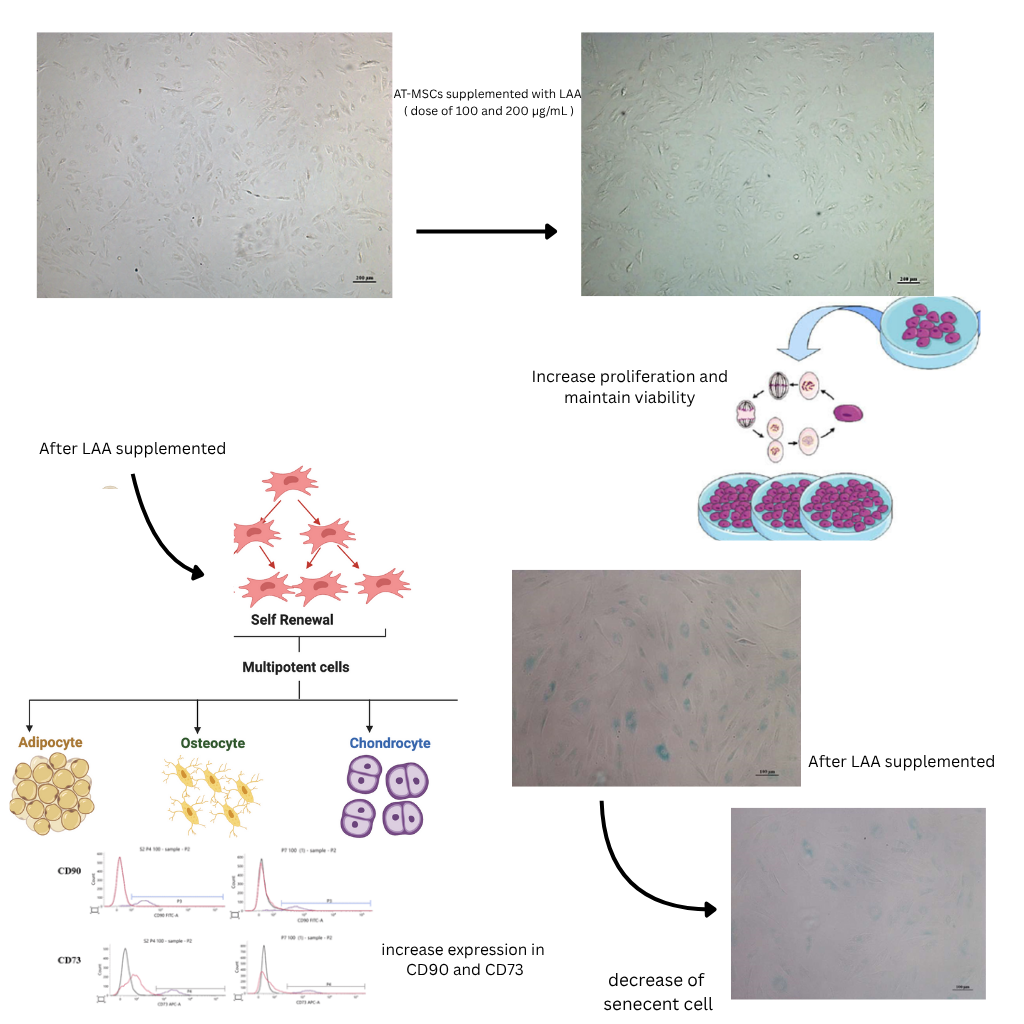
LAA at concentration of 100 and 200 µg/mL LAA demonstrated the ability to maintain high cell viability. Proliferation of AT-MSCs increased significantly in a dose-dependent manner (p < 0.05) following LAA supplementation, while cell viability remained above 90% (p > 0.05), indicating no significant cytotoxicity. LAA treated AT-MSCs also successfully differentiated into chondrocytes, osteocytes and adipocytes, comparable to those cultured under standard conditions. Throughout serial passages, AT-MSCs consistently expressed CD90, CD73, with lower expression of CD105. Moreover, LAA treatment at 100 µg/mL significantly reduced (p < 0.05) the number of senescent cells. Both 100 and 200 µg/mL doses were effective in maintaining cell morphology, supporting high viability, enhancing proliferation, and preserving the differentiation potential. These doses also contributed to reducing cellular senescence while maintaining the expression profile of MSCs surface marker across passages.
HIGHLIGHTS
- This article focused on the optimal dose of supplementation of LAA into AT-MSC culture in different passages to have a better known of its effect on proliferation, viability, differentiation and mitigate cellular senescence during culture without altering MSC characterization
- Reported dose of 100 and 200 µg/mL LAA significantly (p < 0.05) increase proliferation of AT-MSCs culture between passages, meanwhile also maintaining cell viability (p > 0.05) compared to untreated group
- Reported dose of 100 and 200 µg/mL LAA supplementation to AT-MSCs culture successfully differentiated into chondrocytes, osteocytes and adipocytes
- Reported dose of 100 and 200 µg/mL LAA supplementation to AT-MSCs culture consistently expressing CD90 and CD73, but lower expression in CD105 between passages
- Reported dose of 100 µg/mL LAA supplementation to AT-MSCs culture significantly reduced (p < 0.05) the number of senescent cells
GRAPHICAL ABSTRACT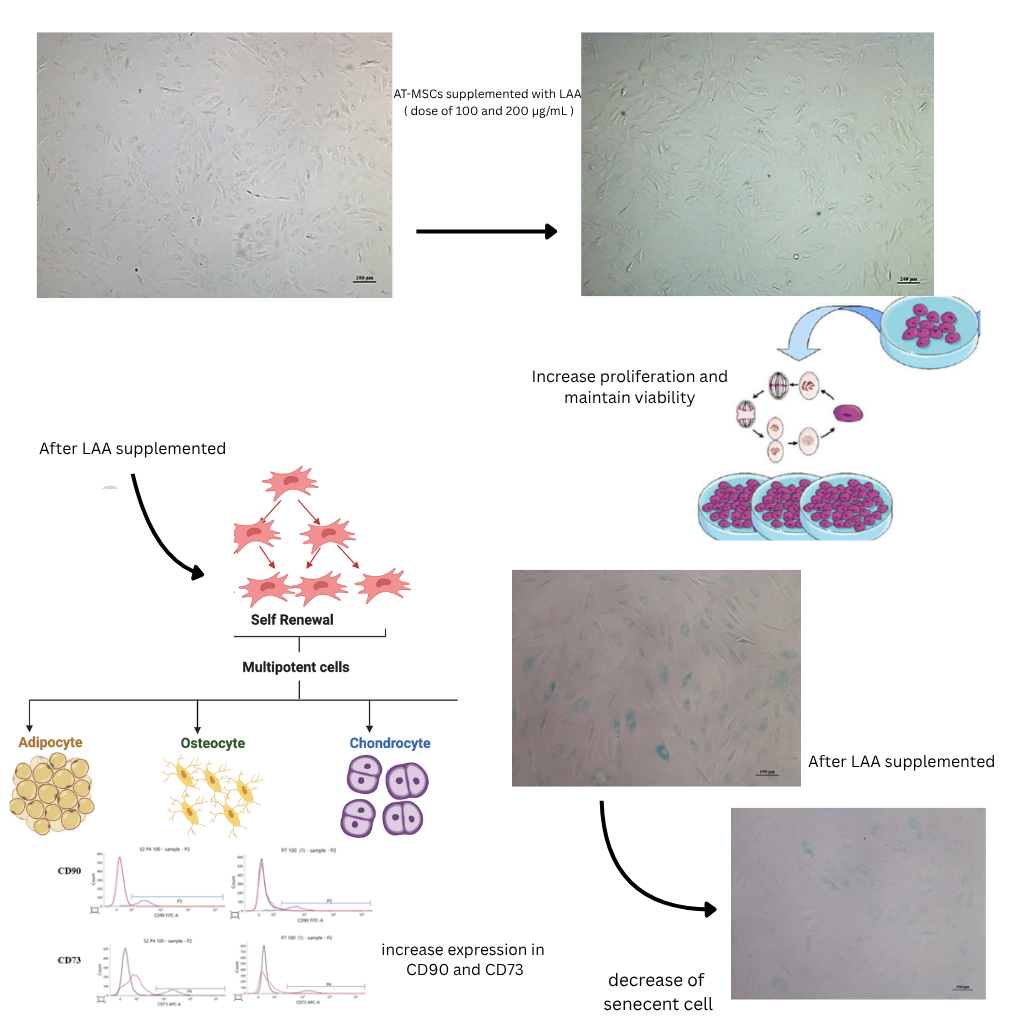
Downloads
References
F Urdiales-Gálvez, S Martín-Sánchez, M Maíz-Jiménez, A Castellano-Miralla and L Lionetti-Leone. Concomitant use of hyaluronic acid and laser in facial rejuvenation. Aesthetic Plastic Surgery 2019; 43(4), 1061-1070.
Y Shimizu, EH Ntege and H Sunami. Current regenerative medicine–based approaches for skin regeneration: A review of literature and a report on clinical applications in Japan. Regenerative Therapy 2022; 21, 73-80.
KA Wahyuningsih. Effect of L-ascorbic acid-2-phosphate towards proliferation rate of human adipose-derived stem cells. Sapporo Medical Journal 2020; 54(7), 07.
SN Kim, CJ Lee, JH Nam, B Choi, E Chung and SU Song. The effects of human bone marrow-derived mesenchymal stem cell conditioned media produced with fetal bovine serum or human platelet lysate on skin rejuvenation characteristics. International Journal of Stem Cells 2021; 14(1), 94-102.
KN Kunze, RA Burnett, J Wright-Chisem, RM Frank and J Chahla. Adipose-derived mesenchymal stem cell treatments and available formulations. Current Reviews in Musculoskeletal Medicine 2020; 13(3), 264-280.
K Karina, I Rosliana, S Sobariah, I Rosadi, I Afini, T Widyastuti, M Remelia,D Sukmawati and JA Pawitan. Diabetes mellitus type 2 reduces the viability, proliferation, and angiogenic marker of adipose-derived stem cells cultured in low-glucose antioxidant-serum supplemented medium. Biomedical Research and Therapy 2019; 6(3), 3073-3082.
M Yang, S Teng, C Ma, Y Yu, P Wang and C Yi. Ascorbic acid inhibits senescent in mesenchymal stem cells through ROS and AKT/mTOR signalling. Cytotechnology 2018; 70(5), 1301-1313.
YC Boo. Ascorbic acid (Vitamin C) as a cosmeceutical to increase dermal collagen for skin antiaging purposes: emerging combination therapies. Antioxidants 2022; 11(9), 1663.
S Bhandi, A Alkahtani, M Mashyakhy, AS Abumelha, NHM Albar, A Renugalakshmi, MF Alkahtany, A Robaian, AS Almeslet, VR Patil, S Varadarajan, TM Balaji, R Reda, L Testarelli and S Patil. Effect of ascorbic acid on differentiation, secretome, and stemness of stem cells from human exfoliated deciduous tooth (SHEDs). Journal of Personalized Medicine 2021; 11(7), 589.
N Liao, Y Shi, C Zhang, Y Zheng, Y Wang, B Zhao, Y Zeng, X Liu and J Liu. Antioxidants inhibit cell senescent and preserve stemness of adipose tissue-derived stem cells by reducing ROS generation during long-term in vitro expansion. Stem Cell Res & Therapy 2019; 10(1), 306.
A Starifulkani, DI Hadisoebroto, PJ Adiwinata, A Ria and GY Ismail. Senescent profile of cryopreserved adipose mesenchymal stem cells after multiple passages. Advanced Science Letters 2017; 7(23), 6921-6927.
K Fujisawa, K Hara, T Takami, S Okada, T Matsumoto, N Yamamoto, I Sakaida, N Yamamoto and I Sakaida. Evaluation of the effect of ascorbic acid on metabolism of human mesenchymal stem cells. Stem Cell Research & Therapy 2018; 9(1), 93.
KM Choi, YK Seo, HH Yoon, KY Song, SY Kwon and HS Lee. Effects of L-ascorbic acid on adipose-derived stem cells in cartilage tissue engineering. Cell Stem Cell 2020; 24(7), 987-997.
TJ Kim, JS Byun, HS Kwon and DY Kim. Cellular toxicity driven by high-dose vitamin C on normal and cancer stem cells. Biochemical and Biophysical Research Communications 2018: 497(1), 347-353.
P Zhang, J Li, Y Qi, Y Zou, L Liu, X Tang, J Duan, H Liu and G Zeng. Vitamin C promotes the proliferation of human adipose-derived stem cells via p53-p21 pathway. Organogenesis 2016; 12(3), 143-151.
D Ivanyuk, G Budash, Y Zheng, JA Gaspar, U Chaudhari, A Fatima, S Bahmanpour, VK Grin, AG Popandopulo, A Sachinidis, J Hescheler and T Šarić. Ascorbic acid-induced cardiac differentiation of murine pluripotent stem cells: transcriptional profiling and effect of small molecue synergist of Wnt/β- catenin signalling pathway. Cellular Physiology and Biochemistry 2015; 36(2), 810-830.
MSR Varela, S Mucci, GAV Richardson, OM Hanon, VA Furmento, SG Miriuka, GE Sevlever, ME Scassa and L Romorini. Regulation of cyclin E1 ekspression in human pluripotent stem cells and derived neural progeny. Cell Cycle 2018; 17(14), 1721-1744.
Y Sorimachi, H Kobayashi, Y Shiozawa, S Koide, R Nakato, Y Shimizu, T Okamura, K Shirahige, A Iwama, N Goda, K Takubo and K Takubo. Mesenchymal loss of p53 alters stem cell capacity and models human soft tissue sarcoma traits. Stem Cell Reports 2023; 18(5), 1211-1226.
CP Segeritz and L Vallier. Cell culture: Growing cells as model systems in vitro. In: M Jalali, FYL Saldanha and M Jalali (Eds.). Basic science methods for clinical researchers. Academic Press, Cambridge, 2017, p. 151-172.
MT Valenti, M Zanatta, L Donatelli, G Viviano, C Cavallini, MT Scupoli and LD Carbonare. Ascorbic acid induces either differentiation or apoptosis in MG-63 osteosarcoma lineage. Anticancer Research 2015; 34(4), 1617-1628.
K Engeland. Cell cycle regulation: p53-p21 RB signalling. Cell Death & Diff 2022; 29(5), 946-960.
T Debnath and LK Chelluri. Standardization and quality assessment for clinical grade mesenchymal stem cells from human adipose tissue. Hematology, Transfusion and Cell Therapy 2019; 41(1), 7-16.
K Izgi, MF Sonmez, H Canatan and B Iskender. Long term exposure to myrtucommulone-a changes CD105 expression and differentiation potential of mesenchymal stem cells. Tissue Engineering and Regenerative Medicine 2017; 14(2), 113-121.
D Wang, N Liu, Y Xie, B Song, S Kong and X Sun. Different culture method changing CD105 expression in amniotic fluid MSCs without affecting differentiation ability of immune function. Journal of Cellular and Molecular Medicine 2020; 24(7), 4212-4222.
LH Pham, NB Vu and PV Pham. The subpopulation of CD105 negative mesenchymal stem cells show strong immunomodulation capacity compared to CD105 positive mesenchymal stem cells. Biomedical Research and Therapy 2019; 6(4), 3131-3140.
Y Sato, H Mera, D Takahashi, T Majima, N Iwasaki, S Wakitani and M Takagi. Synergistic effect of ascorbic acid and collagen addition on the increase in type 2 collagen accumulation in cartilage-like MSC sheet. Cytotechnology 2017; 69(3), 406-416.
KS Park, SK Kim, MS Kim, HS Kim, HJ Kim, KW Chung and BK Kim. L-ascorbic acid enhances adipogenesis by promoting mitotic clonal expansion and cell cycle progression through the extracellular signal-regulated kinase pathway. Molecular Medicine Reports 2017; 16(1), 1915-1920.
I Rosadi, FT Indrady, K Karina and N Hariani. Evaluation effects of ascorbic acid lead to activate and induce protein marker expression: In silico and in-vitro study. Biomedical Research and Therapy 2022; 9(1), 4832-4841.
Z Chang, L Huo, P Li, Y Wu and P Zhang. Ascorbic acid provides protection for human chondrocytes against oxidative stress. Molecular Medicine Reports 2015; 12(5), 7086-7092.
M Marinkovic, R Sridharan, F Santarella, A Smith, JA Garlick and CJ Kearney. Optimization of extracellular matrix production from human induced pluripotent stem cell-derived fibroblasts for scaffold fabrication for application in wound healing. Journal of Biomedical Materials Research Part A 2021; 109(10), 1803-1811.
L Maione-Silva, EGD Castro, TL Nascimento, ER Cintra, LC Moreira, BAS Cintra, MC Valadares and EM Lima. Ascorbic acid encapsulated into negatively charged liposomes exhibits increased skin permeation, retention and enhances collagen synthesis by fibroblasts. Scientific Reports 2019; 9(1), 522.
G Hoxhaj and BD Manning. The PI3K-AKT network at the interface of oncogenic signalling and cancer metabolism. Nature Reviews Cancer 2020; 20(2), 74-88.
S Zhang, P Liu, L Chen, Y Wang, Z Wang and B Zhang. The effects of spheroid formation of adipose- derived stem cells in a microgravity bioreactor on stemness properties and therapeutic potential. Biomaterials 2015; 41, 15-25.
Published
How to Cite
Issue
Section
License
Copyright (c) 2025 Walailak University

This work is licensed under a Creative Commons Attribution-NonCommercial-NoDerivatives 4.0 International License.





