
Chemical Components of a Submerged Mycelial Extract of Calocybe indica and its Anti-inflammatory and Antiaging Properties
DOI:
https://doi.org/10.48048/tis.2025.10817Keywords:
Antioxidant, Anti-inflammation, Calocybe indica, Cosmeceutical, Mushroom, Nutraceutical, Submerged cultureAbstract
Calocybe indica or milky mushrooms, grown in submerged culture, is a potential source of antiaging substances. This study investigated the chemical components, cytotoxicity to RAW 264.7 macrophage cells, and anti-inflammatory activity to human skin keratinocytes (HaCaT) of the ethanolic extract prepared from C. indica mycelia grown in submerged culture. Gas chromatography-mass spectrometry (GC-MS) analysis revealed the presence of 50 bioactive compounds, which were primarily categorized into the following major groups: fatty acids (81.97%), esters (4.25%), ketones (1.68%), aldehydes (1.62%), sterols (0.76%), phenols (0.45%), terpenes (0.36%), and others (8.91%). These act as major contributors to its anti-inflammatory and cosmeceutical properties. The C. indica mycelial extract was non-toxic to RAW 264.7 macrophage cells. Comparable and significant levels of anti-inflammatory activity were observed in both the mycelial extract and control barley b-glucan. The results show a stimulation of the anti-inflammatory cytokine interleukin-10 (IL-10) at 250.7 pg/mL or 63.4% and an inhibition of the pro-inflammatory cytokine IL-6 at 88.3 pg/mL or 69.8%. The anti-inflammatory effect of prostaglandin E2 (PGE2) was observed with a release of PGE2 at 20.31 pg/mL or 70.8% inhibition. Cosmeceutical formulations made with the mycelial extract, particularly in essence form, followed by gel forms, maintained the extract’s bioactivities. The mycelial extract served as an effective antioxidant agent in cosmeceutical formulations that can inhibit collagenase, inflammation, and acne-causing bacteria, providing a dual approach to simultaneously treating both skin aging and acne. This research offers novel insights into C. indica mycelium as a valuable source of nutraceutical and pharmaceutical compounds that contribute to various human health benefits. The mycelial extract of C. indica possesses no toxic effects and has multiple cosmeceutical functionalities. The results suggest that the mycelial extracts of C. indica could be further developed to produce safe natural ingredients for inclusion in nutraceutical and cosmeceutical products.
HIGHLIGHTS
- This is the first report detailing chemical components of ethanolic extracts derived from Calocybe indica mycelia grown in submerged culture.
- indica mycelium grown submerged is a valuable source of nutraceutical and pharmaceutical compounds that contribute to various human health benefits.
- Mycelial extract of indica contains promising antioxidant agents that can inhibit collagenase, inflammation, and acne-causing bacteria, providing a dual approach to simultaneously treating both skin aging and acne.
GRAPHICAL ABSTRACT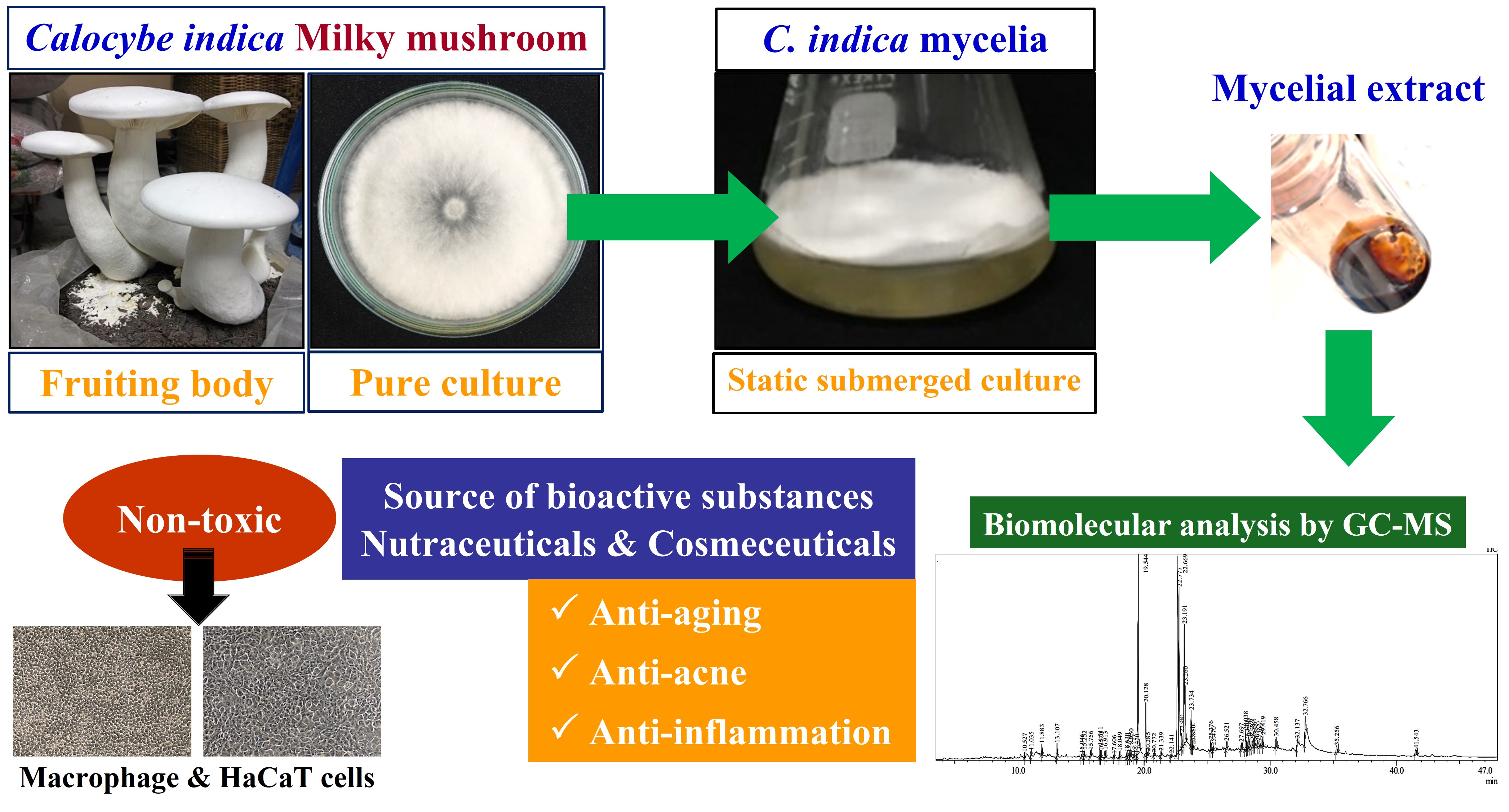
Downloads
References
O Taofiq, SA Heleno, RC Calhelha, MJ Alves, L Barrose, MF Barreiro, AM Gonzalez-Paramas and ICFR Ferreira. Development of mushroom-based cosmeceutical formulations with anti-inflammatory, anti-tyrosinase, antioxidant, and antibacterial properties. Molecules 2016; 21(10), 1372.
UT Dudekula, K Doriya and SK Deverai. A critical review on submerged production of mushroom and their bioactive metabolites. 3 Biotech 2020; 10(8), 337.
HS Mayirnao, K Sharma, P Jangir, S Kaur and R Kapoor. Mushroom-derived nutraceuticals in the 21st century: An appraisal and future perspectives. Journal of Future Foods. 2025; 5(4), 342-360.
A Singh, RK Saini, A Kumar, P Chawla and R Kaushik. Mushrooms as nutritional powerhouses: A review of their bioactive compounds, health benefits, and value-added products. Foods 2025; 14(5), 741.
RCG Correa, AHP De Souza, RC Calhelha, L Barros, J Glamoclija, M Sokovic, RM Peralta, A Bracht and ICFR Ferreira. Bioactive formulations prepared from fruiting bodies and submerged culture mycelia of the Brazilian edible mushroom Pleurotus ostreatoroseus Singer. Food & Function 2015; 6(7), 2155-2164.
AA Khan, A Gani, FA Khanday and FA Masoodi. Biological and pharmaceutical activities of mushroom 𝛽-glucan discussed as a potential functional food ingredient. Bioactive Carbohydrates and Dietary Fibre 2018; 16, 1-13.
N Asuraphong, T leepasert, W Taengphan and C Teerapatsakul. Efficient mycelial biomass and bioactive compound production by Lentinus squarrosulus mycelia grown in an airlift bioreactor as a new source of cosmeceutical biological substances. Trends in Sciences 2025; 22(6), 9717.
T Krupodorova, V Barshteyn, V Dzhagan, A Pluzhnyk, T Zaichenko and Y Blume. Enhancement of antioxidant activity and total phenolic content of Fomitopsis pinicola mycelium extract. Fungal Biology and Biotechnology 2024; 11, 18.
AR Das, M Borthakur, AK Saha, SR Joshi and P Das. Growth of mycelial biomass and fruit body cultivation of Lentinus squarrosulus collected from home garden of Tripura in northeast India. Journal of Applied Biology and Biotechnology 2015; 3(4), 17-19.
N Vajrobol, W Taengphan and C Teerapatsakul. Enhancement of mycelial biomass production and bioactive properties related to cosmeceuticals of Calocybe indica (Milky Mushroom) by optimization of submerged culture conditions. Chiang Mai Journal of Science 2024; 51(5), e2024075.
G Bakratsas, A Polydera, P Katapodis and H Stamatis. Recent trends in submerged cultivation of mushrooms and their application as a source of nutraceuticals and food additives. Future Foods 2021; 4, 100086.
A Najda, A Bains, P Chawla, A Kumar, S Balant, M Walasek-Janusz, D Wach and R Kaushik. Assessment of anti-inflammatory and antimicrobial potential of ethanolic extract of Woodfordia fruticosa flowers: GC-MS analysis. Molecules 2021; 26(23), 7193.
A Bains, P Chawla, A Tripathi and PK Sadh. A comparative study of antimicrobial and anti-inflammatory efficiency of modified solvent evaporated and vacuum oven dried bioactive components of Pleurotus floridanus. Journal of Food Science and Technology 2021; 58(9), 3328-3337.
BB Fuller and DR Smith. Cosmetic formulation of skin care products. Taylor & Francis 2005; 30, 351-353.
R Ganceviciene, AI Liakou, A Theodoridis, E Makrantonaki and CC Zouboulis. Skin anti-aging strategies. Dermatoendocrinol 2012; 4(3), 308-319.
PT Vos, AD Flaxman, M Naghavi, R Lozano, C Michaud, M Ezzati, K Shibuya, JA Salomon, S Abdalla, V Aboyans, J Abraham, I Ackerman, R Aggarwal, SY Ahn, MK Ali, M Alvarado, HR Anderson, LM Anderson, KG Andrews, C Atkinson, …, ZA Memish. Years lived with disability (YLDs) for 1160 sequelae of 289 diseases and injuries 1990-2010: A systematic analysis for the global burden of disease study 2010. The Lancet 2012; 380(9859), 2163-2196.
AK McDonough, JR Curtis and KG Saag. The epidemiology of glucocorticoid-associated adverse events. Current Opinion in Rheumatology 2008; 20(2), 131-137.
M Shashikant, A Bains, P Chawla, M Fogarasi and S Fogarasi. The current status, bioactivity, food, and pharmaceutical approaches of Calocybe indica: A Review. Antioxidants 2022; 11(6), 1145.
RP Anju and M Ukkuru. Health impact and medicinal properties of nutritionally edible milky mushroom (Calocybe indica). International Journal of Advance Research in Engineering 2016; 3(11), 235-237.
SK Ghosh. Study of anticancer effect of Calocybe indica mushroom on breast cancer cell line and human Ewings sarcoma cancer cell lines. New York Science Journal 2015; 8(5), 10-15.
S Datta, J Dubey, S Gupta, A Paul, P Gupta and AK Mitra. Tropical milky white mushroom, calocybe indica (agaricomycetes): An effective antimicrobial agent working in synergism with standard antibiotics. International Journal of Medicinal Mushrooms 2020; 22(4), 335-346.
M Shashikant, A Bains, P Chawla, M Sharma, R Kaushik, S Kandi and RC Kuhad. In-vitro antimicrobial and anti-inflammatory activity of modified solvent evaporated ethanolic extract of Calocybe indica: GCMS and HPLC characterization. International Journal of Food Microbiology 2022; 376, 109741.
L Yin, Y Wei, Y Wang, Y Xu and Y Yang. Long term and standard incubations of WST-1 reagent reflect the same inhibitory trend of cell viability in rat airway smooth muscle cells. International Journal of Medical Sciences 2013; 10(1), 68-72.
S Kim, J Kim, O Kang, S Mun, Y Seo, D Kang, D Yang, S Ryu, Y Lee and D Kwon. Protective effect of ixerisoside A against UVB-induced pro-inflammatory cytokine production in human keratinocytes. International Journal of Medical Sciences 2015; 35(5), 1411-1418.
EH Erbiai, B Amina, A Kaoutar, R Saidi, Z Lamrani, E Pinto, JCGED Silva, A Maouni and LPD Silva. Chemical characterization and evaluation of antimicrobial properties of the wild medicinal mushroom Ganoderma lucidum growing in northern Moroccan forests. Life 2023; 13(5), 1217.
RK Saini, A Rauf, AA Khalil, K Eun-Young, K Young-Soo, S Anwar, A Alamri and KRR Rengasamy. Edible mushrooms show significant differences in sterols and fatty acid compositions. South African Journal of Botany 2021; 141, 344-356.
FT Johra, S Hossain, P Jain, AT Bristy, T Emran, R Ahmed, SM Sharker, AK Bepari and HM Reza. Amelioration of CCl4 – induced oxidative stress hepatotoxicity by ganoderma lucidum in long evans rats. Scientific Reports 2023; 13(1), 9909.
G Chelladurai, TK Yadav and RK Pathak. Chemical composition and nutritional value of paddy straw milky mushroom (calocybe indica). Nature Environment and Pollution Technology 2021; 20(3), 1157-1164.
ZY Chen, PT Chan, KY Kwan and A Zhang. Reassessment of the antioxidant activity of conjugated linoleic acids. Journal of the American Oil Chemists’ Society 1997; 74(6), 749-753.
M Obodai, DLN Mensah, A Fernandes, NK Kortei, M Dzomeku, M Teegarden, SJ Schwartz, L Barros, J Prempeh, RK Takli and ICFR Ferreira. Chemical characterization and antioxidant potential of wild ganoderma species from Ghana. Molecules 2017; 22(2), 196.
S Sharma and R Singh. Forensic analysis of wild toxic and edible amanita mushrooms by gas chromatography-mass spectrometry. Arab Journal of Forensic Sciences and Forensic Medicine 2021; 3(1), 31-49.
S Sindhu, M Theradimani, S Vellaikumar, M Paramasivam and V Ramamoorthy. Oyster mushroom with short cropping duration and good taste developed through mono-monokaryons hybrdization. Research Square, North Carolina, 2023.
SM Mousavi, SA Hashemi, A Gholami, N Omidifar, WH Chiang, VR Neralla, K Yousefi and M Shokripour. Ganoderma lucidum methanolic extract as a potent phytoconstituent: Characterization, in-vitro antimicrobial and cytotoxicity activity. Scientific Reports 2023; 13, 17326.
EM Mohamed and FA Farghaly. Bioactive compounds of fresh and dried Pleurotus ostreatus mushroom. International Journal of Biotechnology for Wellness Industries 2014; 3, 4-14.
S Kumar, M Karnan and A Panneerselvam. Investigation of bioactive compounds on Volvariella bombycina using GC-MS. International Journal of Pharmacy and Biological Sciences 2019; 9(3), 344-347.
PC Nguyen, MTT Nguyen, BT Truong, D Kim, S Shin, J Kim, K Park, J Park, PL Tran, S Ban, J Kim and J Park. Isolation, physicochemical characterization, and biological properties of inotodiol, the potent pharmaceutical oxysterol from chaga mushroom. Antioxidants 2023; 12(2), 447.
V Mishra, S Tomar, P Yadav, S Vishwakarma and MP Singh. Elemental analysis, phytochemical screening and evaluation of antioxidant, antibacterial and anticancer activity of pleurotus ostreatus through in vitro and in silico approaches. Metabolites 2022; 12(9), 821.
H Rathore, S Prasad, S Sehwag and S Sharma. Vitamin D2 fortification of Calocybe indica mushroom by natural and artificial UVB radiations and their potential effects on nutraceutical properties. 3 Biotech 2020; 10(2), 41.
FS Reis, E Pereira, L Barros, MJ Sousa, A Martins and ICFR Ferreira. Biomolecule profiles in inedible wild mushrooms with antioxidant value. Molecules 2011; 16(6), 4328-4338.
O Gulmez, M Ozdal, OF Algur and B Yilmaz. Determination of chemical constituents and bioactive properties of alcohol extracts of Pleurotus sajor-caju and Pleurotus ostreatus. Journal of Information Science and Technology 2021; 11(3), 1734-1741.
Z Wang, M Li, J Fan, Y Bao and Q Chen. Cultivation and nutritional evaluation of agaricus bisporus with tea residue as culture Medium. Foods 2023; 12(13), 2440.
HB Sapan, I Paturusi, I Jusuf, I Patellongi, MN Massi, AD Pusponegoro, SK Arief, I Labeda, AA Islam, L Rendy and M Hatta. Pattern of cytokine (IL-6 and IL-10) level as inflammation and anti-inflammation mediator of multiple organ dysfunction syndrome (MODS) in polytrauma. International Journal of Burns and Trauma 2016; 6(2), 37-43.
JM Rojas, M Avia, V Martin and N Sevilla. IL-10: A multifunctional cytokine in viral infections. Journal of Immunology Research 2014; 2017(1), 6104054.
SK Dhar, K Vishnupriyan, S Damodar, S Gujar and M Das. IL-6 and IL-10 as predictors of disease severity in COVID-19 patients: Results from meta-analysis and regression. Heliyon 2021; 7(2), e06155
K Kawahara, H Hohjoh, T Inazumi, S Tsuchiya and Y Sugimoto. Prostaglandin E2-induced inflammation: Relevance of prostaglandin E receptors. Biochimica et Biophysica Acta (BBA) - Molecular and Cell Biology of Lipids 2015; 1851(4), 414-421.
MX Chen, KS Alexander and G Baki. Formulation and evaluation of antibacterial creams and gels containing metal ions for topical application. Journal of Pharmaceutical 2016; 2016(1), 5754349.
TM Barnes, D Mijalijica, JP Townley, F Spada and IP Harrison. Vehicles for drug delivery and cosmetic moisturizers: Review and comparison. Pharmaceutics 2021; 13(12), 2012.
JJ Torrado, BJ Anaya, A Kara, B Ongoren, S Esteban-Ruiz, A Laguna, A Guillen, MG Saro and DR Serrano. Unraveling the impact of the oil phase on the physicochemical stability and skin permeability of melatonin gel formulations. Gels 2024; 10(9), 595.
G Frei, A Haimhoffer, E Csapo, K Bodnar, G Vasvari, D Nemes, I Lekli, A Gyongyosi, I Bacskay, P Feher and L Jozsa. In vitro and in vivo efficacy of topical dosage forms containing self-nanoemulsifying drug delivery system loaded with Curcumin. Pharmaceutics 2023; 15(8), 2054.
SM Ali and G Yosipovitch. Skin pH: From basic science to basic skin care. Acta Dermato-Venereologica 2013; 93(3), 261-267.
JJ Martinez-Pla, Y Martin-Biosca, S Sagrado, RM Villanueva-Camanas and MJ Medina-Hernandez. Evaluation of the pH effect of formulations on the skin permeability of drugs by biopartitioning micellar chromatography. Journal of Chromatography A 2004; 1047(2), 255-262.
Published
How to Cite
Issue
Section
License
Copyright (c) 2025 Walailak University

This work is licensed under a Creative Commons Attribution-NonCommercial-NoDerivatives 4.0 International License.





