
An In Vitro Hypoxic Cancer Model Using CoCl2 on Vietnamese Breast Cancer Cells for Potential Drug Screening
DOI:
https://doi.org/10.48048/tis.2025.10815Keywords:
Breast cancer, Cancer in vitro model, Hypoxia, Autophagy, Hybrid EMT, StemnessAbstract
Developing effective anti-cancer drugs and overcoming drug resistance continue to pose significant challenges in cancer research and clinical practice. Despite notable advancements, existing cell culture models, including advanced 3D systems, often fall short in terms of speed, scalability, and cost-effectiveness, particularly for high-throughput screening. To address these limitations, this study introduces a simple, cost-effective hypoxia model using 250 µM cobalt (II) chloride (CoCl₂) in Vietnamese breast cancer cell lines (VNBRCA1) to simulate the tumor microenvironment. The induced hypoxic conditions resulted in a significant upregulation of stemness-related genes (Nanog, Sox-4, Oct-2), autophagy-related genes (LC3-II, Beclin-1), and hypoxia-related genes (HIF-1α, HIF-2α), as confirmed by real-time quantitative PCR (RT-qPCR). Functional assays demonstrated enhanced cell migration under hypoxia, as shown by RT-qPCR and wound healing analysis, potentially involving a hybrid epithelial-mesenchymal transition (EMT) mechanism. The model’s applicability was further assessed through cisplatin treatment, revealing distinct responses under hypoxic versus normoxic conditions. These findings suggest that the CoCl₂-induced hypoxia system offers a practical approach to simulating tumor microenvironments, providing a reproducible and scalable in vitro platform for studying tumor biology and evaluating anti-cancer strategies in a more physiologically relevant context.
HIGHLIGHTS
- A simple and cost-effective 2D hypoxia model was developed using cobalt (II) chloride (CoCl₂) in Vietnamese breast cancer cells (VNBRCA1) to mimic the tumor microenvironment.
- The induction of hypoxia resulted in a significant upregulation of key tumor-promoting genes associated with stemness (Nanog, Sox-4, Oct-2), autophagy (LC3-II, Beclin-1), and hypoxia markers (HIF-1α, HIF-2α), thereby more accurately reflecting the complexities of actual tumor biology.
- Hypoxia induced a hybrid epithelial-mesenchymal transition (EMT) phenotype and increased cell migration
- Cisplatin treatment revealed different drug responses under normoxic versus hypoxic conditions, highlighting the model’s relevance in studies of drug resistance.
GRAPHICAL ABSTRACT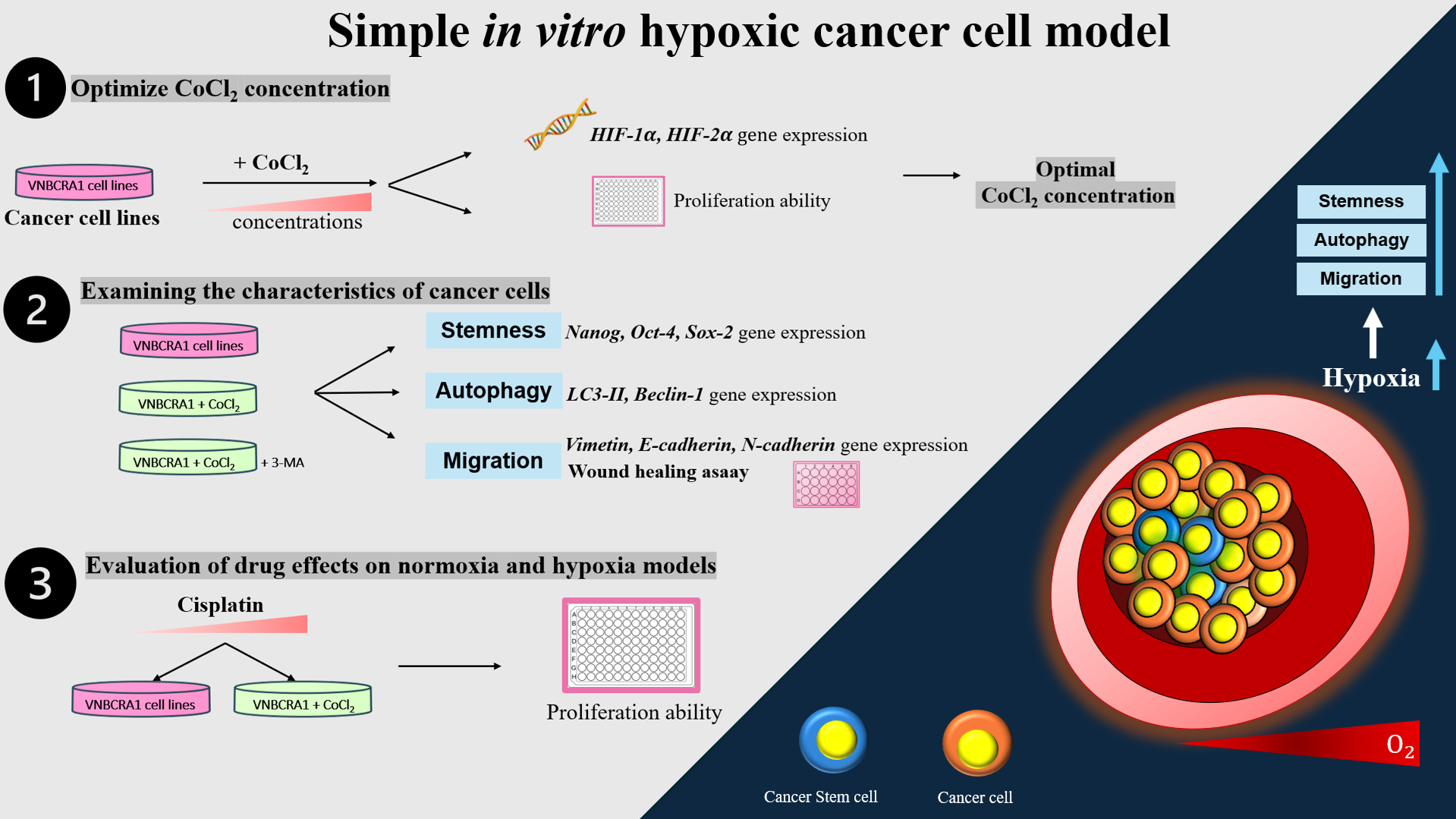
Downloads
References
F Bray, M Laversanne, H Sung, J Ferlay, RL Siegel, I Soerjomataram and A Jemal. Global cancer statistics 2022: GLOBOCAN estimates of incidence and mortality worldwide for 36 cancers in 185 countries. CA: A Cancer Journal for Clinicians 2024; 74(3), 229-263.
CH Wong, KW Siah and AW Lo. Estimation of clinical trial success rates and related parameters. Biostatistics 2019; 20, 273-286.
R Dave, K Pandey, R Patel, N Gour and D Bhatia. Leveraging 3D cell culture and AI technologies for next-generation drug discovery. Cell Biomaterials 2025; 1, 100050.
IR Powley, M Patel, G Miles, H Pringle, L Howells, A Thomas, C Kettleborough, J Bryans, T Hammonds, M MacFarlane and C Pritchard. Patient-derived explants (PDEs) as a powerful preclinical platform for anti-cancer drug and biomarker discovery. British Journal of Cancer 2020; 122, 735-744.
M Turetta, FD Ben, G Brisotto, E Biscontin, M Bulfoni, D Cesselli, A Colombatti, G Scoles, G Gigli and LLD Mercato. Emerging technologies for cancer research: Towards personalized medicine with microfluidic platforms and 3D tumor models. Current Medicinal Chemistry 2018; 25(35), 4616-4637.
MA Barbosa, CP Xavier, RF Pereira, V Petrikaitė and MH Vasconcelos. 3D cell culture models as recapitulators of the tumor microenvironment for the screening of anti-cancer drugs. Cancers 2021; 14, 190.
H Ruiz-Garcia, K Alvarado-Estrada, P Schiapparelli, A Quinones-Hinojosa and DM Trifiletti. Engineering three-dimensional tumor models to study glioma cancer stem cells and tumor microenvironment. Frontiers in Cellular Neuroscience 2020; 14, 558381.
A Baru, S Mazumdar, P Kundu, S Sharma, BPD Purakayastha, S Khan, Profile, R Gupta and NM Arora. Recapitulating tumor microenvironment using preclinical 3D tissueoids model for accelerating cancer research and drug screening. BioRxiv 2020; 21, 423825.
DA Barth, F Prinz, J Teppan, K Jonas, C Klec and M Pichler. Long-noncoding RNA (lncRNA) in the regulation of hypoxia-inducible factor (HIF) in cancer. Non-coding RNA 2020; 6, 27.
MZ Bakleh and AAH Zen. The distinct role of HIF-1α and HIF-2α in hypoxia and angiogenesis. Cells 2025; 14, 673.
RF Zaarour, B Azakir, EY Hajam, H Nawafleh, NA Zeinelabdin, AST Engelsen, J Thiery, C Jamora and S Chouaib. Role of hypoxia-mediated autophagy in tumor cell death and survival. Cancers 2021; 13(3), 533.
HR Yun, YH Jo, J Kim, Y Shin, SS Kim and TG Choi. Roles of autophagy in oxidative stress. International Journal of Molecular Sciences 2020; 21, 3289.
R Rakesh, LCP Dharshini, KM Sakthivel and RR Rasmi. Role and regulation of autophagy in cancer. Biochimica et Biophysica Acta (BBA) - Molecular Basis of Disease 2022; 1868, 166400.
D Ribatti, R Tamma and T Annese. Epithelial-mesenchymal transition in cancer: A historical overview. Translational Oncology 2020; 13, 100773.
I Akrida and H Papadaki. Adipokines and epithelial-mesenchymal transition (EMT) in cancer. Molecular and Cellular Biochemistry 2023; 478, 2419-2433.
SY Tam, VW Wu and HK Law. Hypoxia-induced epithelial-mesenchymal transition in cancers: HIF-1α and beyond. Frontiers in Oncology 2020; 10, 486.
C Su, J Zhang, Y Yarden and L Fu. The key roles of cancer stem cell-derived extracellular vesicles. Signal Transduction and Targeted Therapy 2021; 6, 109.
PV Phuc, TTT Khuong, LV Dong, TT Giang and PK Ngoc. Isolation and characterization of breast cancer stem cells from malignant tumours in Vietnamese women. Journal of Cell and Animal Biology 2010; 4(12), 163-169.
S Prajapati, B Prajapati, M Patel and R Gupta. Acidic pH at physiological salinity enhances the antitumor efficacy of lenvatinib, a drug targeting vascular endothelial growth factor receptors. World Academy of Sciences Journal 2024; 6, 63.
S Chakraborty, A Adhikary, M Mazumdar, S Mukherjee, P Bhattacharjee, D Guha, T Choudhuri, S Chattopadhyay, G Sa, A Sen and T Das. Capsaicin-induced activation of p53-SMAR1 auto-regulatory loop down-regulates VEGF in non-small cell lung cancer to restrain angiogenesis. Plos One 2014; 9, e99743.
BC Jham, T Ma, J Hu, R Chaisuparat, ER Friedman, PP Pandolfi, A Schneider, A Sodhi and S Montaner. Amplification of the angiogenic signal through the activation of the TSC/mTOR/HIF axis by the KSHV vGPCR in Kaposi’s sarcoma. Plos One 2011; 6(4), e19103.
B Shi, C Ma, G Liu and Y Guo. MiR-106a directly targets LIMK1 to inhibit proliferation and EMT of oral carcinoma cells. Cellular & Molecular Biology Letters 2019; 24, 1.
C Morell, A Bort, D Vara-Ciruelos, A Ramos-Torres, M Altamirano-Dimas, I Diaz-Laviada and N Rodriguez-Henche. Up-regulated expression of LAMP2 and autophagy activity during neuroendocrine differentiation of prostate cancer LNCaP cells. Plos One 2016; 11(9), e0162977.
R RK Ramakrishnan, K Bajbouj, SA Heialy, B Mahboub, AW Ansari, IY Hachim, S Rawat, L Salameh, MY Hachim, R Olivenstein, R Halwani, R Hamoudi and Q Hamid. IL-17 induced autophagy regulates mitochondrial dysfunction and fibrosis in severe asthmatic bronchial fibroblasts. Frontiers in Immunology 2020; 11, 1002.
CR Jeter, B Liu, X Liu, X Chen, C Liu, T Calhoun-Davis, J Repass, H Zaehres, JJ Shen and DG Tang. NANOG promotes cancer stem cell characteristics and prostate cancer resistance to androgen deprivation. Oncogene 2011; 30(36), 3833-3845.
M Youssef, N Moussa, MW Helmy and M Haroun. Unraveling the therapeutic potential of GANT61/Dactolisib combination as a novel prostate cancer modality. Medical Oncology 2022; 39, 143.
D Xu and C Li. Regulation of the SIAH2-HIF-1 Axis by protein kinases and its implication in cancer therapy. Frontiers in Cell and Developmental Biology 2021; 9, 646687.
Q Bo, M Shen, M Xiao, J Liang, Y Zhai, H Zhu, M Jiang, F Wang, X Luo and X Sun. 3-Methyladenine alleviates experimental subretinal fibrosis by inhibiting macrophages and M2 polarization through the PI3K/Akt pathway. Journal of Ocular Pharmacology and Therapeutics 2020; 36(8), 618-628.
R Mu, Y Zou, K Tu, D Wang, D Tang, Z Yu and L Zhao. Hypoxia promotes pancreatic cancer cell dedifferentiation to stem-like cell phenotypes with high tumorigenic potential by the HIF-1α/Notch signaling pathway. Pancreas 2021; 50(5), 756-765.
D Sinha, P Saha, A Samanta and A Bishayee. Emerging concepts of hybrid epithelial-to-mesenchymal transition in cancer progression. Biomolecules 2020; 10, 1561.
S Saxena, I Agrawal, P Singh and S Jha. Portable, low‐cost hypoxia chamber for simulating hypoxic environments: Development, characterization and applications. Medical Devices & Sensors 2020; 3, e10064.
S Riffle and RS Hegde. Modeling tumor cell adaptations to hypoxia in multicellular tumor spheroids. Journal of Experimental & Clinical Cancer Research 2017; 36, 102.
K Klimkiewicz, K Weglarczyk, G Collet, M Paprocka, A Guichard, M Sarna, A Jozkowicz, J Dulak, T Sarna, C Grillon and C Kieda. A 3D model of tumour angiogenic microenvironment to monitor hypoxia effects on cell interactions and cancer stem cell selection. Cancer Letters 2017; 396, 10-20.
Y Liu, Z Mohri, W Alsheikh and U Cheema. The role of biomimetic hypoxia on cancer cell behaviour in 3D models: A systematic review. Cancers 2021; 13, 1334.
Y Zhang, MA Yapryntseva, A Vdovin, P Maximchik, B Zhivotovsky and V Gogvadze. Modeling hypoxia facilitates cancer cell survival through downregulation of p53 expression. Chemico-Biological Interactions 2021; 345, 109553.
Y Zhu, B Chang, Y Pang, H Wang and Y Zhou. Advances in Hypoxia-Inducible Factor-1α stabilizer deferoxamine in tissue engineering. Tissue Engineering Part B: Reviews 2022; 29, 347-357.
R Gupta, C Chetty, P Bhoopathi, S Lakka, S Mohanam, JS Rao and DE Dinh. Downregulation of uPA/uPAR inhibits intermittent hypoxia-induced epithelial-mesenchymal transition (EMT) in DAOY and D283 medulloblastoma cells. International Journal of Oncology 2011; 38(3), 733-744.
Published
How to Cite
Issue
Section
License
Copyright (c) 2025 Walailak University

This work is licensed under a Creative Commons Attribution-NonCommercial-NoDerivatives 4.0 International License.





