
Repositioning of Angiotensin II Receptor Blockers for Alzheimer’s Disease: An In-Silico Study
DOI:
https://doi.org/10.48048/tis.2026.10715Keywords:
Alzheimer’s disease, Angiotensin II receptor blockers, Renin-angiotensin system, Molecular docking, Molecular dynamics simulationAbstract
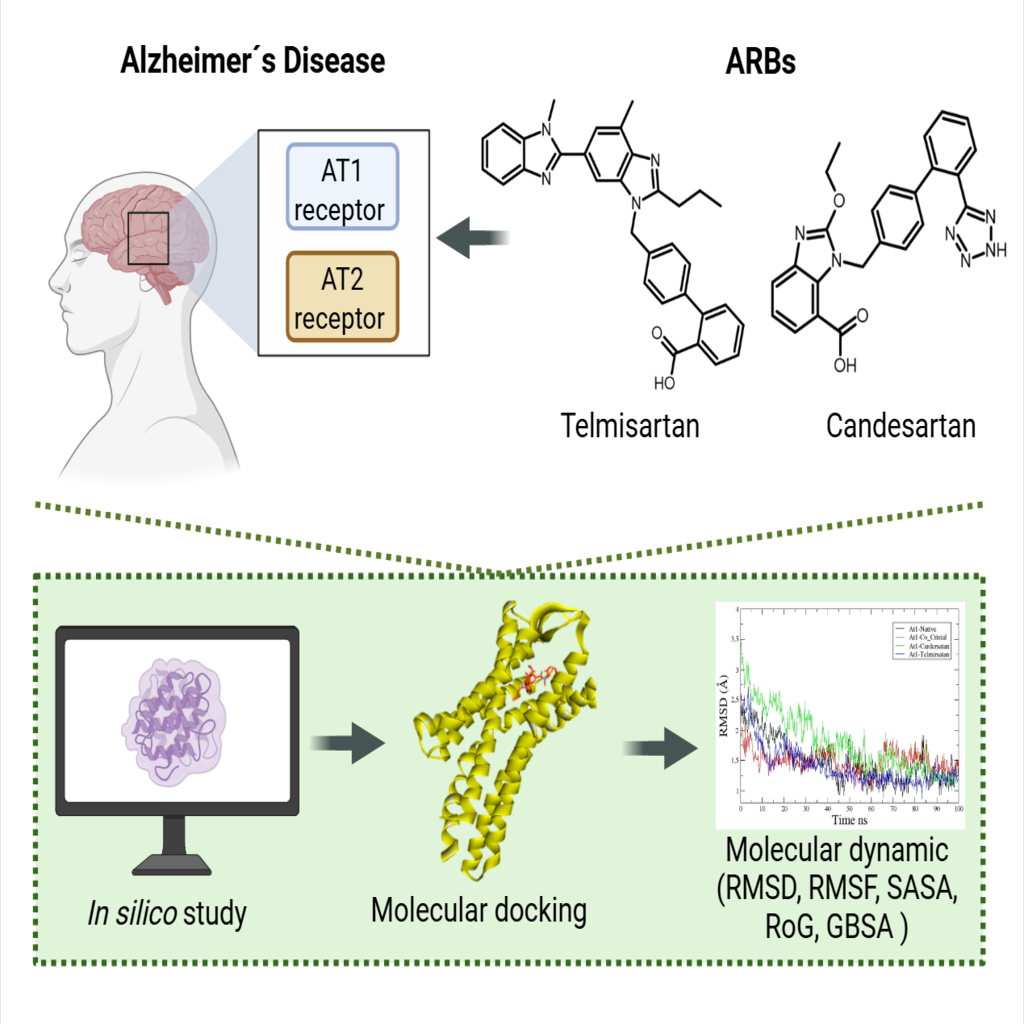
The brain renin-angiotensin-aldosterone system (RAAS), through angiotensin II and its AT1 and AT2 receptors, plays a pivotal role in blood pressure regulation and has been implicated in neurodegenerative processes such as Alzheimer's disease (AD). Angiotensin II receptor blockers (ARBs) inhibit the activation of AT1 receptors, thereby favoring an alternative RAAS pathway mediated by angiotensin IV (Ang-IV) and the AT4 receptor, providing protective effects for the nervous system. In this study, an In-silico evaluation of eight ARBs was performed by molecular docking (AutoDock Vina) and molecular dynamics simulations (AMBER20), assessing their binding affinity and conformational behavior with AT1 and AT2 receptors. Telmisartan and candesartan exhibited the highest affinity for AT1, with binding energies of −10.57 ± 0.12 and −9.83 ± 0.06 kcal/mol, respectively. For AT2, telmisartan showed a binding affinity of −10.60 ± 0.00 kcal/mol, although lower than the control ligand (−13.50 kcal/mol). Molecular dynamics simulations revealed that the AT1-telmisartan and AT1–candesartan complexes maintained structural stability with RMSD values remaining below 2.5 Å. The AT1–telmisartan complex exhibited the smallest radius of gyration (< 20 Å) and a reduced solvent accessible surface area (SASA), suggesting a compact and stable conformation. In contrast, the AT2–telmisartan complex demonstrated increased structural fluctuations (RMSF) within amino acid regions 60 - 75, 105 - 120 and 230 - 245, although overall stability was preserved throughout the 100 ns of simulation. These findings suggest that telmisartan and candesartan are promising candidates for modulating brain RAAS and could be considered as potential agents in Alzheimer's disease. Further in vivo validation is warranted to confirm their neuroprotective effect.
HIGHLIGHTS
- Brain’s renin-angiotensin-aldosterone system through the AT1 and AT2 receptors.
- Angiotensin II Receptor Blockers associated with Alzheimer’s Disease.
- Telmisartan and Candesartan showed considerable affinity for AT1 and AT2 receptors.
- ARBs with AT1 and AT2 receptors presented considerable stability through molecular dynamics.
GRAPHICAL ABSTRACT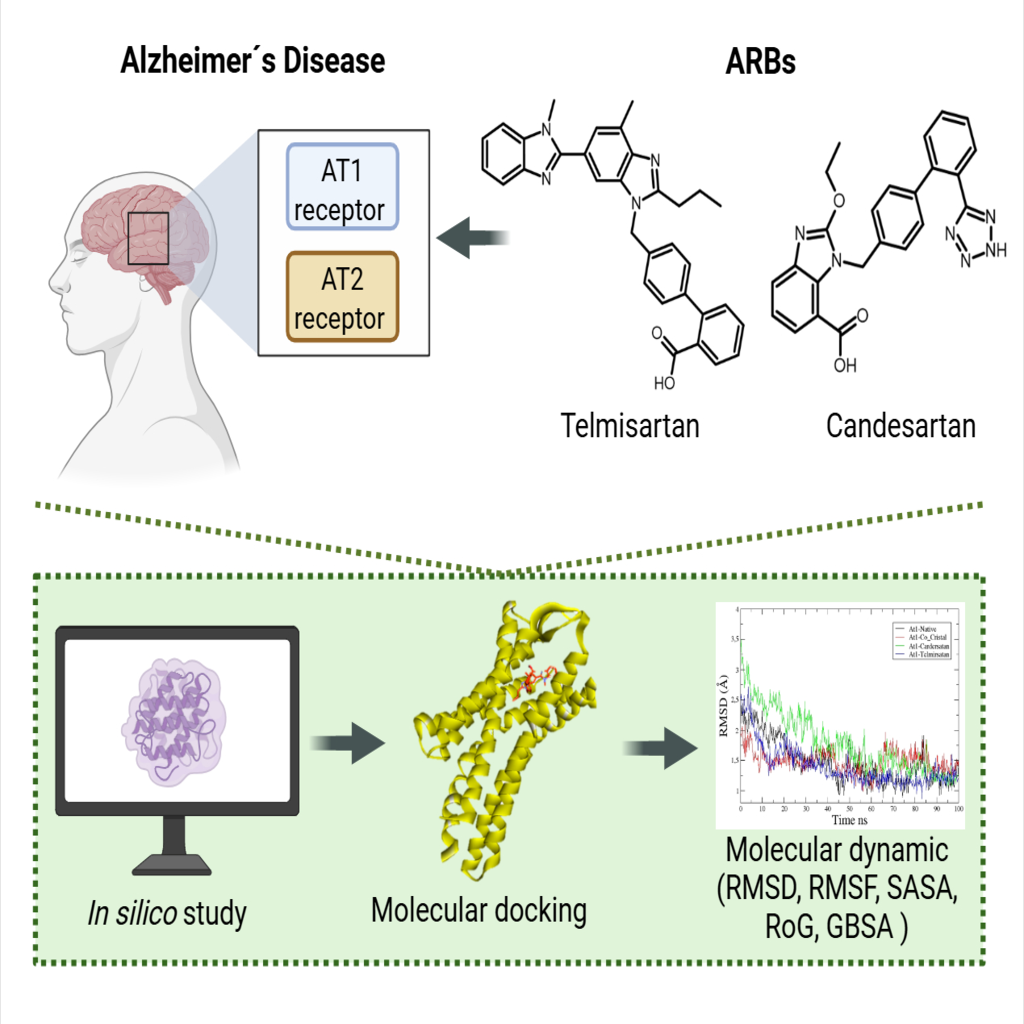
Downloads
References
CP Walther, WC Winkelmayer, PA Richardson, SS Virani and SD Navaneethan. Renin-angiotensin system blocker discontinuation and adverse outcomes in chronic kidney disease. Nephrology Dialysis Transplantation 2021; 36(10), 1893-1899.
E Cantero-Navarro, B Fernández-Fernández, AM Ramos, S Rayego-Mateos, RR Rodrigues-Diez, MD Sánchez-Niño, AB Sanz, M Ruiz-Ortega and A Ortiz. Renin-angiotensin system and inflammation update. Molecular and Cellular Endocrinology 2021; 529,111254.
H Wu, Q Sun, S Yuan, J Wang, F Li, H Gao, X Chen, R Yang and J Xu. AT1 Receptors: Their actions from hypertension to cognitive impairment. Cardiovascular Toxicology 2022; 22(4), 311-325.
F Gouveia, A Camins, M Ettcheto, J Bicker, A Falcão, MT Cruz and A Fortuna. Targeting brain Renin-Angiotensin system for the prevention and treatment of Alzheimer’s disease. Ageing research reviews 2022; 77, 101612.
LJ Trigiani, J Royea, M Lacalle-Aurioles, XK Tong and E Hamel. Pleiotropic benefits of the angiotensin receptor blocker candesartan in a mouse model of Alzheimer disease. Hypertension 2018; 72(5), 1217-1226.
M Molina-Van de Bosch, C Jacobs-Cachá, A Vergara, D Serón and MJ Soler. The renin-angiotensin system and the brain. Hipertensión y Riesgo Vascular 2021; 38(3), 125-132.
VT Ribeiro, LC de Souza, AC Simões and E Silva. Renin-Angiotensin system and Alzheimer’s disease pathophysiology: From the potential interactions to therapeutic perspectives. Protein and Peptide Letters 2020; 27(6), 484-511.
CM Ferrario and AE Mullick. Renin angiotensin aldosterone inhibition in the treatment of cardiovascular disease. Pharmacological Research 2017; 125, 57-71.
OA Abiodun and MS Ola. Role of brain renin angiotensin system in neurodegeneration: An update. Saudi Journal of Biological Sciences 2020; 27(3), 905-912.
CE Evans, JS Miners, G Piva, CL Willis, DM Heard, EJ Kidd, MA Good and PG Kehoe. ACE2 activation protects against cognitive decline and reduces amyloid pathology. Acta Neuropathologica 2020; 139(3), 485-502.
J Royea and E Hamel. Brain angiotensin II and angiotensin IV receptors as potential Alzheimer’s disease therapeutic targets. GeroScience 2020; 42(5), 1237-1256.
E Trofimiuk, P Wielgat and JJ Braszko. Candesartan, angiotensin II type 1 receptor blocker is able to relieve age-related cognitive impairment. Pharmacological Reports 2018; 70(1), 87-92.
J Kulisevsky, S Martínez-Horta, A Campolongo, B Pascual-Sedano, J Marín-Lahoz, H Bejr-Kasem, JL Labandeira-Garcia, JL Lanciego, A Puig-Davi, A Horta-Barba, J Pagonabarraga and J Rodríguez-Antigüedad. A randomized clinical trial of candesartan for cognitive impairment in Parkinson’s disease. Parkinsonism & Related Disorders 2023; 110, 105367.
PG Kehoe, S Wong, NA Mulhim, LE Palmer and JS Miners. Angiotensin-converting enzyme 2 is reduced in Alzheimer’s disease. Alzheimer’s Research & Therapy 2016; 8(1), 50.
AG Elkahloun and JM Saavedra. Candesartan neuroprotection in rat primary neurons negatively correlates with aging and senescence: A transcriptomic analysis. Molecular Neurobiology 2020; 57(3), 1656-1673.
B Shaker, S Ahmad, J Lee, C Jung and D Na. In silico methods and tools for drug discovery. Computers in Biology and Medicine 2021; 137, 104851.
M Kumar and RS Rathore. RamPlot: A webserver to draw 2D, 3D and assorted Ramachandran (φ, ψ) maps. Journal of Applied Crystallography 2025; 58(2), 630-636.
GM Morris, H Ruth, W Lindstrom, MF Sanner, RK Belew, DS Goodsell and AJ Olson. AutoDock4 and AutoDockTools4: Automated docking. Journal of Computational Chemistry 2009; 30(16), 2785-2791.
NM O’Boyle, M Banck, CA James, C Morley, T Vandermeersch and GR Hutchison. Open babel: An open chemical toolbox. Journal of Cheminformatics 2011; 3, 33.
O Trott and AJ Olson. Autodock vina: Improving speed and accuracy. Journal of Computational Chemistry 2010; 31(2), 455-461.
E Bursal, MA Yılmaz, A Aras, F Türkan, Ü Yildiko, Ö Kılıç and A Dey. Determination of phenolic content, biological activity and enzyme inhibitory properties with molecular docking studies of rumex nepalensis, an endemic medicinal plant. Journal of Food and Nutrition Research 2021; 9(3), 114-123
A Alviz-Amador, R Galindo-Murillo, R Pineda-Alemán, H Pérez-González, E Rodríguez-Cavallo, R Vivas-Reyes and D Méndez-Cuadro. 4-HNE carbonylation induces conformational changes. Journal of Molecular Graphics & Modelling 2019; 86, 298-307.
DA Case, RC Walker, TE Cheatham, C Simmerling, A Roitberg, KM Merz, R Luo, T Darden, J Wang, RE Duke, DR Roe, S LeGrand, J Swails, D Cerutti, G Monard, C Sagui, J Kaus, R Betz, B Madej, C Lin, …, PA Kollman. Amber 2016 reference manual. University of California, San Francisco, 2016.
BR Miller, TD McGee, JM Swails, N Homeyer, H Gohlke and AE Roitberg. MMPBSA.py: An efficient program for end-state free energy calculations. Journal of Chemical Theory and Computation 2012; 8(9), 3314-3321.
L Danielyan, R Klein, LR Hanson, M Buadze, M Schwab, CH Gleiter and WH Frey. Protective effects of intranasal losartan in the APP/PS1 transgenic mouse model of alzheimer disease. Rejuvenation Research 2010; 13(2-3), 195-201.
Z Deng, J Jiang, J Wang, D Pan, Y Zhu, H Li, X Zhang, X Liu, Y Xu, Y Li, Y Tang and Alzheimer’s Disease Neuroimaging Initiative. Angiotensin receptor blockers are associated with a lower risk of progression from mild cognitive impairment to dementia. Hypertension 2022; 79(10), 2159-2169.
JM Saavedra. Angiotensin II AT1 receptor blockers as treatments for inflammatory brain disorders. Clinical Science 2012; 123(10), 567-590.
B Ongali, N Nicolakakis, XK Tong, T Aboulkassim, P Papadopoulos, P Rosa-Neto, C Lecrux, H Imboden and E Hamel. Losartan prevents and rescues cerebrovascular, neuropathological and cognitive deficits. Neurobiology of Disease 2014; 68, 126-136.
N Torika, K Asraf, H Cohen and S Fleisher-Berkovich. Intranasal telmisartan ameliorates brain pathology in familial Alzheimer’s disease mice. Brain, Behavior and Immunity 2017; 64, 80-90.
N Torika, K Asraf, RN Apte and S Fleisher-Berkovich. Candesartan ameliorates brain inflammation associated with Alzheimer’s disease. CNS Neuroscience & Therapeutics 2018; 24(3), 231-242.
E Trofimiuk, P Wielgat and J Braszko. Candesartan relieves age-related cognitive impairment. Pharmacological Reports 2018; 70(1), 87-92.
AG Elkahloun and JM Saavedra. Candesartan neuroprotection negatively correlates with aging and senescence. Molecular Neurobiology 2020; 57(3), 1656-1673.
NF Khedr, RH Werida and MA Abo-Saif. Candesartan protects against d-galactose-induced neurotoxicity. Toxicology and Applied Pharmacology 2022; 435, 115827.
M Adesuyan, YH Jani, D Alsugeir, ECL Cheung, CSL Chui, R Howard, ICK Wong and R Brauer. Antihypertensive agents and incident alzheimer’s disease: A systematic review and meta-analysis of observational studies. The Journal of Prevention of Alzheimer’s Disease 2022; 9(4), 715-724.
TJ Oscanoa, J Amado, X Vidal and R Romero-Ortuno. Angiotensin-receptor blockers and the risk of Alzheimer´s disease: A meta-analysis. Current Reviews in Clinical and Experimental Pharmacology 2021; 16(1), 73-78.
EA Belachew, GM Peterson and WM Bezabhe. Comparative effects of angiotensin II stimulating and inhibiting antihypertensives on dementia risk: A systematic review and meta-analysis. Geroscience 2025; 47, 5525–5541.
H Zhang, H Unal, C Gati, GW Han, W Liu, NA Zatsepin, D James, D Wang, G Nelson, U Weierstall, MR Sawaya, Q Xu, M Messerschmidt, GJ Williams, S Boutet, OM Yefanov, TA White, C Wang, A Ishchenko, KC Tirupula, R Desnoyer, J Coe, CE Conrad, P Fromme, RC Stevens, V Katritch, SS Karnik and V Cherezov. Structure of the angiotensin receptor revealed by serial femtosecond crystallography. Cell 2015; 161(4), 833-844.
T Takezako, H Unal, SS Karnik and K Node. Current topics in angiotensin II type 1 receptor research: Focus on inverse agonism, receptor dimerization and biased agonism. Pharmacological Research 2017; 123, 40-50.
H Zhang, H Unal, R Desnoyer, GW Han, N Patel, V Katritch, SS Karnik, V Cherezov and RC Stevens. Structural basis for ligand recognition and functional selectivity at angiotensin receptor. The Journal of Biological Chemistry 2015; 290(49), 29127-29139.
T Takezako, H Unal, SS Karnik and K Node. Structure-function basis of attenuated inverse agonism of angiotensin II type 1 receptor blockers. Molecular Pharmacology 2015; 88(3), 488-501.
H Zhang, GW Han, A Batyuk, A Ishchenko, KL White, N Patel, A Sadybekov, B Zamlynny, MT Rudd, K Hollenstein, A Tolstikova, TA White, MS Hunter, U Weierstall, W Liu, K Babaoglu, EL Moore, RD Katz, JM Shipman, M Garcia-Calvo, S Sharma, P Sheth, SM Soisson, RC Stevens, V Katritch and V Cherezov. Structural basis for selectivity and diversity in angiotensin II receptors. Nature 2017; 544(7650), 327-332.
H Zhang, A Luginina, A Mishin, M Baidya, AK Shukla and V Cherezov. Structural insights into ligand recognition and activation of angiotensin receptors. Trends in Pharmacological Sciences 2021; 42(7), 577-587.
UM Steckelings, RE Widdop, ED Sturrock, L Lubbe, T Hussain, E Kaschina, T Unger, A Hallberg, RM Carey and C Sumners. The angiotensin AT2 receptor: From a binding site to a novel therapeutic target. Pharmacological Reviews 2022; 74(4), 1051-1135.
NJ Deng, W Dai and RM Levy. How kinetics within the unfolded state affects protein folding. The Journal of Physical Chemistry B 2013; 117(42), 12787-12799.
KD Singh, H Unal, R Desnoyer and SS Karnik. Divergent spatiotemporal interaction of angiotensin receptor blocking drugs with angiotensin type 1 receptor. Journal of Chemical Information and Modeling 2018; 58(1), 182-193.
Y Lobanov, NS Bogatyreva and OV Galzitskaya. Radius of gyration is an indicator of compactness of protein structure. Molekuliarnaia Biologiia 2008; 42(4),701-706.
Published
How to Cite
Issue
Section
License
Copyright (c) 2025 Walailak University

This work is licensed under a Creative Commons Attribution-NonCommercial-NoDerivatives 4.0 International License.





