
In Vitro Assessment of Immunomodulatory Effects on HT-29 Cells and Antimicrobial Activity Against Enteropathogenic Bacteria of Lactobacillus plantarum LAB02 Newly Isolated from Guts of the Termite Termes sp.
DOI:
https://doi.org/10.48048/tis.2025.10624Keywords:
Immunomodulatory effect, HT-29 cells, Antimicrobial activity, Enteropathogenic bacteria, Lactobacillus plantarum, Termite gut, Quantitative polymerase chain reaction (qPCR)Abstract
Probiotics are beneficial non-pathogenic microorganisms that inhabit gastrointestinal tracts and provide effective abilities such as preventing pathogenic infection, improving immune system and anti-inflammation enhancing the health of humans and animals. The objectives of this study were to evaluate antimicrobial capability against enteropathogenic bacteria and immunomodulatory effects of lactic acid bacteria isolated from termites. In the study, 5 isolates of lactic acid bacteria were obtained from the guts of the termite Termes sp. They were tested for the ability to inhibit growth potential of enteropathogenic bacteria using the agar well diffusion method and also their adhesion ability and cytotoxicity to human intestinal HT-29 cells. Among all 5 isolates, LAB02 exhibited strong broad-spectrum antimicrobial activity against all nine enteropathogenic bacteria, moreover it possessed non-toxicity and overall higher adhesion ability to HT-29 than the commercial probiotic Lactobacillus rhamnosus GG. Due to its high potential, LAB02 was selected for subsequent experiments. Based on nucleotide sequence analysis of 16S rRNA gene, LAB02 was closely related to Lactobacillus plantarum (100% identity). After inflammatory induction by lipopolysaccharide from Escherichia coli, immunomodulatory effects of LAB02 on the pathogen-induced HT-29 were evaluated in this study. The quantitative polymerase chain reaction (qPCR) assay was provided to measure gene expression level of pro- (IL-1, IL-6, IL-8, TNF-α and NF-κß) and anti-inflammatory cytokines (IL-4, IL-10, TGF-ß1, TGF-ß2 and TGF-ß3) and overall results revealed that LAB02 and its cell free supernatant could down-regulate the gene expression of pro-inflammatory cytokines and up-regulate of anti-inflammatory cytokines in HT-29 cells. The present study demonstrated some evidence indicating the potential of lactic acid bacteria obtained from termite guts. The strain Lactobacillus plantarum LAB02 might be used as a promising alternative agent to control enteropathogenic bacterial infection and modulate the immune system. The findings are useful for future study and applications in food microbiology and technology.
HIGHLIGHTS
- The intestinal tract of termite Termes is a potential source of high-performance lactic acid bacteria.
- Agar well diffusion demonstrated strong broad-spectrum anti-enteropathogenic activity of the isolate Lactobacillus plantarum
- In addition to its non-toxicity and good adhesion ability to human intestinal HT-29 cells, quantitative polymerase chain reaction (qPCR) assay revealed a positive impact of the strain LAB02 on pro- and anti-inflammatory cytokine gene expression.
- The lactic acid bacteria Lactobacillus plantarum LAB02 has antimicrobial and immunomodulatory activity, promising as an effective alternative agent to control enteropathogenic bacterial infection and modulate the human immune system.
GRAPHICAL ABSTRACT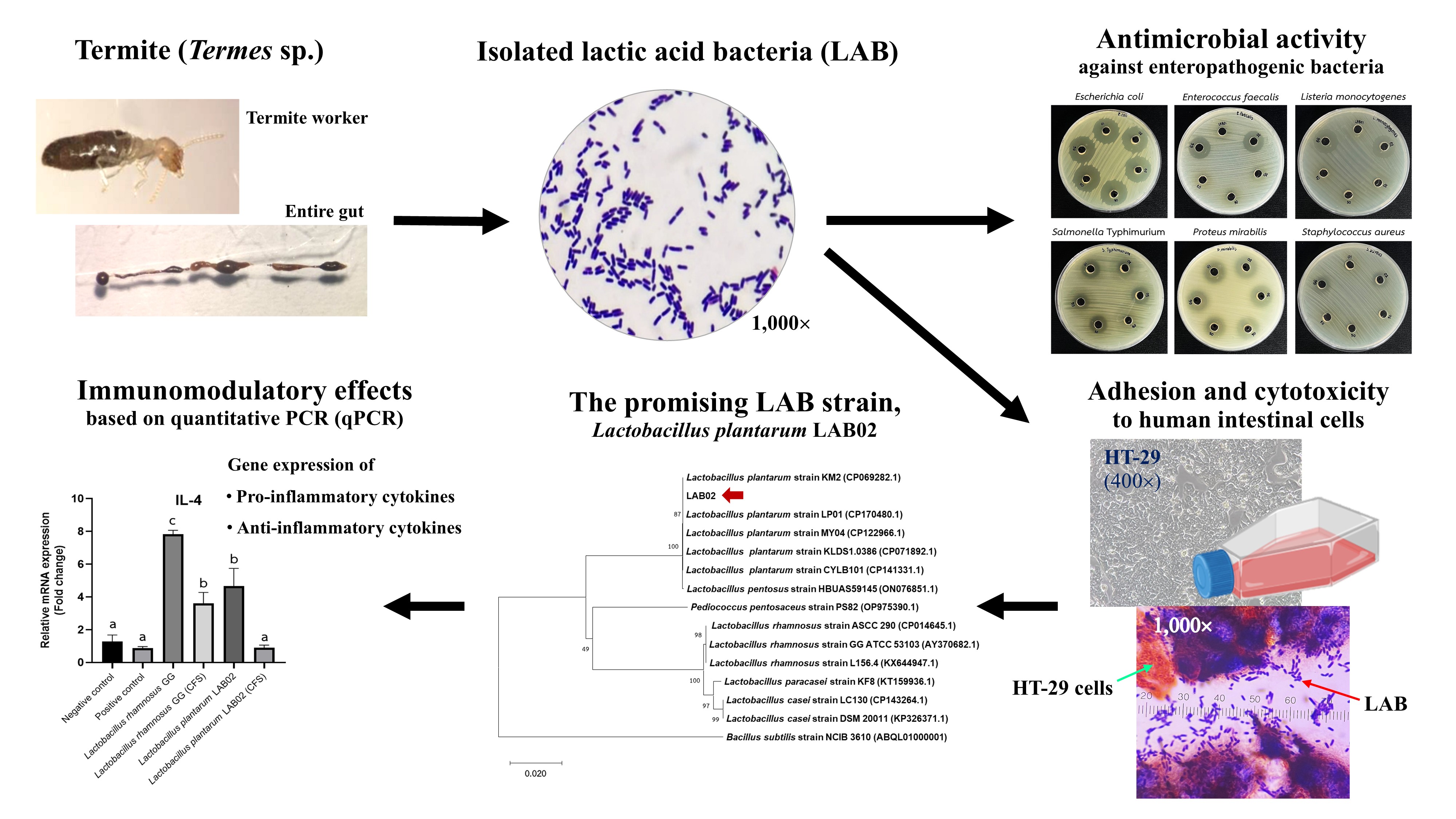
Downloads
References
J Sun and X Zhou. Utilization of lignocellulose-feeding insects for viable biofuels: An emerging and promising wrea of entomological science. In: T Liu and L Kang (Eds). Recent advances in entomological research. Springer, Berlin, 2011, p. 434-500.
RECR Figueirêdo, A Vasconcellos, IS Policarpo and RRN Alves. Edible and medicinal termites: A global overview. Journal of Ethnobiology and Ethnomedicine 2015; 11(1), 29.
RA Arango, CM Carlson, CR Currie, BR McDonald, AJ Book, F Green, NK Lebow, and KF Raffa. Antimicrobial activity of actinobacteria isolated from the guts of subterranean termites. Environmental Entomology 2016; 45(6), 1415-1423.
P Kunhachan, W Sirithana, O Komutiban, V Limkhuansuwan, P Menchai, C Trakunjae, T Lomthong, K Ruchusatsawat, and S Samaimai. Selection of potential bacteria in termite nest and gut for sustainable agriculture. Trends in Sciences 2024; 21(8), 7794.
P Tomtong and P Deevong. Probiotic potentials of non-starch polysaccharide hydrolyzing Bacillus strains newly isolated from guts of the termite Termes propinquus: A source of probiotic bacteria. Korean Journal of Microbiology 2024; 60(2), 68-82.
N Li, A Geng, Z Tu, Y Fan, R Xie, X Li and J Sun. Isolation of Lactococcus sp. X1 from termite gut and its application in lactic acid production. Fermentation 2023; 9(2), 85.
K Chanworawit, P Wangsoonthorn and P Deevong. Characterization of chitinolytic bacteria newly isolated from the termite Microcerotermes sp. and their biocontrol potential against plant pathogenic fungi. Bioscience, Biotechnology, and Biochemistry 2023; 87(9), 1077-1091.
J Arora, Y Kinjo, J Šobotník, A Buček, C Clitheroe, P Stiblik, Y Roisin, L Žifčáková, YC Park, KY Kim, D Sillam-Dussès, V Hervé, N Lo, G Tokuda, A Brune and T Bourguignon. The functional evolution of termite gut microbiota. Microbiome 2022; 10(1), 78.
KG Mansfield, K Lin, D Xia, JV Newman, DB Schauer, J MacKey, AA Lackner and A Carville. Enteropathogenic Escherichia coli and ulcerative colitis in cotton-top tamarins (Saguinus oedipus). The Journal of Infectious Diseases 2001; 184(6), 803-807.
SL Marks, SC Rankin, BA Byrne and JS Weese. Enteropathogenic bacteria in dogs and cats: Diagnosis, epidemiology, treatment and control. Journal of Veterinary Internal Medicine 2011; 25(6), 1195-1208.
I Praharaj, R Revathy, R Bandyopadhyay, B Benny, MA Ko, J Liu, ER Houpt and G Kang. Enteropathogens and gut inflammation in asymptomatic infants and children in different environments in Southern India. American Journal of Tropical Medicine and Hygiene 2018; 98(2), 576-580.
A González-Torralba, C García-Esteban and J Alós. Enteropathogens and antibiotics. Enfermedades Infecciosas y Microbiología Clínica 2018; 36(1), 47-54.
A Latif, A Shehzad, S Niazi, A Zahid, W Ashraf, MW Iqbal, A Rehman, T Riaz, RM Aadil, IM Khan, F Özogul, JM Rocha, T Esatbeyoglu and SA Korma. Probiotics: Mechanism of action, health benefits and their application in food industries. Frontier Microbiology 2023; 14, 1216674.
Khushboo, A Karnwal and T Malik. Characterization and selection of probiotic lactic acid bacteria from different dietary sources for development of functional foods. Frontier Microbiology 2023; 14, 1170725.
ME Sanders, LMA Akkermans, D Haller, C Hammerman, J Heimbach, G Hörmannsperger, G Huys, DD Levy, F Lutgendorff, D Mack, P Phothirath, G Solano-Aguilar and E Vaughan. Safety assessment of probiotics for human use. Gut Microbes. 2010; 1(3), 164-185.
M Bruewer, A Luegering, T Kucharzik, CA Parkos, JL Madara, AM Hopkins and A Nusrat. Proinflammatory cytokines disrupt epithelial barrier function by apoptosis-independent mechanisms. The Journal of Immunology 2003; 171(11), 6164-6172.
I Aggeletopoulou, M Kalafateli, E Tsounis and C Triantos. Exploring the role of IL-1β in inflammatory bowel disease pathogenesis. Frontiers in Medicine 2024; 11, 1307394.
M Neurath. Strategies for targeting cytokines in inflammatory bowel disease. Nature Reviews Immunology 2024; 24(8), 559-576.
SS Iyer and G Cheng. Role of interleukin 10 transcriptional regulation in inflammation and autoimmune disease. Critical Reviews in Immunology 2012; 32(1), 23-63.
P Giuffrida, S Cococcia, M Delliponti, MV Lenti and AD Sabatino. Controlling gut inflammation by restoring anti-inflammatory pathways in inflammatory bowel disease. Cells. 2019; 8(5), 397.
MAK Azad, M Sarker and D Wan. Immunomodulatory effects of probiotics on cytokine profiles. BioMed Research International 2018; 2018, 8063647.
G Cascetta, G Colombo, G Eremita, JGN Garcia, MV Lenti, AD Sabatino and C Travelli. Pro– and anti-inflammatory cytokines: The hidden keys to autoimmune gastritis therapy. Frontier Microbiology 2024; 15, 1450558.
Y Jiang, X Lü, C Man, L Han, Y Shan, X Qu, Y Liu, S Yang, Y Xue and Y Zhang. Lactobacillus acidophilus induces cytokine and chemokine production via NF-κB and p38 mitogen-activated protein kinase signaling pathways in intestinal epithelial cells. Clinical and Vaccine Immunology 2012; 19(4), 603-608.
K Sun, D Xu, C Xie, S Plummer, J Tang, XF Yang and XH Ji. Lactobacillus paracasei modulates LPS-induced inflammatory cytokine release by monocyte-macrophages via the up-regulation of negative regulators of NF-kappaB signaling in a TLR2-dependent manner. Cytokine 2017; 92, 1-11.
C Wei, J Wu, Y Huang, X Wang and J Li. Lactobacillus plantarum improves LPS-induced Caco2 cell line intestinal barrier damage via cyclic AMP-PKA signaling. PLoS One 2022; 17(5), 0267831.
LGR Rodríguez, F Mohamed, J Bleckwedel, R Medina, LD Vuyst, EM Hebert and F Mozzi. Diversity and functional properties of lactic acid bacteria isolated from wild fruits and flowers present in Northern Argentina. Frontier Microbiology 2019; 10, 1091.
K Kim, J Kim, S Kim, TH Nguyen and C Kang. Antioxidant and anti-Inflammatory effect and probiotic properties of lactic acid bacteria isolated from canine and feline feces. Microorganisms 2021; 9(9), 1971.
A Ngamsomchat, T Kaewkod, M Konkit, Y Tragoolpua, S Bovonsombut and T Chitov. Characterisation of Lactobacillus plantarum of dairy-product origin for probiotic chèvre cheese production. Foods 2022; 11(7), 934.
A Alzohairy. BioEdit: An important software for molecular biology. GERF Bulletin of Biosciences 2011; 2(1), 60-61.
S Kumar, G Stecher, M Li, C Knyaz and K Tamura. MEGA X: Molecular Evolutionary Genetics Analysis across computing platforms. Molecular Biology and Evolution 2018; 35(6), 1547-1549.
K Katoh, K Misawa, K Kuma and T Miyata. MAFFT: A novel method for rapid multiple sequence alignment based on fast Fourier transform. Nucleic Acids Research 2002; 30(14), 3059-3066.
CE Jahn, AO Charkowski and DK Willis. Evaluation of isolation methods and RNA integrity for bacterial RNA quantitation. Journal of Microbiological Methods 2008; 75(2), 318-324.
SM Devi, NK Kurrey and PM Halami. In vitro anti-inflammatory activity among probiotic Lactobacillus species isolated from fermented foods. Journal of Functional Foods 2018; 47, 19-27.
M Iorizzo, F Letizia, S Ganassi, B Testa, S Petrarca, G Albanese, DD Criscio and AD Cristofaro. Functional properties and antimicrobial activity from lactic acid bacteria as resources to improve the health and welfare of honey bees. Insects 2022; 13(3), 308.
O Choi, Y Lee, B Kang, SK Cho, Y Kang, D Kang, S Lee, S Bae and J Kim. Identification and characterization of gut-associated lactic acid bacteria isolated from the bean bug, Riptortus pedestris (Hemiptera: Alydidae). PLoS One 2023; 18(3), 0281121.
S Suraporn, S Cansee, S Hupfauf and T Klammsteiner. Lactic acid bacteria from Bombyx mori frass: Probiotic properties and antagonistic activities. Agriculture 2024; 14(6), 924.
MUE Sanam, AIR Detha and NK Rohi. Detection of antibacterial activity of lactic acid bacteria, isolated from Sumba mare's milk, against Bacillus cereus, Staphylococcus aureus and Escherichia coli. Journal of Advanced Veterinary and Animal Research 2022; 9(1), 53-58.
L Bungenstock, A Abdulmawjood and F Reich. Evaluation of antibacterial properties of lactic acid bacteria from traditionally and industrially produced fermented sausages from Germany. PLoS One 2020; 15(3), 0230345.
HC Fonseca, DS Melo, CL Ramos, DR Dias and RF Schwan. Probiotic properties of Lactobacilli and their ability to inhibit the adhesion of enteropathogenic bacteria to Caco-2 and HT-29 cells. Probiotics and Antimicrobial Proteins 2021; 13(1), 102-112.
S Sharma and SS Kanwar. Adherence potential of indigenous lactic acid bacterial isolates obtained from fermented foods of Western Himalayas to intestinal epithelial Caco-2 and HT-29 cell lines. Journal of Food Science and Technology 2017; 54(11), 3504-3511.
T Wang, H Sun, J Chen, L Luo, Y Gu, X Wang, Y Shan, Y Yi, B Liu, Y Zhou, and X Lü. Anti-adhesion effects of Lactobacillus strains on Caco-2 cells against Escherichia coli and their application in ameliorating the symptoms of dextran sulfate sodium-induced colitis in mice. Probiotics and Antimicrobial Proteins 2021; 13(6), 1632-1643.
International Organization for Standardization, Available at: https://www.iso.org/standard/36406.html, accessed March 2025.
R Paolillo, CR Carratelli, S Sorrentino, N Mazzola and A Rizzo. Immunomodulatory effects of Lactobacillus plantarum on human colon cancer cells. International Immunopharmacology 2009; 9(11),1265-1271.
P Dowdell, S Chankhamhaengdecha, W Panbangred, T Janvilisri and A Aroonnual. Probiotic activity of enterococcus faecium and lactococcus lactis isolated from thai fermented sausages and their protective effect against clostridium difficile. Probiotics and Antimicrobial Proteins 2020; 12(2), 641-648.
S Feng, H Wang, X Lin, H Liang, S Zhang, Y Chen and C Ji. Probiotic properties of Lactobacillus plantarum and application in prebiotic gummies. LWT - Food Science and Technology 2023; 174, 114357.
S Nath, J Sikidar, M Roy and B Deb. In vitro screening of probiotic properties of Lactobacillus plantarum isolated from fermented milk product. Food Quality and Safety 2020; 4(4), 213-223.
NI Mohamad, MA Manan and NA Sani. The antibacterial activity of lactic acid bacteria from pickled Spondias dulcis (Ambarella) against foodborne pathogens. Trends in Sciences 2022; 19(5), 2896.
B Ladda, T Theparee, J Chimchang, S Tanasupawat, and M Taweechotipatr. In vitro modulation of tumor necrosis factor α production in THP-1 cells by lactic acid bacteria isolated from healthy human infants. Anaerobe 2015; 33, 109-116.
KJ Han, J Lee, N Lee and H Paik. Antioxidant and anti-inflammatory effect of probiotic Lactobacillus plantarum KU15149 derived from Korean homemade diced-radish kimchi. Journal of Microbiology and Biotechnology 2020; 30(4), 591-598.
C Liu, X Liu, Y Sun, X Qi, Y Ma and R Wang. Anti-inflammatory probiotic Lactiplantibacillus plantarum HF05 screening from Qula: Genomic analysis and alleviating effect on intestinal inflammation. Food Bioscience 2023; 55, 103002.
E Im, FM Riegler, C Pothoulakis and SH Rhee. Elevated lipopolysaccharide in the colon evokes intestinal inflammation, aggravated in immune modulator-impaired mice. American Journal of Physiology Gastrointestinal and Liver Physiology 2012; 303(4), 490-497.
X Zhang, X Tian, Y Wang, Y Yan, Y Wang, M Su, H Lv, K Li, X Hao, X Xing and S Song. Application of lipopolysaccharide in establishing inflammatory models. International Journal of Biological Macromolecules 2024; 279(4), 135371.
S Kook, E Chung, Y Lee, D Lee and S Kim. Isolation and characterization of five novel probiotic strains from Korean infant and children faeces. PLoS One 2019; 14(10), 0223913.
L Sun, W Tian, X Guo, Y Zhang, X Liu, X Li, Y Tian, C Man and Y Jiang. Lactobacillus gasseri JM1 with potential probiotic characteristics alleviates inflammatory response by activating the PI3K/Akt signaling pathway in vitro. Journal of Dairy Science 2020; 103(9), 7851-7864.
B Bahrami, S Macfarlane and G Macfarlane. Induction of cytokine formation by human intestinal bacteria in gut epithelial cell lines. Journal of Applied Microbiology 2011; 110(1), 353-363.
Published
How to Cite
Issue
Section
License
Copyright (c) 2025 Walailak University

This work is licensed under a Creative Commons Attribution-NonCommercial-NoDerivatives 4.0 International License.





