
The Relationship of Modified Bismuth and Ninhydrin Methods with Periodontal Pathogens in Saliva
DOI:
https://doi.org/10.48048/tis.2025.10613Keywords:
Periodontal Diseases, Salivary hydrogen sulfide (Salivary H2S), Salivary total amines, Simplified bismuth method, Simplified ninhydrin method, Periodontal pathogens, Modified bismuth method, Modified ninhydrin method, Bismuth scores, Ninhydrin scores, SalivaAbstract
Periodontal diseases are prevalent and chronic oral conditions. This study was conducted to determine the performance, validity, and applicability of the modified bismuth and ninhydrin methods to detect bacterial degradation for the development of periodontal screening tools. The experiments were conducted to test the performance and validity of both methods using standard solutions and evaluate their applicability using human saliva. Spearman’s correlation was used to find the correlation between the quantity of periodontal pathogens, salivary H2S, and total amines. The experiments showed good performance. The bismuth solution had a limit of detection (LOD) of 1-2 ppm NaHS. The stability test revealed that the 23-week bismuth solution produced the same quantity of bismuth sulfide precipitate as fresh preparations under optimal conditions. The validity test showed acceptable results. The color intensities of the modified ninhydrin method were quantified. The intensity of ∆G was chosen for the quantitative detection of total amines due to its strong correlation with putrescine concentration. The calibration curve exhibited linearity over putrescine concentrations ranging from 0.5 to 4.0 mM (R2 = 0.929). The precision test showed that %RSD ranged from 2.40 to 22.50. The applicability tests demonstrated that both methods detected and scored salivary H2S and total amines in relation to the quantity of analytes. Three periodontal pathogens—F. nucleatum, P. gingivalis, and P. intermedia—were significantly correlated to salivary H2S. Only F. nucleatum was significantly correlated to salivary total amines. The results of this study indicate that the modified bismuth and ninhydrin methods can effectively identify periodontal degradation with acceptable performance and validity.
HIGHLIGHTS
- Periodontal diseases are prevalent and chronic conditions that inflict damage on both the hard and soft tissues of the periodontium.
- Conducting a thorough periodontal examination on a large population requires the expertise of highly qualified practitioners and the use of precise diagnostic tools.
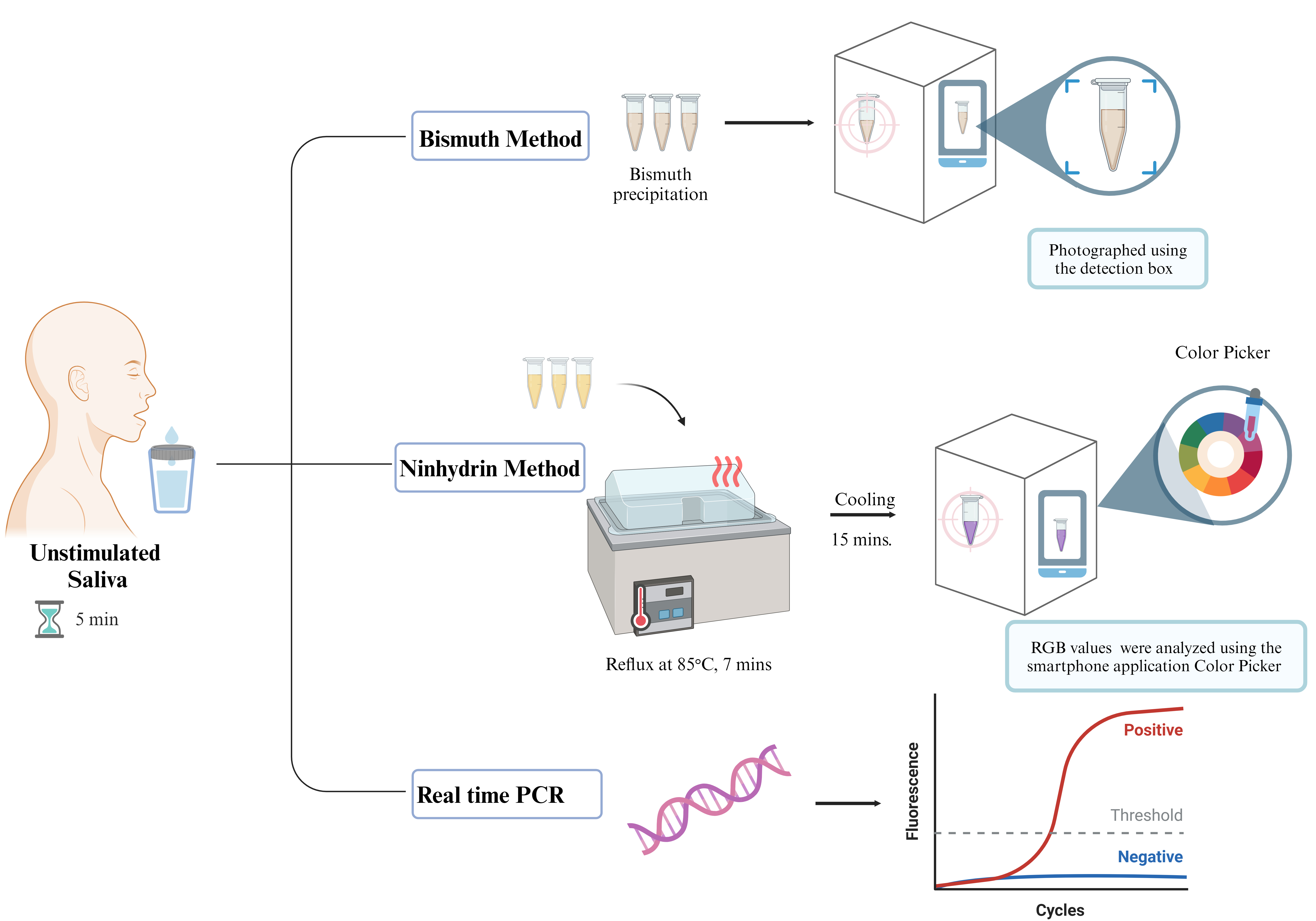
- In this study, we estimated the levels of salivary hydrogen sulfide (H₂S) and total amines using the modified bismuth and ninhydrin methods.
- The findings suggest that these modified methods provide satisfactory performance and validity and can effectively identify periodontal metabolites.
GRAPHICAL ABSTRACT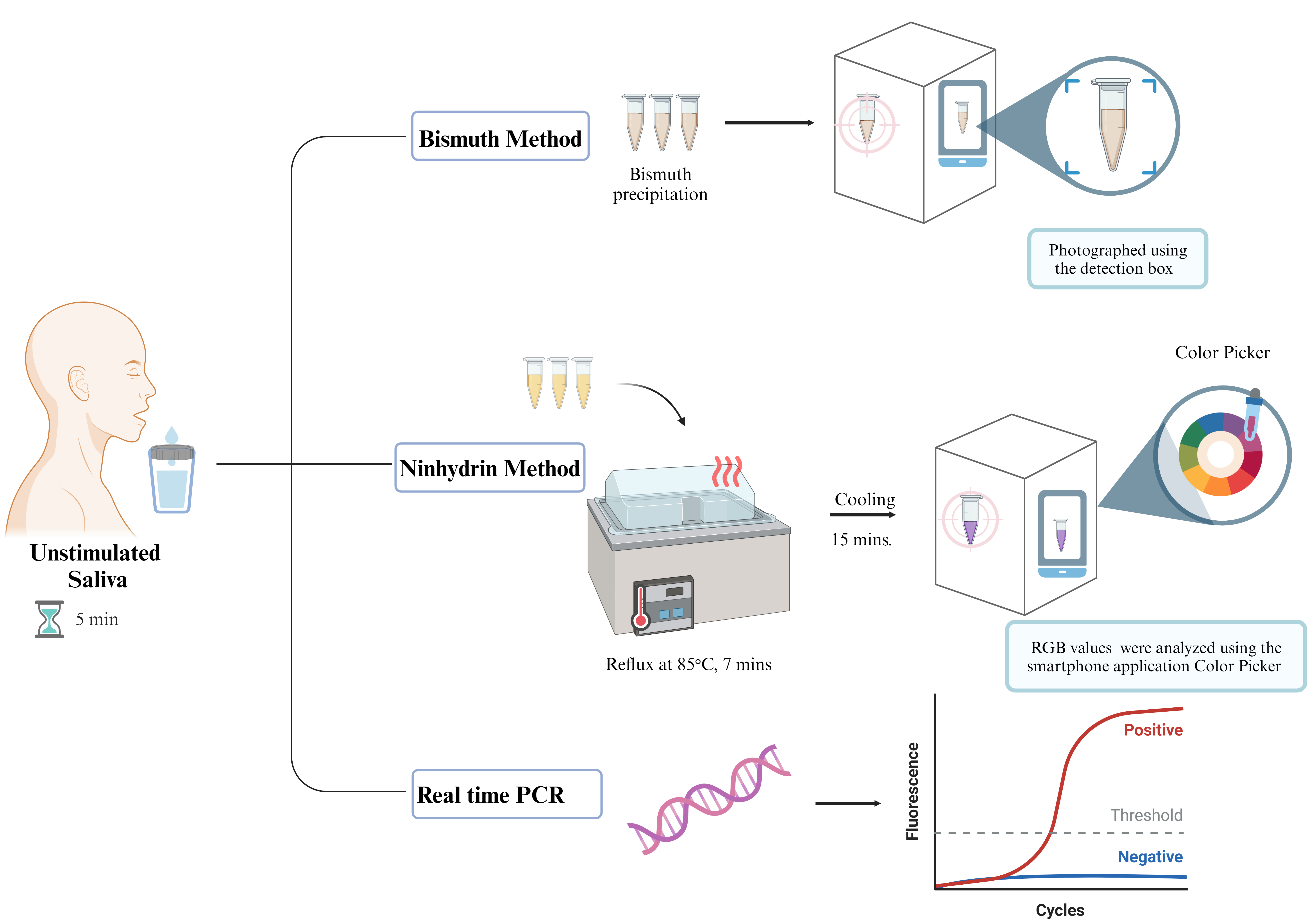
Downloads
References
TJ Ko, KM Byrd and S Kim. The chairside periodontal diagnostic toolkit: Past, present, and future. Diagnostics (Basel) 2021; 11(6), 932.
LM Sedghi, M Bacino and YL Kapila. Periodontal disease: The good, the bad, and the unknown. Frontiers in Cellular and Infection Microbiology 2021; 11, 766944.
GN Belibasakis, D Belstrom, S Eick, UK Gursoy, A Johansson and E Kononen. Periodontal microbiology and microbial etiology of periodontal diseases: Historical concepts and contemporary perspectives. Periodontol 2000 2023. https://doi.org/10.1111/prd.12473
BoD Health. Report on the eighth national oral health survey of Thailand 9th 2023. Department of Health, Ministry of Public Health, Nonthaburi, Thailand, 2024.
MH Rashid, SPK Yellarthi, PK Yellarthi, BGL Didugu and A Mamillapalli. Combined assessment of lysine and N-acetyl cadaverine levels assist as a potential biomarker of the smoker periodontitis. Amino Acids 2024; 56(1), 41.
A Wang, CP Wang, M Tu and DT Wong. Oral biofluid biomarker research: Current status and emerging frontiers. Diagnostics 2016; 6(4), 45.
A Basic, S Blomqvist, A Carlen and G Dahlen. Estimation of bacterial hydrogen sulfide production in vitro. Journal of Oral Microbiology 2015; 7(10), 28166.
A Basic and G Dahlen. Hydrogen sulfide production from subgingival plaque samples. Anaerobe 2015; 35, 21-27.
F Aizawa, M Kishi, T Moriya, M Takahashi, D Inaba and M Yonemitsu. The analysis of characteristics of elderly people with high VSC level. Oral Dis 2005; 11, 80-82.
M Morita and HL Wang. Relationship between sulcular sulfide level and oral malodor in subjects with periodontal disease. Journal of Periodontology 2001; 72(1), 79-84.
A Apatzidou, E Bakirtzoglou, I Vouros, V Karagiannis, A Papa and A Konstantinidis. Association between oral malodour and periodontal disease-related parameters in the general population. Acta Odontologica Scandinavica 2013; 71(1), 189-195.
C Calil, F Liberato, A Pereira, M de Castro Meneghim, J Goodson and F Groppo. The relationship between volatile sulphur compounds, tongue coating and periodontal disease. International Journal of Dental Hygiene 2009; 7(4), 251-255.
YH Lee, SI Shin and JY Hong. Investigation of volatile sulfur compound level and halitosis in patients with gingivitis and periodontitis. Scientific Reports 2023; 13, 13175.
S Awano, K Gohara, E Kurihara, T Ansai and T Takehara. The relationship between the presence of periodontopathogenic bacteria in saliva and halitosis. International Dental Journal 2002; 52(5), 212-216.
Y Makino, T Yamaga, A Yoshihara, K Nohno and H Miyazaki. Association between volatile sulfur compounds and periodontal disease progression in elderly non‐smokers. Journal of Periodontology 2012; 83(5), 635-643.
JL Kroll, CA Werchan, AG Reeves, KJ Bruemmer, AR Lippert and T Ritz. Sensitivity of salivary hydrogen sulfide to psychological stress and its association with exhaled nitric oxide and affect. Physiology & Behavior 2017; 179, 99-104.
E Zaorska, M Konop, R Ostaszewski, D Koszelewski and M Ufnal. Salivary hydrogen sulfide measured with a new highly sensitive self-immolative coumarin-based fluorescent probe. Molecules 2018; 23(9), 2241.
JD Walters. Polyamine analysis of human gingival crevicular fluid. Journal of Periodontal Research 1987; 22(6), 522-523.
S Goldberg, A Kozlovsky, D Gordon, I Gelernter, A Sintov and M Rosenberg. Cadaverine as a putative component of oral malodor. Journal of Dental Research 1994; 73(6), 1168-1172.
M Amin, S Tang, L Shalamanova, RL Taylor, S Wylie, BM Abdullah and KA Whitehead. Polyamine biomarkers as indicators of human disease. Biomarkers 2021; 26(2), 77-94.
S Chu, AKY Chan and CH Chu. Polyamines in dysbiotic oral conditions of older adults: A scoping review. International Journal of Molecular Sciences 2024; 25(19), 10596.
A Sakanaka, M Kuboniwa, E Hashino, T Bamba, E Fukusaki and A Amano. Distinct signatures of dental plaque metabolic byproducts dictated by periodontal inflammatory status. Scientific Reports 2017; 7, 42818.
N Balci, S Kurgan, A Cekici, T Cakır and MA Serdar. Free amino acid composition of saliva in patients with healthy periodontium and periodontitis. Clinical Oral Investigations 2021; 25(6), 4175-4183.
M Greabu, A Totan, D Miricescu, R Radulescu, J Virlan and B Calenic. Hydrogen sulfide, oxidative stress and periodontal diseases: A concise review. Antioxidants 2016; 5(1), 3.
SS Gul, AA Abdulkareem, AM Sha and A Rawlinson. Diagnostic accuracy of oral fluids biomarker profile to determine the current and future status of periodontal and peri-implant diseases. Diagnostics 2020; 10(10), 838.
P Kuasuwan, K Nittayaboon, N Chandeying and V Chandeying. Validity evaluation of in-house preparation kit, vaginal pH paper test combined amine tube test, for the simple diagnosis of bacterial vaginosis. Journal of the Medical Association of Thailand 2012; 95(6), 747-751.
S Arsawiset and S Teepoo. Ready-to-use, functionalized paper test strip used with a smartphone for the simultaneous on-site detection of free chlorine, hydrogen sulfide and formaldehyde in wastewater. Analytica Chimica Acta 2020; 1118, 63-72.
J Jantra, S Teepoo and S Thananimit. Smartphone-based imaging colorimetric assay for monitoring the quality of curcumin in turmeric powder. Analytical Sciences 2024; 40(7), 1311-1321.
A Yoshida, M Yoshimura, N Ohara, S Yoshimura, S Nagashima, T Takehara and K Nakayama. Hydrogen sulfide production from cysteine and homocysteine by periodontal and oral bacteria. Journal of Periodontology 2009; 80(11), 1845-1851.
K Iwanicka‐Grzegorek, E Lipkowska, J Kepa, J Michalik and M Wierzbicka. Comparison of ninhydrin method of detecting amine compounds with other methods of halitosis detection. Oral Diseases 2005; 11, 37-39.
R Munoz-Olivas. Screening analysis: An overview of methods applied to environmental, clinical and food analyses. TrAC Trends in Analytical Chemistry 2004; 23(3), 203-216.
National Association of Testing Authorities. Guidelines for the validation and verification of quantitative and qualitative test methods. National Association of Testing Authorities, New South Wales, Australia, 2012.
J Dadamio, MV Tornout, SV den Velde, R Federico, C Dekeyser and M Quirynen. A novel and visual test for oral malodour: First observations. Journal of breath research 2011; 5(4), 046003.
I Taverniers, MD Loose and EV Bockstaele. Trends in quality in the analytical laboratory. II. analytical method validation and quality assurance. TrAC Trends in Analytical Chemistry 2004; 23(8), 535-552.
R Kumar, R Kumar, R Khursheed, A Awasthi, N Khurana, SK Singh, S Khurana, N Sharma, P Gunjal, J Kaur and Leander Corrie. Development and validation of RP-HPLC method for estimation of fisetin in rat plasma. South African Journal of Botany 2021; 140, 284-289.
SB Hulley, SR Cummings, WS Browner, DG Grady and TB Newman. Designing clinical research. 4th ed. Lippincott Williams & Wilkins, Philadelphia, 2013.
A Tangerman. Measurement and biological significance of the volatile sulfur compounds hydrogen sulfide, methanethiol and dimethyl sulfide in various biological matrices. Journal of Chromatography B-Analytical Technologies in the Biomedical and Life Sciences 2009; 877(28), 3366-3377.
P Schober, C Boer and LA Schwarte. Correlation coefficients: Appropriate use and interpretation. Anesthesia & Analgesia 2018; 126(5), 1763-1768.
MA Nadkarni, FE Martin, NA Jacques and N Hunter. Determination of bacterial load by real-time PCR using a broad-range (universal) probe and primers set. Microbiology 2002; 148(1), 257-266.
I Saygun, A Kubar, S Sahin, K Sener and J Slots. Quantitative analysis of association between herpesviruses and bacterial pathogens in periodontitis. Journal of Periodontal Research 2008; 43(3), 352-359.
JM Morillo, L Lau, M Sanz, D Herrera, C Martin and A Silva. Quantitative real‐time polymerase chain reaction based on single copy gene sequence for detection of periodontal pathogens. Journal of Clinical Periodontology 2004; 31(22), 1054-1560.
J He, W Huang, Z Pan, H Cui, G Qi, X Zhou and H Chen. Quantitative analysis of microbiota in saliva, supragingival, and subgingival plaque of Chinese adults with chronic periodontitis. Clinical Oral Investigations 2012; 16(6), 1579-1588.
H Haririan, O Andrukhov, K Bertl, S Lettner, S Kierstein, A Moritz and X Rausch-Fan. Microbial analysis of subgingival plaque samples compared to that of whole saliva in patients with periodontitis. Journal of Periodontology 2014; 85(6), 819-828.
M Venza, M Visalli, D Cicciu and D Teti. Determination of polyamines in human saliva by high-performance liquid chromatography with fluorescence detection. Journal of Chromatography B: Biomedical Sciences and Applications 2001; 757(1), 111-117.
A Basic and G Dahlen. Microbial metabolites in the pathogenesis of periodontal diseases: A narrative review. Frontiers in Oral Health 2023; 4, 1210200.
Published
How to Cite
Issue
Section
License
Copyright (c) 2025 Walailak University

This work is licensed under a Creative Commons Attribution-NonCommercial-NoDerivatives 4.0 International License.





