
Highly Sensitive Electrochemical Sensor Modified with Pt/Pd-MnO2/CNT Nanocomposite for the Determination of Glutamate
DOI:
https://doi.org/10.48048/tis.2025.10611Keywords:
Pd/Pt-MnO2/CNT, Nanomaterials, Glutamate Quantification, Electrochemical Sensor, Instant Noodles, MnO2/CNT, Nanomaterials, Glutamate quantification, Electrochemical sensor, Instant noodlesAbstract
A novel nanocomposite comprising platinum/palladium-decorated manganese dioxide on carbon nanotubes (Pt/Pd-MnO2/CNT) was successfully synthesized and immobilized onto a screen-printed carbon electrode (SPCE) for the electrochemical detection of glutamate. The electrocatalytic performance of the modified electrode was systematically evaluated using cyclic voltammetry (CV) and chronoamperometry (CA). Conventional glutamate biosensors that rely on the immobilization of glutamate oxidase often encounter several limitations, including high detection limits, electrode fouling, and poor operational stability, primarily due to enzyme leaching or denaturation. In contrast, the proposed sensor circumvents the need for enzyme immobilization on electrode by utilizing an electrocatalytic approach. This strategy maintains a high degree of analyte selectivity while significantly improving the sensor’s stability, reproducibility, and overall analytical performance. The resulting sensor exhibited high sensitivity, with a detection limit of 1.98 µM, surpassing previously reported values. It demonstrated a linear response in the range of 0.005 - 0.08 mM and showed excellent selectivity by minimizing interference from common electroactive species such as ascorbic acid (AA) and uric acid (UA), thanks to a reduction-based detection mechanism. The sensor also exhibited strong durability, retaining 96 % of its initial signal after 3 weeks of storage. Furthermore, it demonstrated excellent repeatability and reproducibility, as well as high resistance to common interferences. Validation studies conducted on spiked samples showed recovery rates between 99 and 105 %, confirming the method’s precision and accuracy. The practical application of the sensor was demonstrated through the quantification of glutamate in various instant noodle seasoning samples. The amounts of glutamate detected were 63.55 mg in Shrimp Tom Yum, 127.23 mg in Yentafo Tom Yum Mohfai, and 82.91 mg in Shrimp Creamy Tom Yum seasoning packets, respectively. In summary, the Pt/Pd-MnO2/CNT-modified electrode offers a reliable, sensitive, and selective platform for real-time electrochemical detection of glutamate in complex food matrices, highlighting its potential for application in food safety and quality control.
HIGHLIGHTS
- A newly developed glutamate biosensor utilizing a Pt/Pd-MnO₂/CNT electrode enables efficient glutamate detection.
- The sensor demonstrates high selectivity, contributing to its cathodic current detection.
- The sensor exhibits high sensitivity, accuracy, and stability.
- The sensor was successfully applied to detect glutamate in food samples.
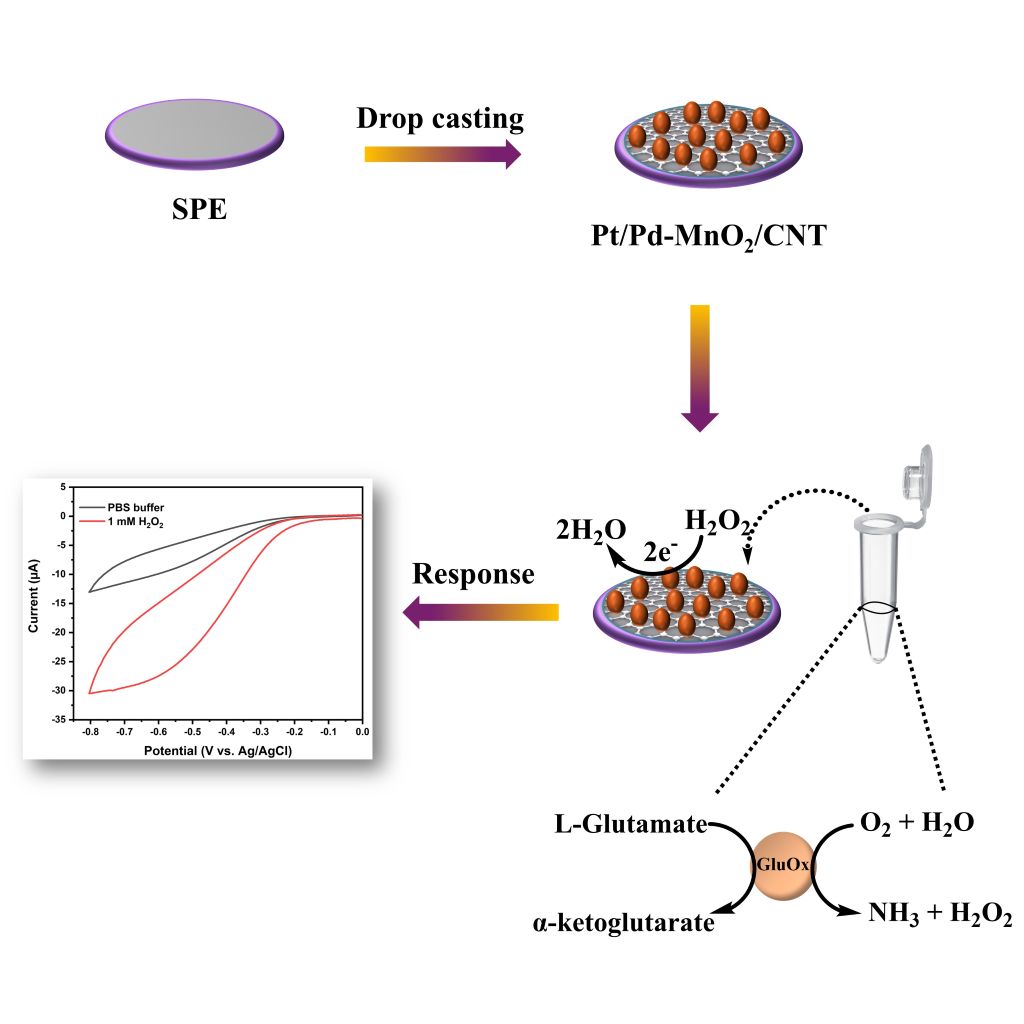
GRAPHICAL ABSTRACT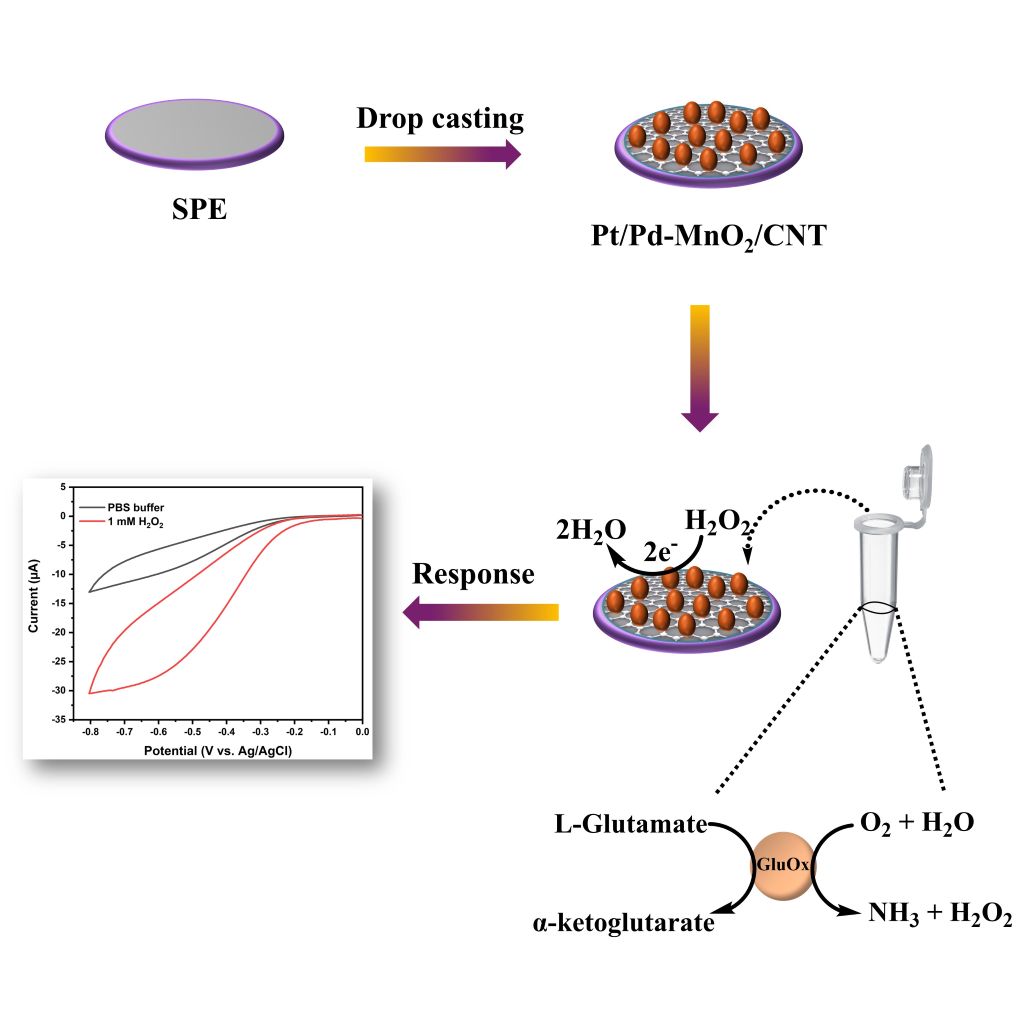
Downloads
References
X Wei, Y Chen, S He, H Lian, X Cao and B Liu. L-histidine-regulated zeolitic imidazolate framework modified electrochemical interface for enantioselective determination of L-glutamate. Electrochimica Acta 2021; 400, 139464.
M Jamal, S Chakrabarty, MA Yousuf, A Khosla and KM Razeeb. Micro and nanostructure based electrochemical sensor platform for glutamate detection. Microsystem Technologies 2018; 24, 4193-4206.
L Yang, R Bai, B Xie, N Zhuang, Z Lv, M Chen, W Dong, J Zhou and M Jiang. A biosensor based on oriented immobilization of an engineered l-glutamate oxidase on a screen-printed microchip for detection of l-glutamate in fermentation processes. Food Chemistry 2023; 405, 134792.
A Mentana, D Nardiello, C Palermo and D Centonze. Accurate glutamate monitoring in foodstuffs by a sensitive and interference-free glutamate oxidase-based disposable amperometric biosensor. Analytica Chimica Acta 2020; 1115, 16-22.
HP Aung and U Pyell. In-capillary derivatization with o-phthalaldehyde in the presence of 3-mercaptopropionic acid for the simultaneous determination of monosodium glutamate, benzoic acid, and sorbic acid in food samples via capillary electrophoresis with ultraviolet detection. Journal of Chromatography A 2016; 1449, 156-165.
W Wang, Y He, Y Gao, H Gao, L Deng, Q Gui, Z Cao, Y Yin and Z Feng. A peptide aptamer based electrochemical amperometric sensor for sensitive L-glutamate detection. Bioelectrochemistry 2022; 146, 108165.
EFSA Panel on Food Additives and Nutrient Sources added to Food (ANS), A Mortensen, F Aguilar, R Crebelli, A Di Domenico, B Dusemund, MJ Frutos, P Galtier, D Gott, U Gundert‐Remy and JC Leblanc. Re‐evaluation of glutamic acid (E 620), sodium glutamate (E 621), potassium glutamate (E 622), calcium glutamate (E 623), ammonium glutamate (E 624) and magnesium glutamate (E 625) as food additives. EFSA Journal 2017; 15(7), e04910.
H Bayomy and E Alamri. Technological and nutritional properties of instant noodles enriched with chickpea or lentil flour. Journal of King Saud University-Science 2022; 34(3), 101833.
C Farrand, K Charlton, M Crino, J Santos, R Rodriguez-Fernandez, C Ni Mhurchu and J Webster. Know your noodles! assessing variations in sodium content of instant noodles across countries. Nutrients 2017; 9(6), 612.
F Errington, T Fujikura and D Gewertz. Instant noodles as an antifriction device: Making the BOP with PPP in PNG. American Anthropologist 2012; 114(1), 19-31.
C Agius, S Von Tucher, B Poppenberger and W Rozhon. Quantification of glutamate and aspartate by ultra-high performance liquid chromatography. Molecules 2018; 23(6),1389.
AA Monge-Acuña and J Fornaguera-Trías. A high performance liquid chromatography method with electrochemical detection of gamma-aminobutyric acid, glutamate and glutamine in rat brain homogenates. Journal of Neuroscience Methods 2009; 183(2), 176-181.
ER Moraes, AB Grisolia, KR Oliveira, DL Picanço-Diniz, ME Crespo-López, C Maximino and AM Herculano. Determination of glutamate uptake by high performance liquid chromatography (HPLC) in preparations of retinal tissue. Journal of Chromatography. B, Analytical Technologies in the Biomedical and Life Sciences 2012; 907, 1-6.
CP Ferreira, FT Antunes, IN Rebelo, CA da Silva Junior, FN Vilanova, DS Corrêa and AH de Souza. Application of the UV-vis spectrophotometry method for the determination of glutamate in the cerebrospinal fluid of rats. Journal of Pharmaceutical and Biomedical Analysis 2020; 186, 113290.
W Khampha, V Meevootisom and S Wiyakrutta. Spectrophotometric enzymatic cycling method using L-glutamate dehydrogenase and D-phenylglycine aminotransferase for determination of L-glutamate in foods. Analytica Chimica Acta 2004; 520(1-2), 133-139.
CA Vyas, SM Rawls, RB Raffa and JG Shackman. Glutamate and aspartate measurements in individual planaria by rapid capillary electrophoresis. Journal of Pharmacological and Toxicological Methods 2011; 63(1), 119-122.
JS Marvin, BG Borghuis, L Tian, J Cichon, MT Harnett, J Akerboom, A Gordus, SL Renninger, TW Chen, CI Bargmann and MB Orger. An optimized fluorescent probe for visualizing glutamate neurotransmission. Nature Methods 2013; 10(2), 162-170.
D Maity and RR Kumar. Highly sensitive amperometric detection of glutamate by glutamic oxidase immobilized Pt nanoparticle decorated multiwalled carbon nanotubes (MWCNTs)/polypyrrole composite. Biosensors and Bioelectronics 2019; 130, 307-314.
L Yu, Q Zhang, D Jin, Q Xu and X Hu. A promising voltammetric biosensor based on glutamate dehydrogenase/Fe3O4/graphene/chitosan nanobiocomposite for sensitive ammonium determination in PM 2.5. Talanta 2019; 197, 622-630.
L Luo, F Li, L Zhu, Z Zhang, Y Ding and D Deng. Non-enzymatic hydrogen peroxide sensor based on MnO2-ordered mesoporous carbon composite modified electrode. Electrochimica Acta 2012; 77, 179-183.
H Lan, L Wang, S Liu, Y Qian, T Jin and L Lu. Highly sensitive electrochemical detection of paracetamol based on MnO2/MWCNTs-NH2 composite. Inorganic Chemistry Communications 2022; 146, 110105.
A Meng, X Hong, Y Zhang, W Liu, Z Zhang, L Sheng and Z Li. A free-standing flexible sensor MnO2-Co/rGO-CNT for effective electrochemical hydrogen peroxide sensing and real-time cancer biomarker assaying. Ceramics International 2023; 49(2), 2440-2450.
S Chen, Y Xie, X Guo and D Sun. Self-supporting electrochemical sensors for monitoring of cell-released H2O2 based on metal nanoparticle/MOF nanozymes. Microchemical Journal 2022; 181, 107715.
J Čović, V Mirceski, A Zarubica, D Enke, S Carstens, A Bojić and M Ranđelović. Palladium-graphene hybrid as an electrocatalyst for hydrogen peroxide reduction. Applied Surface Science 2022; 574, 151633.
S Tajik, H Beitollahi, S Shahsavari and FG Nejad. Simultaneous and selective electrochemical sensing of methotrexate and folic acid in biological fluids and pharmaceutical samples using Fe3O4/ppy/Pd nanocomposite modified screen printed graphite electrode. Chemosphere 2022; 291, 132736.
NS Anuar, WJ Basirun, M Shalauddin and S Akhter. A dopamine electrochemical sensor based on a platinum–silver graphene nanocomposite-modified electrode. RSC Advances 2020; 10, 17336-17344.
V Vinoth, N Pugazhenthiran, RV Mangalaraja, A Syed, N Marraiki, H Valdés and S Anandan. Development of an electrochemical enzyme-free glucose sensor based on self-assembled Pt-Pd bimetallic nanosuperlattices. Analyst 2020; 145(24), 7898-7906.
C Zhang and Z Ma. PtCu nanoprobe-initiated cascade reaction modulated iodide-responsive sensing interface for improved electrochemical immunosensor of neuron-specific enolase. Biosensors and Bioelectronics 2019; 143, 111612.
A Şavk, H Aydın, K Cellat and F Şen. A novel high-performance non-enzymatic electrochemical glucose biosensor based on activated carbon-supported Pt-Ni nanocomposite. Journal of Molecular Liquids 2020; 300, 112355.
R Wu, Y Li, W Gong and PK Shen. One-pot synthesis of Pt-Pd bimetallic nanodendrites with enhanced electrocatalytic activity for oxygen reduction reaction. ACS Sustainable Chemistry & Engineering 2019; 7, 8419-8428.
H Zhang, M Jin and Y Xia. Enhancing the catalytic and electrocatalytic properties of Pt-based catalysts by forming bimetallic nanocrystals with Pd. Chemical Society Reviews 2012; 41, 8035-8049.
GN Vayssilov, Y Lykhach, A Migani, T Staudt, GP Petrova, N Tsud, T Skála, A Bruix, F Illas, KC Prince, V Matolı´n, KM Neyman and J Libuda. Support nanostructure boosts oxygen transfer to catalytically active platinum nanoparticles. Nature Materials 2011; 10, 310-315.
L Lu. Highly sensitive detection of nitrite at a novel electrochemical sensor based on mutually stabilized Pt nanoclusters doped CoO nanohybrid. Sensors and Actuators B: Chemical 2019; 281, 182-190.
X Ru, W Li, X Wang, Z Shi, X Wen, S Mo and D Mo. Regulating the surface local environment of MnO2 materials via metal-support interaction in Pt/MnO2 hetero-catalysts for boosting methanol oxidation. Chemical Engineering Science 2023; 281, 119079.
E Kaivosoja, N Tujunen, V Jokinen, V Protopopova, S Heinilehto, J Koskinen and T Laurila. Glutamate detection by amino functionalized tetrahedral amorphous carbon surfaces. Talanta 2015; 141, 175-181.
G Hughes, RM Pemberton, PR Fielden and JP Hart. Development of a novel reagentless, screen-printed amperometric biosensor based on glutamate dehydrogenase and NAD+, integrated with multi-walled carbon nanotubes for the determination of glutamate in food and clinical applications. Sensors and Actuators B: Chemical 2015; 216, 614-621.
P Salazar, M Martín, RD O’Neill and JL González-Mora. Glutamate microbiosensors based on Prussian Blue modified carbon fiber electrodes for neuroscience applications: In-vitro characterization. Sensors and Actuators B: Chemical 2016; 235, 117-125.
X Wang, J Duan, Y Cai, D Liu, X Li, Y Dong and F Hu. A modified nanocomposite biosensor for quantitative l-glutamate detection in beef. Meat Science 2020; 168, 108185.
J Liu, Y Fan, G Chen and Y Liu. Highly sensitive glutamate biosensor based on platinum nanoparticles decorated MXene-Ti3C2Tx for l-glutamate determination in foodstuffs. LWT 2021; 148, 111748.
M Marquitan, MD Mark, A Ernst, A Muhs, S Herlitze, A Ruff and W Schuhmann. Glutamate detection at the cellular level by means of polymer/enzyme multilayer modified carbon nanoelectrodes. Journal of Materials Chemistry B 2020; 8, 3631-3639.
F Hu, T Liu, J Pang, Z Chu and W Jin. Facile preparation of porous Co3O4 nanocubes for directly screen-printing an ultrasensitive glutamate biosensor microchip. Sensors and Actuators B: Chemical 2020; 306, 127587.
F Teng, S Santhanagopalan, Y Wang and DD Meng. In-situ hydrothermal synthesis of 3-dimensional MnO2-CNT nanocomposites and their electrochemical properties. Journal of Alloys and Compounds 2010; 499, 259-264.
M Wojnicki, K Fitzner and M Luty-Błocho. Kinetic studies of nucleation and growth of palladium nanoparticles. Journal of Colloid and Interface Science 2016; 465, 190-199.
Additional Files
Published
How to Cite
Issue
Section
License
Copyright (c) 2025 Walailak University

This work is licensed under a Creative Commons Attribution-NonCommercial-NoDerivatives 4.0 International License.





