
Rapid Microwave-Assisted Synthesis of Fe/Co Bimetallic Metal-Organic Frameworks and Evaluating the Role of Coordinatively Unsaturated Sites for Selective CO2 Capture
DOI:
https://doi.org/10.48048/tis.2025.10552Keywords:
Metal-organic Frameworks, Bimetallic MOF, Microwave synthesis, Energy-efficient, CO2 Capture, High selectivity, Coordinatively Unsaturated metal sites, Metal-organic frameworks, Microwave synthesis, CO2 capture, High selectivity, Coordinatively unsaturated metal sitesAbstract
In this study, a novel CO2 adsorbent was synthesized using a rapid microwave-assisted process, combining iron and cobalt metal ion precursors with terephthalic acid. A spindle-shaped bimetallic MOF sorbent with a crystal structure similar to MIL-88B was observed. The properties of the bimetallic MOFs were studied in comparison with their monometallic equivalents, and the mixed-metal MOFs showed a higher surface area and greater CO2 adsorption capabilities. X-ray photoelectron spectroscopy studies revealed the presence of both bi- and trivalent ions, although only Fe3+ and Co2+ were used in the synthesis. Furthermore, the bimetallic MOFs exhibited coordinatively unsaturated metal sites, as evidenced by the acid-base titrations. Structural defects from incomplete coordination due to rapid synthesis and mixed-valence metal ion substitutions led to strong acidity. As a result, the bimetallic adsorbent exhibited a CO2 adsorption capacity of 1 mmol g-1 with a 40-fold selectivity of CO2 over N2 under ambient conditions. The synthesis of adsorbents via the microwave process provides an energy-efficient pathway to produce MOFs with abundant active sites for selective CO2 capture.
HIGHLIGHTS
- Rapid microwave-assisted synthesis of bimetallic MOF resulted in MIL-88B topology
- Abundant unsaturated metal sites due to incomplete coordination at metal nodes
- CO2 adsorption of bimetallic MOF encompasses the monometallic MOFs
- Higher selectivity of ~40 times for CO2 over N2 at ambient conditions
- Acidity due to charge imbalance & unsaturated metal sites influenced CO2 capture
GRAPHICAL ABSTRACT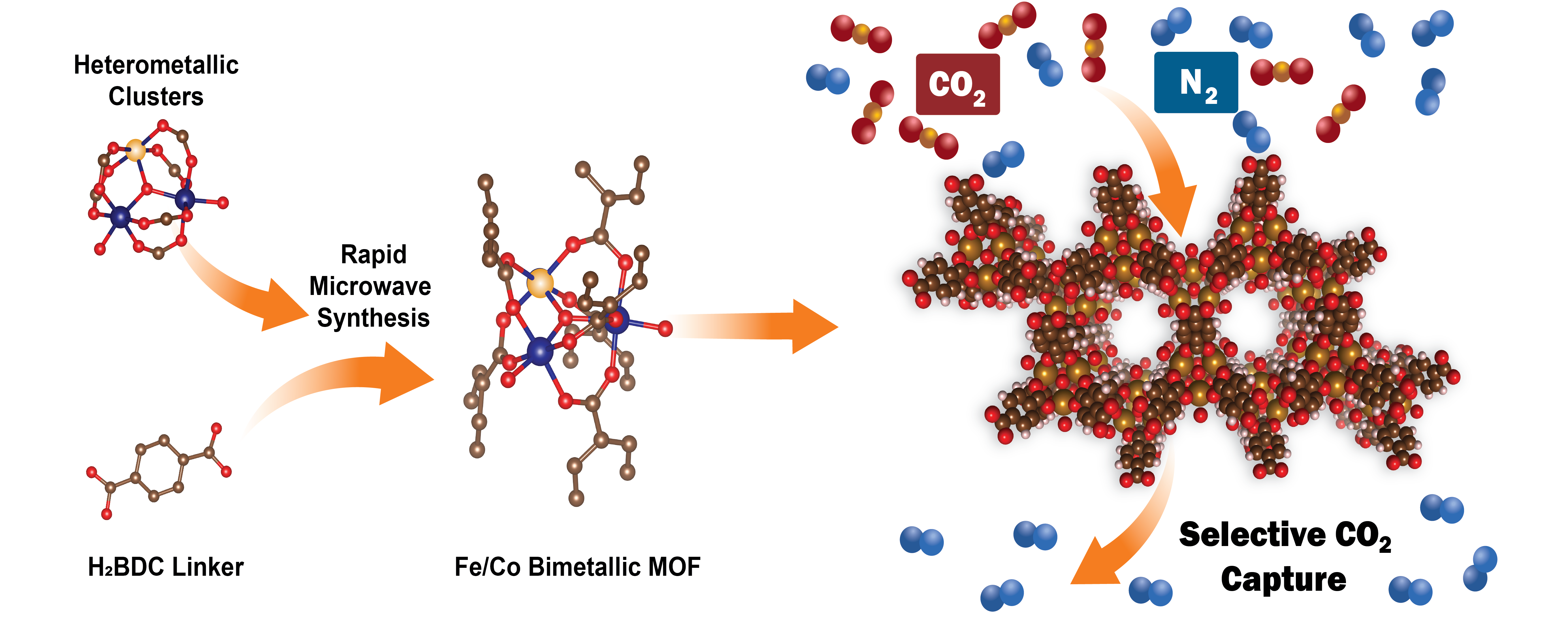
Downloads
References
C Estruch, R Curcoll, JA Morgui, R Segura-Barrero, V Vidal, A Badia, S Ventura, J Gilabert and G Villalba. Exploring how the heterogeneous urban landscape influences CO2 concentrations: The case study of the Metropolitan Area of Barcelona. Urban Forestry & Urban Greening 2024; 99, 128438.
X Zhang, H Zhao, Q Yang, M Yao, Yn Wu and Y Gu. Direct air capture of CO2 in designed metal-organic frameworks at lab and pilot scale. Carbon Capture Science & Technology 2023; 9, 100145.
D Yuan, D Zhao, D Sun and HC Zhou. An Isoreticular Series of Metal-Organic Frameworks with Dendritic Hexacarboxylate Ligands and Exceptionally High Gas-Uptake Capacity. Angewandte Chemie International Edition 2010; 122(31), 5485-5489.
J McEwen, JD Hayman and A Ozgur Yazaydin. A comparative study of CO2, CH4 and N2 adsorption in ZIF-8, Zeolite-13X and BPL activated carbon. Chemical Physics 2013; 412, 72-76.
KS Walton, AR Millward, D Dubbeldam, H Frost, JJ Low, OM Yaghi and RQ Snurr. Understanding Inflections and Steps in Carbon Dioxide Adsorption Isotherms in Metal-Organic Frameworks. Journal of the American Chemical Society 2008; 130(2), 406-407.
Y Lin, Q Yan, C Kong and L Chen. Polyethyleneimine Incorporated Metal-Organic Frameworks Adsorbent for Highly Selective CO2 Capture. Scientific Reports 2013; 3, 1859.
CA Trickett, A Helal, BA Al-Maythalony, ZH Yamani, KE Cordova and OM Yaghi. The chemistry of metal-organic frameworks for CO2 capture, regeneration and conversion. Nature Reviews Materials 2017; 2, 17045.
AC Kizzie, AG Wong-Foy and AJ Matzger. Effect of Humidity on the Performance of Microporous Coordination Polymers as Adsorbents for CO2 Capture. Langmuir 2011; 27(10), 6368-6373.
L Chen, HF Wang, C Li and Q Xu. Bimetallic metal-organic frameworks and their derivatives. Chemical Science 2020; 11(21), 5369-5403.
PDC Dietzel, V Besikiotis and R Blom. Application of metal-organic frameworks with coordinatively unsaturated metal sites in storage and separation of methane and carbon dioxide. Journal of Materials Chemistry 2009; 19(39), 7362-7370.
L Grajciar, W Andrew D, PL Llewellyn, JS Chang and P Nachtigall. Understanding CO2 Adsorption in CuBTC MOF: Comparing Combined DFT-ab Initio Calculations with Microcalorimetry Experiments. The Journal of Physical Chemistry C 2011; 115(36), 17925-17933.
AO Yazaydın, RQ Snurr, TH Park, K Koh, J Liu, MD LeVan, AI Benin, P Jakubczak, M Lanuza, DB Galloway, JJ Low and RR Willis. Screening of Metal-Organic Frameworks for Carbon Dioxide Capture from Flue Gas Using a Combined Experimental and Modeling Approach. Journal of the American Chemical Society 2009; 131(51), 18198-18199.
X He, DR Chen and WN Wang. Bimetallic metal-organic frameworks (MOFs) synthesized using the spray method for tunable CO2 adsorption. Chemical Engineering Journal 2020; 382, 122825.
TR Katugampalage, P Waribam, P Opaprakasit, C Kaewsaneha, SH Hsu, W Chooaksorn, CA Jong, P Sooksaen, C Ratanatawanate and P Sreearunothai. Bimetallic Fe:Co metal-organic framework (MOF) with unsaturated metal sites for efficient Fenton-like catalytic degradation of oxytetracycline (OTC) antibiotics. Chemical Engineering Journal 2024; 479, 147592.
P Waribam, T Rajeendre Katugampalage, P Opaprakasit, C Ratanatawanate, W Chooaksorn, LP Wang, CH Liu and P Sreearunothai. Upcycling plastic waste: Rapid aqueous depolymerization of PET and simultaneous growth of highly defective UiO-66 metal-organic framework with enhanced CO2 capture via one-pot synthesis. Chemical Engineering Journal 2023; 473, 145349.
Y Xu, B Li, S Zheng, P Wu, J Zhan, Xue, Q Xu and H Pang. Ultrathin two-dimensional cobalt-organic framework nanosheets for high-performance electrocatalytic oxygen evolution. Journal of Materials Chemistry A 2018; 6(44), 22070-22076.
GT Vuong, MH Pham and TO Do. Direct synthesis and mechanism of the formation of mixed metal Fe2Ni-MIL-88B. CrystEngComm 2013; 15(45), 9694-9703.
M Kurmoo, H Kumagai, M Green, B Lovett, S Blundell, A Ardavan and J Singleton. Two Modifications of Layered Cobaltous Terephthalate: Crystal Structures and Magnetic Properties. Journal of Soli State Chemistry 2001; 159(2), 343-351.
Y Li, G Hou, J Yang, J Xie, X Yuan, H Yang and M Wang. Facile synthesis of MOF 235 and its superior photocatalytic capability under visible light irradiation. RSC Advances 2016; 6(20), 16395-16403.
D Bara, EG Meekel, I Pakamore, C Wilson, S Ling and RS Forgan. Exploring and expanding the Fe-terephthalate metal-organic framework phase space by coordination and oxidation modulation. Materials Horizons 2021; 8(12), 3377-3386.
GT Vuong, MH Pham and TO Do. Synthesis and engineering porosity of a mixed metal Fe2Ni MIL-88B metal-organic framework. Dalton Transactions 2013; 42(2), 550-557.
S Abednatanzi, PG Derakhshandeh, H Depauw, FX Coudert, H Vrielinck, PVD Voort and K Leus. Mixed-metal metal-organic frameworks. Chemical Society Reviews 2019; 48(9), 2535-2565.
RF Mendes, J Rocha and FAA Paz. Chapter 8 - Microwave synthesis of metal-organic frameworks, in: M. Mozafari (Ed.). Metal-Organic Frameworks for Biomedical Applications Woodhead Publishing 2020; 1, 159-176.
VN Le, HT Kwon, TK Vo, JH Kim, WS Kim and J Kim. Microwave-assisted continuous flow synthesis of mesoporous metal-organic framework MIL-100 (Fe) and its application to Cu(I)-loaded adsorbent for CO/CO2 separation. Materials Chemistry and Physics 2020; 253, 123278.
W Xuan, R Ramachandran, C Zhao and F Wang. Influence of synthesis temperature on cobalt metal-organic framework (Co-MOF) formation and its electrochemical performance towards supercapacitor electrodes. Journal of Solid State Electrochemistry 2018; 22, 3873-3881.
WSA El-Yazeed, YGA El-Reash, LA Elatwy and AI Ahmed. Facile fabrication of bimetallic Fe-Mg MOF for the synthesis of xanthenes and removal of heavy metal ions. RSC Advances 2020; 10(16), 9693-9703.
A Benitez, J Amaro-Gahete, D Esquivel, FJ Romero-Salguero, J Morales and A Caballero. MIL-88A Metal-Organic Framework as a Stable Sulfur-Host Cathode for Long-Cycle Li-S Batteries. Nanomaterials 2020; 10(3), 424.
S Zhang, Y Zhuo, CI Ezugwu, CC Wang, C Li and S Liu. Synergetic Molecular Oxygen Activation and Catalytic Oxidation of Formaldehyde over Defective MIL-88B(Fe) Nanorods at Room Temperature. Environmental Science & Technology 2021; 55(12), 8341-8350.
H Lv, H Zhao, T Cao, L Qian, Y Wang and G. Zhao. Efficient degradation of high concentration azo-dye wastewater by heterogeneous Fenton process with iron-based metal-organic framework. Journal of Molecular Catalysis A: Chemical 2015; 400, 81-89.
J Zhu, X Lu, J Zhang, H Sun, C Zhang, Z Jiang, C Ju, Z Wang, F Huang and J Zhu. The effect of Fe2+ ions on dielectric and magnetic properties of Yb3Fe5O12 ceramics. Journal of Applied Physics 2012; 111(1).
A Indra, PW Menezes, I Zaharieva, H Dau and M Driess. Detecting structural transformation of cobalt phosphonate to active bifunctional catalysts for electrochemical water-splitting. Journal of Materials Chemistry A 2020; 8(5), 2637-2643.
W Liang, L Li, J Hou, ND Shepherd, TD Bennett, DM DʼAlessandro and V Chen. Linking defects, hierarchical porosity generation and desalination performance in metal-organic frameworks. Chemical Science 2018; 9(14), 3508-3516.
RC Klet, Y Liu, TC Wang, JT Hupp and OK Farha. Evaluation of Brønsted acidity and proton topology in Zr- and Hf-based metal-organic frameworks using potentiometric acid-base titration. Journal of Materials Chemistry 2016; 4, 1479-1485.
PDC Dietzel, RE Johnsen, H Fjellvag, S Bordiga, E Groppo, S Chavan and R Blom. Adsorption properties and structure of CO2 adsorbed on open coordination sites of metal-organic framework Ni2(dhtp) from gas adsorption, IR spectroscopy and X-ray diffraction. Chemical Communications 2008; 1(41), 5125-5127.
Y Abdoli, M Razavian and S Fatemi. Bimetallic Ni-Co-based metal-organic framework: An open metal site adsorbent for enhancing CO2 capture. Applied Organometallic Chemistry (2019); 33(8), 5004.
Z Zhou, L Mei, C Ma, F Xu, J Xiao, Q Xia and Z Li. A novel bimetallic MIL-101(Cr, Mg) with high CO2 adsorption capacity and CO2/N2 selectivity. Chemical Engineering Science 2016; 147, 109-117.
L Lei, Y Cheng, C Chen, M Kosari, Z Jiang and C He. Taming structure and modulating carbon dioxide (CO2) adsorption isosteric heat of nickel-based metal organic framework (MOF-74(Ni)) for remarkable CO2 capture. Journal of Colloid and Interface Science 2022; 612, 132-145.
Published
How to Cite
Issue
Section
License
Copyright (c) 2025 Walailak University

This work is licensed under a Creative Commons Attribution-NonCommercial-NoDerivatives 4.0 International License.





