
Quantum Circuit Algorithm for Heart Disease Detection
DOI:
https://doi.org/10.48048/tis.2025.10520Abstract
This study investigates hybrid quantum-classical K-Means algorithms for clustering heart disease patient data. Using quantum swap-test circuits for distance calculation, 2 approaches were tested on both noisy and ideal quantum simulators. A real-world dataset of over 1,000 records was preprocessed using standard techniques, including normalization, outlier removal, and dimensionality reduction. The results show that both quantum methods achieve accuracy up to 0.83 and F1-scores comparable to the classical K-Means baseline (0.82 - 0.83), even when executed on quantum simulators with real-device noise models. These findings highlight the practical potential of quantum-enhanced clustering methods. The study supports the feasibility of applying quantum-enhanced clustering in medical analytics, particularly for early-stage heart disease detection and patient risk stratification.
HIGHLIGHTS
- This paper introduces a hybrid quantum–classical K-Means clustering framework for analyzing heart disease data.
- Two quantum circuits for distance calculation are designed and evaluated on a real-world dataset using both ideal quantum simulators and noisy quantum hardware (e.g., IBM’s ibm_brisbane).
- The quantum clustering algorithms demonstrate performance comparable to classical K-Means and traditional models such as XGBoost.
- Future work will focus on circuit optimization, scalable encoding strategies, and validation on larger datasets using real quantum devices.
GRAPHICAL ABSTRACT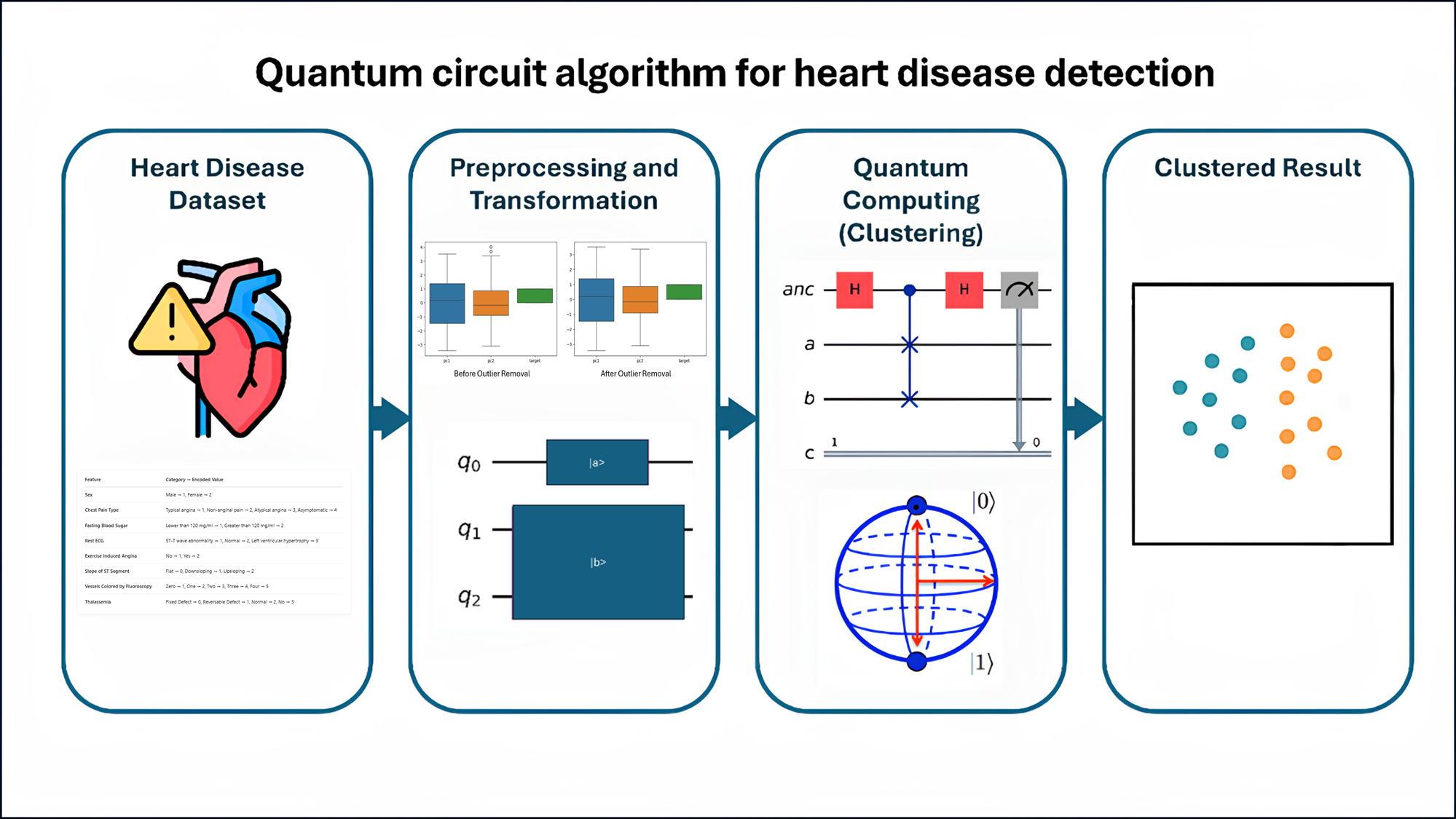
Downloads
References
SMS Shah, FA Shah, SA Hussain and S Batool. Support vector machines-based heart disease diagnosis using feature subset, wrapping selection and extraction methods. Computers & Electrical Engineering 2020; 84, 106628.
A Salau, T Admassu, G Chhabra, K Kaushik and SL Braide. Heart disease detection model using support vector machine with feature selection. In: Proceedings of the 2nd International Conference on Advancement in Computation & Computer Technologies (InCACCT), Gharuan, India. 2024, p. 204-207.
AA Ahmad and H Polat. Prediction of heart disease based on machine learning using jellyfish optimization algorithm. Diagnostics 2023; 13(14), 2392.
M Porumb, E Iadanza, S Massaro and L Pecchia. A convolutional neural network approach to detect congestive heart failure. Biomedical Signal Processing and Control 2020; 55, 101597.
ID Mienye, Y Sun and Z Wang. An improved ensemble learning approach for the prediction of heart disease risk. Informatics in Medicine Unlocked 2020; 20, 100402.
H El-Sofany, B Bouallegue and YM Abd El-Latif. A proposed technique for predicting heart disease using machine learning algorithms and an explainable AI method. Scientific Reports 2024; 14(1), 23277.
J Biamonte, P Wittek, N Pancotti, P Rebentrost, N Wiebe and S Lloyd. Quantum machine learning. Nature 2017; 549(7671), 195-202.
J Preskill. Quantum computing in the NISQ era and beyond. Quantum 2018; 2, 79.
M Cerezo, A Arrasmith, R Babbush, SC Benjamin, S Endo, K Fujii, JR McClean, K Mitarai, X Yuan, L Cincio and PJ Coles. Variational quantum algorithms. Nature Reviews Physics 2021; 3(9), 625-644.
A Poggiali, A Berti, A Bernasconi, GMD Corso and R Guidotti. Guidotti. Quantum clustering with k-Means: A hybrid approach. Theoretical Computer Science 2024; 992, 114466.
SU Khan, AJ Awan and G Vall-llosera. K-Means clustering on noisy intermediate scale quantum computers. ArXiv 2019, 1-12.
D Quiroga, P Date and R Pooser. Discriminating quantum states with quantum machine learning. In: Proceedings of the 2021 IEEE International Conference on Quantum Computing and Engineering (QCE), Broomfield, CO, USA. 2021, p. 56-63.
D Arthur and P Date. Balanced k-means clustering on an adiabatic quantum computer. Quantum Information Processing 2021; 20(9), 294.
I Kerenidis, J Landman, A Luongo and A Prakash. q-means: A quantum algorithm for unsupervised machine learning. ArXiv 2018, p. 1-11.
H Urgelles, P Picazo-Martínez and JF Monserrat. Application of quantum computing to accurate positioning in 6G indoor scenarios. In: Proceedings of the ICC 2022 - IEEE International Conference on Communications, Seoul, Korea. 2022, p. 643-647.
O Ouedrhiri, O Banouar, S El Hadaj and S Raghay. Intelligent recommender system based on quantum clustering and matrix completion. Concurrency and Computation: Practice and Experience 2022; 34(15), e6943.
S DiAdamo, C O’Meara, G Cortiana and J Bernabé-Moreno. Practical quantum k-means clustering: Performance analysis and applications in energy grid classification. IEEE Transactions on Quantum Engineering 2022; 3(11), 1-16.
SS Kavitha and N Kaulgud. Quantum K-means clustering method for detecting heart disease using quantum circuit approach. Soft Computing 2022; 27(18), 13255-13268.
H Gupta, H Varshney, TK Sharma, N Pachauri and OP Verma. Comparative performance analysis of quantum machine learning with deep learning for diabetes prediction. Complex & Intelligent Systems 2022; 8(4), 3073-3087.
S Lloyd. Least squares quantization in PCM. IEEE Transactions on Information Theory 1982; 28(2), 129-137.
A Likas, N Vlassis and JJ Verbeek. The global k-means clustering algorithm. Pattern Recognition 2003; 36(2), 451-461.
C Shi, B Wei, S Wei, W Wang, H Liu and J Liu. A quantitative discriminant method of elbow point for the optimal number of clusters in clustering algorithm. EURASIP Journal on Wireless Communications and Networking 2021; 2021(1), 31,
M Rath and H Date. Quantum data encoding: A comparative analysis of classical-to-quantum mapping techniques and their impact on machine learning accuracy. EPJ Quantum Technology 2024; 11(1), 72.
K Gangal. Heart disease dataset (UCI). UCI, Irvine , California, 2025.
AM Kuruvilla and NV Balaji. Heart disease prediction system using correlation based feature selection with multilayer perceptron approach. IOP Conference Series: Materials Science and Engineering 2021; 1085(1), 012028.

Published
How to Cite
Issue
Section
License
Copyright (c) 2025 Walailak University

This work is licensed under a Creative Commons Attribution-NonCommercial-NoDerivatives 4.0 International License.





