
BNCT Displays Cytotoxic Effect on Malignant Meningioma Via the Induction of DNA Damage
DOI:
https://doi.org/10.48048/tis.2025.10511Keywords:
BNCT, DNA damage, Malignant meningiomas, L-Type amino acid transporter 1Abstract
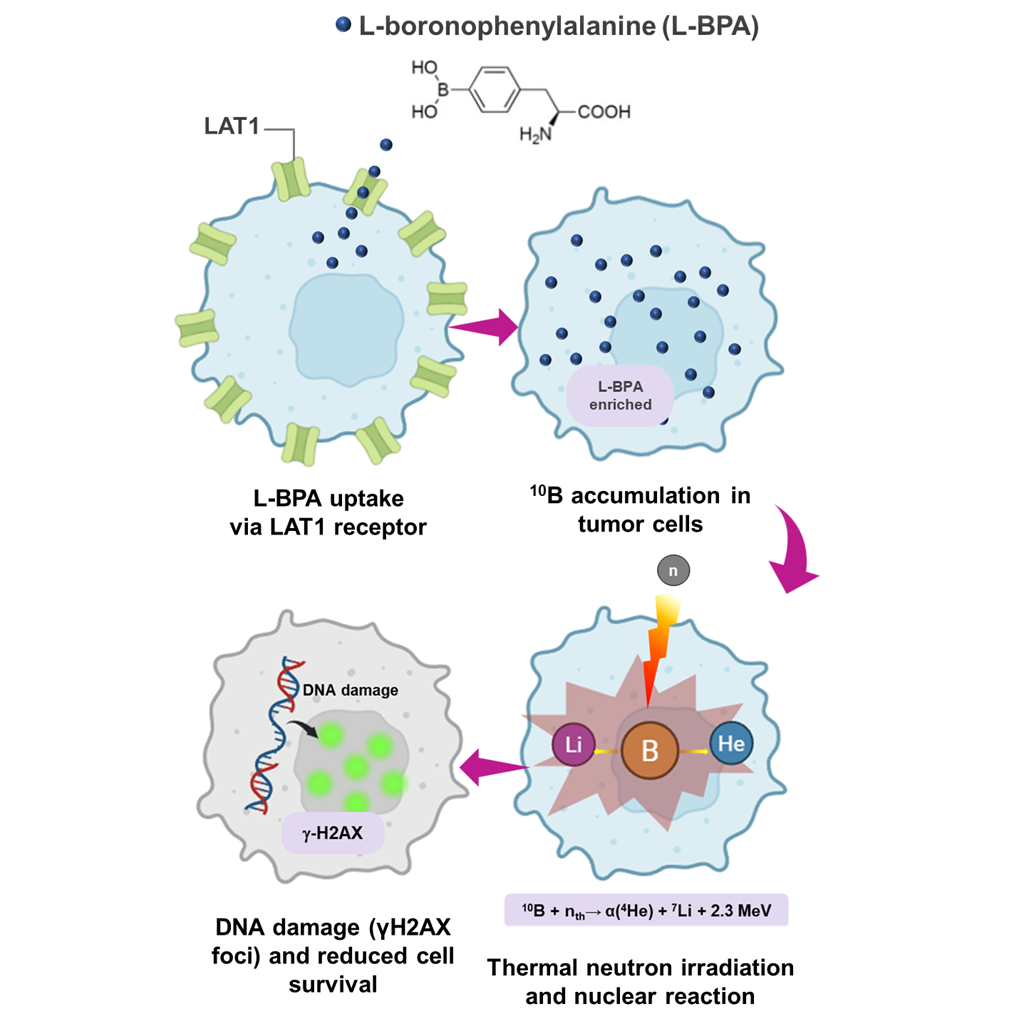
Malignant meningiomas are an aggressive cancer with high recurrence and poor prognosis. It is difficult to treat via surgical resection and radiotherapy, especially recurrent meningiomas. Boron neutron capture therapy (BNCT) is a targeted radiotherapy that can selectively kill malignant tumor cells with increased uptake of p-10B-para-boronophenylalanine (BPA) via up-regulation of L-Type Amino Acid Transporter 1 (LAT1). BNCT has been used in clinical studies to treat malignant meningiomas. However, it has never been reported on the basic study of BNCT and the mechanism of BNCT-mediated cell death in the meningiomas. The results of the present study demonstrated that LAT1 was a major LAT isoform in meningiomas. High mRNA expression of LAT1 was observed in both malignant meningioma cell lines and primary benign meningioma cells. The intracellular retention of 10B was increased in dose- and time-dependent manners. The cell viability of HKBMM cells after boron neutron irradiation for 30 min was decreased as 4-borono-L-phenylalanine-fructose (L-BPA-fr) concentration increased. Next, the effect of BNCT on DNA damage was performed via the expression of phosphorylated H2AX (γH2AX). The increase in γH2AX foci per nucleus, brighter and larger of foci were associated with the increase of intracellular 10B concentrations and radiation dose. Taken together, our findings suggest that the efficacy of BNCT on DNA damage and cell viability depends on the intracellular retention of 10B and radiation dosage.
HIGHLIGHTS
- LAT1 is highly expressed in meningiomas.
- L-BPA-fr mediated ¹⁰B uptake increases in a dose- and time-dependent manner.
- BNCT significantly decreases cell viability in malignant meningioma cells.
- BNCT induces γH2AX foci formation associated with DNA double-strand breaks.
- The efficacy of BNCT depends on intracellular ¹⁰B retention and neutron radiation dose.
GRAPHICAL ABSTRACT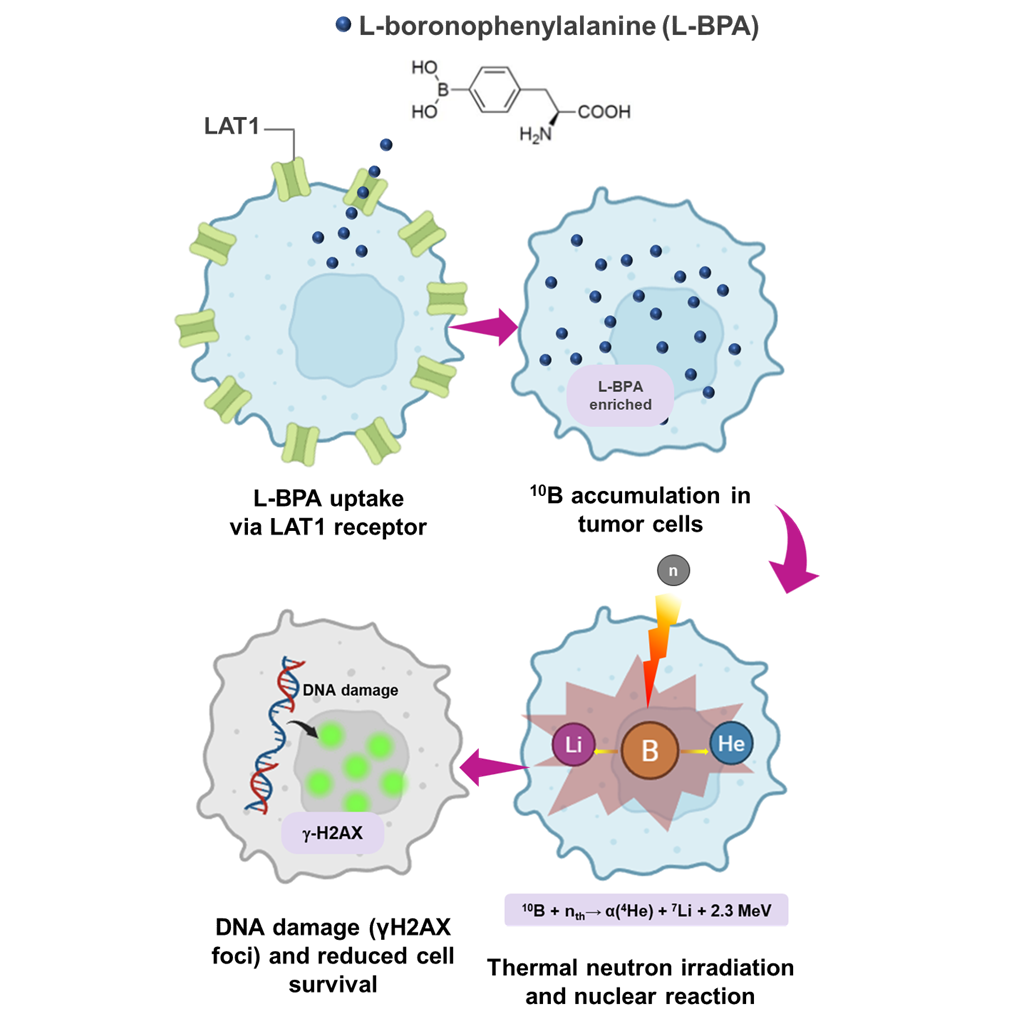
Downloads
References
QT Ostrom, N Patil, G Cioffi, K Waite, C Kruchko and JS Barnholtz-Sloan. CBTRUS statistical report: Primary brain and other central nervous system tumors diagnosed in the United States in 2013-2017. Neuro-Oncology 2020; 22(S2), iv1-iv96.
V Yarabarla, A Mylarapu, TJ Han, SL McGovern, SM Raza and TH Beckham. Intracranial meningiomas: An update of the 2021 World Health Organization classifications and review of management with a focus on radiation therapy. Frontiers in Oncology 2023; 13, 1137849.
E Marastoni and V Barresi. Meningioma grading beyond histopathology: Relevance of epigenetic and genetic features to predict clinical outcome. Cancers 2023; 15(11), 2945.
R Goldbrunner, P Stavrinou, MD Jenkinson, F Sahm, C Mawrin, DC Weber, M Preusser, G Minniti, M Lund-Johansen, F Lefranc, E Houdart, K Sallabanda, EL Rhun, D Nieuwenhuizen, G Tabatabai, R Soffietti and M Weller. EANO guideline on the diagnosis and management of meningiomas. Neuro-Oncology 2021; 23(11), 1821-1834.
AP Wojcieszynski, N Ohri, DW Andrews, JJ Evans, AP Dicker and M Werner-Wasik. Reirradiation of recurrent meningioma. Journal of Clinical Neuroscience 2012; 19(9), 1261-1264.
M Suzuki. Boron neutron capture therapy (BNCT): A unique role in radiotherapy with a view to entering the accelerator-based BNCT era. International Journal of Clinical Oncology 2020; 25(1), 43-50.
Y Zhao, L Wang and J Pan. The role of L-type amino acid transporter 1 in human tumors. Intractable & Rare Diseases Research 2015; 4(4), 165-169.
S Takai, M Wanibuchi, S Kawabata, K Takeuchi, Y Sakurai, M Suzuki, K Ono and SI Miyatake. Reactor-based boron neutron capture therapy for 44 cases of recurrent and refractory high-grade meningiomas with long-term follow-up. Neuro-Oncology 2022; 24(1), 90-98.
TL Lan, CF Lin, YY Lee, KH Lin, FC Chang, SC Lin, JC Lee, FI Chou, JJ Peir, HM Liu, PF Mu and YW Chen. Advances in boron neutron capture therapy (BNCT) for recurrent intracranial meningioma. International Journal of Molecular Sciences 2023; 24(5), 4978.
M Higashino, T Aihara, S Takeno, H Naonori, T Jinnin, K Nihei, K Ono and R Kawata. Boron neutron capture therapy as a larynx-preserving treatment for locally recurrent laryngeal carcinoma after conventional radiation therapy: A preliminary report. Auris Nasus Larynx 2024; 51(4), 792-796.
C Rodriguez, M Carpano, P Curotto, S Thorp, M Casal, G Juvenal, M Pisarev and MA Dagrosa. In vitro studies of DNA damage and repair mechanisms induced by BNCT in a poorly differentiated thyroid carcinoma cell line. Radiation and Environmental Biophysics 2018; 57(2), 143-152.
KH Chen, ZY Lai, DY Li, YC Lin, FI Chou and YJ Chuang. Analysis of DNA damage responses after boric acid-mediated boron neutron capture therapy in hepatocellular carcinoma. Anticancer Research 2019; 39(12), 6661-6671.
GV Mechetin and DO Zharkov. DNA damage response and repair in boron neutron capture therapy. Genes 2023; 14(1), 127.
C Talabnin, T Trasaktaweesakul, P Jaturutthaweechot, P Asavaritikrai, D Kongnawakun, A Silsirivanit, N Araki and K Talabnin. Altered O-linked glycosylation in benign and malignant meningiomas. PeerJ 2024; 12(21), e16785.
Y Sakurai and T Kobayashi. Spectrum evaluation at the filter-modified neutron irradiation field for neutron capture therapy in Kyoto University Research Reactor. Nuclear Instruments and Methods in Physics Research Section A 2004; 531(3), 585-595.
S Khophai, S Chokchaisiri, K Talabnin, JK Cairns and C Talabnin. Black rice bran-derived anthocyanins prevent H2 O2-induced oxidative stress and DNA damage in cholangiocytes through activation of the Nrf2-NQO1 axis. ScienceAsia 2024; 50(6), 1-10.
P Wongthai, K Hagiwara, Y Miyoshi, P Wiriyasermkul, L Wei, R Ohgaki, I Kato, K Hamase, S Nagamori and Y Kanai. Borono-phenylalanine, a boron delivery agent for boron neutron capture therapy, is transported by ATB0,+, LAT1 and LAT2. Cancer Science 2015; 106(3), 279-286.
IH Seo, J Lee, D Na, H Kyung, J Yang, S Lee, SJ Jeon, JW Choi, KY Lee, J Yi, J Han, M Yoo and SH Kim. The anti-tumor effect of boron neutron capture therapy in glioblastoma subcutaneous xenograft model using the proton linear accelerator-based BNCT system in Korea. Life 2022; 12(8), 1264.
S Terada, S Tsunetoh, Y Tanaka, T Tanaka, H Kashiwagi, T Takata, S Kawabata, M Suzuki and M Ohmichi. Boron uptake of boronophenylalanine and the effect of boron neutron capture therapy in cervical cancer cells. Applied Radiation and Isotopes 2023; 197, 110792.
K Maliszewska-Olejniczak, D Kaniowski, M Araszkiewicz, K Tymińska and A Korgul. Molecular mechanisms of specific cellular DNA damage response and repair induced by the mixed radiation field during boron neutron capture therapy. Frontiers in Oncology 2021; 11, 676575.
N Kondo, H Michiue, Y Sakurai, H Tanaka, Y Nakagawa, T Watanabe, M Narabayashi, Y Kinashi, M Suzuki, SI Masunaga and K Ono. Detection of γH2AX foci in mouse normal brain and brain tumor after boron neutron capture therapy. Reports of Practical Oncology & Radiotherapy 2016; 21(2), 108-112.
Published
How to Cite
Issue
Section
License
Copyright (c) 2025 Walailak University

This work is licensed under a Creative Commons Attribution-NonCommercial-NoDerivatives 4.0 International License.





