
Screening of Antibacterial Compound and Detection of Polyketide Synthetase - Non Ribosomal Peptide Synthetase (PKS-NRPS) Biosynthetic Gene from Tunicates-Associated Bacteria Collected from The Kumbang Shipwreck (Karimunjawa, Indonesia)
DOI:
https://doi.org/10.48048/tis.2025.10472Keywords:
Antibacterial, MDR bacteria, Tunicate, PKS genes, NRPS genesAbstract
The presence of bacteria resistant to various types of antibiotics referred to as MDR (Multi Drugs Resistant) bacteria has driven the exploration of bioactive compounds as new antibiotic candidates. Tunicates-associated bacteria have been reported to have the potential to produce bioactive compounds that can fight MDR bacteria. This study aims to isolate and analyze the number of colonies of tunicate-associated bacteria on different media, analyze the antibacterial activity of isolates against MDR bacteria, find potential tunicate-associated bacterial species in inhibiting MDR bacteria, and detect PKS-1 and NRPS genes from potential isolates. The methods used were isolation of associated bacteria by multistage dilution method, screening of antibacterial activity using agar plug method, amplification of 16S rRNA, PKS-1 and NRPS genes using Polymerase Chain Reaction (PCR) method, and species identification by 16S rRNA gene sequencing then analyzed using Basic Local Alignment Search Tool (BLAST). The results were obtained tunicates from the Genera Polycitorella, Plebobranchia, Rhopalaea, Clavelina, and Didemnum. Pure isolates that were successfully isolated from the 6 tunicates were 12 isolates from Zobell 2216 media and 69 isolates from M1 media. Potential isolates obtained include isolate KM402-02 which is Klebsiella variicola (homology 99.20%) able to inhibit S. aureus (3.3 mm), E. coli (5.8 mm) and P. aeruginosa (4.6 mm), isolate KJ2Z411-04 is Vibrio alginolytiicus (homology 99.86%) able to inhibit S. aureus (10 mm) and E. coli (8.4 mm), and isolate KJ2Z318-01 is Bacillus paramycoides (homology 99.86%) able to inhibit S. aureus (7.8 mm) and E. coli (4.1 mm). Isolation using M1 media showed better results on the growth of tunicates association bacteria. This study succeeded in identifying 3 potential bacteria as anti-MDR. PKS-1 gene was detected in Klebsiella variicola and Vibrio alginolytiicus.
HIGHLIGHTS
- Tunicates from the Genera Polycitorella, Plebobranchia, Rhopalaea, Clavelina, and Didemnum can be used as inoculum sources to produce bacterial isolates that have antibacterial properties.
- Pure isolates that were successfully isolated from the 6 tunicates were 12 isolates from Zobell 2216 media and 69 isolates from M1 (M1 medium for marine bacteria).
- Potential isolates obtained include isolate KM402-02 which is Klebsiella variicola (homology 99.20%) able to inhibit MDR aureus (3.3 mm), E. coli (5.8 mm) and P. aeruginosa (4.6 mm).
- Isolate KJ2Z411-04 is Vibrio alginolytiicus (homology 99.86%) able to inhibit MDR aureus (10 mm) and E. coli (8.4 mm)
- Isolate KJ2Z318-01 is Bacillus paramycoides (homology 99.86%) able to inhibit MDR aureus (7.8 mm) and E. coli (4.1 mm). PKS-1 gene was detected in Klebsiella variicola and Vibrio alginolytiicus.
GRAPHICAL ABSTRACT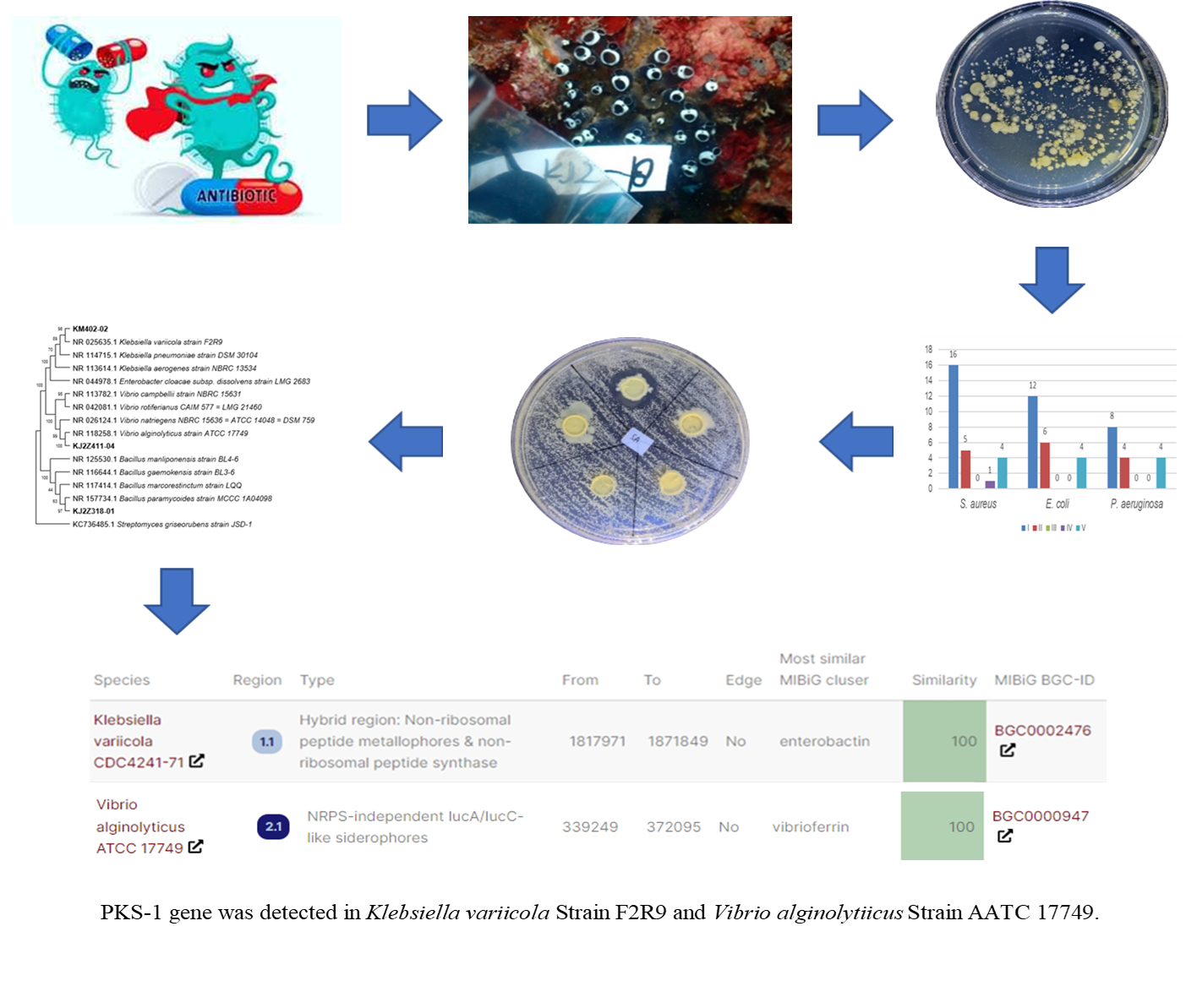
Downloads
References
ER Utami. Antibiotics, resistance, and rationality of therapy. El-Hayah Jurnal Biologi 2011; 1(4), 3.
S Cesur and AP Demiroz. Antibiotics mechanism of resistance to antibiotics. Medical Journal of Islamic World Academy of Sciences 2013; 21(4), 138-142.
JR Wartu, AQ Butt, U Suleiman, M Adeke, FB Tayaza, BJ Musa and J Baba. Multidrug resistance by microorganisms: A review. Science World Journal 2019; 14(4), 49-56.
MM Khoeri, OK Radjasa and A Sabdono. Bioprospecting of bacterial symbiont of tunicate Didemnum mole from Sambangan, Karimunjawa Islands. Journal of Coastal Development 2011. 14(3), 255-261.
Q Song, XM Li, XY Hu, X Li, LP Chi, HL Li and BG Wang. Antibacterial metabolites from ascidian-derived fungus aspergillus clavatus AS-107. Phytochemistry Letters 2019; 34, 30-34.
A Bauermeister, PC Branco, LC Furtado, PC Jimenez, LVC Lutovo and TMC Lutovo. Tunicates: A model organism to investigate the effects of associated-microbiota on the production of pharmaceuticals. Drug Discovery Today: Disease Models. 2019; 28, 8.
C Ramesh, BR Tulasi, M Raju, N Thakur and L Dufosse. Marine natural products from tunicates and their associated microbes. Marine Drugs 2021; 19(6), 308.
S Flock, S Antonsen, HG Smith, AM Langseter, L Skattebol and Y Stenstrom. The first synthesis of crucigasterin 227- a polyunsaturated C-18 amino alcohol from the mediterranean tunicate pseudomonas crucigaster. Tetrahedron 2016; 72(30), 4518-4522.
D Ayuningrum, Y Liu, Riyanti, MT Sibero, R Kristiana, MA Asagabaldan, ZG Wuisan, A Triyanto, OK Radjasa, A Sabdono and TF Scaberle. Tunicate-associated bacteria show a great potential for the discovery of antimicrobial compounds. PLoS One 2019; 14(3), e0213797-e0213797.
DAA Farraj, R Varghese, C Vagvolgyi, MS Elshikh, AM Alokda and AH Mahmoud. Antibiotics production in optimized culture condition using low-cost substrates from streptomyces sp. AS4 isolated from mangrove soil sediment. Journal of King Saud University-Science. 2020; 32(2), 1528-1535.
A Ayuso-Sacido and O Ganilloud. New PCR primers for the screening of NRPS and PKS-I systems in actinomycetes: Detection and distribution of these biosynthetic gene sequences in major taxonomic groups. Microbial Ecology 2004; 49(1), 10-24.
S Romano, SA Jackson, S Patry and ADW Dobson. Extending the one strain many compounds (OSMAC) principle to marine microorganism. Marine Drugs 2018; 16(7), 244.
RM Putra, D Ayuningrum and A Sabdaningsih. Isolation and morphological characterization of tunicate-associated bacterial colonies from the shipwreck of Kumbang Karimunjawa, Jepara, Indonesia. International Journal of Research Publication and Reviews 2024; 5(6), 446-453.
D Ayuningrum, R Kristiana, AA Nisa, SK Radjasa, SI Muchlissin, OK Radjasa, A Sabdono and A Triyanto. Bacteria associated with tunicate, policarpa aurata, from Lease Sea, Maluku, Indonesia exhibiting anti-multidrug resistant bacteria. Biodiversitas Journal of Biological Diversity 2019; 20(4), 956-964.
HJ Benson. Microbiological application 8th edition. McGraw Hill, New York, 2001, p. 64-203.
A Sabdaningsih, O Cristianawat, MT Sibero, M Aini, OK Radjasa, A Sabdono and A Triyanto. Anti-MDR Acinetobacter baumannii of the sponges-associated fungi from Karimunjawa National Park. AACL Bioflux 2019; 12(5), 1970-1983.
AA Tomaseto, MC Alpiste, AFC Nassar and SAL Destefano. Antibacterial activity of phytopathogenic streptomyces strains against bacteria associated to clinical diseases. Arquivos do Instituto Biologico 2020; 87(1-7), e0142020.
A Bharadwaj, A Rastogi, S Pandey, S Gupta and JS Sohal. Multidrug-resistant bacteria: Their mechanism of action and prophylaxis. BioMed Research International 2022; 2022(3), 1-17.
SS Noer, R Yulia, F Herawati and A Zamroni. Analysis of antibiotic use in neurosurgery patients in the ICU room of Dr. Sosodoro Djatikoesoemo Bojonegoro hospital. Syntax Literate: Indonesian Scientific Journal 2022; 7(7), 9037-9052.
D Wulandari, LH Amatullah, AT Lunggani, AR Pratiwi and A Budiharjo. Antibacterial activity and molecular identification of soft coral Sinularia sp. symbiont bacteria from karimunjawa island against skin pathogens propionibacterium acnes and staphylococcus epidermidis. BIO Web of Conferences 2024; 92, 02001.
DR Jayanetti, DR Braun, KJ Barns, SR Rajski and TS Bugni. Bulbiferates A and B: Antibacterial Acetamidohydroxybenzoates from a marine proteobacterium, Microbulbifer sp. Journal of Natural Products 2019; 82(7), 1930-1934.
AA Sung, SM Gromek and MJ Balunas. Upregulation and identification of antibiotic activity of a marine-derived Streptomyces sp. via co-cultures with human pathogens. Marine Drugs 2017; 15(8), 250.
P Dewapriya, ZG Khalil, P Prasad, AA Salim, PC Morales, E Marcellin and RJ Capon. Talaropeptides A-D: Structure and biosynthesis of extensively N methylated linear peptides from an Australian marine tunicate-derived Talaromyces sp. Frontiers in Chemistry 2018; 6, 394.
BK Krochmal and RD Wicher. The minimum inhibitory concentration of antibiotics: Methods, interpretation, clinical relevance. Pathogens 2021; 10(2), 165.
M Balouiri, M Sadiki and SK Ibnsouda. Methods for in vitro evaluating antimicrobial activity: A review. Journal of Pharmaceutical Analysis 2016; 6(2), 71-79.
D Sune, H Rudberg, AN Augustinsson, L Serrander and MB Jungestrom. Optimation of 16S rRNA gene analysis for use in the diagnostic clinical microbiology service. Journal of Microbiological Methods 2020; 170(4), 105854.
S Suprianto, IM Budiarsa and F Dhafir. Studi in silico: Hasil BLAST gen clock pada megapodiidae. Jurnal Riset Sains dan Teknologi 2022; 6(1), 33.
MA Anwar, S Nurjanah and WP Rahayu. Aplikasi basic local alignment search tool (BLAST) NCBI pada Penelitian Molekuler Salmonela spp. Syntax Literate: Jurnal Ilmiah Indonesia 2022; 7(11), 15446.
MA Syah. Isolation and molecular characterization of 16S rRNA gene of lipolytic bacteria from cashew seed shell waste. Journal of Biological Resources 2022; 8(1), 20-26.
NR Medina, HB Camacho, JD Bedolla and UG Ramoz. Klebsiella variicola: An emerging pathogen in humans. Emerging Microbes & Infection 2019; 8(1), 973-988.
L Yang and K Yang. Biological function of klebsiella variicola and its effect on the rhizosphere soil of maize seedlings. PeerJ 2020; 8, e9894.
H Nursyam. Antibacterial activity of metabolites product of vibrio alginolyticus isolated from sponge Haliclona sp. against staphylococcus aureus. Italian Journal of Food Safety 2017; 6(1), 6237.
J Sarwan and JC Bose. Isolation, screening, and characterisation of bacillus paramycoides for producing cellulases, proteases and amylases from fabric industry. Research Square 2022. https://doi.org/10.21203/rs.3.rs-1700944/v1
A Trianto, OK Radjasa, A Sabdono, SI Muchlissin, R Afriyanto, S Sulistiowati, SK Radjasa, P Crews and E Mccauley. Exploration culturable bacterial symbionts of sponges from Ternate Island, Indonesia. Biodiversitas Journal of Biological Diversity 2019; 20(3), 776-782.
NLPI Dharmayanti. Molecular phylogenetic: Organism taxonomy method based on evolution history. Wartazoa 2011; 21(1), 10.
DA Lestari, R Azrianingsih and H Hendrian. Filogenetik Jenis-jenis Annonaceae dari Jawa Timur Koleksi Kebun Raya Purwodadi Berdasarkan coding dan non-coding sekuen DNA. Journal of Tropical Biodiversity and Biotechnology 2018; 3(1), 1-7.
WJ Kress, LMP MacKechnie and KJ Williams. The phylogeny and a new classification of the ginger (Zingiberaceae): Evidence from molecular data. American Journal of Botany 2002; 89(10), 1682-1696.
Y Wei, L Zhang, Z Zhou and X Yan. Diversity of gene cluster for polyketide and non-ribosomal peptide biosynthesis revealed by metagenomic analysis of the yellow sea sediment. Frontiers in Microbiology 2018; 9, 295.
H Komaki and T Tamura. Polyketide synthase and Nonribosomal peptide synthetase gene cluster in type strains of the genus Phytohabitans. Life 2020; 10(11), 257.
A Parmanik, S Das, B Kar, A Bose, GR Dwivedi and MM Pandey. Current treatment strategies against multidrug-resistant bacteria: A review. Current Microbiology 2022; 79(12), 388.
A Kumar, S Chakravorty, T Yang, TA Russo, SM Newton and PE Klebba. Siderophore-mediated iron acquisition by Klebsiella pneumoniae. Journal of Bacteriology 2024; 206(5), e0002424.
R Han, M Niu, S Liu, J Mao, Y Yu and Y Du. The effect of siderophore virulence genes entB and ybtS on the virulence of Carbapenem-resistant Klebsiella pneumoniae. Microbial Pathogenesis 2022; 171(3), 105746.
M Balado, CR Osorio and ML Lemos. A gene cluster involved in the biosynthesis of vanchrobactin, a chromosome-encoded siderophore produced by Vibrio anguillarum. Microbiology 2006; 152(P12), 3517-3528.
A Pramanik and RK Vibhuti. Molecular mechanism of iron transport systems in vibrio. Journal of Pure and Applied Microbiology 2022; 16(1), 116-129.
M Sandy, A Han, J Blunt, M Munro, M Haygood and A Butler. Vanchrobactin and Anguibactin Siderophores Produced by Vibrio sp. DS40M4. Journal of Natural Products 2010; 73(6), 1038-1043.
SA Amin, DH Green, FC Kupper and CJ Carrano. Vibrioferrin, an Unusual Marine Siderophore: Iron Binding, Photochemistry, and Biological Implications. Inorganic Chemistry 2009; 48(23), 11451-1148.
WA Norfolk, C Shue, WM Henderson, DA Glinski and EK Lipp. Vibrio alginolyticus growth kinetics and the metabolic effects of iron. Environmental Microbiology 2023; 11(6), e0268023.
A Darbandi, A Asadi, MM Ari, E Ohadi, M Talebi, MH Zadeh, AD Emamie, R Ghanavati and M Kakanj. Bacteriocins: Properties and potential use as antimicrobials. Journal of Clinical Laboratory Analysis 2022; 36(1), e24093.
MT Sibero, OK Radjasa, KG Bondar, LMI Simbolon, L Meilana, D Ayuningrum. Antibacterial activity and phytochemical content of Holothuria atra from Panjang Island, Jepara, Indonesia. AIP Conference Prociding 2019; 2120(1), 080005.

Published
How to Cite
Issue
Section
License
Copyright (c) 2025 Walailak University

This work is licensed under a Creative Commons Attribution-NonCommercial-NoDerivatives 4.0 International License.





