
Process Intensification of Polyphenol and Flavonoid Extraction from Ant Nest (Myrmecodia pendans) via Ohmic Heating: Investigating Joule Heating and Electric Field-Time Interactions Using a Response Surface Methodology
DOI:
https://doi.org/10.48048/tis.2025.10471Keywords:
Ant nest (Myrmecodia pendans), Extraction, Ohmic heating, Optimization, Response Surface Methodology (RSM)Abstract
Ant nest (Myrmecodia pendans) is a unique epiphytic plant native to the tropical forests of Eastern Indonesia, traditionally used by indigenous communities for its medicinal properties. It is characterized by its tuber-like structure, which serves as a natural habitat for ants and is believed to contribute to its rich content of bioactive compounds. This plant is particularly valued for its high levels of polyphenols and flavonoids, which are known for their antioxidant, anti-inflammatory and therapeutic effects. Ohmic heating is an innovative, energy-efficient extraction technique that utilizes electrical resistance to generate internal heat within conductive plant materials. This study applied ohmic heating as an innovative and energy-efficient extraction method to enhance the recovery of these bioactive compounds. Response Surface Methodology (RSM) with Central Composite Design (CCD) was used to optimize the extraction conditions. Two independent variables, holding time (90 - 270 s) and gradient voltage (20 - 60 V/cm), were investigated. Quadratic polynomial models were developed for total phenolic content (TPC), total flavonoid content (TFC) and extraction yield through multiple linear regression. The optimization using the desirability function indicated that the optimal extraction conditions were a holding time of 195.883 s and a gradient voltage of 52.761 V/cm, which predicted values of 256.145 mg GAE/g (TPC), 118.837 mg QE/g (TFC) and 38.154% extraction yield. Critically, the performance of the ohmic system was characterized based on electrical and thermal parameters. The initial electrical conductivity of the extraction medium ranged from 0.171 to 0.407 S/m, increasing with voltage and time. The temperature of the medium rose from ~30 °C to a peak of 87 °C during treatment, indicating efficient internal volumetric heating. Corresponding energy consumption ranged from 0.0805 to 0.3045 kWh per batch, equivalent to 28.98 - 109.62 kJ per g of dry ant nest powder. These results confirm that ohmic heating enables rapid and energy-efficient extraction while preserving thermal sensitivity of bioactive compounds.
HIGHLIGHTS
- The ant nest plant was studied for its phenolic and flavonoid content.
- RSM with CCD used to optimize ohmic heating extraction.
- Electrical conductivity, energy input and temperature rise were quantitatively assessed.
- Optimal extraction conditions yielded a high content of phenolics and flavonoids.
- Ohmic heating is efficient and eco-friendly for compound extraction.
GRAPHICAL ABSTRACT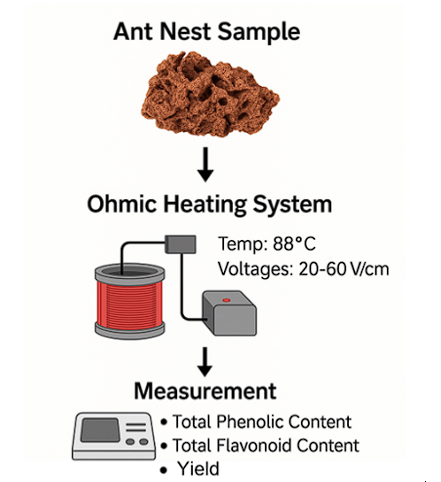
Downloads
References
A Pradityana, S Sulistijono and A Shahab. Effectiveness of Myrmecodia pendans extract as eco-friendly corrosion inhibitor for material API 5L grade B in 3,5% NaCl solution. Advanced Materials Research 2013; 789, 484-491.
J Sudiono and M Hardina. The effect of Myrmecodia pendans ethanol extract on inflamed pulp: Study on sprague dawley rats. Molecular and Cellular Biomedical Sciences 2019. https://doi.org/10.21705/mcbs.v3i2.70
F Kuswandani, MH Satari and AM Maskoen. Antimicrobial efficacy of Myrmecodia pendens extract and fraction combination against enter action combination against Enterococcus faecalis a ococcus faecalis ATCC 29212. Journal of Dentistry Indonesia 2019. https://doi.org/10.14693/jdi.v26i3.1085
T Widyawati, MA Pase, M Daulay, IB Sumantri and NA Yusoff. Evaluation of Myrmecodia pendans water extracts on hematology profiles, liver, kidney function and malondialdehyde level in healthy volunteer. Pharmacognosy Journal 2020. https://doi.org/10.5530/pj.2020.12.204
H Achmad, S Horax, S Ramadhany, IE Rieuwpassa, M Sari, H Handayani, MF Singgih and S Sugiharto. Anti-cancer and anti-proliferation activity of ethyl asetat extract from ant nest (Myrmecodia pendans) in burkitt’s lymphoma cancer cells. Pesquisa Brasileira Em Odontopediatria E Clínica Integrada 2019. https://doi.org/10.4034/pboci.2019.191.29
MH Bashari, S Hidayat, YAR Ruswandi, T Putri, N Qomarilla, RG Dwiwina, D Kurnia, MH Satari and F Huda. The N-Hexane fraction of myrmecodia pendans inhibits cell survival and proliferation in colon cancer cell line. International Journal of Pharmacy and Pharmaceutical Sciences 2018. https://doi.org/10.22159/ijpps.2018v10i1.21882
D Delima, L Widowati, H Siswoyo, N Nurhayati, OD Sampurno and FS Halim. The pattern of herbal medicine prescribed by medical doctor for 10 health problems in several cities of indonesia (analysis of jamu registry 2016 and 2018 database). Advances in health sciences research. In: Proceedings of the 4th International Symposium on Health Research (ISHR 2019), Bali, Indonesia. 2020, p. 625-629.
CMS Lima, MAT Fujishima, BÉF dos Santos, BP Lima, PC Mastroianni, FFO Sousa and JO Silva. Phytopharmacovigilance in the elderly: Highlights from the Brazilian amazon. Evidence-Based Complementary and Alternative Medicine 2019. https://doi.org/10.1155/2019/9391802
Priyono, D Kuswaji, D Danardono, HZ Hadibasyir, A Ambarwati and K Harismah. Digital marketing education of Jamu (Indonesian Traditional Herbal Medicine) for students of state junior high school 3 Tawangsari, Sukoharjo Regency as an effort to support Jamu Regency. Journal of Community Services and Engagement: Voice of Community 2023. https://doi.org/10.23917/voc.v2i2.1523
MB Mardiyanto, RS Foresty, V Arlysia, ZFN Chorunissa, GD Nugroho, A Yasa, D Naim and AD Setyawan. Plants as herbal medicine at Nguter Traditional Market, Sukoharjo, Central Java, Indonesia. Asian Journal of Ethnobiology 2023. https://doi.org/10.13057/asianjethnobiol/y060108
AM Engida, NS Kasim, YA Tsigie, S Ismadji, LH Huynh and YH Ju. Extraction, identification and quantitative HPLC analysis of flavonoids from sarang semut (Myrmecodia pendans). Industrial Crops and Products 2013. https://doi.org/10.1016/j.indcrop.2012.04.043
Y Nakamura, S Watanabe, N Miyake, H Kohno and T Osawa. Dihydrochalcones: Evaluation as novel radical scavenging antioxidants. Journal of agricultural and food chemistry 2003. https://doi.org/10.1021/jf0341060.
Neldawati, Ratnawulan and Gusnedi. Analisis nilai absorbansi dalam penentuan kadar flavonoid untuk berbagai jenis daun tanaman obat. Pillar of Physics 2013; 2, 76-83.
D Amić, D Davidović-Amić, D Bešlo, V Rastija, B Lučić and N Trinajstić. SAR and QSAR of the antioxidant activity of flavonoids. Current Medicinal Chemistry 2007. https://doi.org/10.2174/092986707780090954
C Huan, C Chen, W Xu, T Guo, H Pan and S Gao. Study on antiviral activities of glycyrrhizin. International Journal of Biomedical Engineering and Clinical Science 2020. https://doi.org/10.11648/j.ijbecs.20200604.11
Z Djenni, D Pingret, TJ Mason and F Chemat. Sono-soxhlet: In situ ultrasound-assisted extraction of food products. Food Analytical Methods 2013. https://doi.org/10.1007/s12161-012-9531-2
DT Wahyuni and SB Widjanarko. Pengaruh jenis pelarut dan lama ekstraksi terhadap ekstrak karotenid labu kuning dengan metode gelombang ultrasonik. Jurnal Pangan dan Agroindustri 2015; 3(2), 390-401.
FFV Gutiérrez. Ohmic heater for extracting essential oils from aromatic plants. Scientia Et Technica 2018. https://doi.org/10.22517/23447214.16931
H Saberian, Z Hamidi‐Esfahani, HA Gavlighi, A Banakar and M Barzegar. The potential of ohmic heating for pectin extraction from orange waste. Journal of Food Processing and Preservation 2017. https://doi.org/10.1111/jfpp.13458
F Pagels, RN Pereira, HM Amaro, VVasconcelos, AC Guedes and AA Vicente. Continuous pressurized extraction versus electric fields-assisted extraction of cyanobacterial pigments. Journal of Biotechnology 2021. https://doi.org/10.1016/j.jbiotec.2021.05.004
SG Pereira, C Teixeira-Guedes, G Souza-Matos, É Maricato, C Nunes, MA Coimbra, JA Teixeira, RN Pereira and CM Rocha. Influence of ohmic heating in the composition of extracts from Gracilaria vermiculophylla. Algal Research 2021. https://doi.org/10.1016/j.algal.2021.102360
P Loypimai, A Moongngarm, K Sittisuanjik and T Wongsadee. Enhancement of bioactive compounds and oxidation stability of soybean oil by enrichment with tocols and Γ‐oryzanol extracted from rice bran using ultrasound and ohmic heating. Journal of Food Processing and Preservation 2022. https://doi.org/10.1111/jfpp.16991
G Zhang, L He and M Hu. Optimized ultrasonic-assisted extraction of flavonoids from Prunella vulgaris L. and evaluation of antioxidant activities in vitro. Innovative Food Science & Emerging Technologies 2011. https://doi.org/10.1016/j.ifset.2010.12.003
A Ju, Y Cho, BR Kim, S Lee, HTT Le, HL Vuong and S Cho. Anticancer effects of methanol extract of myrmecodia platytyrea Becc. Leaves against human hepatocellular carcinoma cells via Inhibition of ERK and STAT3 signaling pathways. International Journal of Oncology 2017. https://doi.org/10.3892/ijo.2017.4178
SW Kidane. Application of response surface methodology in food process modeling and optimization. IntechOpen 2021. https://doi.org/10.5772/intechopen.100113
TT Lari, HR Bozorgzadeh, H Atashi, AM Davarpanah and AA Mirzaei. Effect of oleylamine concentration and operating conditions on ternary nanocatalyst for fischer-tropsch synthesis using response surface methodology. American Journal of Chemical Engineering 2019. https://doi.org/10.11648/j.ajche.20190702.13
L Ming, Z Li, F Wu, R Du and Y Feng. A two-step approach for fluidized bed granulation in pharmaceutical processing: Assessing different models for design and control. Public Library of Science One 2017. https://doi.org/10.1371/journal.pone.0180209
AG Rana and M Minceva. Analysis of photocatalytic degradation of phenol with exfoliated graphitic carbon nitride and light-emitting diodes using response surface methodology. Catalysts 2021. https://doi.org/10.3390/catal11080898
S Waqas, N Harun, BR Muhammad, S Taufik, NAHMD Nik, S Norazanita, NBD Asep, H Nurul and J Jumardi. Response surface methodology for optimization of rotating biological contactor combined with external membrane filtration for wastewater treatment. Membranes 2022. https://doi.org/doi: 10.3390/membranes12030271
K Luo, G Zhao and X Tian. Effects of maize resistance and leaf chemical substances on the structure of phyllosphere fungal communities. Frontiers in Plant Science 2023. https://doi.org/10.3389/fpls.2023.1241055
ID Toro, RR Ribbons and AM Ellison. Ant‐mediated ecosystem functions on a warmer planet: Effects on soil movement, decomposition and nutrient cycling. Journal of Animal Ecology 2015. https://doi.org/10.1111/1365-2656.12367
R Roslizawaty, M Abrar, K Khairan, G Gholib, SN Tongku, S Syafruddin, S Amalia, A Putri and A Hanipah. Potential of ant nest extract (Hydnophytum formicarum) for protection of testicular morphometry, epididymal functions, and sperm quality in male rats with alloxan-induced diabetes. NarraJ 2024. https://doi.org/10.52225/narra.v4i3.922
LS Lee, N Lee, YH Kim, C Lee, SP Hong, YW Jeon and YE Kim. Optimization of ultrasonic extraction of phenolic antioxidants from green tea using response surface methodology. Molecules 2013. https://doi.org/10.3390/molecules181113530
M Atanassova, S Georgieva and K Ivancheva. Total phenolic and total flavonoid contents, antioxidant capacity and biological contaminants in medicinal herbs. Journal of the University of Chemical Technology and Metallurgy 2011; 46(1), 81-88.
N Nittaya, M Orawan, C Yaowared, B Chantana, M Juthamart, K Charinya, K Pakakrong, P Supaporn and D Supawadee. Optimization of extraction method for kleeb bua daeng formula and comparison between ultrasound-assisted and microwave-assisted extraction. Journal of Applied Research on Medicinal and Aromatic Plants 2022. https://doi.org/10.1016/j.jarmap.2022.100369
K Varghese, MC Pandey, K Radhakrishna and AS Bawa. Technology, applications and modelling of ohmic heating: A review. Journal of Food Science and Technology 2012. https://doi.org/10.1007/s13197-012-0710-3
K Aurina and A Sari. Ohmic heating: A review and application in food industry. Atlantis Press 2022. https://doi.org/10.2991/absr.k.220305.016
SR Sawant, PK Sharma and I Mani. Development of ohmic heating apparatus for extraction of edible oil from black cumin seed. European Journal of Nutrition & Food Safety 2024. https://doi.org/10.9734/ejnfs/2024/v16i71468
SE Kantar, N Boussetta, HN Rajha, RG Maroun, N Louka and E Vorobiev. High voltage electrical discharges combined with enzymatic hydrolysis for extraction of polyphenols and fermentable sugars from orange peels. Food Research International 2018. https://doi.org/10.1016/j.foodres.2018.01.070
AM Assiry, MH Gaily, M Alsamee and A Sarifudin. Electrical conductivity of seawater during ohmic heating. Desalination 2010. https://doi.org/10.1016/j.desal.2010.05.015
S Torgbo, U Sukatta, P Kamonpatana and P Sukyai. Ohmic heating extraction and characterization of rambutan (Nephelium lappaceum L.) peel extract with enhanced antioxidant and antifungal activity as a bioactive and functional ingredient in white bread preparation. Food Chemistry 2022. https://doi.org/10.1016/j.foodchem.2022.132332
M Gavahian and R Chu. Ohmic heating extraction at different times, temperatures, voltages and frequencies: A new energy-saving technique for pineapple core valorization. Foods 2022; 11, 1-17.
H Darvishi, MH Khostaghaza and G Najafi. Ohmic heating of pomegranate juice: Electrical conductivity and pH change. Journal of the Saudi Society of Agricultural Sciences 2013. https://doi.org/10.1016/j.jssas.2012.08.003
S Agatonovic-Kustrin, DW Morton, HH Mizaton and H Zakaria. The relationship between major polyphenolic acids and stigmasterol to antioxidant activity in different extracts of Myrmecodia platytyrea. South African Journal of Botany 2018. https://doi.org/10.1016/j.sajb.2017.12.011
RM Aadil, XA Zeng, Z Han and DW Sun. Effects of ultrasound treatments on quality of grapefruit juice. Food Chemistry 2013. https://doi.org/10.1016/j.foodchem.2013.06.008
P Ferreira-Santos, C Nobre, RM Rodrigues, Z Genisheva, C Botelho and JA Teixeira. Extraction of phenolic compounds from grape pomace using ohmic heating: Chemical composition, bioactivity and bioaccessibility. Food Chemistry 2024. https://doi.org/10.1016/j.foodchem.2023.137780
TG Abedelmaksoud, SM Mohsen, L Duedahl-Olesen, MM Elnikeety and AH Feyissa. Optimization of ohmic heating parameters for polyphenoloxidase inactivation in not-from-concentrate elstar apple juice using RSM. Journal of Food Science and Technology 2018. https://doi.org/10.1007/s13197-018-3159-1
TG Abedelmaksoud, SM Mohsen, L Duedahl-Olesen, MM Elnikeety and AH Feyissa. Effect of ohmic heating parameters on inactivation of enzymes and quality of not-from-concentrate mango juice. Asian Journal of Scientific Research 2018. https://doi.org/10.3923/ajsr.2018.383.392
NK Doan, QD Lai, TKP Le and NT Le. Influences of AC frequency and electric field strength on changes in bioactive compounds in ohmic heating of pomelo juice. Innovative Food Science & Emerging Technologies 2021. https://doi.org/10.1016/j.ifset.2021.102754
MJ Rodríguez-Roque, B Ancos, C Sánchez-Moreno, MP Cano, P Elez-Martínez and O Martín-Belloso. Impact of food matrix and processing on the In Vitro bioaccessibility of vitamin c, phenolic compounds and hydrophilic antioxidant activity from fruit juice-based beverages. Journal of Functional Foods 2015. https://doi.org/10.1016/j.jff.2015.01.020
M Corrales, S Toepfl, P Butz, D Knorr and B Tauscher. Extraction of anthocyanins from grape by-products assisted by ultrasonics, high hydrostatic pressure or pulsed electric fields: A comparison. Innovative Food Science and Emerging Technologies 2008. https://doi.org/10.1016/j.ifset.2007.06.002
RE Sanjaya, YY Tedjo, A Kurniawan, YH Ju, A Ayucitra and S Ismadji. Investigation on supercritical CO2 extraction of phenolic-phytochemicals from an epiphytic plant tuber (Myrmecodia pendans). Journal of CO2 Utilization 2014. https://doi.org/10.1016/j.jcou.2014.03.001
F Donsì, M Annunziata, M Sessa and G Ferrari. Nanoencapsulation of essential oils to enhance their antimicrobial activity in foods. LWT - Food Science and Technology 2011. https://doi.org/10.1016/j.lwt.2011.03.003
C Proestos, IS Boziaris, GJE Nychas and M Komaitis. Analysis of flavonoids and phenolic acids in greek aromatic plants: Investigation of their antioxidant capacity and antimicrobial activity. Food Chemistry 2006. https://doi.org/10.1016/j.foodchem.2005.01.049
R Junqua, D Carullo, G Ferrari, G Pataro and R Ghidossi. Ohmic heating for polyphenol extraction from grape berries: An innovative prefermentary process. OENO One: Vine and Wine Open Access Journal 2021. https://doi.org/10.20870/oeno-one.2021.55.3.4647
C Aydın and F Eser. Impact of ohmic heating extraction on the bioactive components of parsley: Comparison with conventional and green extraction techniques. Journal of Food Measurement and Characterization 2024. https://doi.org/10.1007/s11694-024-02749-7
FS Nur, UA Qamar, M Syed, AAS Syed, K Alfi, M Sayeed, AA Meshari, P Humaira and AZ Zainul. Antibacterial effects of flavonoids and their structure-activity relationship study: A comparative interpretation. Molecules 2022. https://doi.org/10.3390/molecules27041149
G Hardinasinta, M Mursalim, J Muhidong and S Salengke. Degradation kinetics of anthocyanin, flavonoid and total phenol in bignay (Antidesma bunius) fruit juice during ohmic heating. Food Science and Technology 2022. https://doi.org/10.1590/fst.64020
MC Knirsch, CAd Santos, AA Vicente and TCV Penna. Ohmic heating - a review. Trends in Food Science & Technology 2010. https://doi.org/10.1016/j.tifs.2010.06.003
AS Bećić, R Cvrk, A Kusur, H Junuzović and T Brčina. Comparative Analysis of the antioxidant capacity of some natural and synthetic antioxidants added to palm oil. Acta Scientiarum Technology 2023. https://doi.org/10.51558/2232-7568.2022.15.2.19
İ Gülçın. Antioxidants and antioxidant methods: An updated overview. Archives of Toxicology 2020. https://doi.org/10.1007/s00204-020-02689-3
AE Kashtiban, COR Okpala, A Karimidastjerd and S Zahedinia. Recent advances in nano-related natural antioxidants, their extraction methods and applications in the food industry. Explor Foods Foodomics 2024. https://doi.org/10.37349/eff.2024.00030
JN DeBenedictis, TM Kok and SG Breda. Impact of processing method and storage time on phytochemical concentrations in an antioxidant-rich food mixture. Antioxidants 2023. https://doi.org/10.3390/antiox12061252
I Parmar, M Tanwar and RK Gupta. Curcumin and ZnO-NPs loaded xanthan gum and hydroxypropyl guar gum-based hydrogel film for food packaging. Indian Journal of Chemical Technology 2024. https://doi.org/10.56042/ijct.v31i4.9102
T Kotnik, L Rems, M Tarek and D Miklavčič. Membrane electroporation and electropermeabilization: Mechanisms and models. Annual Review of Biophysics 2019. https://doi.org/10.1146/annurev-biophys-052118-115451
ML Yarmush, A Golberg, G Serša, T Kotnik and D Miklavčič. Electroporation-based technologies for medicine: Principles, applications and challenges. Annual Review of Biomedical Engineering 2014. https://doi.org/10.1146/annurev-bioeng-071813-104622
U Farooq, L Nadeem, P Nangdev, T Mahmood and A Moqaddas. Green approach to novel flavonoid extraction: Purification methods and therapeutic benefits for optimizing health and wellness initiatives. Journal of Health and Rehabilitation Research 2024. https://doi.org/10.61919/jhrr.v4i1.701
M Niyozaliev, J Matyakubov, D Abduvokhidov, P Attri, Z Chen and J Razzokov. Unraveling the influence of nitration on pore formation time in electroporation of cell membranes: A molecular dynamics simulation approach. Journal of Physics D Applied Physics 2024. https://doi.org/10.1088/1361-6463/ad3bc8
M Tokman, JH Lee, ZA Levine, MC Ho, ME Colvin and PT Vernier. Electric field-driven water dipoles: nanoscale architecture of electroporation. Public Library of Science ONE 2013. https://doi.org/10.1371/journal.pone.0061111
B Sаbinа, H Emir, A Hurija, B Edita, S Salih, CK Ermina, I Merima, Z Amila, K Enida and S Merima. Antioxidant capacity and total phenolic and flavonoid contents of methanolic extracts of Urtica dioica L. by different extraction techniques. International Research Journal of Pure and Applied Chemistry 2020. https://doi.org/10.9734/irjpac/2020/v21i2330319
P Diaz, SC Jeong, S Lee, C Khoo and SR Koyyalamudi. Antioxidant and anti-inflammatory activities of selected medicinal plants and fungi containing phenolic and flavonoid compounds. Chinese Medicine 2012. https://doi.org/10.1186/1749-8546-7-26
Y Zhang, P Cai, G Cheng and Y Zhang. A Brief review of phenolic compounds identified from plants: Their extraction, analysis and biological activity. Natural Product Communications 2022. https://doi.org/10.1177/1934578x211069721
Published
How to Cite
Issue
Section
License
Copyright (c) 2025 Walailak University

This work is licensed under a Creative Commons Attribution-NonCommercial-NoDerivatives 4.0 International License.





