
Influence of Electric Potential on Dielectric Barrier Discharge (DBD) Cold Plasma Treatment and Its Effect on the Affinity of Leaf Printing on Cotton Fabric
DOI:
https://doi.org/10.48048/tis.2025.10461Keywords:
Cold plasma treatment, Leaf printing, Natural dyes, Fabric printing, Dielectric Barrier Discharge (DBD), Cold plasma treatment, Leaf printing, Natural dyes, Fabric printing, Dielectric Barrier Discharge (DBD)Abstract
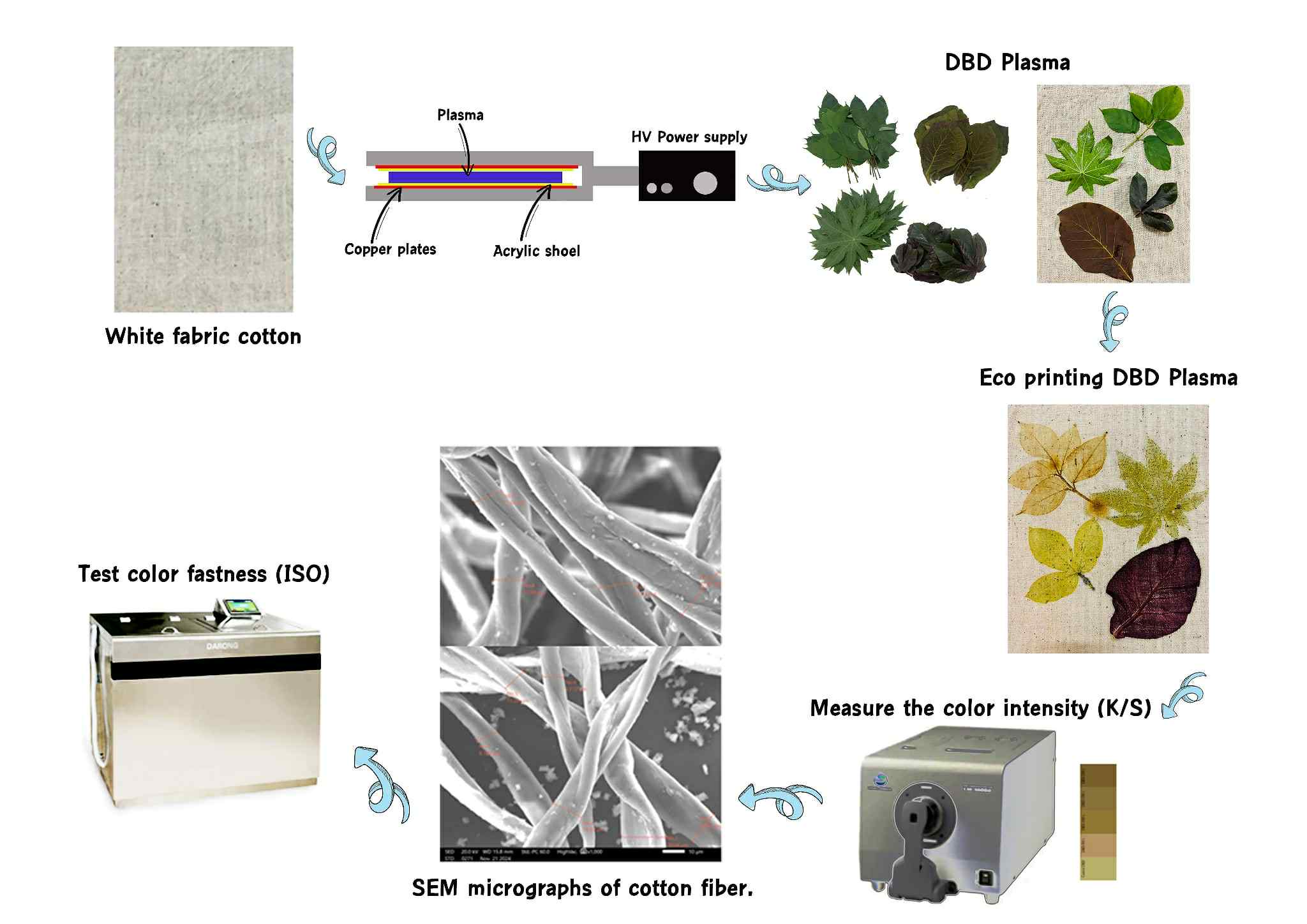
This research aimed to develop a fabric printing process that utilizes natural dyes in combination with dielectric barrier discharge (DBD) plasma treatment. The study focused on determining the optimal electric potential for plasma treatment of cotton fabric and implementing eco-printing by transferring leaf pigments onto the fabric through heat transfer. Four types of leaves used for cotton fabric printing include Teak leaves (Tectona grandis Linn. f.), Indian trumpet flower leaves (Oroxylum indicum L. Kurz), Castor Bean leaves (Ricinus communis L.), and Bellyache bush leaves (Jatropha gossypifolia L.). Cotton fabric was subjected to DBD cold plasma treatment at 500, 1,000, 1,500, and 2,000 V, respectively, prior to leaf printing. The highest absorption coefficient and scattering coefficient (K/S) values were obtained from each printed leaf. The results revealed that high-voltage plasma treatment leads to a high K/S. These findings confirm that cold plasma has altered the physical structure of the cotton fibers, facilitating improved dye penetration into the fabric. Scanning Electron Microscope (SEM) images showed that untreated cotton fibers appeared smooth, round, and undamaged, while plasma-treated fibers exhibited rough, flattened, and fractured surfaces. However, the results concerning color fastness properties, including rub, light, and wash fastness, indicated that the color tends to fade and wash out easily. The optimal electrical potential for plasma treatment was 1,000 V, resulting in the cotton fibers absorbing the highest color intensity. This voltage also maintained favorable mechanical characteristics, with warp and weft tensile strengths of 500 and 360 N, respectively, and elongation values of 15.4 and 17.6%.
HIGHLIGHTS
- Dielectric Barrier Discharge (DBD) Plasma enhances surface properties without damaging the material’s core structure and is an environmentally friendly process.
- The use of (DBD) Plasma with Eco Print is an innovative approach that enhances fabric properties, improving its ability to absorb plant-based dyes more effectively.
- The selection of the appropriate electric potential (Voltage) for using DBD Plasma with cotton fabric.
GRAPHICAL ABSTRACT
Downloads
References
JC Griffiths. Coloring food & beverages. Food Technology 2005; 59(5), 38-44.
C Watters and A Cantero. Rat liver parenchymal cell function during azo dye carcinogenesis. Cancer Research 1964; 25, 67-71.
A Puntener and P Cambell. European ban on certain azo dyes. Leather International, Bangkok, Thailand, 2003, p. 50-51.
A Zeb and S Mehmood. Carotenoids contents from various sources and their potential health application. Pakistan Journal of Nutrition 2004; 3(3), 199-204.
JV Vastrad and VV Sangannavar. Commercialization of cassia gums in eco-printing of textiles. Asian Journal of Home Science 2018; 13(1), 345-351.
S Boruah and BB Kalita. Eco-printing of eri silk with turmeric natural dye. International Journal of Textile and Fashion Technology 2015; 5(4), 27-32.
R Bhuyan and CN Saikia. Extraction of natural colourants from roots of Morinda angustifolia Roxb. - Their identification and studies of dyeing characteristics on wool. Indian Journal of Chemical Technology 2003; 10(2), 131-136.
N Pujeeb. The study of differences in color adhesion of plants: Natural mordant experiments with the eco-printing technique (in Thai). Silpa Bhirasri Journal of Fine Arts 2023; 11(1), 1-18.
A Zubairu and YM Mshelia. Effects of selected mordants on the application of natural dye from onion skin (Allium cepa). Science and Technology 2015; 5(2), 26-32.
W Wanphonthong. Dyeing with natural dyes. Journal of the Department of Science Service 2005; 53(168), 35-37.
A Manuja, I Ojha and M Singh. Eco-printing: A domestic technique of textile printing using the leaves of Rose Indica. International Journal of Engineering Technology and Management Sciences 2023; 7(3), 116-121.
R Mongkholrattanasit, C Klaichoi, N Rungruangkitkrai, N Vuthiganond and M Nakpathom. Eco-printing on cotton fabric with natural indigo dye using wild taro corms as a new thickening agent. Journal of Natural Fibers 2021; 19(13), 5435-5450.
Y Dixit. The path to sustainability: Anticipating the acceptance of eco printing method in the upcoming markets. International Journal of Humanities and Social Science: Insights and Transformations 2023; 8(1), 63-77.
N Zainuddin, NNF Rosli, N Tulos, MH Zakaria and A Aris. The study of marigold, cosmos, and butterfly pea color properties on eco printing using cotton, linen, and silk fabrics. Journal of Physics: Conference Series 2024; 2928(1), 12010.
W Seelarat, S Sangwanna, T Panklai, N Chaosuan, A Bootchanont, N Subcharoen, N Chanchula, D Boonyawan and P Porjai. Enhanced fruiting body production and bioactive phytochemicals from white Cordyceps militaris by blending Cordyceps militaris and using a cold plasma jet. Plasma Chemistry and Plasma Processing 2023; 43, 139-162.
C Wattanawikkam, A Bootchanont, N Barnthip, S Pavasupree, P Jitjing, D Boonyawan, K Kachayut and P Porjai. Discharge duty cycles effects of 20 kHz air APPJ on MB solution degradation. Suranaree Journal of Science and Technology 2023; 30(2), 10204.
NN Misra, SK Pankaj, A Segat and K Ishikawa. Cold plasma interactions with enzymes in foods and model systems. Trends in Food Science and Technology 2016; 55, 39-47.
S Inbakumar, R Morent, ND Geyter, T Desmet, A Anukaliani, P Dubruel and C Leys. Chemical and physical analysis of cotton fabrics plasma-treated with a low-pressure DC glow discharge. Cellulose 2010; 17, 417-426.
W Seelarat, S Sangwanna, T Chaiwon, T Panklai, N Chaosuan, A Bootchanont, C Wattanawikkam, P Porjai, W Khuangsatung and D Boonyawan. Impact of pretreatment with dielectric barrier discharge plasma on the drying characteristics and bioactive compounds of jackfruit slices. Journal of the Science of Food and Agriculture 2024; 104(6), 3654-3664.
T Panklai, N Kumchaiseemak, W Seelarat, S Sangwanna, C Chutimayanaphat, A Bootchanont, C Wattanawikkam, T Rittidach, D Boonyawan and P Porjai. Investigating effects of air-cold plasma jet on enzymatic activity and nutritional quality attributes of Mangosteen (Garcinia mangostana L.) juice. Innovative Food Science and Emerging Technologies 2025; 99, 103878.
J Promping, T Trikool, J Promping, T Trikool, P Prakhongsil and R Picha. Efficacy of DBD plasma generator with different shapes and materials of electrodes for reducing the microbial contamination of herb powder. Walailak Journal of Science and Technology 2019; 16(6), 415-422.
W Rao, Y Li, H Dhaliwal, M Feng, Q Xiang, MS Roopesh, D Pan and L Du. The application of cold plasma technology in low-moisture foods. Food Engineering Reviews 2023; 15(1), 86-112.
D Dobrynin, S Kalghatgi, G Fridman, A Wu, E Podolsky, K Barbee, A Brooks, G Friedman and A Fridman. Toxicity of low temperature plasma treatment of living tissue. In: Proceedings of the Drexel IEEE Graduate Forum, Technical Poster Symposium 2009, Philadelphia, USA. 2009.
RA Jelil. A review of low-temperature plasma treatment of textile materials. Journal of Materials Science 2015; 50(1), 5913-5943.
MA Shanker, AC Khanashyam, R Pandiselvam, M Kumar and A Kothakota. Implications of cold plasma and plasma-activated water on food texture - A review. Food Control 2023; 151, 109793.
K Ruangwong, C Thammaniphit, S Suwannarat, W Kanokbannakorn and S Srisonphan. Localized electric field roles in nonthermal corona plasma for surface functionalization. In: Proceedings of the 8th International Electrical Engineering Congress, Chiang Mai, Thailand. 2020, p. 1-4.
K Lawongsa, S Sangwanran and W Srilarat. A study of dyeing with tamarind leaves using sappanwood for natural fabric printing through the color transfer technique onto cotton fabric. VRU Research and Development Journal Science and Technology 2022; 17(3), 87-95.
Industrial Product Standards. Textile testing methods, TIS 121, Volume 25: Color fastness to water. Office of Industrial Product Standards, Bangkok, Thailand, 2009.
W Seelarat, S Sangwanna, T Panklai, N Chaosuan, A Bootchanont, N Subcharoen, N Chanchula, D Boonyawan and P Porjai. Enhanced fruiting body production and bioactive phytochemicals from white Cordyceps militaris by blending Cordyceps militaris and using a cold plasma jet. Plasma Chemistry and Plasma Processing 2023; 43, 139-162.
W Samee, K Matra, N Lakkham, B Dongkaew, P Sumkhum, W Sangwang, W Nupangtha and J Promping. Electrical breakdown in liquid-phase processing on an enhancement of 7-hydroxymitragynine conversion from mitragynine in Mitragyna speciosa (Kratom). Heliyon 2024; 10(17), e36676.
K Matra, W Aryuwong, W Meetang, S Ruthairat, C Dechthummarong, W Sangwang and V Luang-In. Application of electrical breakdown in liquid process on inulin structural transformations. IEEE Access 2023; 11, 114777-114789.
Y Ding and HS Freeman. Mordant dye application on cotton: Optimization and combination with natural dyes. Coloration Technology 2017; 133(5), 369-375.
JR Aspland. Textile dyeing and coloration. American Association of Textile Chemists and Colorists, Durham, North Carolina, 1997.
F Abdelghaffar, RA Abdelghaffar, UM Rashed and HM Ahmed. Highly effective surface modification using plasma technologies toward green coloration of polyester fabrics. Environmental Science and Pollution Research 2020; (27), 28949-28961.
WM Raslan, H El-Sayad and AA El-Halwagy. Recent advances in plasma/nanoparticles treatments of textile fibers. Journal of Textiles, Coloration and Polymer Science 2020; 17(2), 87-105.
Reema, RR Khanikar, H Bailung and K Sankaranarayanan. Review of the cold atmospheric plasma technology application in food, disinfection, and textiles: A way forward for achieving circular economy. Frontiers in Physics 2022; (10), 942952.
R Shishoo. Plasma technologies for textiles. Woodhead Publishing, Sawston, Cambridge, 2007.
MM Morshed, S Ali and AJ Shaikh. Atmospheric plasma treatment on jute fabric: Study of surface morphology and mechanical properties. Surface and Coatings Technology 2010; 204(16-17), 2635-2641.
R Morent, ND Geyter, T Desmet, P Dubruel and C Leys. Plasma surface modification of biodegradable polymers: A review. Plasma Processes and Polymers 2008; 8(3), 171-190.
MH Ullah, H Akther, MM Rahman, ABM Foisal, MM Hasan, SMAA Zumahi and A Amri. Surface modification and improvements of wicking properties and dyeability of grey jute-cotton blended fabrics using low-pressure glow discharge air plasma. Heliyon 2021; 7(8), e07893.
M Gorjanc, V Bukošek, M Gorenšek and M Mozetic. CF4 plasma and silver functionalized cotton. Textile Research Journal 2010; 80(20), 2204-2213.
M Kaygusuz, M Meyer, F Junghans and A Aslan. Modification of leather surface with atmospheric pressure plasma and nanofinishing. Polymer-Plastics Technology and Engineering 2018; 57(4), 260-268.
Y Jiang, J Li, F Liu, Z Zhang, Z Li, M Yang and L Li. The effects of surface modification using O2 low temperature plasma on chrome tanning properties of natural leather. Journal of Industrial Textile 2018; 49(4), 534-547.
NV Bhat, AN Netravali, AV Gore, MP Sathianarayanan, GA Arolkar and RR Deshmukh. Surface modification of cotton fabrics using plasma technology. Textile Research Journal 2011; 81(10), 1014-1026.
S Shahidi and J Wiener. Eco-friendly dyeing of cotton using plasma and natural dyes. Coloration Technology 2010; 126(6), 345-350.
AI Ribeiro, L Almeida, AP Souto and N Carneiro. Sustainable finishing of cotton fabrics with natural extracts assisted by plasma. Textile Research Journal 2020; 90(17-18), 1960-1970.
Published
How to Cite
Issue
Section
License
Copyright (c) 2025 Walailak University

This work is licensed under a Creative Commons Attribution-NonCommercial-NoDerivatives 4.0 International License.





