
The Influence of Polyphenols on Calcium Dynamics in Synaptosomes of Model Rats with Attention Deficit Hyperactivity Disorder of Varying Ages
DOI:
https://doi.org/10.48048/tis.2025.10434Keywords:
Сalcium dysregulation, ADHD, Synaptosomes, Glutamatergic hyperactivation, GABA, VGCCAbstract
Intrоduсtiоn: ADHD is characterized by disrupted neuronal excitability, often associated with dysregulated calcium (Ca²⁺) signaling. We investigated the effects of the polyphenol ANK-2 on intracellular Ca²⁺ dynamics in synaptosomes isolated from the brains of healthy and ADHD-model rats of different ages. Mаtеriаls аnd Mеthоds: In the studies, rats weighing 150 - 200 g were subjected to an ADHD model by administering 6-OHDA at 2 different doses of 8 and 4 mg/kg orally for 14 days using a special probe. Also, in order to induce the АDHD model in the prenatal period in young rats, it was first established that rats of both sexes were placed together, their condition was determined using a swab, and then, on average 3 - 4 days before birth, CdCl₂ was dissolved (50 ppm) and administered orally to pregnant rats weighing 200 - 250 g using a special probe, as a result of which the ADHD model was manifested in the offspring. Using the calcium-sensitive fluorescent probe Fluo-4AM, we found that ANK-2 significantly reduced cytosolic Ca²⁺ levels in a dose-dependent manner. Results and discussion: In ADHD models, baseline Ca²⁺ content was markedly elevated compared to age-matched controls, consistent with hyperactive synaptic transmission. GABA (100 μM) decreased [Ca²⁺] in by 14 % in healthy rats and 20 % in ADHD rats, suggesting enhanced compensatory GABAergic inhibition in the ADHD condition. Co-incubation with ANK-2 (10 - 100 μM) further suppressed calcium influx, indicating a synergistic enhancement of GABAergic effects. Additionally, ANK-2 potentiated the calcium-lowering effect of levetiracetam (5 μM), a selective N-type Ca²⁺ channel blocker, further reducing cytosolic Ca²⁺ levels. Соnсlusiоns: These findings suggest that ANK-2 acts through multiple mechanisms, including enhancement of GABAergic signaling, direct or indirect inhibition of voltage-gated calcium channels, and modulation of neurotransmitter release. Our results position ANK-2 as a promising candidate for correcting excitatory-inhibitory imbalance in ADHD by targeting calcium-dependent synaptic transmission.
HIGHLIGHTS
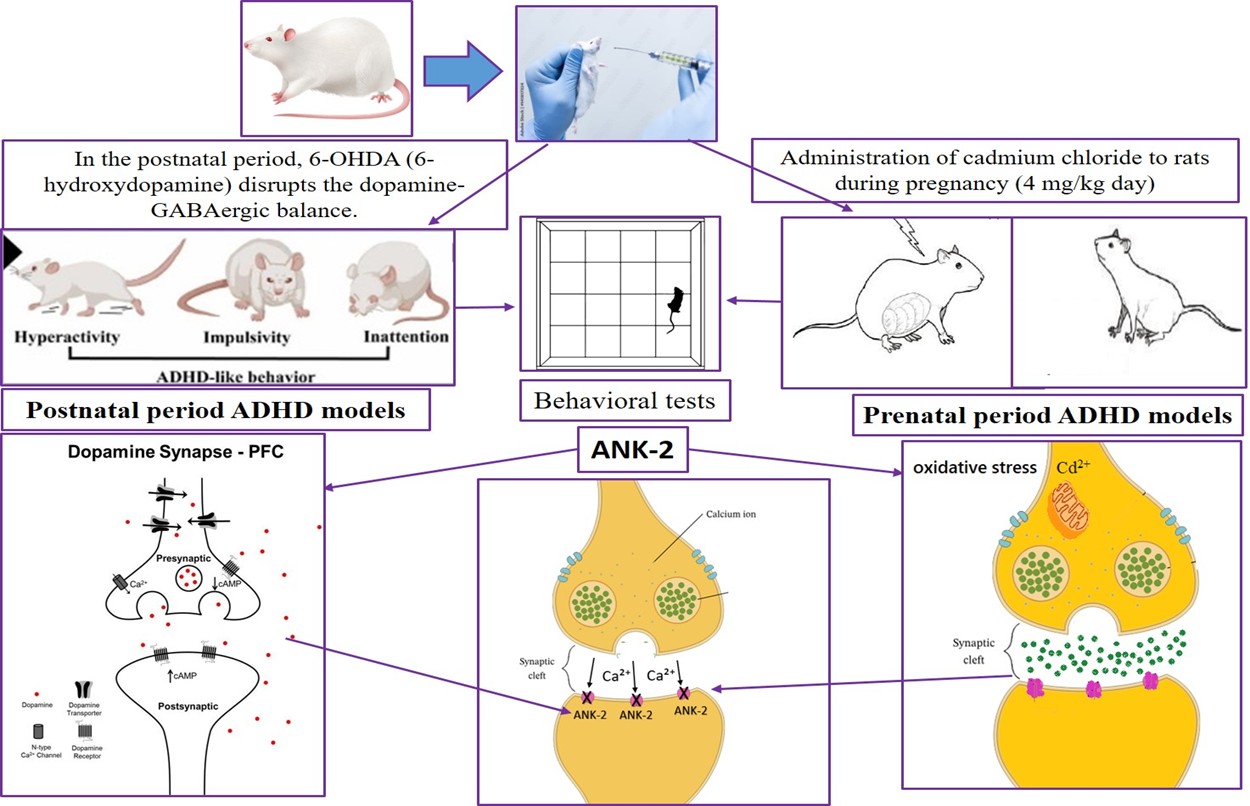
- 6-OHDA selectively damages dopaminergic and noradrenergic neurons, mimicking ADHD-like hyperactivity. Provide a description for each abbreviation at the beginning: Dopamine (DA) levels alter voltage-gated calcium channels (VGCC) and intracellular calcium buffering, leading to abnormal calcium influx. 6-OHDA induces dopaminergic neurodegeneration, particularly in the mesocortical and nigrostriatal pathways. This results in compensatory activation of glutamate receptors and VGCC in postsynaptic neurons, resulting in an increase in intracellular Ca²⁺.
- On the other hand, cadmium chloride disrupts calcium channels (e.g., L-type Ca2+ channels) and calcium-dependent functions in mitochondria, which aggravates synaptic dysfunction. Cd²⁺ mimics Ca²⁺ and blocks Ca²⁺ ATPases and Na⁺/Ca²⁺ exchangers, disrupting calcium transport. Impaired Ca²⁺ buffering and elevated synaptosomal calcium levels cause oxidative stress and mitochondrial dysfunction.
- The results of behavioral tests on rats with ADHD model during our experiments show that in the control groups the experimental animals were very active and hyperactive in the Open Field test, moved quickly and hardly stood still. At the same time, the model showed that the ADHD groups were very hyperactive, with nervous system processes being activated, while the animals remained motionless.
- The polyphenol ANK-2 significantly reduces intracellular calcium levels in Fluo-4 AM synaptosome suspensions from rat brains of different ages. This may explain that polyphenol ANK-2 enhances the inhibitory effect of GABA (gamma-aminobutyric acid), helping to reduce neuronal excitability, or probably acts as a direct or indirect modulator of presynaptic calcium channels, particularly N-type Ca²⁺ channels, thereby reducing calcium influx.
GRAPHICAL ABSTRACT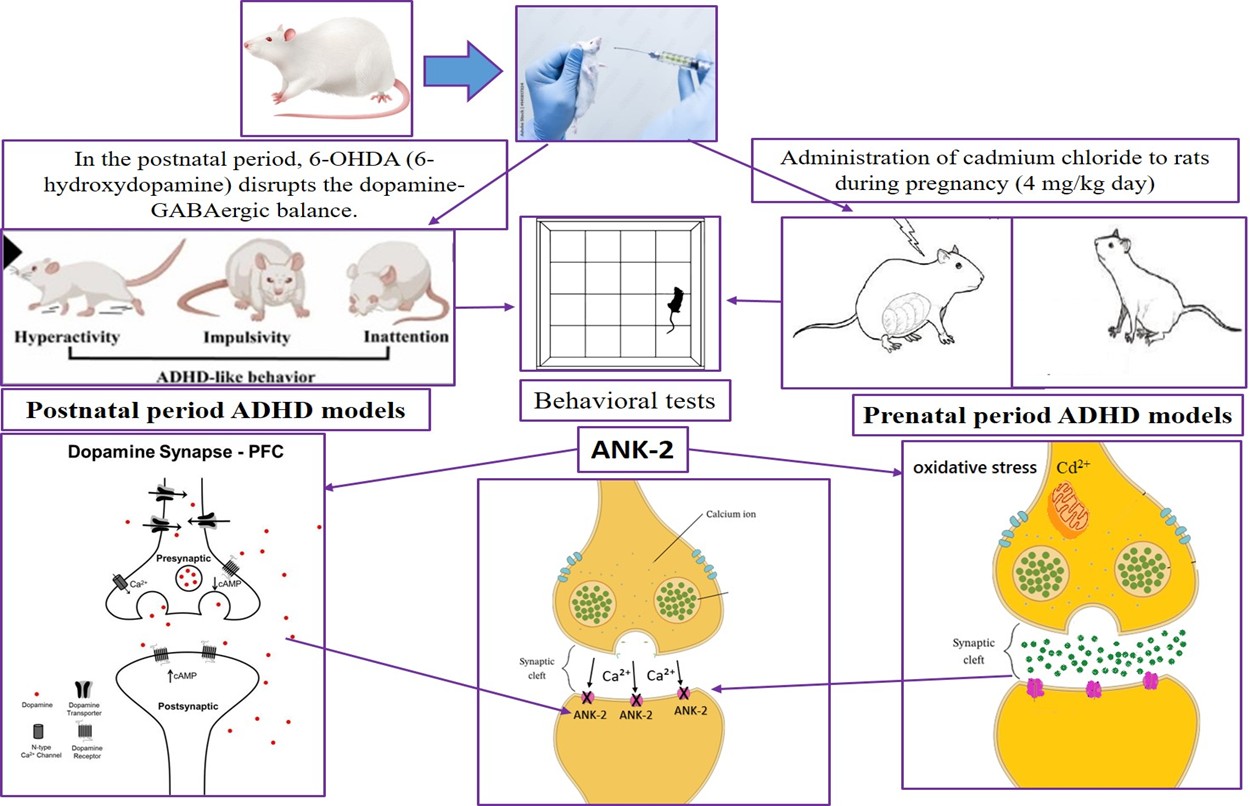
Downloads
References
VA Russell, T Sagvolden and EB Johansen. Animal models of attention-deficit hyperactivity disorder. Behavioral and Brain Functions 2005; 1(9).
SS Rosenberg and NC Spitzer. Calcium signaling in neuronal development. Cold Spring Harbor Perspectives in Biology 2011; 3(10), 004259.
C Ren and T Komiyama. Characterizing Cortex-Wide Dynamics with Wide-Field Calcium Imaging. Journal of Neuroscience 2021; 41(19), 4160-4168.
D Kim, D Yadav and M Song. An updated review on animal models to study attention-deficit hyperactivity disorder. Transl Psychiatry 2024; 14, 187.
C Grienberger and A Konnerth. Imaging calcium in neurons. Neuron 2012; 73(5), 862-885.
VA Russell, RD Oades, R Tannock, PR Killeen, JG Auerbach, EB Johansen and T Sagvolden. Response variability in Attention-Deficit/Hyperactivity Disorder: A neuronal and glial energetics hypothesis. Behavioral and Brain Functions 2006; 2(30).
P Majdak, JR Ossyra, JM Ossyra, AJ Cobert, GC Hofmann, S Tse, B Panozzo, EL Grogan, A Sorokina and JS Rhodes. A new mouse model of ADHD for medication development. Scientific Reports 2016; 6, 39472.
H Zhang and R Tsao. Dietary polyphenols oxidative stress antioxidant anti-inflammatory effects. Current Opinion in Food Science 2016; 8, 33-42.
V Dragovic-Uzelac, B Levaj, V Mrkic, D Bursac and M Boras. The content of polyphenols and carotenoids in three apricot cultivars depending on stage of maturity and geographical region. Food Chemistry 2007; 102(3), 966-975.
M DʼArchivio, C Filesi, RD Benedetto, R Gargiulo, C Giovannini and R Masella. Polyphenols, dietary sources and bioavailability. Annali dell’Istituto Superiore di Sanità 2007; 43(4), 348-361.
F Visioli, CADL Lastra, C Andres-Lacueva, M Aviram, C Calhau, A Cassano, M DʼArchivio, A Faria, G Fave, V Fogliano, R Llorach, P Vitaglione, M Zoratti and M Edeas. Polyphenols and human health: A prospectus. Critical Reviews in Food Science and Nutrition 2011; 51(6), 524-546.
M McSweeney and K Seetharaman. State of polyphenols in the drying process of fruits and vegetables. Critical Reviews in Food Science and Nutrition 2015; 55(5), 660-669.
NN Khoshimov, AA Mukhtorov, KE Nasirov, RN Rakhimov and RR Mamadaminov. Effects of Polyphenols on changes in the transport of Ca2+ NMDA-receptors under the influence of L-glutamate. Research Journal of Pharmacy and Technology 2023; 16(3).
G Caruso, SA Torrisi, MP Mogavero, W Currenti, S Castellano, J Godos, R Ferri, F Galvano, GM Leggio, G Grosso and F Caraci. Polyphenols and neuroprotection: Therapeutic implications for cognitive decline. Pharmacology & Therapeutics 2022; 232, 108013.
EV Mitroshina, AM Pakhomov, MI Krivonosov, RS Yarkov, MS Gavrish, AV Shkirin, MV Ivanchenko and MV Vedunova. Novel Algorithm of Network Calcium Dynamics Analysis for Studying the Role of Astrocytes in Neuronal Activity in Alzheimerʼs Disease Models. International Journal of Molecular Sciences 2022; 23(24), 15928.
Strasbourg, Available at: http://convеntions.coе.int, accessed March 1986.
JP Kostrzewa, RA Kostrzewa, RM Kostrzewa, R Brus and P Nowak. Perinatal 6-Hydroxydopamine Modeling of ADHD. Current Topics in Behavioral Neurosciences is a journal 2016; 29, 279-293.
P Nowak, J Dąbrowska, A Bortel, B Izabela, RM Kostrzewa and R Brus. Prenatal cadmium and ethanol increase amphetamine-evoked dopamine release in rat striatum. Neurotoxicology and Teratology. 2006; 28(5), 563-572.
PR Dunkley, PE Jarvie and PJ Robinson. A rapid Pеrcoll gradiеnt procеdurе for prеparation of sуnaptosomеs. Nature Protocols 2008; 3 (11), 1718-1728.
MH Weiler, CB Gundersen and DJ Jenden. Choline uptake and acetylcholine synthesis in synaptosomes: Investigations using two different labeled variants of choline. Journal of Neurochemistry 1981; 36(5), 1802-1812.
G Grynkiewicz, M Poenie and RY Tsien. A new generation of Ca2+ indicators with greatly improved fluorescence properties. Journal of Biological Chemistry 1985; 260(6), 3440-3450.
NN Petrischev, LV Vasina, AV Selyutin, SV Chepanov and SA Selkov. The application of Fluo-3 AM in measurement of level of cytoplasmic calcium in thrombocytes by flow cytofluorometry. Russian Clinical Laboratory Diagnostics 2017; 62(2), 97-99.
X DONG. Measurement of cytoplasmic Ca2+ concentration in Saccharomycescerevisiae induced by air cold plasma. Plasma Science and Technology 2018; 20, 044001.
FX Castellanos and E Proal. Large-Scale brain systems in ADHD: Beyond the Prefrontal-Striatal Model. Trends in Cognitive Sciences 2012; 16(1), 17-26.
HR Kim and M Martina. Bidirectional regulation of GABAA reversal potential in the Adult Brain: Physiological and pathological implications. Life (Basel) 2024; 14(1), 143.
SC Stanford. Animal Models of ADHD. Current Topics in Behavioral Neurosciences 2022; 57, 363-393.
VU Nna, GA Ujah, M Mohamed, KB Etim, BO Igba, ER Augustine and EE Osim. Cadmium chloride-induced testicular toxicity in male wistar rats; prophylactic effect of quercetin, and assessment of testicular recovery following cadmium chloride withdrawal. Biomedicine & Pharmacotherapy 2017; 94, 109-123.
NB Pivovarova and SB Andrews. Calcium-dependent mitochondrial function and dysfunction in neurons. The FEBS Journal 2010; 277(18), 3622.
U Alyagon, H Shahar, A Hadar, N Barnea-Ygael, A Lazarovits , H Shalev and A Zangen. Alleviation of ADHD symptoms by non-invasive right prefrontal stimulation is correlated with EEG activity. NeuroImage: Clinical 2020; 26, 102206.
NN Khoshimov, GM Raimova, KE Nasirov, ZA Mamatova, NI Mamadaliyeva and AS Тuraev. The effect of Sulphated cellulose on System of Haemostasis. Research Journal of Pharmacy and Technology 2021; 14(6), 3283-3289.
KN Numonjonovich, KI Baxtiyarovich, DI Ugli, KS Salimovich, MAA Ugli, OMM Ugli, N Erkinovich, MZ Amindjanovna, SG Abdullayevna and R Nurillayevich. Еffесt of pоlyphеnоls on chаngеs in thе hеmоstаtiс systеm of blооd plаsmа in hеаlthy and mоdеl rаts with Аlzhеimеr’s disеаsе. Trends in Sciences 2024; 21(9), 8081.
HY Chen, CY Yang, TH Hsieh, CW Peng, LL Chuang, YL Chang, HJ Chi, HM Lee and SHY Liang. Effects of transcranial direct current stimulation on improving performance of delayed- reinforcement attentional set-shifting tasks in attention-deficit/hyperactivity disorder rat model. Behavioural Brain Research 2023; 437, 114145.
GM Raimova, NN Khoshimov, KE Nasirov, AS Тuraev and ME Savutova. Anti-thrombotic action of sulfated polysaccharides on thrombosis caused by thromboplastin. Research Journal of Pharmacy and Technology 2021; 14(11), 6085-6088.
AS Ferranti, DJ Luessen and CM Niswender. Novel pharmacological targets for GABAergic dysfunction in ADHD. Neuropharmacology 2024; 249, 109897.
C Peerboom and CJ Wierenga. The postnatal GABA shift: A developmental perspective. Neuroscience & Biobehavioral Reviews 2021; 124, 179-192.
G Cellot and E Cherubini. GABAergic signaling as therapeutic target for autism spectrum disorders. Frontiers in Pediatrics 2024; 2(70), 70
Z Buraei and J Yang. Structure and function of the β subunit of voltage-gated Ca²⁺ channels. Biochimica et Biophysica Acta 2013; 1828(7), 1530-1540.
M Sheng, BL Sabatini and TC Sudhof. Synapses and Alzheimerʼs disease. Cold Spring Harbor Perspectives in Biology 2012; 4(5), 005777.
H Yamamoto-Imoto, D Zamolodchikov, ZL Chen, SL Bourne, S Rizvi, P Singh, EH Norris, F Weis-Garcia and S Strickland. A novel detection method of cleaved plasma high-molecular-weight kininogen reveals its correlation with Alzheimerʼs pathology and cognitive impairment. Alzheimerʼs & Dementia: Diagnosis, Assessment & Disease Monitoring 2018; 10, 480-489.
HM Abelaira, GZ Reus, KF Ribeiro, G Zappellini, AL Cipriano, G Scaini, EL Streck and J Quevedo. Lamotrigine treatment reverses depressive-like behavior and alters BDNF levels in the brains of maternally deprived adult rats. Pharmacology Biochemistry & Behavior 2012; 101(3), 348-353.
N Khoshimov, AA Mukhtoro, KE Nasirov, RN Rakhimov and RR Mamadaminov. Effeсts of Рolyрhenols on Сhanges in the Transрort of Сa2+ NMDA-reсeрtors Under the Influenсe of L-glutamate against the Baсkground of Alzheimer’s Disease. Journal of Рharmaceutical Negative Results 2022; 13, 1322-1332.
T Tomson, J Zelano, YL Dang and P Perucca. The pharmacological treatment of epilepsy in adults. Epileptic Disorders 2023; 25(5), 649-669.
Published
How to Cite
Issue
Section
License
Copyright (c) 2025 Walailak University

This work is licensed under a Creative Commons Attribution-NonCommercial-NoDerivatives 4.0 International License.





