
Petrotectonics of Thoen Plutonic Rocks, Lampang Province, Eastern Granitic Belt of Thailand
DOI:
https://doi.org/10.48048/tis.2025.10421Keywords:
Thoen granite, I-type granite, Active continental margin, Post-collision, High-K calc alkalic rock, Eastern granitic beltAbstract
The plutonic rocks cropped in area of Thoen District, Lampang Province. The felsic to intermediate igneous rocks compositionally range from rhyolite, monzogranite to quartz monzonite, monzonite, granodiorite, diorite to gabbroic diorite with titanite as a minor constituent, characteristic of I-type granitic rocks. Based on minerals characters, 21 plutonic rock samples can be divided into 4 magmatic groups: Group I rhyolite, Group II monzogranite, Group III granodiorite and quartz monzonite, and Group IV granodiorite, diorite, monzonite and gabbroic diorite. Based on major and trace elements can be classified into 2 groups felsic to intermediate plutonic rocks and felsic volcanic rock (Group I, Group II and Group III) and intermediate mafic plutonic rocks (Group IV). The felsic intermediate plutonic rocks and felsic volcanic rock are the presence of mainly high-K calc-alkaline granite, I-type magma series that have active continental margins, with the involvement of continental crust. The intermediate to mafic plutonic rocks range from low-K to high-K calc-alkaline and shoshonitic series, indicating the feature of continental volcanic arc magma. All Thoen plutonic rocks have similar patterns in their chondrite and primitive mantle normalized patterns. Chondrite-normalized REE patterns are LREE enrichments and HREE depletion with negative Eu and Nb anomalies that are typical of volcanic arc granites. N-MORB normalized multi-element patterns are variable LILE enrichments (Rb, Ba, Th, Ce), HFSE depletions (Ta, Nb, Sr and Ti) and are typical of I-type volcanic arc granites. Thoen pluton is the part of EGB that indicates the magmatism along the boundary between Sukhothai Arc and Inthanon Zone.
HIGHLIGHTS
- Thoen felsic to intermediate plutonic and felsic volcanic rocks are high-K calc-alkaline granite, with I-type magma series and intermediate to mafic plutonic rocks ranging from low K to high-K calc-alkaline and shoshonitic series.
- Chondrite-normalized REE patterns are enrichments in LREE and depletions in HREE.
- N-MORB normalized multi-element patterns are LILE enrichments and depletions in HFSE.
- The tectonic setting of Thoen plutonic is a volcanic arc in an active continental margin that is a part of the Eastern Granitic Belt.
GRAPHICAL ABSTRACT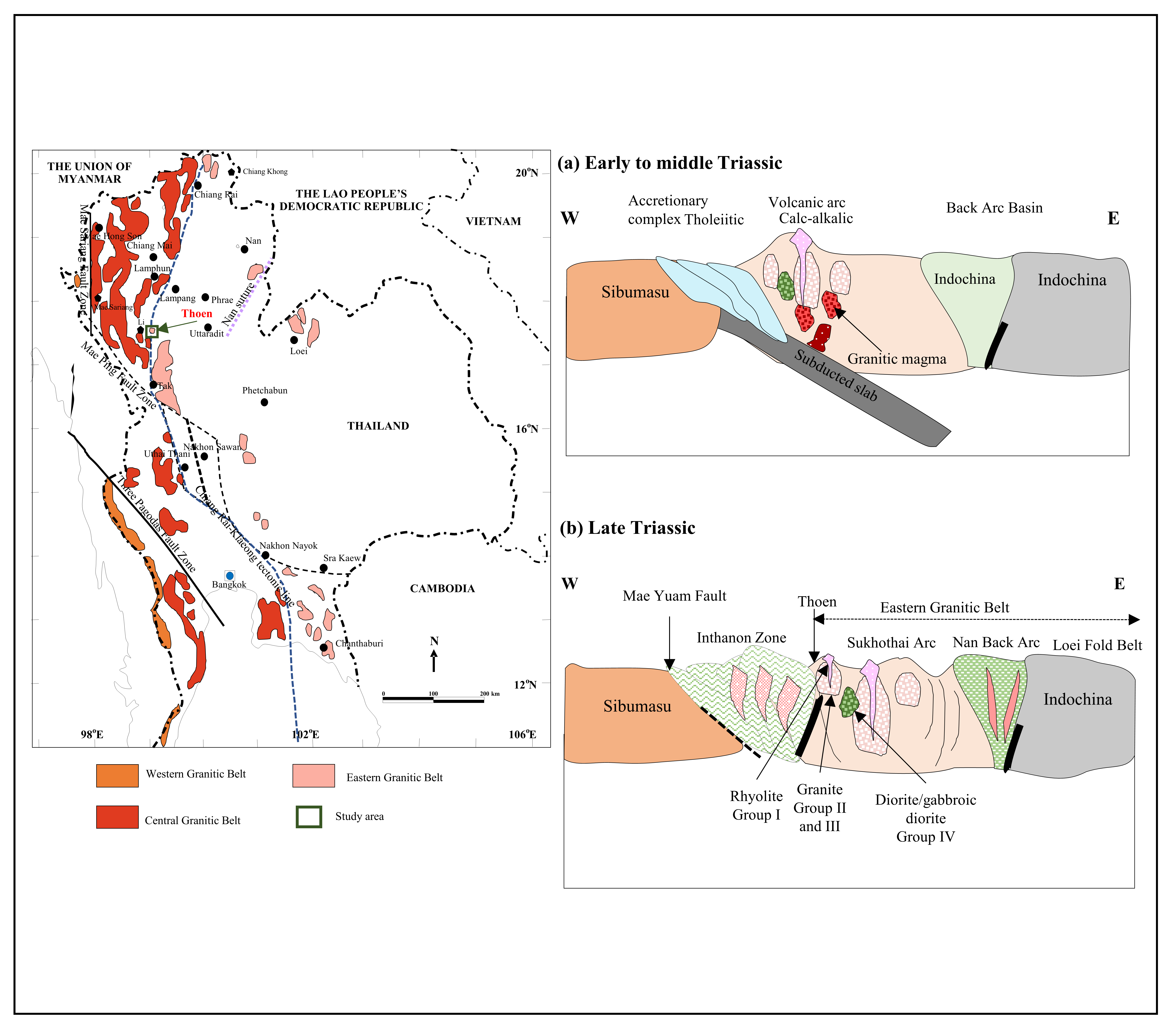
Downloads
References
EJ Cobbing, DIJ Mallick, PEJ Pitfield and LH Teoh. The granites of the Southeast Asian Tin Belt. Journal of the Geological Society London 1986; 143(3), 537-550.
P Charusiri, AH Clark, E Farrar, D Archibald and B Charusiri. Granite belts in Thailand: Evidence from the 40Ar/39 Ar geochronological and geological syntheses. Journal of Southeast Asian Earth Sciences 1993; 8(1-4), 127-136.
RL Linnen. Depth of emplacement, fluid provenance and metallogeny in granitic terranes: A comparison of western Thailand with other tin belts. Mineralium Deposita 1998; 33(5), 461-476.
P Putthapiban. Geology and geochronology of igneous rocks of Thailand. In: Proceedings of the Symposium on Geology of Thailand, Department of Mineral Resources, Bangkok, Thailand. 2002, p. 261-283.
P Charusiri, T Pungrassami and G Sinclair. Classification of rare-earth element (REE) deposit in Thailand: A genetic model. Journal of the Geological Society Thailand 2006; 1(1), 57-66.
K Phountong, A Salam and T Manaka. Petrochemistry of granite from Takua Pit Thong area, Ratchaburi, Thailand. Bulletin of Earth Science of Thailand 2020; 12(1), 15-29.
MP Searle, MJ Whitehouse, L Robb, AA Ghani, CS Hutchison, M Sone, SWP Ng, MH Roselee, SL Chung and JGH Oliver. Tectonic evolution of the Sibumasu-Indochina terrane collision zone in Thailand and Malaysia: Constraints from new U-Pb zircon chronology of SE Asian tin granitoids. Journal of the Geological Society 2012; 169(4), 489-500.
PK Jundee, S Phanbuppha, T Jamsai and B Phajuy. Petrochemistry of granitic rock in Tha Pai area, Mae Hi Sub-District, Pai District, Mae Hong Son Province, Thailand. Songklanakarin Journal of Science and Technology 2022; 44(6), 1427-1433.
PK Jundee, S Chaiwchan, S Inthacharoensarn, B Phajuy and P Nontarak. Petrochemistry and tectonic setting of the Phroa-Wiang Pa Pao Granitic Rocks, Chiang Mai, and Chiang Rai Provinces, Central Granitic Belt of Thailand. Trends in Sciences 2024; 21(10), 8055.
CK Morley. A tectonic model for the Tertiary evolution of strike-slip faults and rift basins in SE Asia. Tectonophysics 2002; 347(4), 189-215.
AA Ghani, MP Searle, L Robb and SL Chung. Transitional I S type characteristic in the Main Range granite, peninsular Malaysia. Journal of Asian Earth Sciences 2013; 76, 225-240.
AA Ghani, CH Lo and SL Chung. Basaltic dykes of the Eastern Belt of Peninsular Malaysia: the effects of the difference in crustal thickness of Sibumasu and Indochina. Journal of Asian Earth Sciences 2013; 77, 127-139.
Y Wang, H He, P Cawood, W Fan, B Srithai, Q Feng, Y Zhang and Q Xin. Geochronology, elemental and Sr-Nd-Hf-O isotopic constraints on the petrogenesis of the Triassic post-collisional granitic rocks in NW Thailand and its Paleotethyan implications. Lithos 2016; 266(3-4), 264-286.
Q Xin, Q Feng, Y Wang, T Zhao, JW Zi, M Udchachon and Y Wang. Late Triassic post-collisional granites related to Paleotethyan evolution in SE Thailand: Geochronological and geochemical constraints. Lithos 2017; 286, 440-453.
P Nualkhao, R Takahashi, A Imai and P Charusiri. Petrochemistry of granitoids along the Loei Fold Belt, Northeastern Thailand. Resource Geology 2018; 68(4), 1-30.
A Fanka and S Nakapadungrat. Preliminary study on petrography and geochemistry of granitic rocks in the Khao Phra - Khao Sung area, Amphoe Nong Bua, Changwat Nakhon Sawan, Central Thailand. Bulletin of Earth Science of Thailand 2018; 10(1), 55-68.
X Qian, Y Wang, Y Zhang, Y Wang and V Senebouttalath. Late Triassic post-collisional granites related to Paleotethyan evolution in northwestern Lao PDR: Geochronological and geochemical evidence. Gondwana Research 2020; 84, 163-176.
E Uchida, S Nagano, S Niki, K Yonezu, Y Saitoh, KC Shin and T Hirat. Geochemical and radiogenic isotopic signatures of granitic rocks in Chanthaburi and Chachoengsao provinces, southeastern Thailand: Implications for origin and evolution. Journal of Asian Earth Science X 2022; 8, 100111.
S Piyasin. Geological Map of Thailand NE47-11. 1:250,000 (Changwat Uttaradit). Department of Minerals and Resources, Bangkok, Thailand. 1974.
Department of Minerals and Resources. Geological map of Lampang province. Department of Minerals and Resources, Bangkok, Thailand. 2007.
CS Hutchison. Laboratory handbook of petrographic techniques. John Wiley and Sons, Inc., New York, USA. 1973, p. 527.
K Govindaraju and I Roelandts. Second report (1993) on the first three GIT-IWG rock reference samples: Anorthosite from Greenland, AN-G; basalt D’ Essey-la-Côte, BE-N; granite De Beauvoir, MA-N. Geostandards and Geoanalytical Research 1993; 17(2), 227-294.
N Imai, S Terashima, S Itoh and A Ando. 1994 complication of analytical data for minor and trace elements in seventeen GSJ geochemical reference samples, “Igneous rock series”. Geostandards and Geoanalytical Research 1995; 19(2), 135-213.
A Streckeisen. To each plutonic rock its proper name. Earth-Science Reviews 1976; 12(1), 1-33.
RR Large, JB Gemmell, H Paulick and DL Huston. The alteration box plot: a simple approach to understanding the relationship between alteration mineralogy and lithogeochemistry associated with volcanic-hosted massive sulfide deposits. Economic Geology 2001; 96(5), 957-971.
EAK Middlemost. Naming materials in the magma/igneous rock system. Earth-Science Reviews 1994; 37(3-4), 215-224.
TNJ Irvine and WRA Baragar. A guide to the chemical classification of the common volcanic rocks. Canadian Journal of Earth Sciences 1971; 8(5), 523-548.
JA Winchester and PA Floyd. Geochemical discrimination of different magma series and their differentiation products using immobile elements. Chemical Geology 1977; 20, 325-343.
PC Rickwood. Boundary lines within petrologic diagrams which use oxides of major and minor elements. Lithos 1989; 22(4), 247-263.
SR Taylor and MK Gorton. Geochemical application of spark source mass spectrography—III. Element sensitivity, precision and accuracy. Geochimica et Cosmochimica Acta 1977; 41(9), 1375-1380.
HR Rollinson. Using geochemical data: Evaluation, presentation, interpretation. Longman Scientific & Technical. Harlow, England, 1993, p. 380.
SS Sun and WF McDonough. Chemical and isotopic systematics of oceanic basalt: Implications for mantle composition and processes. Geological Society, London, Special Publications 1989; 42(1), 313-345.
WS Pitcher. Granite type and tectonic environment. In: K Hsu (Ed.). Mountain building processes. Academic Press, London, England, 1983, p. 19-40.
WS Pitcher. The nature and origin of granite. Blackie, London, 1993, p. 321.
B Barbarin. Granitoids: Main petrogenetic classification in relation to origin and tectonic setting. Geology Journal 1990; 25(3-4), 227-238.
MP Atherton and J Tarney. Origin of granite batholiths: Geochemical evidence. Shiva Publishing Limited, Orpington, England, 1979, p. 148.
JD Winter. Principles of igneous and metamorphic petrology. Pearson New International Edition. Pearson Education Limited, Harlow, England, 2014, p. 745.
J Baier, A Audétat and H Kepple. The origin of the negative niobium tantalum anomaly in subduction zone magmas. Earth and Planetary Science Letters 2008; 267(1-2), 290-300.
AD Fowler and R Doig. The significance of europium anomalies in the REE spectra of granites and pegmatites, Mont Laurier, Quebec. Geochimica et Cosmochimica Acta 1983; 47(6), 1131-1137.
BW Chappell and AJR White. Two contrasting granite types. Pacific Geology 1974; 8, 173-174.
BW Chappell and AJR White. Two contrasting granite types: 25 years later. Australian Journal of Earth Sciences 2001; 48(4), 489-499.
JA Pearce, NBW Harris and AG Tindle. Trace element discrimination diagrams for the tectonic interpretation of granite rocks. Journal of Petrology 1984; 25(4), 956-983.
J Pearce. Sources and settings of granitic rocks. Episodes 1996; 19(4), 120-125.
TH Pearce, BE Gorman and TC Birkett. The relationship between major element chemistry and tectonic environment of basic and intermediate volcanic rocks. Earth and Planetary Science Letters 1977; 36(1), 121-132.
JA Pearce and JR Cann. Tectonic setting of basic volcanic rocks determined using trace element analyses. Earth and Planetary Science Letters 1973; 19(2), 290-300.
E Saccani. A new method of discriminating different types of post-Achean ophiolite basalts and their tectonic significance using Th-Nb and Ce-Dy-Yb systematics. Geoscience Frontiers 2015; 6(4), 4158-501.
B Phajuy and V Singtuen. Petrochemical characteristics of Tak volcanic rocks, Thailand: Implication for tectonic significance. ScienceAsia 2019; 45(4), 350-360.
P Watthanapond, A Fanka, K Pang and S Chung. Petrogenesis of REE-mineralized granitic plutons in central Thailand, Southeast Asian tin belt: New insights from geochemistry and zircon U-Pb geochronology. Journal of Asian Earth Sciences 2025; 277, 106368.
PK Jundee, P Limtrakun, A Boonsoong and Y Panjasawatwong. Petrography and REE geochemical characteristics of felsic to mafic volcanic/hypabyssal rock in Nakhon Sawan and Uthai Thani Provinces, Central Thailand. Chiang Mai Journal of Science 2017; 44(4), 1722-1734.
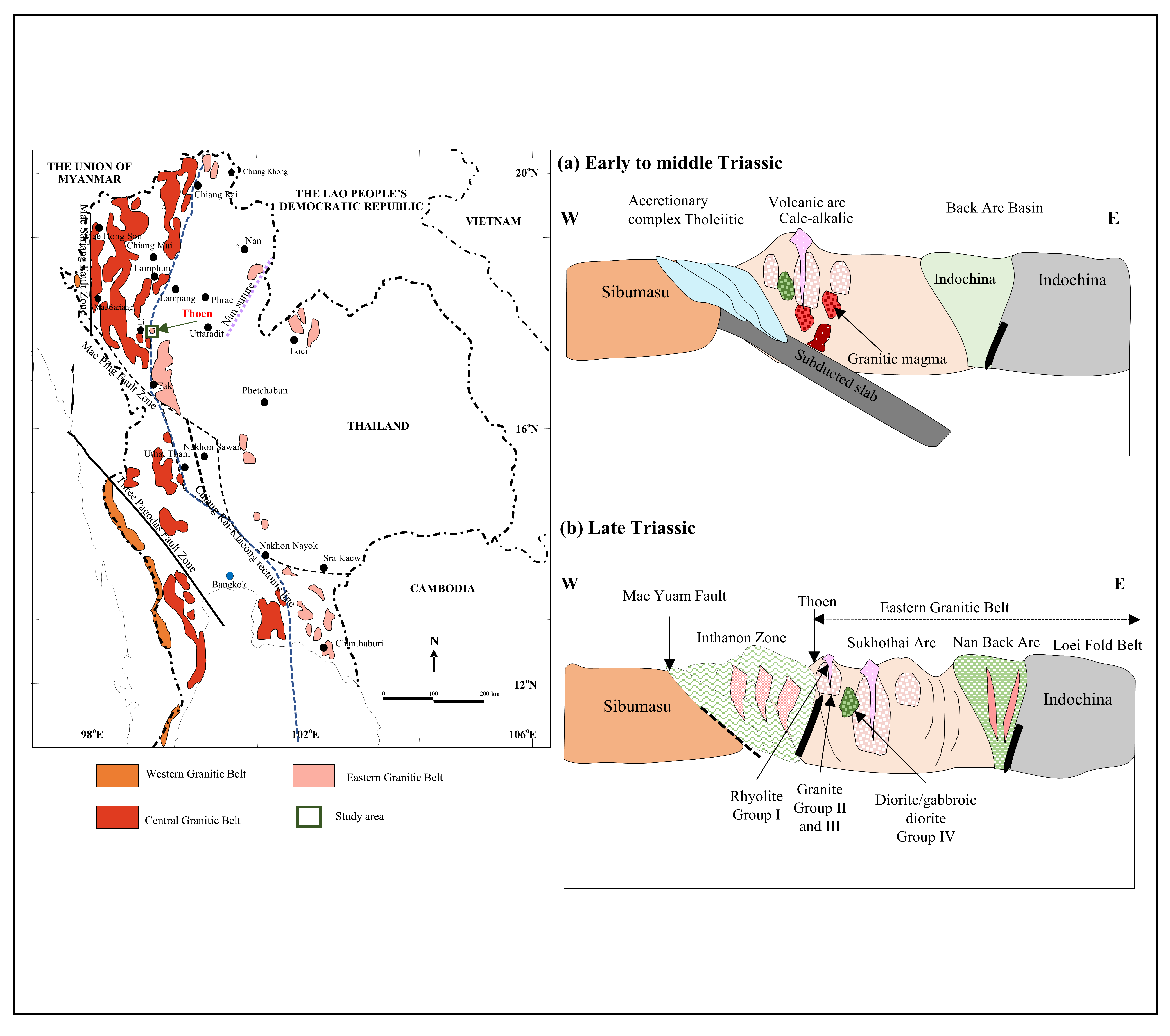
Published
How to Cite
Issue
Section
License
Copyright (c) 2025 Walailak University

This work is licensed under a Creative Commons Attribution-NonCommercial-NoDerivatives 4.0 International License.





