
A Green Approach to N, S-doped Carbon Dots from Jengkol Peel (Archidendron pauciflorum) for Ratiometric Sensing of Amaranth Dye
DOI:
https://doi.org/10.48048/tis.2025.10340Keywords:
Amaranth dye detection, Carbon dots, Jengkol peel, Food safety analysis, FRET mechanism, Nitrogen and sulfur co-dopants, Ratiometric fluorescence probeAbstract
The development of environmentally safe and cost-effective carbon nanoparticle-based ratiometric fluorescence sensors is critical for identifying hazardous synthetic food dyes. N, S-doped carbon dots (N, S-CD) were synthesized via a simple hydrothermal method using jengkol peel waste as the carbon source, with sodium thiosulfate and urea as co-dopants. The material exhibited spherical morphology with an average diamter 7.41 nm and a quantum yield of 20.5 %. Structural analysis confirmed the presence of graphitic structures containing hydroxyl, carboxyl, nitrogen, and sulfur functional groups on the particle surface, which improved dispersibility and created a conjugate system for fluorescence emission. With ideal emission/excitation peaks at 515/370 nm, N, S-CD exhibits excitation-dependent fluorescence. This N, S-CD based sensor has a detection limit of 7.5 nM (range 2.5 - 20 μM) and responds to amaranth with dual-emission fluorescence (λem 515/646 nm, λex 370 nm) through a FRET process. Validation on food samples revealed 94 - 98 % recovery, demonstrating the potential of biomass-based sensors for food safety analysis.
HIGHLIGHTS
- N,S doped carbon dots were successfully synthesized from jengkol peel waste through a green hydrothermal method, resulting in spherical nanoparticles with an average diameter of 7.41 nm.
- The dual-doping strategy significantly enhanced fluorescence properties, increasing quantum yield from 4.5 % (CD) to 20.5 % (N, S-CD) with optimal emission at 515 nm when excited 370 nm.
- The N, S-CD sensor exhibits excellent analytical performance for amaranth dye detection with a LOD of 7.5 nM and linear range of 2.5 - 20 μM through a ratiometric approach (F515/F646).
- The sensing mechanism involves fluorescence resonance energy transfer (FRET), providing dual-emission signals that shift from cyan to yellow under UV light as amaranth concentration increases.
- High selectivity was demonstrated against common food additives and metal ions, with actual samples (strawberry syrup and tomato juice) showing 94 - 98 % recovery rates.
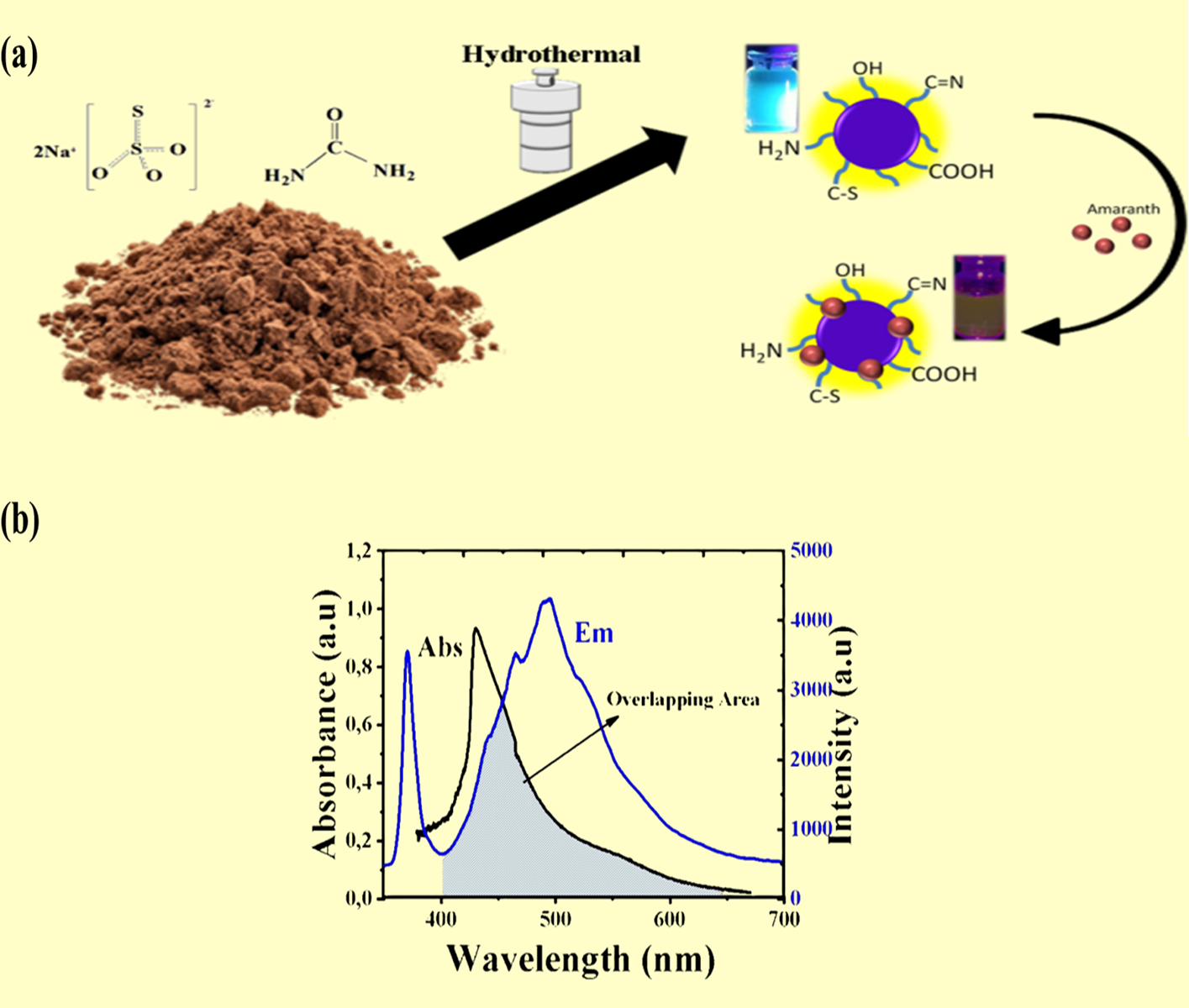
GRAPHICAL ABSTRACT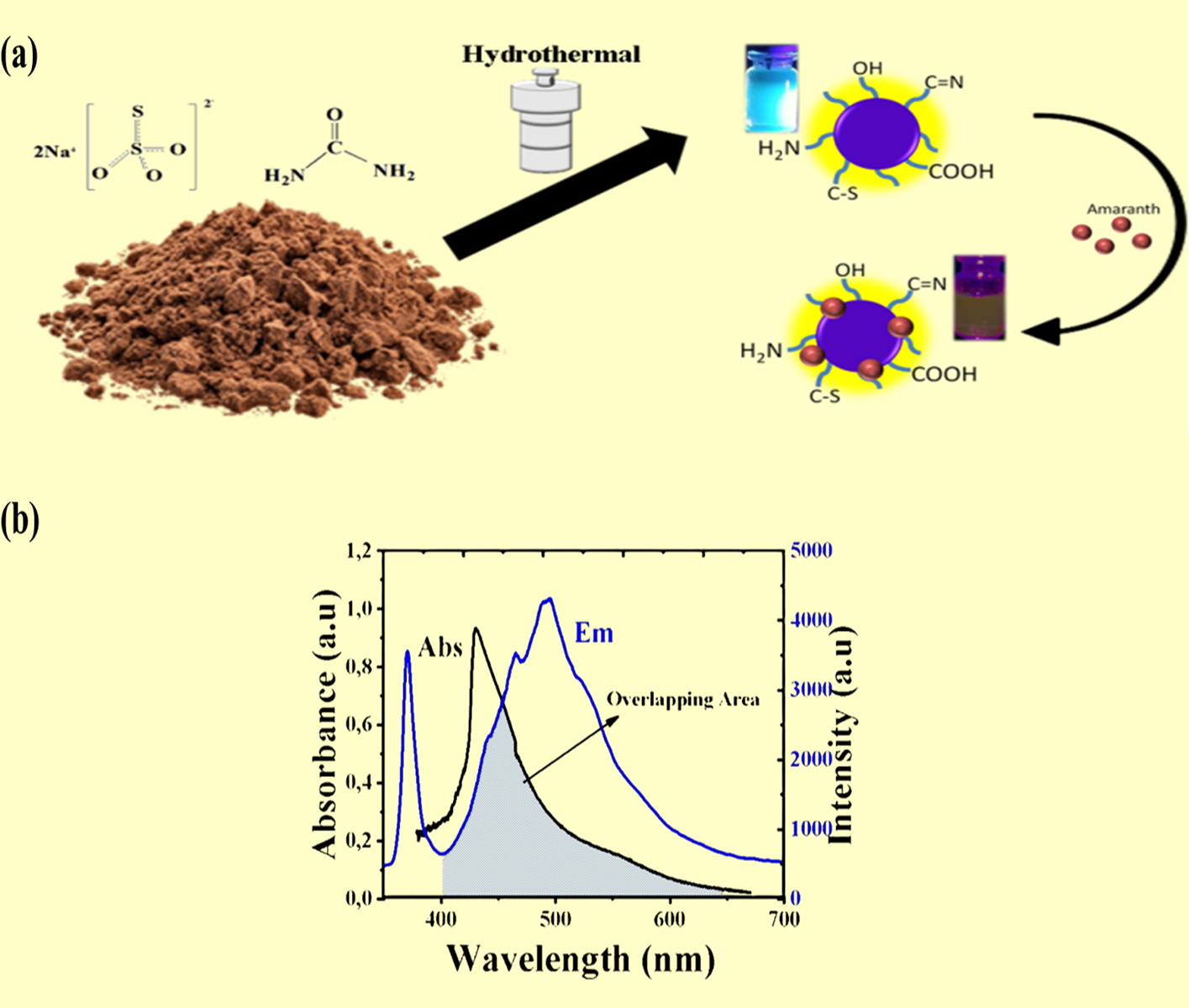
Downloads
References
MM Silva, FH Reboredo and FC Lidon. Food colour additives: A synoptical overview on their chemical properties. applications in food products, and health side effects. Foods 2006; 11(3), 379.
K Rovina, S Siddiquee and SM Shaarani. Toxicology, extraction and analytical methods for determination of Amaranth in food and beverage products. Trends in Food Science & Technology 2017; 65(1), 68-79.
S Manzoor, A Dar, K Dash, V Pandey, S Srivastava, I Bashir and S Khan. Carbon dots applications for development of sustainable technologies for food safety: A comprehensive review. Applied Food Research 2023; 3(1), 100263.
H Shabbir, E Csapo and M Wojnicki. Carbon quantum dots: The role of surface functional groups and proposed mechanisms for metal ion sensing. Inorganics 2023; 11(6), 262.
S Munusamy, T Mandlimath, P Swetha, GA Sehemi, M Pannipara, S Koppala, P Shanmugam, S Boonyuen, R Pothu and R Boddula. Nitrogen-doped carbon dots: Recent developments in its fluorescent sensor applications. Environmental Research 2023; 231(1), 116046.
H Shabbir, T Tokarski, D Ungor and M Wojnicki. Eco-friendly synthesis of carbon dot by hydrothermal method for metal ions salt identification. Materials 2021; 14(24), 7604.
R Gui and H Jin. Dual-emitting fluorescence ratiometric nanoprobes of in-vitro/in-vivo pH from constructions to sensing, imaging and therapeutic applications. Journal of Photochemistry and Photobiology C 2024; 58(9), 100650.
A Daulay, L Nasution, M Huda, M Amin, M Nikmatullah, Supiyani and Yusmiati. Green sources for carbon dots synthesis in sensing for food application: A review. Biosensors Bioelectronics: X 2024; 17(1), 100460.
M Rahmayanti, AN Syakina, I Fatimah and T Sulistyaningsih. Green synthesis of magnetite nanoparticles using peel extract of Jengkol (Archidendron pauciflorum) for methylene blue adsorption from aqueous media. Chemical Physics Letters 2022; 803(1), 139834.
GA Wardani, L Nuramalia, WT Wulandari and E Nofiyanti. Utilization of Jengkol peel (Pithecellobium jiringa (jack) prain) as lead (II) ions bio-sorbent with column method. Jurnal Kimia Sains dan Aplikasi 2020; 23(5), 160-166.
X Yang, S Fu, A Basta and L Lucia. A true biomass standout: Preparation and application of biomass-derived carbon quantum dots. BioResources 2024; 19(6), 6838-6858.
Z Yi, X Li, H Zhang, X Ji, W Sun, Y Yu, Y Liu, J Huang, Z Sarshar and M Sain. High quantum yield photoluminescent N-doped carbon dots for switch sensing and imaging. Talanta 2021; 222(1), 121663.
M Wu, J Li, Y Wu, X Gong and M Wu. Design of a synthetic strategy to achieve enhanced fluorescent carbon dots with sulfur and nitrogen codoping and its multifunctional applications. Small 2023; 9(42), e2302764.
A Saengsrichan, C Saikate, P Silasana, P Khemthong, W Wanmolee, J Phanthasri, S Youngjan, P Posoknistakul, S Ratchahat, N Laosiripojana and C Sakdaronnarong. The role of n and s doping on photoluminescent characteristics of carbon dots from palm bunches for fluorimetric sensing of Fe3+ ion. International Journal of Molecular Science 2022; 23(1), 5001.
D Cai, X Zhong, L Xu, Y Xiong, W Deng, G Zou, H Hou and X Ji. Biomass-derived carbon dots: Synthesis, modification and application in batteries. Chemical Science 2025; 16(12), 4937.
N Zheng, M Zhang, B Liu, J Tang, F Zhang and G Chen. Influence of nitrogen-boron-sulfur triple-doping on the fluorescence emission of carbon dots and their sensing detection of copper ions. Process Safety and Environmental Protection 2025; 198(2), 107184.
DK Dang, VN Nguyen, Z Tahir, H Jeong, S Kim, HN Tran, S Cho, YC Park, JS Bae, CT Le, J Yoon and YS Kim. An efficient green approach to constructing adenine sulfate-derived multicolor sulfur- and nitrogen-codoped carbon dots and their bioimaging applications. ACS Applied Materials & Interfaces Journal 2023; 15(27), 32783-3279.
Y Zhu, G Li, W Li, X Luo, Z Hu and F Wu. Facile synthesis of efficient red-emissive carbon quantum dots as a multifunctional platform for biosensing and bioimaging. Dyes and Pigments 2023; 215(1), 111303.
M Hamid, S Humaidi, H Wijoyo, I Isnaeni, IR Saragi, C Simanjuntak, NHM Kaus, MMA Kechik, A Nurbillah, Y yaakob and TI Nasution. Solvothermal synthesized N-S doped carbon dots derived from cavendish banana peel (Musa paradisiaca) for detection of Fe(III) and Pb(II). Case Studies in Chemical and Environmental Engineering 2024; 10(1), 100832.
Y Zhang, N Liu, J Huang, S Wang, T Qing, Z Peng and B Feng. N, s co-doped carbon dots for fluorescent and colorimetric dual-mode detection of Co(II) in actual water. Journal of Industrial and Engineering Chemistry 2024; 37(12), 122-131.
RB Gonzalez-Gonzalez, LT Gonzalez, M Madou, CL Porras, SO Martinez-Chapa and A Mendoza. Synthesis, purification, and characterization of carbon dots from non-activated and activated pyrolytic carbon black. Nanomaterials 2022; 12(3), 298.
S Gavalas and A Kelarakis. Towards red emissive systems based on carbon dots. Nanomaterial 2021; 11(8), 2089.
FRM Diana, A Suratman, ET Wahyuni, M Mudasir and S Suherman. Development of N, S-CDs fluorescent probe method for early detection of Cr (VI) in the environment. Chemical Papers 2022; 76(12), 7793-7809.
D Ozyurt, MA Kobaisi, RK Hocking and B Fox. Properties, synthesis, and applications of carbon dots: A review. Carbon Trends 2023; 12(3), 100276.
R Pramudita, Marpongahtun, S Gea, A Daulay, M Harahap, YZ Tan, R Goei, ALY Took and MJ Molaei. Synthesis of fluorescent citric acid carbon dots composites derived from empty fruit bunches of palm oil tree and its anti-bacterial property. Case Studies in Chemical and Environmental Engineering 2022; 6(1), 100277.
MJ Molaei. A review on nanostructured carbon quantum dots and their applications in biotechnology, sensors, and chemiluminescence. Talanta 2019; 196(1), 456-478.
SMS do Nascimento, AF Sonsin, CDA do ES Barbosa and EJS Fonseca. Study of the pH effect on the optical and morphological properties of S, N self-doped carbon dots applied as fluorescent anti-counterfeiting ink and pH sensor. Nanotechnology 2023; 34(36), 365708.
H Xuan, OL Juan, W Ji, LF Ling, SZ Ming, ZC Yan and SA Ming. Ratiometric fluorescence sensor for protamine and heparin based on N,P‐doped carbon dots and Eosin Y. Journal of the Chinese Chemical Society 2024; 71(1), 1084-1091.
AM Alaseem, K Alhazzani, AZ Alanazi, SM Alsanad, OA Alkhamees, G Alasiri, MME Wekil and ABH Ali. Dual-modulation ratiometric fluorescence strategy for cobalt and topotecan detection using Red-Emissive carbon dots. Microchemical Journal 2024; 201(4), 110645.
N Ullal, K Muthamma and D Sunil. Carbon dots from eco-friendly precursors for optical sensing application: An up-to-date review. Chemical Papers 2022; 76(10), 6097-6127.
Q Hu, J Kuang, J Yuan, Y Feng and Z Cheng. Detection of amaranth and iron in foods by modified carbon quantum dots as a ratiometric fluorescence probe. Chemistry Select 2024; 9(2), e202303816.
A Kaur and U Gupta. Spectrophotofluorometric study of amaranth with fluorescent carbon dots and its analytical application. Asian Journal Chemistry 2014; 26(12), 70-73.
L Liu, Z Mi, H Li, C Li, Q Hu and F Feng. Highly selective and sensitive detection of amaranth by using carbon dots-based nanosensor. RSC Advances 2019; 9(45), 26315-26320.
Y Xiang, Y Tu, L Jiang, L Yuan, Z Liu, Q Xie, X Xiong and F Song. Orange fluorescent dual-mode nanoprobe for selective and sensitive detection of amaranth based on S,N-Doped carbon dots. Dyes and Pigments 2022; 205(6), 110533.
L Yuan, L Liu, Z Mi, M Chen, Y Bai, J Qin and F Feng. A ratiometric sensor based on dual-emission carbon dots sensitive detection of amaranth. Spectrochimica Acta Part A: Molecular and Biomeecular Spectroscopy 2023; 302(1), 123058.
Published
How to Cite
Issue
Section
License
Copyright (c) 2025 Walailak University

This work is licensed under a Creative Commons Attribution-NonCommercial-NoDerivatives 4.0 International License.





