
Design and Study of Nano-Composite Materials based Transparent Conductive Electrode using Green Synthesis method for Solar Cells
DOI:
https://doi.org/10.48048/tis.2025.10305Keywords:
Tin Doped Zinc Oxide (ZTO), Solar cell, Transmission, GPVDM simulation, Transparent electrodes, Aloe barbadensis millAbstract
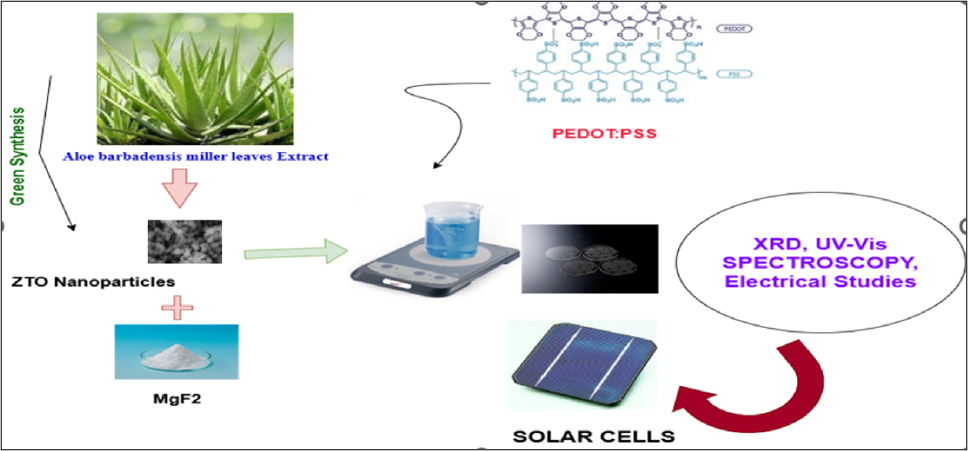
The fabrication of transparent electrodes using green-synthesized nanoparticles offers an eco-friendly, cost-effective, and efficient alternative to conventional clean-room methods. The spin coating technique was used to fabricate a transparent electrode utilizing green synthesized ZTO (Zinc Tin Oxide) Nano composites and MgF2 (Magnesium Fluoride) nanoparticles. In this procedure, glass substrate rotating at 4000 rpm is spin-coated with green synthesized ZTO nanoparticles at varying rotational speeds. For 5000, 6000, and 8000 rpms, follow the same steps. The samples were then dried for an h at 60 °C in a hot air oven. Subsequently, ZTO samples operating at 2000 rpm are covered with MgF2. For the remaining samples, use the same process. There was no discernible conductivity even with a high level of transparency. Finally, on top of MgF2, the conducting polymer PEDOT:PSS is placed. This step completed the fabrication of the transparent electrode. Advanced electronic and optoelectronic devices can benefit from the excellent electrical conductivity and transparency of tin-doped zinc oxide (ZTO) films and multilayer combined with other conducting materials. To examine optical and electrical characteristics, UV-visible spectroscopy and a frequency/impedance analyser were utilised. The study determined that the best combination for performance analysis using the GPVDM (General-purpose Photovoltaic Device Model) simulator was 1:1 ZTO nanoparticles extracted with Aloe barbadensis mill and anti-reflection coating as MgF2 as a second layer and PEDOT:PSS as a tri layer. The modeling findings showed that a number of common transparent electrodes used in solar cells may be effectively replaced by green ZTO nanoparticles coated in many layers.
HIGHLIGHTS
- Transparent electrodes are fabricated using green-synthesized ZTO nanoparticles and MgF2 in a simple, eco-friendly and cost-effective route.
- Best performance found with a 1:1 ratio of ZTO nanoparticles extracted from Aloe barbadensis mill, MgF₂ as an anti-reflection coating, and PEDOT:PSS as a third layer.
- Optical and electrical properties of the electrodes were investigated using various characterization techniques.
- Green-synthesized, multilayer-coated ZTO nanoparticles can effectively replace conventional transparent electrodes in solar cells and other optoelectronic applications.
- Achieved maximum electrical conductivity of ~3×10⁻⁸ S/cm in ZTO + MgF₂ + PEDOT:PSS film on glass substrate (sample-4) spun at 4000 RPM.
GRAPHICAL ABSTRACT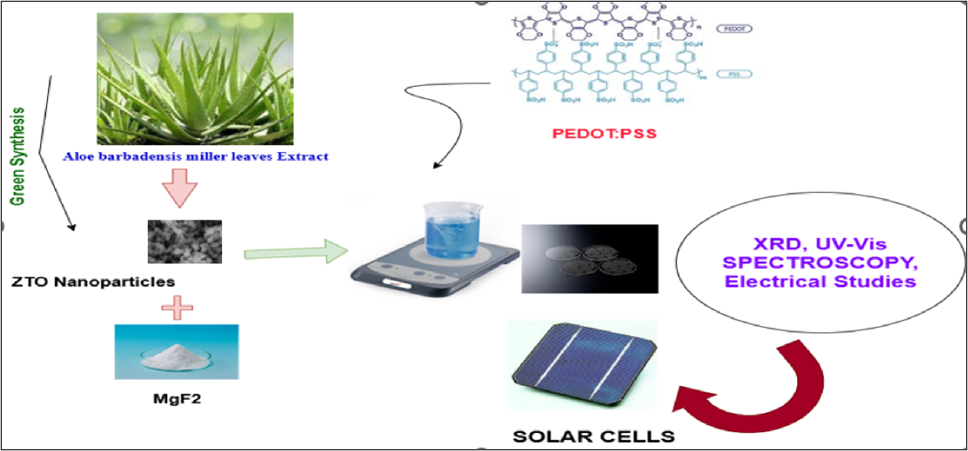
Downloads
References
TA Gessert, J Burst, X Li, M Scott and TJ Coutts. Advantages of transparent conducting oxide thin films with controlled permittivity for thin film photovoltaic solar cells. Thin Solid Films 2011; 519(21), 7146-7148.
FU Hamelmann. Transparent conductive oxides in thin film photovoltaics. Journal of Physics: Conference Series 2014; 559(1), 012016.
J Liu, F Luo, A Wei, Z Liu and Y Zhao. In-situ growth of Cu₂ZnSnS₄ nanospheres thin film on transparent conducting glass and its application in dye-sensitized solar cells. Materials Letters 2015; 141, 228-230.
P Karthick, D Vijayanarayanan, M Sridharan, RTA Kumar, C Sanjeeviraja and K Jeyadheepan. Optimization of substrate temperature and characterization of tin oxide based transparent conducting thin films for application in dye-sensitized solar cells. Thin Solid Films 2017; 631, 1-11.
BG Nair, H Rahman, V Sharma, GS Okram, U Deshpande, V Ganesan and RR Philip. Al doping for bipolarity induction in transparent conducting CuInO₂ and its application in diode fabrication. Materials Science and Engineering: B 2020; 255, 114520.
X Cao, S Sun, B Lu , Y Liu, R Ma, H Cao, H Ma and H Huang. Spectral photoluminescence properties of YAG:Ce,R (R: Gd³⁺, Pr³⁺, Gd³⁺ and Pr³⁺) transparent fluorescent thin film prepared by pulse laser deposition. Journal of Luminescence 2020; 223, 117222.
A Karabulut, A Dere, AG Al-Sehemi, AA Al-Ghamdi and F Yakuphanoglu. Zinc oxide based 3-components semiconductor oxide photodiodes by dynamic spin coating method. Materials Science in Semiconductor Processing 2021; 134, 106034.
F Yakuphanoglu, B Gunduz, AA Al-Ghamdi, WA Farooq and F El-Tantawy. Transparent ultraviolet photodiodes based conductive gallium-indium-oxide films/p-type silicon for solar panel tracking systems. Sensors and Actuators A: Physical 2015; 234, 212-222.
MM Makhlouf. Preparation and optical characterization of β-MnO₂ nano thin films for application in heterojunction photodiodes. Sensors and Actuators A: Physical 2018; 279, 145-156.
BA Gozeh, A Karabulut, CB Ismael, SI Saleh and F Yakuphanoglu. Zn-doped CdO effects on the optical, electrical and photoresponse properties of heterojunctions-based photodiodes. Journal of Alloys and Compounds 2021; 872, 159624.
RR Kumar, Raghvendra, SK Pandey and SK Pandey. Experimental investigation and comparative analysis of electron beam evaporated ZnO/MgₓZn₁₋ₓO/CdₓZn₁₋ₓO thin films for photodiode applications. Superlattices and Microstructures 2021; 150, 106787.
JW Han, B Jung, DW Kim, KT Lim, SY Jeong, and YH Kim. Transparent conductive hybrid thin-films based on copper-mesh/conductive polymer for ITO-free organic light-emitting diodes. Organic Electronics 2019; 73, 13-17.
A El-Shaer, W Ismail and M Abdelfatah. Towards low cost fabrication of inorganic white light emitting diode based on electrodeposited Cu₂O thin film/TiO₂ nanorods heterojunction. Materials Research Bulletin 2019; 116, 111-116.
N Saxena, P Manzhi, RJ Choudhary, S Upadhyay, S Ojha, GR Umapathy, V Chawla, OP Sicha and R Krishna. Performance optimization of transparent and conductive Zn₁₋ₓAlₓO thin films for opto-electronic devices: An experimental & first-principles investigation. Vacuum 2020; 177, 109369.
K Ueda, SH Kweon, H Hida, Y Mukouyama and I Kanno. Transparent piezoelectric thin-film devices: Pb(Zr,Ti)O₃ thin films on glass substrates. Sensors and Actuators A: Physical 2021; 327, 112786.
R Fan, R Peng, X Huang and M Wang. Making structured metals transparent for ultrabroadband electromagnetic waves and acoustic waves. Annals of Physics 2015; 358, 5-19.
M Ekmekcioglu, N Erdogan, AT Astarlioglu, S Yigen, G Aygun, L Ozyuzer and M Ozdemir. High transparent, low surface resistance ZTO/Ag/ZTO multilayer thin film electrodes on glass and polymer substrates. Vacuum 2021; 187, 110100.
MA Islam, KS Rahman, H Misran, N Asim, MS Hossain, M Akhtaruzzaman and N Amin. High mobility and transparent ZTO ETM prepared by RF reactive co-sputtering for perovskite solar cell application. Results in Physics 2019; 14, 102518.
I Arora, P Kumar, TS Sathiaraj and R Thangaraj. Structure, optical and electrical properties of sol-gel derived Zn₁.₅₊ₓSn₁.₅₋ₓO₄ nanostructured films for optoelectronic applications. Thin Solid Films 2020; 698, 137871.
Q Zhang, G Xia, L Li, W Xia, H Gong and S Wang. High-performance zinc-tin-oxide thin film transistors based on environment-friendly solution process. Current Applied Physics 2019; 19(2), 174-181.
S Lee, YH Joo and CI Kim. Influences of film thickness and annealing temperature on properties of sol-gel derived ZnO–SnO₂ nanocomposite thin film. Applied Surface Science 2014; 320, 494-501.
MF Zainal and Y Mohd. Characterization of PEDOT films for electrochromic applications. Polymer-Plastics Technology and Engineering 2015; 57(3), 276-281.
NC Das and PE Sokol. Hybrid photovoltaic devices from regioregular polythiophene and ZnO nanoparticles composites. Renewable Energy 2010; 35(12), 2683-2688.
D Vanossi, L Cigarini, A Giaccherini, ED Como and C Fontanesi. An integrated experimental/theoretical study of structurally related poly-thiophenes used in photovoltaic systems. Molecules 2016; 21(1), 110.
AK Mittal, Y Chisti and UC Banerjee. Synthesis of metallic nanoparticles using plant extracts. Biotechnology Advances 2013; 31(2), 346-356.
S Ng, TJ Patey, R Buchel, F Krumeich, J Wang, HK Liu, SE Pratsinis and P Novak. Flame spray-pyrolyzed vanadium oxide nanoparticles for lithium battery cathodes. Physical Chemistry Chemical Physics 2009; 11(19), 3748-3755.
D Manikprabhu and L Kattimani. Antibacterial activity of silver nanoparticles against methicillin-resistant Staphylococcus aureus synthesized using model Streptomyces sp. pigment by photo-irradiation method. Journal of Pharmacy Research 2013; 6(2), 255-260.
RW Jones. Fundamental principles of sol-gel technology. Elsevier Science, Amsterdam, Netherlands, 1989.
T Zhou, T Zhang, R Zhang, J Deng, Z Lou, G Lu and L Wang. Highly sensitive sensing platform based on ZnSnO₃ hollow cubes for detection of ethanol. Applied Surface Science 2017; 400, 262-268.
J Xu, X Jia, X Lou and J Shen. One-step hydrothermal synthesis and gas sensing property of ZnSnO₃ microparticles. Solid-State Electronics 2006; 50(3), 504-507.
SK Sharma, DS Verma, LU Khan, S Kumar and S Khan. Handbook of materials characterization. Springer Nature, Cham, Switzerland, 2017.
N Mayedwa, N Mongwaketsi, S Khamlich, K Kaviyarasu, N Matinise and M Maaza. Green synthesis of zinc tin oxide (ZnSnO₃) nanoparticles using Aspalathus linearis natural extracts: Structural, morphological, optical and electrochemistry study. Applied Surface Science 2018; 446, 250-257.
N Soin, P Zhao, K Prashanthi, J Chen, P Ding, E Zhou, T Shah, SC Ray, C Tsonos, T Thundat, E Siores and J Luo. High performance triboelectric nanogenerators based on phase-inversion piezoelectric membranes of poly(vinylidene fluoride)-zinc stannate (PVDF–ZnSnO₃) and polyamide-6 (PA6). Nano Energy 2016; 30, 470-480.
Y Chen, L Yu, Q Li, Y Wu, Q Li and T Wang. An evolution from 3D face-centered-cubic ZnSnO₃ nanocubes to 2D orthorhombic ZnSnO₃ nanosheets with excellent gas sensing performance. Nanotechnology 2012; 23(41), 415501.
S Medda, A Hajra, U Dey, P Bose and NK Mondal. Biosynthesis of silver nanoparticles from Aloe vera leaf extract and antifungal activity against Rhizopus sp. and Aspergillus sp. Applied Nanoscience 2015; 5(7), 875-880.
SA Khan, SB Khan, LU Khan, A Farooq, K Akhtar and AM Asiri. Fourier transform infrared spectroscopy: fundamentals and application in functional groups and nanomaterials characterization. Springer Nature, Cham, Switzerland, 2018.
YV Bhaskaralakshmi, P Swapna, BK Babu and YS Rao. Green-synthesis, characterization and the biological evolution of ZnSnO3. Asian Journal of Chemistry 2022; 34(8), 2086-2090.
V Panwar and G Anoop. Flexible piezoresistive strain sensor based on optimized elastomer-electronic polymer blend. Measurement 2021; 168, 108406.
S Long, K Yoon, L Dong-Ju and K Tae-Dong. Synthesis and characterization of PEDOT:PSS-PAs with good electrical conductivity for supercapacitor. Chemical Science International Journal 2023; 32(5), 13-25.
R Kawamura and T Michinobu. PEDOT:PSS versus polyaniline: A comparative study of conducting polymers for organic electrochemical transistors. Polymers 2023; 15(24), 4657.
Published
How to Cite
Issue
Section
License
Copyright (c) 2025 Walailak University

This work is licensed under a Creative Commons Attribution-NonCommercial-NoDerivatives 4.0 International License.





