
In Silico Analysis of Metabolite Compounds from the Essential Oil of Cinnamomum burmannii Bark with COX-1 and COX-2 as Target Molecules
DOI:
https://doi.org/10.48048/tis.2025.10292Keywords:
In silico, Cinnamomum burmannii, COX-1, COX-2, Anti-inflammatoryAbstract
In silico approaches, including molecular docking, have emerged as powerful tools in predicting the interaction between natural compounds and molecular targets such as COX-1 and COX-2. These computational methods provide valuable insights into the binding affinity and selectivity of these compounds, making them indispensable in modern drug discovery. The interactions between metabolites from C. burmanii essential oil and COX-1 and COX-2 were investigated through in silico analysis. This analysis involves several stages, including In Silico Activity Analysis, Drug-likeness Test, Anti-inflammatory Agent Probability, and Molecular Docking. The study suggests that specific compounds could serve as anti-inflammatory adjuvants alongside conventional anti-inflammatory drugs (NSAIDs), potentially reducing dosages or minimizing the side effects associated with NSAID use. The in silico analysis results obtained by simulating the binding of metabolites with COX-1 and COX-2 target proteins using PyRx 0.8 software indicated that 12 out of 14 volatile oil metabolites might contribute to anti-inflammatory activity. However, the anti-inflammatory effects of cinnamon oil require further validation through in vivo testing.
HIGHLIGHTS
- This article focused on in silico approaches in predicting the interaction between natural compounds and molecular targets such as COX-1 and COX-2.
- In silico approaches provide valuable insights into the binding affinity and selectivity of COX-1 and COX-2.
- Cyclooxygenase-1 (COX-1) and cyclooxygenase-2 (COX-2) are enzymes that play a significant role in biological response, particularly in inflammation.
- The major role of Cinnamomum burmannii essential oil is to selectively inhibit COX-1 and COX-2, potentially offering a natural alternative for inflammation management with reduced side effects compared to conventional NSAIDs.
GRAPHICAL ABSTRACT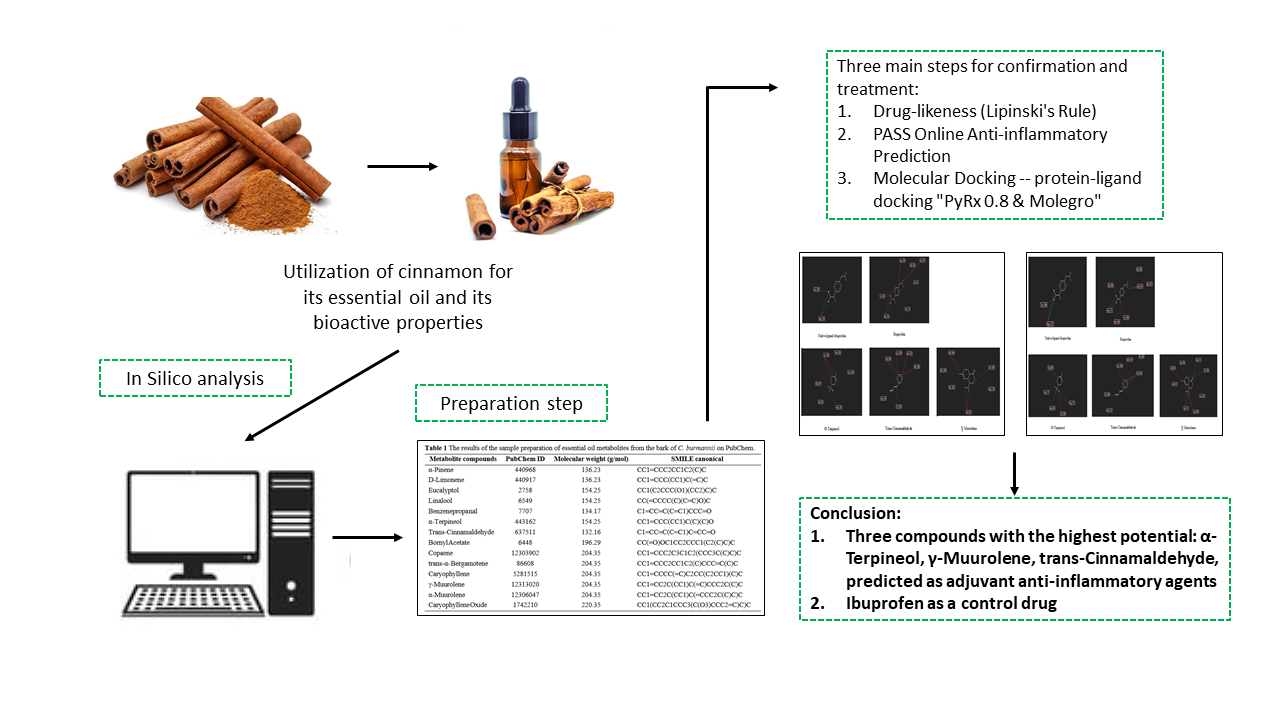
Downloads
References
A Handayani, IQ Lailaty, A Rosyidah, DRT Sari, N Yunarto and D Suherman. Indonesian cinnamon (Cinnamomum burmanni (Nees & T. Nees) Blume) as promising medicinal resources: A review. Jurnal Sylva Lestari 2024; 12(3), 610-633.
SF Nabavi, N Braidy and SM Nabavi. The potential role of cinnamon in modulating inflammatory pathways. Current Pharmaceutical Design 2015; 21(5), 1072-1078.
L Minghetti. Cyclooxygenase-2 (COX-2) in inflammatory and degenerative brain diseases. Journal of Neuropathology and Experimental Neurology 2004; 63(9), 901-910.
L Laine. The gastrointestinal effects of nonselective NSAIDs and COX-2-selective inhibitors. Seminars in Arthritis and Rheumatism 2002; 32(3), 25-32.
A Zarghi and S Arfaei. Selective COX-2 inhibitors: A review of their structure-activity relationships. Iranian Journal of Pharmaceutical Research 2011; 10(4), 655-683.
Budiastuti, RD Nurcholida, R Primaharinastiti and Sukardiman. Anti-inflammatory activity of cinnamon bark oil (Cinnamomum burmannii (Nees & T. Nees) blume from Lombok Timur Indonesia. Pharmacognosy Journal 2021: 13(4), 1005-1013.
ZYI Syarafina, M Safithri, M Bintang and R Kurniasih. In silico screening of cinnamon (Cinnamomum burmannii) bioactive compounds as acetylcholinesterase inhibitors. Journal of Scientific and Applied Chemistry 2022; 25(3), 97-107.
HM Berman, J Westbrook, Z Feng, G Gilliland, TN Bhat, H Weissig, IN Shindyalov and PE Bourne. The protein data bank. Nucleic Acids Research 2000; 28(1), 235-242.
WP Walters. Going further than Lipinski’s rule in drug design. Expert Opinion on Drug Discovery 2012; 7(2), 99-107.
Z Shi, H Li, J Cheng, W Zhang, J Ruan, Q Zhang, Z Dang, Y Zhang and T Wang. Constituents from Dolichos lablab L. flowers and their anti-inflammatory effects via inhibition of IL-1β release. Molecules 2024; 29(16), 3751.
S Kim, J Chen, T Cheng, A Gindulyte, J He, S He, Q Li, BA Shoemaker, PA Thiessen, B Yu, L Zaslavsky, J Zhang and EE Bolton. PubChem 2019 update: Improved access to chemical data. Nucleic Acids Research 2019; 47(D1), D1102-D1109.
KE Hevener, W Zhao, DM Ball, K Babaoglu, J Qi, SW White and RE Lee. Validation of molecular docking programs for virtual screening against dihydropteroate synthase. Journal of Chemical Information and Modeling 2009; 49(2), 444-460.
G Rossino, M Rui, L Pozzetti, D Schepmann, B Wünsch, D Zampieri, G Pellavio, U Laforenza, S Rinaldi, G Colombo, L Morelli, P Linciano, D Rossi and S Collina. Setup and validation of a reliable docking protocol for the development of neuroprotective agents by targeting the Sigma-1 Receptor (S1R). International Journal of Molecular Sciences 2020; 21(20), 7708.
DA Filimonov, AA Lagunin, TA Gloriozova, AV Rudik, DS Druzhilovskii, PV Pogodin and VV Poroikov. Prediction of the biological activity spectra of organic compounds using the pass online web resource. Chemistry of Heterocyclic Compounds 2014; 50, 444-457.
C Sucularlı, B Tozkoparan and SP Aytaç. In silico activity and target prediction analyses of three triazolothiadiazine derivatives. Acta Medica 2022; 53(3), 251-260.
L Zhao, M Teng, X Zhao, Y Li, J Sun, W Zhao, Y Ruan, KMY Leung and F Wu. Insight into the binding model of per- and polyfluoroalkyl substances to proteins and membranes. Environment International 2023; 175, 107951.
DPD Sousa, ROS Damasceno, R Amorati, HA Elshabrawy, RDD Castro, DP Bezerra, VRV Nunes, RC Gomes and TC Lima. Essential oils: Chemistry and pharmacological activities. Biomolecules 2023; 13(7), 1144.
SD Oniga, L Pacureanu, CI Stoica, MD Palage, A Crăciun, LR Rusu, EL Crisan and C Araniciu. COX inhibition profile and molecular docking studies of some 2-(trimethoxyphenyl)-thiazoles. Molecules 2017; 22(9), 1507.
A Lagunin, A Stepanchikova, D Filimonov and V Poroikov. PASS: Prediction of activity spectra for biologically active substances. Bioinformatics 2000; 16(8), 747-748.
Published
How to Cite
Issue
Section
License
Copyright (c) 2025 Walailak University

This work is licensed under a Creative Commons Attribution-NonCommercial-NoDerivatives 4.0 International License.





