
miR-153-5p Promotes Pancreatic Cancer Progression by Targeting Tumor Suppressor Gene S100A14 Through an Oncogenic Mechanism
DOI:
https://doi.org/10.48048/tis.2025.10237Keywords:
Pancreatic cancer, miRNA-153-5p, S100A14, Tumor suppressor, Invasion, Apoptosis, Therapeutic targetAbstract
Pancreatic cancer is a highly aggressive malignancy with limited treatment options and poor prognosis. MicroRNAs (miRNAs) have emerged as critical regulators of cancer progression. This study investigates the oncogenic role of miRNA-153-5p and its regulatory effects on the tumor suppressor gene S100A14 in pancreatic cancer. The expression levels of miRNA-153-5p and S100A14 were analyzed in 20 pancreatic cancer tissue samples and adjacent normal tissues using quantitative PCR and Western blot techniques. Bioinformatics analysis predicted S100A14 as a direct target of miRNA-153-5p, which was validated via luciferase reporter assays. Functional assays, including migration, invasion, proliferation, cell cycle, and apoptosis analyses, were performed in pancreatic cancer cell lines with miRNA-153-5p overexpression or inhibition. miRNA-153-5p was significantly upregulated in pancreatic cancer tissues and cell lines, while S100A14 was downregulated, demonstrating an inverse correlation. Luciferase assays confirmed S100A14 as a direct target of miRNA-153-5p. Functional assays revealed that miRNA-153-5p overexpression enhanced cancer cell proliferation, migration, and invasion while suppressing apoptosis. Conversely, miRNA-153-5p inhibition reduced tumorigenic properties, an effect reversed by S100A14 knockdown. miRNA-153-5p promotes pancreatic cancer progression by targeting the tumor suppressor S100A14. These findings highlight the potential of miRNA-153-5p as a therapeutic target for pancreatic cancer treatment.
HIGHLIGHTS
- miRNA-153-5p is significantly upregulated in pancreatic cancer and directly suppresses S100A14.
- miRNA-153-5p promotes pancreatic cancer cell proliferation, migration, and invasion while inhibiting apoptosis.
- Inhibition of miRNA-153-5p restores S100A14 expression and reduces the aggressiveness pancreatic cancer.
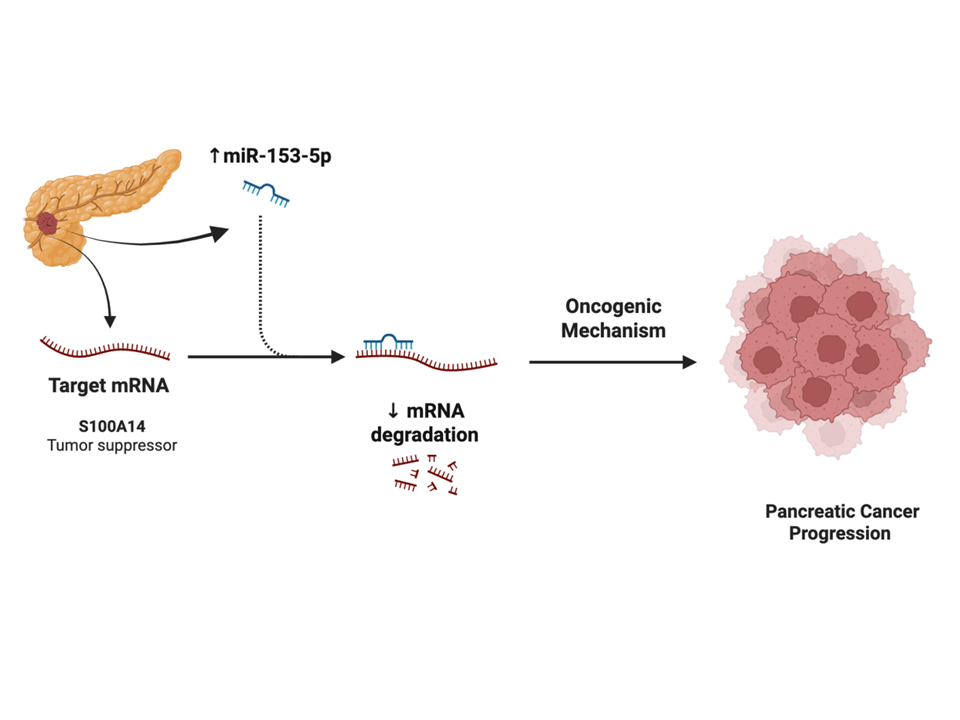
GRAPHICAL ABSTRACT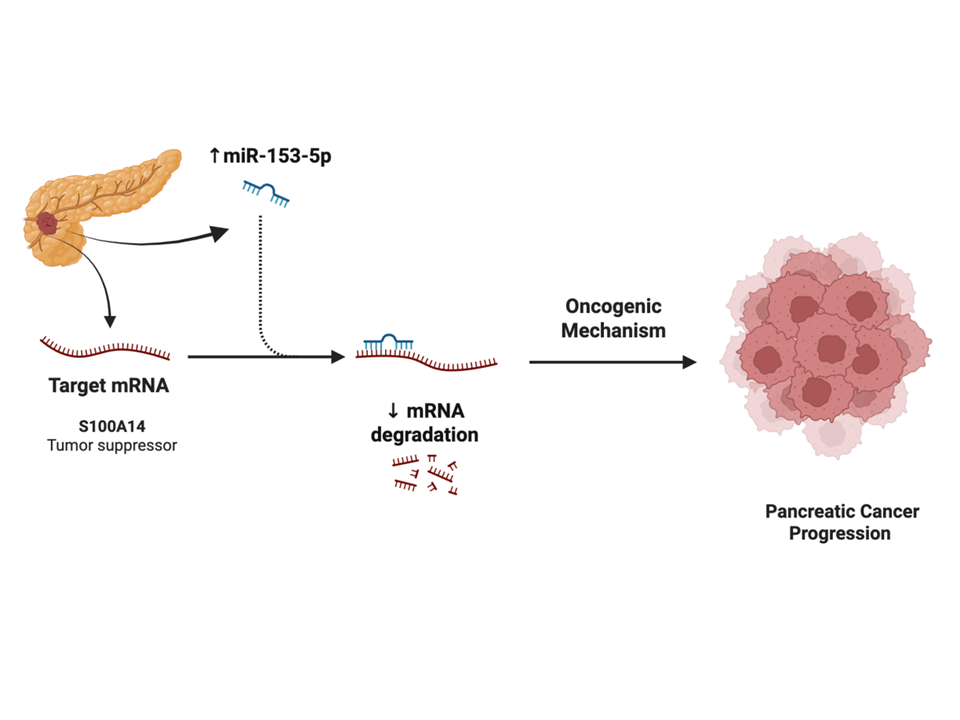
Downloads
References
RL Siegel, AN Giaquinto and A Jemal. Cancer statistics, 2024. CA: A Cancer Journal for Clinicians 2024; 74(1), 12-49.
H Sung, J Ferlay, RL Siegel, M Laversanne, I Soerjomataram, A Jemal and F Bray. Global cancer statistics 2020: GLOBOCAN estimates of incidence and mortality worldwide for 36 cancers in 185 countries. CA: A Cancer Journal for Clinicians 2021; 71(3), 209-249.
L Cekaite, PW Eide, GE Lind, RI Skotheim and RA Lothe. MicroRNAs as growth regulators, their function and biomarker status in colorectal cancer. Oncotarget 2016; 7(6), 6476-6505.
S Landskroner-Eiger, I Moneke and WC Sessa. miRNAs as modulators of angiogenesis. Cold Spring Harbor Perspectives in Medicine 2013; 3(2), a006643.
V Pileczki, R Cojocneanu-Petric, M Maralani, IB Neagoe and R Sandulescu. MicroRNAs as regulators of apoptosis mechanisms in cancer. Medicine and Pharmacy Reports 2016; 89(1), 50-55.
Z Li, S Zhao, S Zhu and Y Fan. MicroRNA-153-5p promotes the proliferation and metastasis of renal cell carcinoma via direct targeting of AGO1. Cell Death & Disease 2021; 12(1), 33.
Z Zuo, F Ye, Z Liu, J Huang and Y Gong. MicroRNA-153 inhibits cell proliferation, migration, invasion and epithelial-mesenchymal transition in breast cancer via direct targeting of RUNX2. Experimental and Therapeutic Medicine 2019; 17(6), 4693-4702.
J Chen, S Xie, M Feng and D Wang. MiRNA-153 attenuates progression of non-small cell lung cancer through targeting positive regulatory/SET domain 2. African Health Sciences 2024; 24(3), 194-204.
Y He, L Zhang, F Tan, L Wang, D Lui, R Wang and X Yin. MiR-153-5p promotes sensibility of colorectal cancer cells to oxaliplatin via targeting Bcl-2-mediated autophagy pathway. Bioscience, Biotechnology & Biochemistry 2020; 84(8), 1645-1651.
S Yousefnia. A comprehensive review on miR-153: Mechanistic and controversial roles of miR-153 in tumorigenicity of cancer cells. Frontiers in Oncology 2022; 12, 985897.
W Zhang, K Liu, Y Pei, J Tan, J Ma and J Zhao. Long noncoding RNA HIF1A-AS2 promotes non-small cell lung cancer progression by the miR-153-5p/S100A14 axis. OncoTargets and Therapy 2020; 13, 8715-8722.
Q Al-Ismaeel, Q Al-Ismaeel, CP Neal, H Al-Mahmoodi, Z Almutairi, I Al-Shamarti, K Straatman, N Jaunbocus, A Irvine, E Issa, C Moreman, AR Dennison, AE Sayan, J McDearmid, P Greaves, E Tulchinsky and M Kriajevska. ZEB1 and IL-6/11-STAT3 signalling cooperate to define invasive potential of pancreatic cancer cells via differential regulation of the expression of S100 proteins. British Journal of Cancer 2019; 121(1), 65-75.
R Donato, BR Cannon, G Sorci, F Riuzzi, K Hsu, DJ Weber and CL Geczy. Functions of S100 proteins. Current Molecular Medicine 2013; 13(1), 24-57.
A McGuigan, P Kelly, RC Turkington, C Jones, HG Coleman and RS McCain. Pancreatic cancer: A review of clinical diagnosis, epidemiology, treatment and outcomes. World Journal of Gastroenterology 2018; 24(43), 4846-4861.
L Zhang, K Pickard, V Jenei, MD Bullock, A Bruce, R Mitter, G Kelly, C Paraskeva, J Strefford, J Primrose, GJ Thomas, G Packham and AH Mirnezami. miR-153 supports colorectal cancer progression via pleiotropic effects that enhance invasion and chemotherapeutic resistance. Cancer Research 2013; 73(21), 6435-6447.
D Shi, Y Li, L Fan, Q Zhao, B Tan and G Cui. Upregulation of miR-153 inhibits triple-negative breast cancer progression by targeting ZEB2-mediated EMT and contributes to better prognosis. OncoTargets and Therary 2019; 12, 9611-9625.
G Zhao, Y Zhang, Z Zhao, H Cai, X Zhao, T Yang and W Chen, C Yao, Z Wang, Z Wang, C Han and H Wang. MiR-153 reduces stem cell-like phenotype and tumor growth of lung adenocarcinoma by targeting Jagged1. Stem Cell Research & Therary 2020; 11(1), 170.
KKW To, W Fong, CWS Tong, M Wu, W Yan and WCS Cho. Advances in the discovery of microRNA-based anticancer therapeutics: Latest tools and developments. Expert Opinion on Drug Discovery 2020; 15(1), 63-83.
H Chen, Y Zhao, B Yu, X Liu and Y Zhang. Functional role of S100A14 genetic variants and their association with esophageal squamous cell carcinoma. Cancer Research 2009; 69(8), 3451-3457.
D Sapkota, DE Costea, M Blo, O Bruland, JB Lorens, EN Vasstrand and SO Ibrahim. S100A14 inhibits proliferation of oral carcinoma-derived cells through G1-arrest. Oral Oncology 2012; 48(3), 219-225.
AR Bresnick, DJ Weber and DB Zimmer. S100 proteins in cancer. Nature Reviews Cancer 2015; 15(2), 96-109.
DP Bartel. MicroRNAs. Cell 2004; 116(2), 281-297.
R Rupaimoole and FJ Slack. MicroRNA therapeutics: Towards a new era for the management of cancer and other diseases. Nature Reviews Drug Discovery 2017; 16(3), 203-222.
SP Nana-Sinkam and CM Croce. Clinical applications for microRNAs in cancer. Clinical Pharmacology & Therapeutics 2013; 93(1), 98-104.
Published
How to Cite
Issue
Section
License
Copyright (c) 2025 Walailak University

This work is licensed under a Creative Commons Attribution-NonCommercial-NoDerivatives 4.0 International License.





