
Optimization of Cocoa Nibs Fermentation Using Saccharomyces cerevisiae Starter Cultures: Impact on Physicochemical Properties and Aroma Profile
DOI:
https://doi.org/10.48048/tis.2025.10201Keywords:
Cocoa fermentation, Physicochemical properties, Aroma compounds,microbial metabolism, Controlled fermentation, Starter cultures, Saccharomyces cerevisiaeAbstract
Cocoa fermentation is a crucial post-harvest process that significantly influences cocoa beans’ flavor, aroma, and quality. This study investigates the impact of controlled fermentation using Saccharomyces cerevisiae strains 71B and K1V-1116 on cocoa nibs’ physicochemical and aromatic properties. The fermentation process was analyzed through total soluble solids (°Brix), pH, titratable acidity, cut test scores, sugar and acid composition, and volatile aroma compounds. Results indicate that total soluble solids decreased progressively as fermentation advanced, with natural fermentation retaining higher sweetness levels (0.66 °Brix on day 9) than K1V-1116 (0.43 °Brix) and 71B (0.46 °Brix). pH levels fluctuated, initially decreasing before rising in later stages, with natural fermentation reaching the highest final pH (6.28). Titratable acidity exhibited an inverse trend, where 71B fermentation maintained higher lactic acid levels (75.80 mg/100 mL), while acetic acid levels were lowest in K1V-1116 (45.87 mg/100 mL), suggesting a milder fermentation profile. After nine days, the cut test score was highest in K1V-1116 (86.66 %), indicating superior fermentation efficiency. Sugar analysis revealed a significant reduction in sucrose for inoculated fermentations, while 71B produced the highest fructose levels (31.47 mg/100 mL). Aroma analysis confirmed that controlled fermentation enhanced floral and sweet notes while reducing undesirable fatty and amine compounds. Pearson’s correlation analysis revealed strong positive correlations between sugar content and aroma compound concentrations, and negative correlations between organic acid levels and aroma compound. These findings demonstrate that targeted yeast fermentation enhances cocoa quality and may support consistent flavor production. This approach presents a promising strategy for improving post-harvest processing and achieving high-quality cocoa suitable for cocoa nib’ production.
HIGHLIGHTS
- Controlled fermentation improves cocoa fermentation efficiency.
- Starter cultures enhance sugar breakdown and sweetness perception.
- Balanced acidity with higher lactic acid and lower acetic acid levels.
- Improved aroma with more floral, sweet, and phenolic compounds.
- Supports optimized cocoa processing for better chocolate quality.
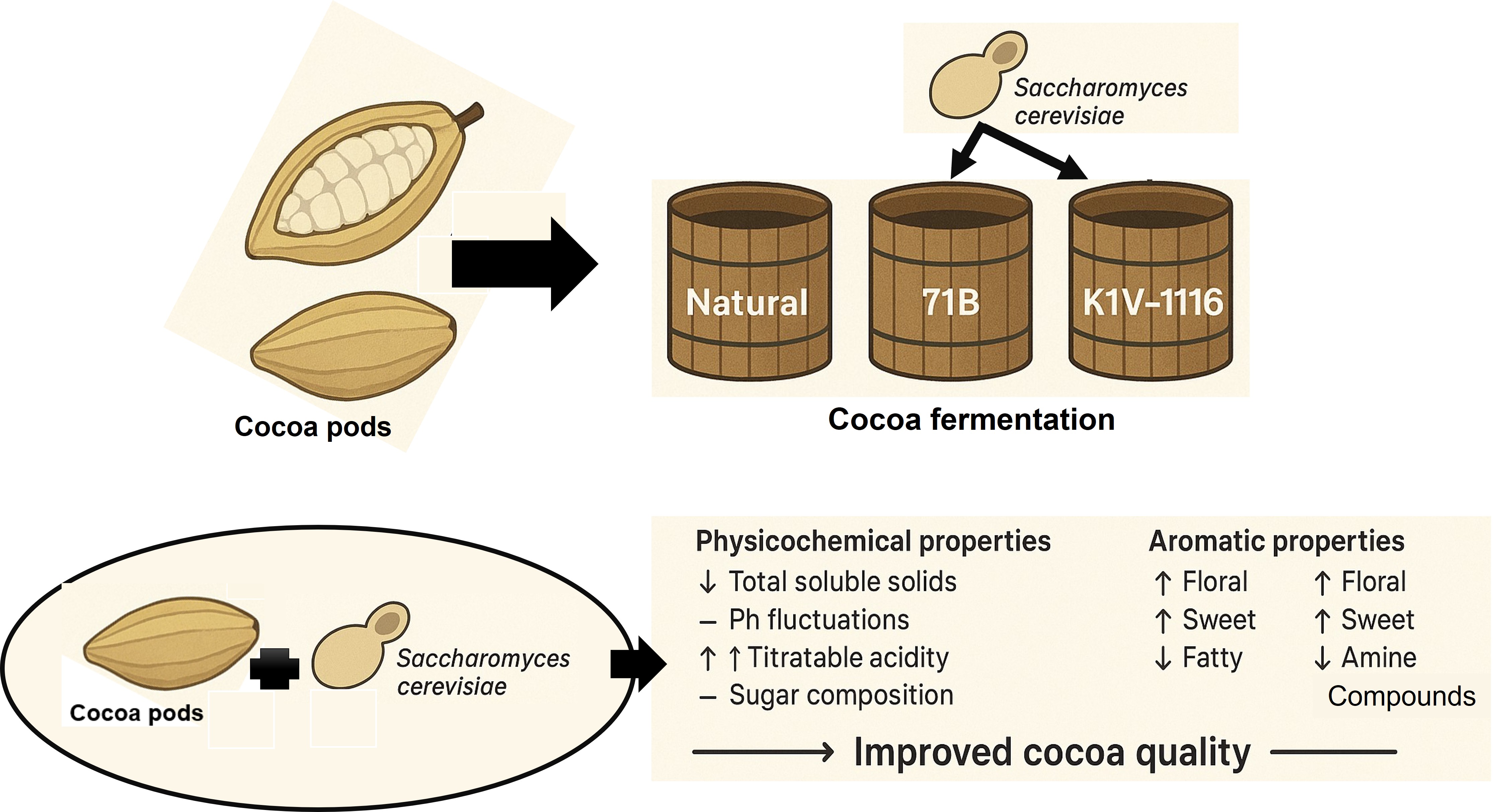
GRAPHICAL ABSTRACT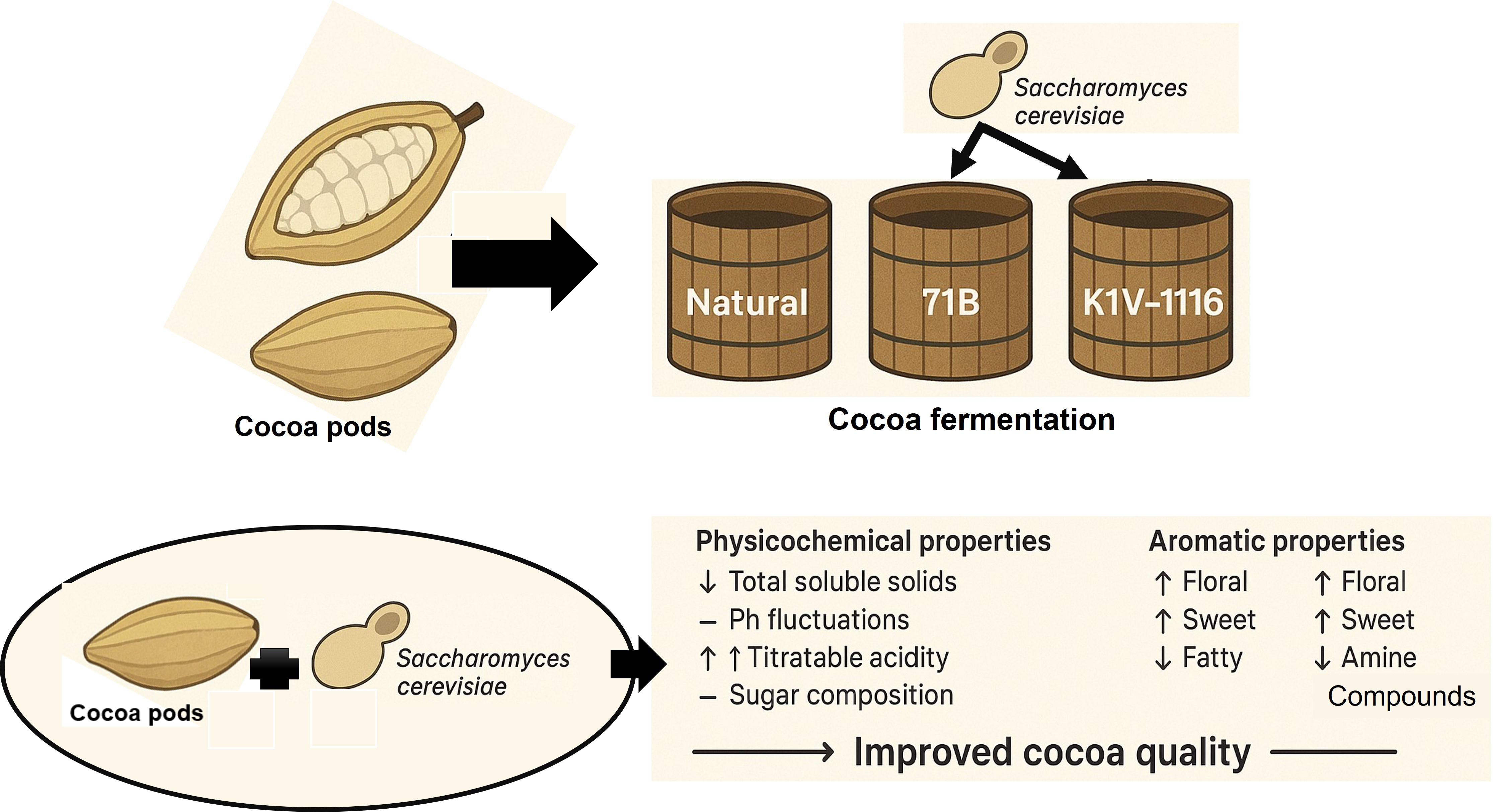
Downloads
References
L Haruna, EE Abano, E Teye, I Tukwarlba, W Yeboah, KJ Agyei and M Lukeman. Effects of predrying and spontaneous fermentation treatments on nib acidification, fermentation quality, and flavour attributes of Ghanaian cocoa (Theobroma cacao) beans. International Journal of Food Science 2024; 2024(1), 5198607.
JE Kongor and DRA Muhammad. Processing of cocoa and development of chocolate beverages. Natural Products in Beverages. Springer, Cham, 2024.
E Subroto, M Djali, R Indiarto, E Lembong and N Baiti. Microbiological activity affects post-harvest quality of cocoa (Theobroma cacao L.) beans. Horticulturae 2023; 9(7), 805.
SP Akoa, J Kouam, ML Ondobo, JM Ndjaga, PF Djocgoue and PE Onomo. Identification of methylxanthines and phenolic compounds by UPLC-DAD-ESI-MS OTOF and antioxidant capacities of beans and dark chocolate bars from three Trinitario × Forastero cocoa (Theobroma cacao L.) hybrids. Journal of Food Research 2021; 10(2), 32-46.
D Bogueva and S Danova. Comparing precision fermentation and traditional fermentations: Consumer views. In: D Bogueva (Ed.). Consumer Perceptions and Food. Springer, Singapore. 2024. p. 563-588.
TS Ooi, ASY Ting and LF Siow. Physicochemical properties, antioxidant content, volatile organic compounds and sensory profile of cocoa beans fermented with yeast starter cultures. Journal of Food Processing and Preservation 2021; 45(11), e15893.
DVD Voorde, C Díaz-Muñoz, CE Hernandez, S Weckx and LD Vuyst. Yeast strains do have an impact on the production of cured cocoa beans, as assessed with Costa Rican Trinitario cocoa fermentation processes and chocolates thereof. Frontiers in Microbiology 2023; 14, 1232323.
MSDSE Souza, LLR Borges, HdB Kobi, VV Freitas, TCB Rigolon, LS Olegário, EA Gutiérrez, PHC Felix, MCTR Vidigal and PC Stringheta. Roasted and unroasted cocoa nibs: Bioactive compounds analysis and application in cereal bars. Foods 2024; 13(21), 3510.
L Haruna, EE Abano, E Teye, I Tukwarlba, S Adu, KJ Agyei, E Kuma, W Yeboah and M Lukeman. Effect of partial pulp removal and fermentation duration on drying behavior, nib acidification, fermentation quality, and flavor attributes of Ghanaian cocoa beans. Journal of Agriculture and Food Research 2024; 17, 101211.
B Hirko, H Mitiku and A Getu. Role of fermentation and microbes in cacao fermentation and their impact on cacao quality. Systems Microbiology and Biomanufacturing 2023; 3(4), 509-520.
ID Camargo, LG Rodriguez-Silva, R Carreño-Olejua, AC Montenegro and LF Quintana-Fuentes. High temperature and nib acidification during cacao-controlled fermentation improve cadmium transfer from nibs to testa and the liquor’s flavor. Scientific Reports 2024; 14(1), 12254.
MM Oliveira, BV Cerqueira, SB Jr and DF Barbin. Classification of fermented cocoa beans (cut test) using computer vision. Journal of Food Composition and Analysis 2021; 97, 103771.
H Chang, C Gu, M Wang, J Chen, M Yue, J Zhou, Z Chang, C Zhang, F Liu and Z Feng. Screening and characterizing indigenous yeasts, lactic acid bacteria, and acetic acid bacteria from cocoa fermentation in Hainan for aroma development. Journal of Food Science 2025; 90(1), e17612.
CE Falconí, V Yánez-Mendizábal, RJ Haro and DR Claudio. Inoculum of a native microbial starter cocktail to optimize fine-aroma cocoa (Theobroma cacao) bean fermentation. Agronomy 2023; 13(10), 2572.
C Díaz-Muñoz, D Van de Voorde, E Tuenter, V Lemarcq, D Van de Walle, JPS Maio, A Mencía, CE Hernandez, A Comasio and E Sioriki. An in-depth multiphasic analysis of the chocolate production chain, from bean to bar, demonstrates the superiority of Saccharomyces cerevisiae over Hanseniaspora opuntiae as functional starter culture during cocoa fermentation. Food Microbiology 2023; 109, 104115.
H Tsaaqifah, F Fahrurrozi and A Meryandini. Selection of lactic acid bacteria as starter culture for cocoa fermentation (Theobroma cacao L.). Jurnal Penelitian Pendidikan Ilmu Pengetahuan Alam 2023; 9(2), 825-831.
GCA Chagas Junior, NR Ferreira, MBA Gloria, RM Gobira, FdA Maia and AS Lopes. Identification of lactic acid bacteria on raw material for cocoa bean fermentation in the Brazilian Amazon. Fermentation 2022; 8(5), 199.
C Piankarn, R Liamkaew, K Chaisu and C Chiu-Hsia. Fermentation profile of thai cocoa beans. In: Proceedings of the 4th PIM International Conference, Bankok, Thailand. 2021, p. 24-33.
CR Vizcaino-Almeida, D Guajardo-Flores, R Caroca-Cáceres, SO Serna-Saldívar, M Briones-García and MA Lazo-Vélez. Non-conventional fermentation at laboratory scale of cocoa beans: Using probiotic microorganisms and substitution of mucilage by fruit pulps. International Journal of Food Science and Technology 2022; 57(7), 4307-4315.
J Martín-Gómez, T García-Martínez, MÁ Varo, J Mérida and MP Serratosa. Phenolic compounds, antioxidant activity and color in the fermentation of mixed blueberry and grape juice with different yeasts. Lebensmittel-Wissenschaft und -Technologie - Food Science and Technology 2021; 146, 111661.
RF Peña‐Correa, BA Mogol and V Fogliano. Fluidized bed roasting modifying the microstructure of cocoa nibs and improving cocoa butter quality. Journal of the American Oil Chemists’ Society 2023; 100(10), 815-827.
DFA Riza, AW Putranto, Z Iqbal, H Firmanto and CD Anggraini. Prediction of fermentation index and pH of cocoa (Theobroma cacao L.) beans based on color features (cut test) and partial least square regression model. Food Science and Technology 2023; 11(1), 54-62.
FF Liu, YQ Li, CY Wang, Y Liang, XZ Zhao, JX He and HZ Mo. Physicochemical, functional and antioxidant properties of mung bean protein enzymatic hydrolysates. Food Chemistry 2022; 393, 133397.
Co Excellence. Guide for the assessment of cacao quality and flavour. Cacao of Excellence, Rome, Italy, 2023.
C Hernández‐Hernández, PA López‐Andrade, MA Ramírez‐Guillermo, D Guerra Ramirez and JF Caballero Perez. Evaluation of different fermentation processes for use by small cocoa growers in Mexico. Food Science and Nutrition Research. 2016; 4(5), 690-695.
F Mohamadi Alasti, N Asefi, R Maleki and SS SeiiedlouHeris. Investigating the flavor compounds in the cocoa powder production process. Food Science and Nutrition Research 2019; 7(12), 3892-3901.
HF Akbulut and M Akbulut. Mineral composition, the profile of phenolic compounds, organic acids, sugar and in vitro antioxidant capacity, and antimicrobial activity of organic extracts of Juniperus drupacea fruits. Food Science and Nutrition 2023; 11(10), 6435-6446.
LD Vuyst and F Leroy. Functional role of yeasts, lactic acid bacteria and acetic acid bacteria in cocoa fermentation processes. Federation of European Microbiological Societies Microbiology Reviews 2020; 44(4), 432-453.
F Comitini, A Agarbati, L Canonico and M Ciani. Yeast interactions and molecular mechanisms in wine fermentation: A comprehensive review. International Journal of Molecular Sciences 2021; 22(14), 7754.
AM Calvo, BL Botina, MC García, WA Cardona, AC Montenegro and J Criollo. Dynamics of cocoa fermentation and its effect on quality. Scientific Reports 2021; 11(1), 16746.
AMP Rivera, JL Silva, LS Torres-Valenzuela and JLP Dorado. Development of starter inoculum for controlled arabica coffee fermentation using coffee by-products (pulp and mucilage broth), yeast, and lactic acid bacteria. Fermentation 2024; 10(10), 516.
KM Koné, BJ Assi-Clair, ADD Kouassi, AK Yao, L Ban-Koffi, N Durand, M Lebrun, I Maraval, R Bonlanger and TS Guehi. Pod storage time and spontaneous fermentation treatments and their impact on the generation of cocoa flavour precursor compounds. International Journal of Food Science 2021; 56(5), 2516-2529.
L Farrera, ACDL Noue, C Strub, B Guibert, C Kouame, J Grabulos, D Montet and C Teyssier. Towards a starter culture for cocoa fermentation by the selection of acetic acid bacteria. Fermentation 2021; 7(1), 42.
X Wang, X Wang, H Lou, Y Li and R Zhao. Understanding the correlation between formation of flavor compounds and dominant bacteria during Luoyang mung bean sour fermentation. Food Bioscience 2024; 60, 104374.
Y Li, Y Feng, S Zhu, C Luo, J Ma and F Zhong. The effect of alkalization on the bioactive and flavor related components in commercial cocoa powder. Journal of Food Composition and Analysis 2012; 25(1), 17-23.
Published
How to Cite
Issue
Section
License
Copyright (c) 2025 Walailak University

This work is licensed under a Creative Commons Attribution-NonCommercial-NoDerivatives 4.0 International License.





