
Evaluation of Sensory Profiles, Protein Digestibility, and Mineral Composition in Mocaf-Multi-grain Noodles with Different Binding Agents
DOI:
https://doi.org/10.48048/tis.2025.10099Keywords:
Additives, Amino acids, CMC, Caulerpa lentillifera, Carrageenan, Instant noodles, Mineral content, Protein digestibility, Sensory profileAbstract
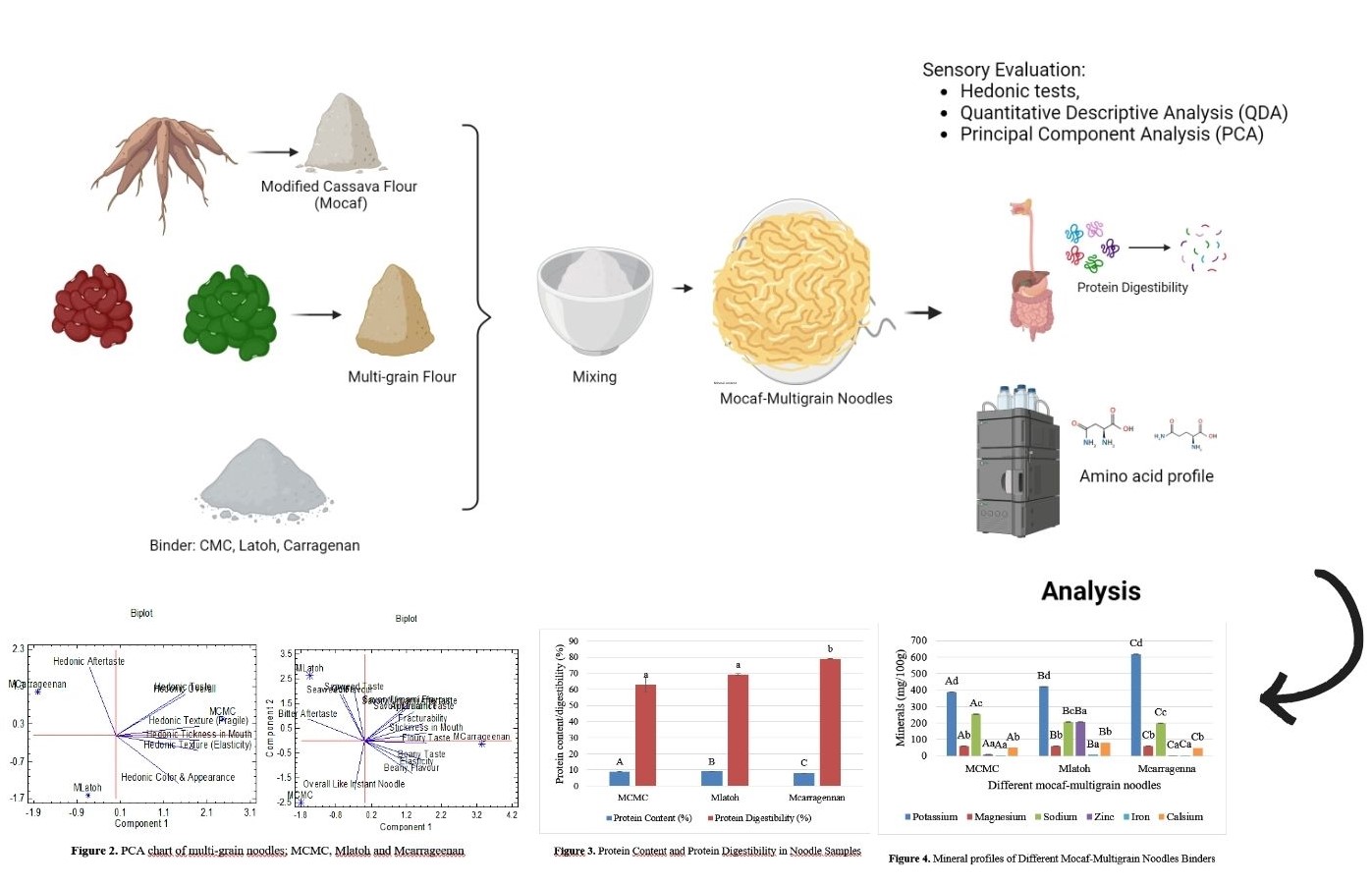
The demand for healthier instant noodle alternatives has increased due to dietary restrictions and nutritional concerns. This study explored the sensory profiles, protein profiles and digestibility, as well as the mineral composition of instant noodles made with modified cassava flour (mocaf), multi-grain flours (mung and kidney beans), and different binder (carboxymethyl cellulose (CMC), Caulerpa lentillifera (latoh), and carrageenan). Three formulations were prepared using 55 % mocaf, 30 % wheat flour, and 15 % multi-grain with different binders. Sensory evaluations included hedonic tests, Quantitative Descriptive Analysis (QDA), and Principal Component Analysis (PCA). Protein digestibility, free amino acid profiles, and mineral content were also analyzed. Noodles with CMC binder were well-accepted, exhibiting desirable sensory characteristics such as bright color, uniform appearance, chewy texture, and moderate umami aroma and taste. PCA revealed that the characteristics of noodles with CMC binders were related to preference attributes, including texture fragility, aftertaste, and overall acceptability. Protein digestibility analysis showed that noodles with carrageenan had the highest protein digestibility (55.10 %), followed by latoh (48.18 %) and CMC (43.90 %). Noodles with latoh had the highest increase in total amino acid content after digestion (105 %), compared to CMC (58 %) and carrageenan (58 %). Carrageenan as a binder resulted in the highest potassium and iron content, while latoh contributed to increased magnesium, sodium and zinc levels. These findings provide valuable insights into the development of nutritionally enhanced instant noodles using alternative ingredients. Further research on optimization and consumer acceptance is recommended to enhance the market potential of these innovative formulations. Further research on optimizing the binder types and concentrations in relating to consumer acceptance is recommended to enhance the market potential of these innovative formulations.
HIGHLIGHTS
- Mocaf-multi-grain noodles with different binders (CMC, latoh, carrageenan) were evaluated for sensory attributes, protein digestibility, and mineral content.
- CMC-based noodles had the best sensory appeal, with vibrant color, consistent appearance, and chewy texture.
- Protein digestibility was highest in noodles with carrageenan (55.10 %), followed by latoh (48.18 %) and CMC (43.90 %).
- Noodles with latoh had the highest increase in total amino acid content after digestion (105 %).
- Carrageenan as a binder resulted in the highest potassium and iron content. In contrast, the Latoh binder was associated with enhanced levels of magnesium, sodium, and zinc.
GRAPHICAL ABSTRACT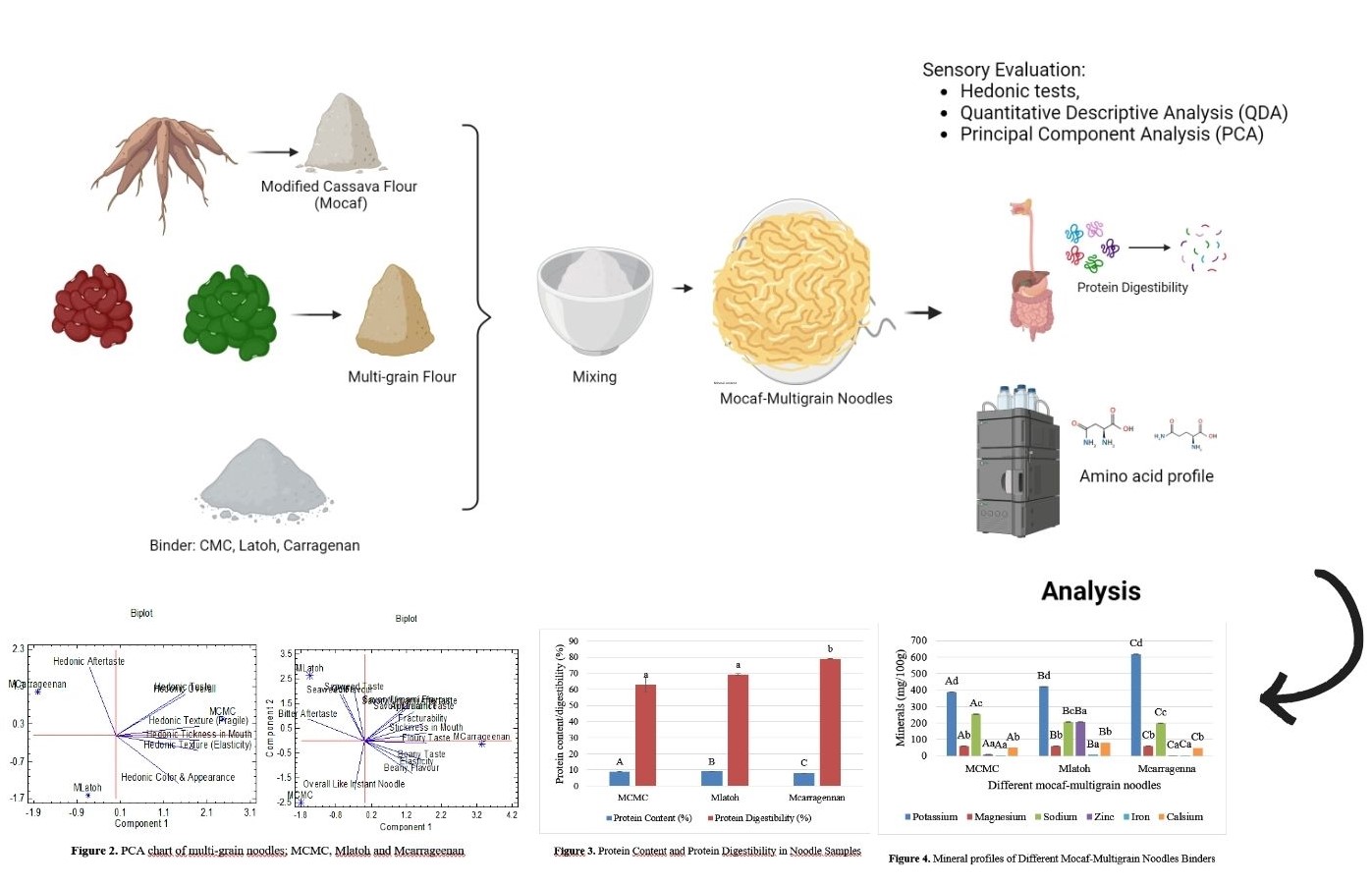
Downloads
References
P Satmalee, S Winitchai, S Saah and J Chaiyut. Effect of crude sea grape hydrocolloids extract on the rice starch physicochemical and digestibility properties. Food Science and Technology 2024; 44, e00221.
B Arora, S Kamal and VP Sharma. Nutritional and quality characteristics of instant noodles supplemented with oyster mushroom (P. ostreatus). Journal of Food Processing and Preservation 2018; 42(2), e13521.
H Toiba, AY Noor, MS Rahman, R Hartono, R Asmara and D Retnoningsih. Consumers’ preference and future consideration towards organic instant noodles: Evidence from Indonesia. AGRIS On-line Papers in Economics and Informatics 2023; 15(1), 127-137.
PD Shere, P Sahni, AN Devkatte and VN Pawar. Influence of hydrocolloids on quality characteristics, functionality and microstructure of spinach puree-enriched instant noodles. Nutrition and Food Science 2020; 50(6), 1267-1277.
NY Lee. Effects of blends of low-protein winter wheat flour and barley byproducts on quality changes in noodles. Preventive Nutrition and Food Science 2016; 21(4), 361-366.
W Suk, J Kim, DY Kim, H Lim and R Choue. Effect of wheat flour noodles with bombyx mori powder on glycemic response in healthy subjects. Preventive Nutrition and Food Science 2016; 21(3), 165-170.
IM Rumadana and AA Salu. Uji organoleptik Spritz Cookies (kue semprit) dengan tepung Mocaf sebagai substitusi sebagian tepung terigu. Jurnal of Gastronomi Indonesia 2020; 8(1), 32-40.
SB Wahjuningsih, Haslina, N Nazir, MN Azkia and A Triputranto. Characteristic of mocaf noodles with sago flour substitution (Metroxylon sago) and addition of latoh (Caulerpa lentillifera). International Journal on Advanced Science Engineering Information Technology 2023; 13(2), 417-422.
Yanti, V Violina, CE Putri and BW Lay. Branched chain amino acid content and antioxidant activity of mung bean tempeh powder for developing oral nutrition supplements. Foods 2023; 12(14), 2789.
H Kaur, H Bobade, A Singh, B Singh and S Sharma. Effect of formulations on functional properties and storage stability of nutritionally enriched multi-grain pasta. Chemical Science International Journal 2017; 19(1), 33348.
FM Idris, K Urga, H Admassu, EG Fentie, SM Kwon and JH Shin. Profiling the nutritional, phytochemical, and functional properties of mung bean varieties. Foods 2025; 14(4), 571.
L Kan, S Nie, J Hu, S Wang, SW Cui, Y Li, S Xu, Y Wu, J Wang, Z Bai and M Xie. Nutrients, phytochemicals and antioxidant activities of 26 kidney bean cultivars. Food and Chemical Toxicology 2017; 108(B), 467-477.
X Zhang, P Peng, Q Ma, S Niu, S Duan, Y Zhang, X Hu and X Wang. the quality and starch digestibility of multi-grain noodles are regulated by the additive amount of dendrobium officinale. Foods 2025; 14(3), 413.
FA Afandi, CH Wijaya, DN Faridah, NE Suyatma and A Jayanegara. Evaluation of various starchy foods: A systematic review and meta-analysis on chemical properties affecting the glycemic index values based on in vitro and in vivo experiments. Foods 2021; 10(2), 364.
A Hinggiranja, NMAS Singapurwa, IGP Mangku, IP Candra and AM Semariyani. The characteristics of wet noodles from mocaf flour and moringa flour. Formosa Journal of Science and Technology 2023; 2(4), 1091-1104.
J Kang, J Lee, M Choi, Y Jin, D Chang, YH Chang, M Kim, Y Jeong and Y Lee. Physicochemical and textural properties of noodles prepared from different potato varieties. Preventive Nutrition and Food Science 2017; 22(3), 246-250.
N Syakilla, R George, FY Chye, W Pindi, S Mantihal, NA Wahab, FM Fadzwi, PH Gu and P Matanjun. A Review on nutrients, phytochemicals, and health benefits of green seaweed, Caulerpa lentillifera. Foods 2022; 11(18), 2832.
J Anggraini and D Lo. Health impact of carrageenan and its application in food industry: A review. In: Proceedings of the 6th International Conference on Eco Engineering Development 2022, Jakarta, Indonesia. 2023, p. 12098.
P Zang, Y Gao, P Chen, C Lv and G Zhao. Recent advances in the study of wheat protein and other food components affecting the gluten network and the properties of noodles. Foods 2022; 11(23), 3824.
SB Wahjuningsih, MN Azkia, ZD Siqhny, L Purwitasari, RI Oktaviani and N Nazir. Formulation and quality study of mocaf substitute noodles with the addition of multi-grain. International Journal on Advanced Science Engineering Information Technology 2024; 14(3), 967-975.
FD Mihafu, JY Issa and MW Kamiyango. Implication of sensory evaluation and quality assessment in food product development: A review. Current Research in Nutrition and Food Science Journal 2020; 8(3), 690-702.
C Marques, E Correia, LT Dinis and A Vilela. An overview of sensory characterization techniques: From classical descriptive analysis to the emergence of novel profiling methods. Foods 2022; 11(3), 255.
Badan Standardisasi Nasional. Pedoman pengujian sensori pada produk perikanan (in Indonesian). Badan Standardisasi Nasional, Jarkata, Indonesia, 2015.
D Ghosh and P Chattopadhyay. Application of principal component analysis (PCA) as a sensory assessment tool for fermented food products. Journal of Food Science and Technology 2012; 49(3), 328-334.
P Selvaraj, A Sanjeevirayar and A Shanmugam. Application of principal component analysis as properties and sensory assessment tool for legume milk chocolates. American Journal of Computations Mathematics 2023; 13, 136-152.
AOAC International. Official methods of analysis. 18th eds. AOAC International, Gaithersburg, Maryland, 2006.
F Xiao, S Chen, L Li, J He, W Cheng and G Ren. In vitro antioxidant activity of peptides from simulated gastro-intestinal digestion products of Cyprinus carpio haematopterus scale gelatin. Foods 2019; 8(12), 618.
FA Settle. Handbook of instrumental techniques for analytical chemistry. Prentice Hall PTR, Upper Saddle River, New Jersey, 1997.
E Poitevin. Determination of calcium, copper, iron, magnesium, manganese, potassium, phosphorus, sodium, and zinc in fortified food products by microwave digestion and inductively coupled plasma-optical emission spectrometry: Single-laboratory validation and ring trial. Journal of AOAC International 2012; 95(1), 177-185.
S Arslan-Tontul. Correlation of bread staling and starch digestibility and role of carboxymethyl cellulose. Starch 2023; 75(11-12), 2300007.
MA Ayadi, A Kechaou, I Makni and H Attia. Influence of carrageenan addition on turkey meat sausages properties. Journal of Food Engineering 2009; 93(3), 278-283.
S Kraithong and S Rawdkuen. Effects of food hydrocolloids on quality attributes of extruded red Jasmine rice noodle. PeerJ 2020; 8, e10235.
H Manninen, M Sandell, S Mattila, A Hopia and T Laaksonen. Comparing the taste-modifying properties of nanocellulose and carboxymethyl cellulose. Journal of Food Science 2021; 86(5), 1928-1935.
G Keser and T Ozcan. Determining product development and consumer strategies with food texture-aroma interactions. International Journal of Scientific and Technology Research 2020; 6(10), 29-54.
I Fernández-Segovia, MJ Lerma-García, A Fuentes and JM Barat. Characterization of Spanish powdered seaweeds: Composition, antioxidant capacity and technological properties. Food Research International 2018; 111, 212-219.
J Milinovic, P Mata, M Diniz and JP Noronha. Umami taste in edible seaweeds: The current comprehension and perception. International Journal of Gastronomy and Food Science 2021; 23, 100301.
V Figueroa, M Farfán and JM Aguilera. Seaweeds as novel foods and source of culinary flavors. Food Reviews International 2023; 39(1), 1-26.
MI Rushdi, IAM Abdel-Rahman, EZ Attia, WM Abdelraheem, H Saber, HA Madkour, E Amin, HM Hassan and UR Abdelmohsen. A review on the diversity, chemical and pharmacological potential of the green algae genus Caulerpa. South African Journal of Botany 2020; 132, 226-214.
M Maghsoud, A Heshmati, M Taheri, A Emamifar and F Esfarjani. The influence of carboxymethyl cellulose and hydroxypropyl methylcellulose on physicochemical, texture, and sensory characteristics of gluten-free pancake. Food Science and Nutrition 2023; 12(2), 1304-1317.
W Panutai, P Satmalee, S Saah, Y Paopun and M Tamtin. Brine-processed Caulerpa lentillifera macroalgal stability: Physicochemical, nutritional and microbiological properties. Life 2023; 13(11), 2112.
SA Sofi, J Singh, N Chhikara, A Panghal and Y Gat. Quality characterization of gluten free noodles enriched with chickpea protein isolate. Food Bioscience 2020; 36, 100626.
M Scarton and MTPS Clerici. Gluten-free pastas: Ingredients and processing for technological and nutritional quality improvement. Food Science and Technology 2022; 42, e65622.
X Gong, X Hui, G Wu, JD Morton, MA Brennan and CS Brennan. In vitro digestion characteristics of cereal protein concentrates as assessed using a pepsin-pancreatin digestion model. Food Research International 2022; 152, 110715.
N Resti, F Ayustaningwarno, N Nuryanto, E Chasanah, EY Purwani, F Zhu, I Sudarmawan and DN Afifah. Physicochemical quality of dry noodles from maize flour and fish protein hydrolyzate (Mizepi) as a potential emergency food. Food Production, Processing and Nutrition 2024; 6, 92.
X Feng, X Wu, T Gao, M Geng, F Teng and Y Li. Revealing the interaction mechanism and emulsion properties of carboxymethyl cellulose on soy protein isolate at different pH. Food Hydrocolloids 2024; 150, 109739.
A Belščak-Cvitanović, D Komes, S Karlović, S Djaković, I Spoljarić, G Mršić and D Ježek. Improving the controlled delivery formulations of caffeine in alginate hydrogel beads combined with pectin, carrageenan, chitosan and psyllium. Food Chemistry 2015; 167, 378-386.
MB David, CS Levi and U Lesmes. Carrageenan impact on digestive proteolysis of meat proteins in meatballs or soluble hydrolyzed collagen. Food Research International 2023; 174, 113560.
Y You, C Song, Y Fu, Y Sun, C Wen, B Zhu and S Song. Structure-activity relationship of Caulerpa lentillifera polysaccharide in inhibiting lipid digestion. International Journal of Biological Macromolecules 2024; 260, 129435.
M Meherunnahar, T Ahmed, RS Chowdhury, MAS Miah, K Sridhar, BS Inbaraj, MM Hoque and M Sharma. Development of novel foxtail millet-based nutri-rich instant noodles: Chemical and quality characteristics. Foods 2023; 12(4), 819.
E Yaver. Dephytinized flaxseed flours by phytase enzyme and fermentation: Functional ingredients to enhance the nutritional quality of noodles. Journal of the Science of Food and Agriculture 2023; 103(4), 1946-1953.
SM Loveday. Protein digestion and absorption: The influence of food processing. Nutrition Research Reviews 2023; 36(2), 544-559.
S Liu, Y Sun, R Zhao, Y Wang, W Zhang and W Pang. Isoleucine increases muscle mass through promoting myogenesis and intramyocellular fat deposition. Food and Function 2021; 12, 144-153.
Z Cao, L Zhou, S Gao, C Yang, X Meng and Z Liu. Effects of different amounts of okara on texture, digestive properties, and microstructure of noodles. Food Science and Nutrition 2024; 12(5), 3433-3442.
Y Liu, C Dong, P Wang and Y Zhang. The effect of different meat types on the in vitro digestibility of starch and protein in meat noodles. Journal of Agriculture and Food Research 2023; 14, 100755.
MSM Wee and CJ Henry. Effects of transglutaminase on the protein network and in vitro starch digestibility of Asian wheat noodles. Foods 2019; 8(12), 607.
A Dullius, P Fassina, M Giroldi, MI Goettert and CFVD Souza. A biotechnological approach for the production of branched chain amino acid containing bioactive peptides to improve human health: A review. Food Research International 2020; 131, 109002.
S Mabeau and J Fleurence. Seaweed in food products: Biochemical and nutritional aspects. Trends in Food Science and Technology 1993; 4(4), 103-107.
C Gaudichon and J Calvez. Determinants of amino acid bioavailability from ingested protein in relation to gut health. Current Opinion in Clinical Nutrition and Metabolic Care 2021; 24(1), 55-61.
J Zhang, R Duan, L Huang, Y Song and JM Regenstein. Characterisation of acid-soluble and pepsin-solubilised collagen from jellyfish (Cyanea nozakii Kishinouye). Food Chemistry 2014; 150, 22-26.
V Rosilio, G Albrecht, A Baszkin and L Merle. Surface properties of hydrophobically modified carboxymethylcellulose derivatives. Effect of salt and proteins. Colloids and Surfaces B: Biointerfaces 2000; 19(2), 163-172.
K Goto. Hydrophobic accessible surface areas are proportional to binding energies of serine protease-protein inhibitor complexes. Biochemical and Biophysical Research Communication 1995; 206(2), 497-501.
P Matanjun, S Mohamed, NM Mustapha and K Muhammad. Nutrient content of tropical edible seaweeds, Eucheuma cottonii, Caulerpa lentillifera and Sargassum polycystum. Journal of Applied Phycology 2009; 21, 75-80.
S David, A Wojciechowska, R Portmann, A Shpigelman and U Lesmes. The impact of food-grade carrageenans and consumer age on the in vitro proteolysis of whey proteins. Food Research International 2020; 130, 108964.
NR Tari, MZ Fan, T Archbold, E Kristo, A Guri, E Arranz and M Corredig. Effect of milk protein composition of a model infant formula on the physicochemical properties of in vivo gastric digestates. Journal of Dairy Science 2018; 101(4), 2851-2861.
S Xue, N Zhao, J Song and X Wang. Interactive effects of chemical composition of food waste during anaerobic co-digestion under thermophilic temperature. Sustainability 2019; 11(10), 2933.
IL Muñoz and NF Díaz. Minerals in edible seaweed: Health benefits and food safety issues. Critical Reviews in Food Science and Nutrition 2022; 62(6), 1592-1607.
D Alemayehu, G Desse, K Abegaz, BB Desalegn and D Getahun. Proximate, mineral composition and sensory acceptability of home made noodles from stinging nettle (Urtica simensis) leaves and wheat flour blends. International Journal of Food Science and Nutrition Engineering 2016; 6(3), 55-61.
Published
How to Cite
Issue
Section
License
Copyright (c) 2025 Walailak University

This work is licensed under a Creative Commons Attribution-NonCommercial-NoDerivatives 4.0 International License.





