
Growth and Characterization of Cadmium and Nickel Nanocomposites on Porous Silicon for Some Antibacterial Properties
DOI:
https://doi.org/10.48048/tis.2025.10054Keywords:
Antibacterial, Molecular detection of bacteria, Porous silicon, CdO, NiOAbstract
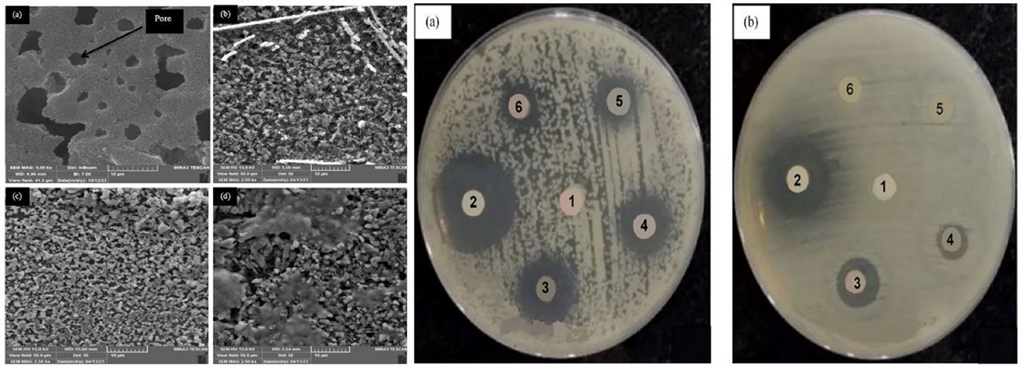
This study uses the chemical spray technique to employ the cadmium and nickel oxide nanostructures deposited on porous silicon substrate. CdO and NiO nanocomposites were prepared by a mixture exchange process with different composites at 25 % CdO-NiO, 50 % CdO-NiO and 75 % CdO-NiO. The biological activity was studied, and it was found that the concentrations of 50 and 100 µg/mL of 50 % CdO-NiO and 75 % CdO-NiO were the best concentrations, low concentrations of the nanoparticle mixture at 25 µg/mL also encouraged the growth of symbiotic bacteria. The investigation and characterization of NiO and CdO thin films nanostructures on porous silicon at different compositions were observed. A scanning electron microscope image revealed that the particle size of the prepared samples decreased from 26.36 to 22.61 nm with an increase of Cd2+ content. XRD pattern showed a cubic structure and good crystallinity of CdO and NiO nanocomposites. In addition, I-V measurements refer to the presence of rectifying behavior in a hetero structure. In terms of external current, the highest value was found to be at 75 % CdO. The optical energy was decreased from 2.69 to 2.55 eV for 25 % CdO and 75 % CdO, respectively. In addition, this paper focuses on the optimization of performance mixture CdO-NiO/PSi hybrid nanostructures to enhance their physical and biological properties.
HIGHLIGHTS
- This work uses the chemical spray technique to employ the cadmium and nickel oxide nanostructures deposited on porous silicon substrate.
- Cadmium and nickel oxides nanocomposites were prepared by a mixture exchange process with different composites at 25 % CdO-NiO, 50 % CdO-NiO and 75 % CdO-NiO.
- The biological activity was studied, and it was found that the concentrations of 50 and 100 µg/mL of 50 % CdO-NiO and 75 % CdO-NiO were the best concentrations, low concentrations of the nanoparticle mixture at 25 µg/mL also encouraged the growth of symbiotic bacteria.
- The investigation and characterization of NiO and CdO thin films nanostructures on porous silicon at different compositions were observed.
- This paper focuses on the optimization of performance mixture CdO-NiO/PSi hybrid nanostructures to enhance their physical and biological properties.
GRAPHICAL ABSTRACT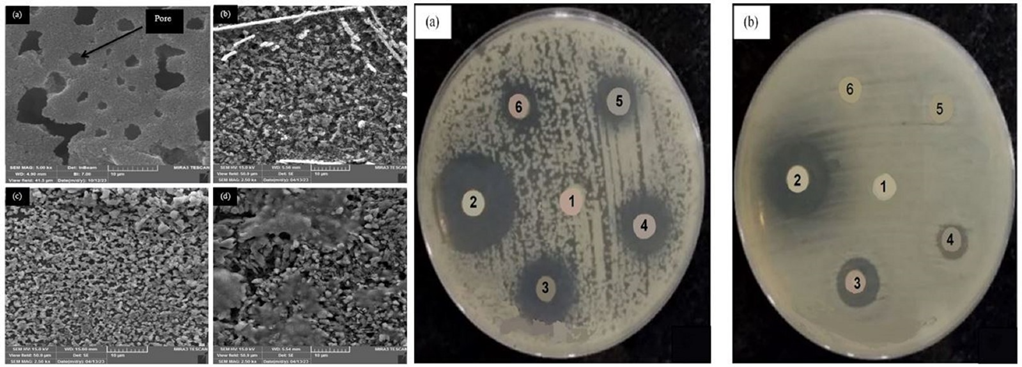
Downloads
References
S Garba and A Yakubu. Nickel Oxide (NiO) devices and applications: A review. International Journal of Engineering Research and Technology 2019; 8(4), 461-467.
AAA Al-Mushki, AAA Ahmed, AM Abdulwahab, SAS Qaid, NS Alzayed, M Shahabuddin, JMA Abduljalil and FAA Saad. Effect of the molar ratio of (Ni2+ and Fe3+) on the magnetic, optical and antibacterial properties of ternary metal oxide CdO-NiO-Fe2O3 nanocomposites. Scientific Reports 2023; 13(1), 9021.
B Abbas, AU Ahmad, S Shabbir, M Shahid, T Ahmad, MH Braga, I Naz, F Ahmad, Z Farooq and H Anwar. Enhancing photocatalytic and antibacterial performance through compositional optimization of NiO-CdO heterogeneous nanocomposites. Ceramics International 2023; 49(21), 33525-33536.
TA Aswad, TA Abbas and GG Ali. Effect of deposition time on optical properties of CuO thin film prepared by chemical bath deposition method. Digest Journal of Nanomaterials and Biostructures 2021; 16(3), 831-838.
OA Alhamd, GG Ali and MSH Aljuboori. Study and characterization of copper and titanium oxides nanostructures for some molecular and biological applications. Trends in Sciences 2024; 21(4), 7402.
GG Ali, MA Ahmed and AA Sulaiman. Structural properties of AuNPs/PSi nanostructure. Digest Journal of Nanomaterials and Biostructures 2022; 17(2), 473-480.
D Bonardo, N Darsono, S Humaidi, A Imaduddin and NS Silalahi. Effect of calcination frequency on the thermoelectric properties of Ti doped CuCrO2 by solid state method. Journal of Metals, Materials and Minerals 2023; 33(4), 1785.
D Bonardo, NLW Septiani, E Estananto, S Suyatman, S Humaidi and B Yuliarto. Synthesis and characterization of WO3 sensitive layers for NO2 gas sensor application. In: Proceedings of the Engineering Physics International Conference 2021, Yogyakarta, Indonesia. 2023, p. 50012.
YN Al-Douri, N Badi and CH Voon. Etching time effect on optical properties of porous silicon for solar cells fabrication. Optik 2017; 147, 343-349.
O Bisia, O Stefano and L Pavesi. Porous silicon: A quantum sponge structure for silicon-based optoelectronics surface. Science Reports 2000; 38(1-3), 1-126.
T Kumeria, SJP McInnes, S Maher and A Santos. Porous silicon for drug delivery applications and theranostics: Recent advances, critical review and perspectives. Expert Opinion on Drug Delivery 2017; 14(12), 1407-1422.
H Föll, J Carstensen, M Christopersen and G Hasse. New view of silicon electrochemistry. Physica Status Solidi 2000; 182(1), 7-16.
AA Sulaiman, GG Ali and AI Thanon. Synthesis and study of ZnO thin films using CVD technique for waveguide sensor applications. Journal of Nanostructures 2022; 12(1), 1-11.
X Yang, F Xi, X Chen, S Li, X Wan, W Ma, P Dong, J Duan and Y Chang. Porous silicon fabrication and surface cracking behavior research based on anodic electrochemical etching. Fuel Cells 2020; 21(1), 52-57.
J Park, Y Yanagida and T Hatsuzawa. Fabrication of p-type porous silicon using double tank electrochemical cell with halogen and LED light sources. Sensors and Actuators B: Chemical 2016; 233, 136-143.
R Vercauteren, G Scheen, JP Raskin and LA Francis. Porous silicon membranes and their applications: Recent advances. Sensors and Actuators A: Physical 2021; 318, 112486.
K Karthik, S Dhanuskodi, C Gobinath, S Prabukumar and S Sivaramakrishnan. Nanostructured CdO-NiO composite for multifunctional applications. Journal of Physics and Chemistry of Solids 2018; 112, 106-118.
AA Ezhilarasi, JJ Vijaya, K Kaviyarasu, M Maaza, A Ayeshamariam and LJ Kennedy. Green synthesis of NiO nanoparticles using Moringa oleifera extract and their biomedical applications: Cytotoxicity effect of nanoparticles against HT-29 cancer cells. Journal of Photochemistry and Photobiology B: Biology 2016; 164, 352-360.
S Anitha, M Suganya, D Prabha, J Srivind, S Balamurugan and AR Balu. Synthesis and characterization of NiO-CdO composite materials towards photoconductive and antibacterial applications. Materials Chemistry and Physics 2018; 211(1), 88-96.
PA Thomas, O Alhamd, G Iszkuło, M Dering and TA Mukassabi. Biological flora of the British Isles: Aesculus hippocastanum. Journal of Ecology 2019; 107(2), 992-1030.
K Karthik, S Dhanuskodi, C Gobinath, S Prabukumar and S Sivaramakrishnan. Multifunctional properties of microwave assisted CdO-NiO-ZnO mixed metal oxide nanocomposite: Enhanced photocatalytic and antibacterial activities. Journal of Materials Science: Materials in Electronics 2018; 29, 5459-5471.
NB Hasan and MJ Mohammed. Structural and morphological studies of (NiO)1–x(CuO)x thin films prepared by chemical spray paralysis technique. International Letters of Chemistry, Physics and Astronomy 2015; 58, 102-112.
OA Hammadi, MK Khalaf and FJ Kadhim. Fabrication of UV photodetector from nickel oxide nanoparticles deposited on silicon substrate by closed-field unbalanced dual magnetron sputtering techniques. Optical and Quantum Electronics 2015; 3(1), 134-142.
J Xu, S Liu, Y Yang, J Li, C Tian, L Guo, S Zhang, Y Liu and Z Zhong. Preparation of porous silicon by electrochemical etching methods and its morphological and optical properties. International Journal of Electrochemical Science 2019; 14(6), 5188-5199.
MS Mohammed and RA Shlaga. Morphological and optical properties of porous silicon. Engineering and Technology Journal 2019; 37(1), 17-20.
A Murat, S Gao, L Wang, L Chai, S Abliz and A Yimit. Synthesis and characterization of cadmium ion-imprinted/natural sand composite and research on its adsorption properties. Coating 2023; 13(7), 1288.
I Syahidi, E Prayogo, B Pratama, K Triyana, K Khairurrijal, H Susanto and R Suryana. Porous silicon fabrication on N-type Si (111) electrochemical anodization technique with HF: Methanol solution. Materials Today: Proceedings 2021; 44(3), 3430-3433.
K Omar and KA Salman. Effects of electrochemical etching time on the performance of porous silicon solar cells on crystalline n-type (100) and (111). Journal of Nano Research 2017; 46, 45-56.
O Volovlikova, S Gavrilov and P Lazarenko. Influence of illumination on porous silicon formed by photo-assisted etching of p-type Si with a different doping level. Micromachines 2020; 11(2), 199.
S Khafory, KA Addim and G Ali. Effect of concentrations ratios of NiO on the efficiency of solar cell for (CdO)1–x(NiO)x thin films. Iraqi Journal of Physics 2017; 15(33), 63-70.
EA Saverina, DY Zinchenko, SD Farafonova, AS Galushko, AA Novikov, MV Gorbachevskii, VP Ananikov, MP Egorov, VV Jouikov and MA Syroeshkin. Porous silicon preparation by electrochemical etching in ionic liquids. ACS Sustainable Chemistry and Engineering 2020; 8(27), 10259-10264.
AAA Ahmed, AAA Al-Mushki, BA Al-Asbahi, AM Abdulwahab, JMA Abduljalil, FAA Saad, SMH Qaid, HM Ghaithan, WA Farooq and AEH Omar. Effect of ethylene glycol concentration on the structural and optical properties of multimetal oxide CdO-NiO-Fe2O3 nanocomposites for antibacterial activity. Journal of Physics and Chemistry of Solids 2021; 155, 110113.
M Singh, AK Mallick, M Banerjee and R Kumar. Loss of outer membrane integrity in Gram-negative bacteria by silver nanoparticles loaded with Camellia sinensis leaf phytochemicals: Plausible mechanism of bacterial cell disintegration. Bulletin of Materials Science 2016; 39, 1871-1878.
Z Xu, C Zhang, X Wang and D Liu. Release strategies of silver ions from materials for bacterial killing. ACS Applied Bio Materials 2021; 4(5), 3985-3999.
UM Nayef, HT Hussein and AMA Hussien. Study of photoluminescence quenching in porous silicon layers that using for chemical solvents vapor sensor. Optik 2018; 172, 1134-1139.
YS Ocak, D Batibay and S Baturay. Optical and electrical properties of Ni-doped CdO thin films by ultrasonic spray pyrolysis. Journal of Materials Science: Materials in Electronics 2018; 29, 17425-17431.
N Hossain, MH Mobarak, MA Mimona, MA Islam, A Hossain, FT Zohura and MA Chowdhury. Advances and significances of nanoparticles in semiconductor applications - A review. Results in Engineering 2023; 19, 101347.
M Aftab, MZ Butt, D Ali, ZH Aftab, MU Tanveer and B Fayyaz. Investigation of antifungal response of NiO and copper-doped NiO thin films against Aspergillus niger and Macrophomina phaseolina fungi. Environmental Science and Pollution Research 2022; 29, 3840-3852.
M Suganya, R Baskaran, VS Nagarethinam and AR Balu. Photoconductive and antimicrobial properties of Psidium guajava leaf extract mediated green synthesized SnS2-CdO and SnS2-NiO nanocomposites. International Journal of Nanoscience 2021; 20(4), 2150034.
AM Al-Jezbi. Synthesis and study of some physical properties of (CdO/NiO) nanocomposite via sol-gel method and their antibacterial activities. Albaydha University Journal 2022; 4(2), 998-1017.
Published
How to Cite
Issue
Section
License
Copyright (c) 2025 Walailak University

This work is licensed under a Creative Commons Attribution-NonCommercial-NoDerivatives 4.0 International License.





