
Green Reinforcement of Epoxy Nanocomposites: Enhancing Flame Retardancy and Mechanical Properties with Epoxidized Linseed Oil, MWCNTs, and Montmorillonite Clay
DOI:
https://doi.org/10.48048/tis.2025.10053Keywords:
Antimony trioxide, Chlorinated paraffin, Flame retardancy, Epoxy resin, Multi-walls carbon nanotubes, Epoxidised linseed oilAbstract
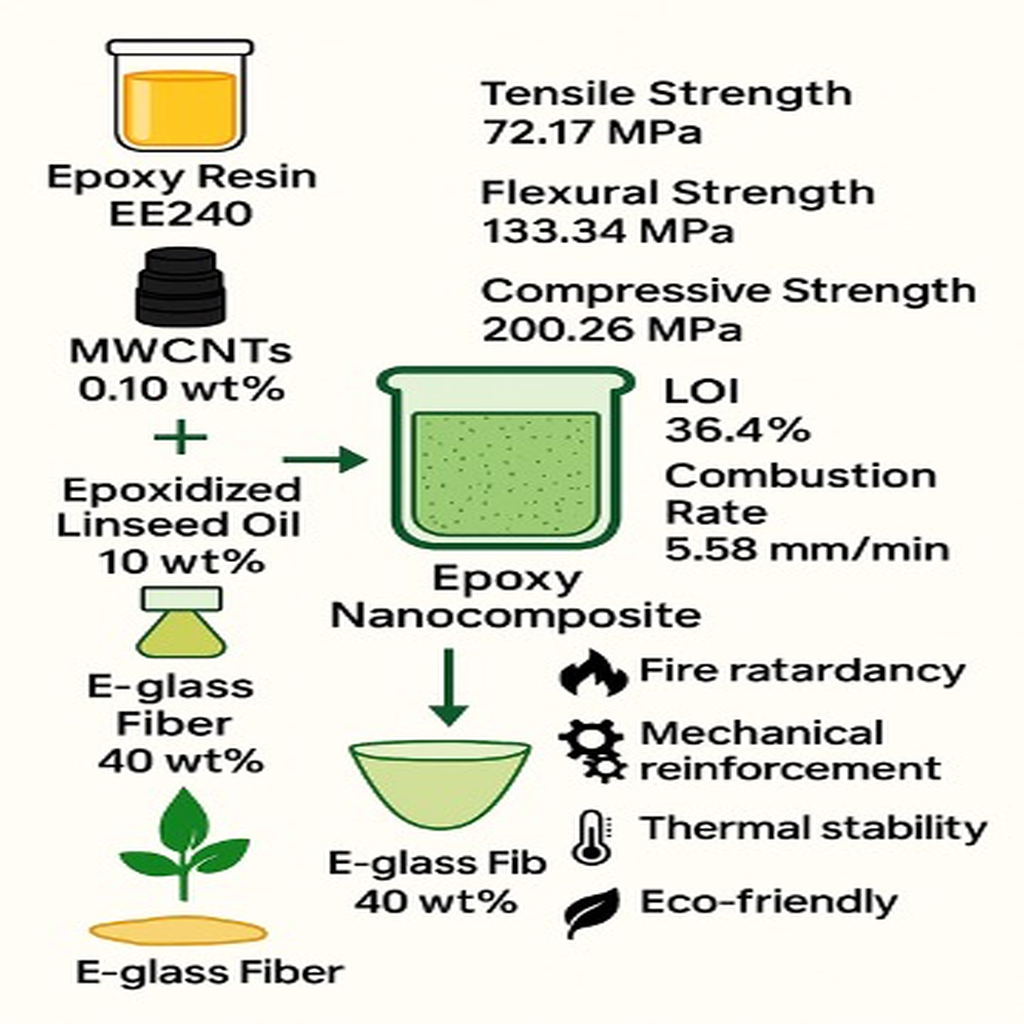
This study focuses on enhancing the flame retardancy and mechanical properties of epoxy nanocomposites by incorporating multi-walled carbon nanotubes (MWCNTs), montmorillonite nanoclay I.30E, and flame retardants such as chlorinated paraffin and antimony trioxide. The materials were fabricated through mechanical stirring and ultrasonication, ensuring uniform dispersion of additives within the epoxy matrix. The results indicate that the optimal ultrasonication time for dispersing MWCNTs is 90 min at room temperature, with 0.10 wt% MWCNTs significantly improving mechanical properties and flame retardancy. The addition of MWCNTs and nanoclay I.30E increased the limiting oxygen index (LOI), reduced the combustion rate, and formed a protective layer that prevented flame propagation. When 2 wt% nanoclay was added, tensile strength increased to 72.17 MPa, flexural strength reached 133.34 MPa, and compressive strength improved to 200.26 MPa. However, at higher concentrations (3 - 4 wt%), mechanical properties deteriorated due to uneven dispersion. Additionally, epoxidized linseed oil (ELO) was used as a plasticizer to enhance flexibility and optimize the balance between mechanical performance and flame retardancy. The MWCNTs/Nanoclay I.30E/Sb2O3/CP system with 10 wt% ELO achieved the highest LOI (36.4 %), the lowest combustion rate (5.58 mm/min), and a UL-94 V-0 rating. Overall, this study demonstrates that the combination of MWCNTs, nanoclay I.30E, flame retardants, and glass fibers significantly improves the mechanical and flame-retardant properties of epoxy composites, making them suitable for high-safety applications in various industries.
HIGHLIGHTS
- A novel hybrid system was developed by integrating MWCNTs, nanoclay I.30E, and epoxidized linseed oil (ELO) into epoxy resin.
- Optimal MWCNT content (0.10 wt%) yielded the best dispersion, enhancing tensile, flexural, and impact strength significantly.
- 2 wt% nanoclay I.30E improved interfacial interaction and char formation, maximizing flame retardancy.
- The final formulation achieved LOI 36.4 %, UL-94 V-0 rating, and low combustion rate (5.58 mm/min).
- The synergy of bio-based and nanostructured additives offers a sustainable solution for fire-safe, high-performance epoxy composites.
GRAPHICAL ABSTRACT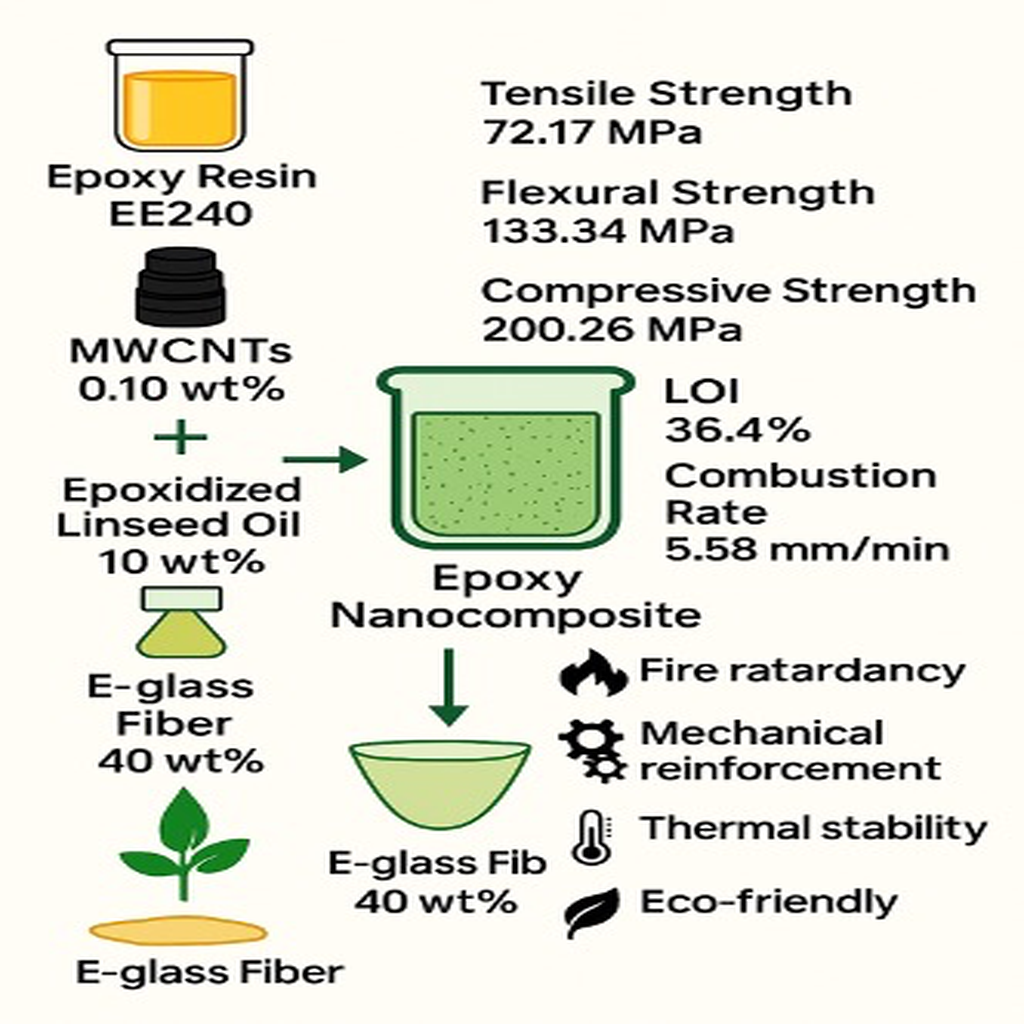
Downloads
References
M Mandal, Z Halim and TK Maji. Mechanical, moisture absorption, biodegradation and physical properties of nanoclay-reinforced wood/plant oil composites. SN Applied Sciences 2020; 2, 250.
M Bahrami, J Abenojar and MÁ Martínez. Recent progress in hybrid biocomposites: Mechanical properties, water absorption, and flame retardancy. Materials 2020; 13(22), 5145.
TA Nguyen. Mechanical and flame-retardant properties of nanocomposite based on epoxy resin combined with epoxidized linseed oil, which has the presence of nanoclay and MWCNTs. Journal of Chemistry 2020; 2020(1), 2353827.
G Xu, L Tan, K Liu, R Yang, Y Nie, X Fang and G Chen. Enhancing the mechanical properties and heat resistance of epoxy resin via blending with polythioetherimide. Polymer Engineering & Science 2023; 63(6), 1772-1780.
S Zhao and MM Abu-Omar. Biobased epoxy nanocomposites derived from lignin-basedmonomers. Biomacromolecules 2015; 16(7), 2025-2031.
H Salam and Y Dong. Optimisation of material formulation and processing parameters in relation to mechanical properties of bioepoxy/clay nanocomposites using taguchi design of experiments (DoEs). Biomacromolecules 2021; 16(7), 113-144.
M Alam, D Akram, E Sharmin, F Zafar and S Ahmad. Vegetable oil based eco-friendly coating materials: A review article. Arabian Journal of Chemistry 2021; 7, 469-479.
R Turco, R Tesser, V Russo, T Cogliano, M Di Serio and E Santacesaria. Epoxidation of linseed oil by performic acid produced in situ. Industrial & Engineering Chemistry Research 2021; 60, 16607-16618.
MD Samper, JM Ferri, A Carbonell-Verdu, R Balart and O Fenollar. Properties of biobased epoxy resins from epoxidized linseed oil (ELO) crosslinked with a mixture of cyclic anhydride and maleinized linseed oil. Express Polymer Letters 2019; 13, 407-418.
L Yin, K Gong, H Pan, X Qian, C Shi, L Qian and K Zhou. Novel design of MOFs-based hierarchical nanoarchitecture: Towards reducing fire hazards of epoxy resin. Composites Part A: Applied Science and Manufacturing 2022; 158, 106957.
W Wang, B Lin, ACY Yuen and GH Yeoh. One-dimensional nanomaterials for flame retardant epoxy thermosets and composites. In: Y Hu and X Wang (Eds.). Non-halogenated flame-retardant technology for epoxy thermosets and composites. Woodhead Publishing, Cambridge, 2024, p. 291-322.
L Yan, J Guan, Z Wei, X Tang and Z Xu. Combination effect of ADP-intercalated kaolinite and ammonium polyphosphate on simultaneously enhancing the flame retardancy and smoke suppression of epoxy resins. Journal of Vinyl and Additive Technology 2024; 30, 868-879.
TA Nguyen and TN Nguyen. Green evolution: Advancing epoxy composite materials with durian peel fiber innovation. Trends in Sciences 2024; 22(2), 9099.
TA Nguyen, TMH Pham, TH Dang, TH Do and QT Nguyen. Study on mechanical properties and fire resistance of epoxy nanocomposite reinforced with environmentally friendly additive: Nanoclay I.30E. Journal of Chemistry 2020; 2020(1), 3460645.
TA Nguyen, QT Nguyen, XC Nguyen and VH Nguyen. Study on fire resistance ability and mechanical properties of composites based on Epikote 240 Epoxy Resin and thermoelectric fly ash: An ecofriendly additive. Journal of Chemistry 2019; 2019(1), 2635231.
TA Nguyen. Effects of the amount of fly ash modified by stearic acid compound on mechanical properties, flame retardant ability, and structure of the composites. International Journal of Chemical Engineering 2020; 2020(1), 2079189.
TA Nguyen and QT Nguyen. Study on synergies of fly ash with multiwall carbon nanotubes in manufacturing fire retardant epoxy nanocomposite. Journal of Chemistry 2020; 2020(1), 6062128.
TA Nguyen and TMH Pham. Study on the properties of epoxy composites using fly ash as an additive in the presence of nanoclay: Mechanical properties, flame retardants, and dielectric properties. Journal of Chemistry 2020; 2020(1), 8854515.
NT Anh. Mechanical and flame-retardant properties of Exoxy Epikote 240/epoxidized linseed oil composites using fiber-glass. Mehran University Research Journal of Engineering & Technology 2020; 39(1), 9-20.
MA Sarhan, S Shihab, BE Kashem and M Rasheed. New exact operational shifted pell matrices and their application in astrophysics. Journal of Physics: Conference Series 2021; 1879(2), 022122.
M Rasheed, MN Al-Darraji, S Shihab, A Rashid and T Rashid. Solar PV modelling and parameter extraction using iterative algorithms. Journal of Physics: Conference Series 2021; 1963(1), 012059.
M Rasheed, MN Al-Darraji, S Shihab, A Rashid and T Rashid. The numerical calculations of single-diode solar cell modeling parameters. Journal of Physics: Conference Series 2021; 1963(1), 012058.
Published
How to Cite
Issue
Section
License
Copyright (c) 2025 Walailak University

This work is licensed under a Creative Commons Attribution-NonCommercial-NoDerivatives 4.0 International License.





