
Performance of Dye-Sensitized Solar Cell with Carrot-Based Dyes in Deep Eutectic Solvent and KI/I2 Electrolytes
DOI:
https://doi.org/10.48048/tis.2025.10041Keywords:
Carrots, Photovoltaics, Solar, Sustainable, Technology, Carrots, Photovoltaics, Renewable, Solar, Sustainable, TechnologyAbstract
Dye-sensitized solar cells (DSSCs) offer a potential alternative to the conventional silicon-based photovoltaic cells due to their low cost and the wide choice of materials available. Their efficiency and stability, however, greatly depend on the photosensitizer and electrolyte materials. In the study, the possibility of carrot roots and leaves as natural photosensitizers with the combination of Deep Eutectic Solvent (DES) and KI/I2 electrolytes on DSSC performance was explored.
Among the treatments, Treatment 3 (DES with carrot roots) exhibited the highest performance, with an Isc of 0.0042 A, Voc of 1.2 V, and an overall efficiency (η) of 3.53 %. This performance is attributed to DES’s ability to enhance charge transport and minimize recombination losses. Treatment 1 (DES with carrot leaves) also demonstrated favorable results, achieving an efficiency of 2.5 %, attributed to the effectiveness of DES in stabilizing natural dyes. In contrast, Treatment 2 (KI/I2 with carrot leaves) displayed a reduced efficiency of 1.43 %. Meanwhile, Treatment 4 (KI/I2 with carrot roots) recorded the lowest efficiency of 0.68 %, suggesting that KI/I2 electrolyte limits charge transfer in natural dye-based DSSCs.
Conductivity measurements supported these findings, with Treatment 3 exhibiting the highest conductivity (3.50×10⁻⁴ Ω⁻¹⋅m⁻¹) and the lowest resistance (285.71 Ω), followed by Treatment 1. Conversely, Treatments 2 and 4 exhibited higher resistance values, correlating with their lower photovoltaic performance. Additionally, dark current analysis demonstrated that DES-based treatments exhibited lower current leakage over time, reinforcing their potential for long-term stability.
Conclusively, these results have demonstrated the potential of DES-based electrolytes in improving natural photosensitizer efficiencies in DSSCs and provide evidence for designing a more effective and stable solar cell. Moreover, it contributes to the development of renewable energy in which natural materials of low cost are combined with DES to develop green solar technologies as an alternative to fossil fuels.
HIGHLIGHTS
- The study proves that DSSCs with the use of DES-based electrolytes have higher efficiency and heat resistance than KI/I2 DES treatments yielded efficiencies of 3.53 %, with enhanced charge transportation and low recombination loss.
- The DES-based electrolytes maintain stable open-circuit voltage (Voc) and charge transport at varying temperatures. This suggests DES as a promising alternative for improving DSSC stability under fluctuating environmental conditions.
- Carrot leaf extracts, rich in carotenoids and chlorophyll, were explored as eco-friendly photosensitizers. While carotenoids contributed to efficient light absorption and electron transfer, chlorophylls showed lower efficiency, suggesting the potential for optimizing natural dye combinations for DSSCs.
GRAPHICAL ABSTRACT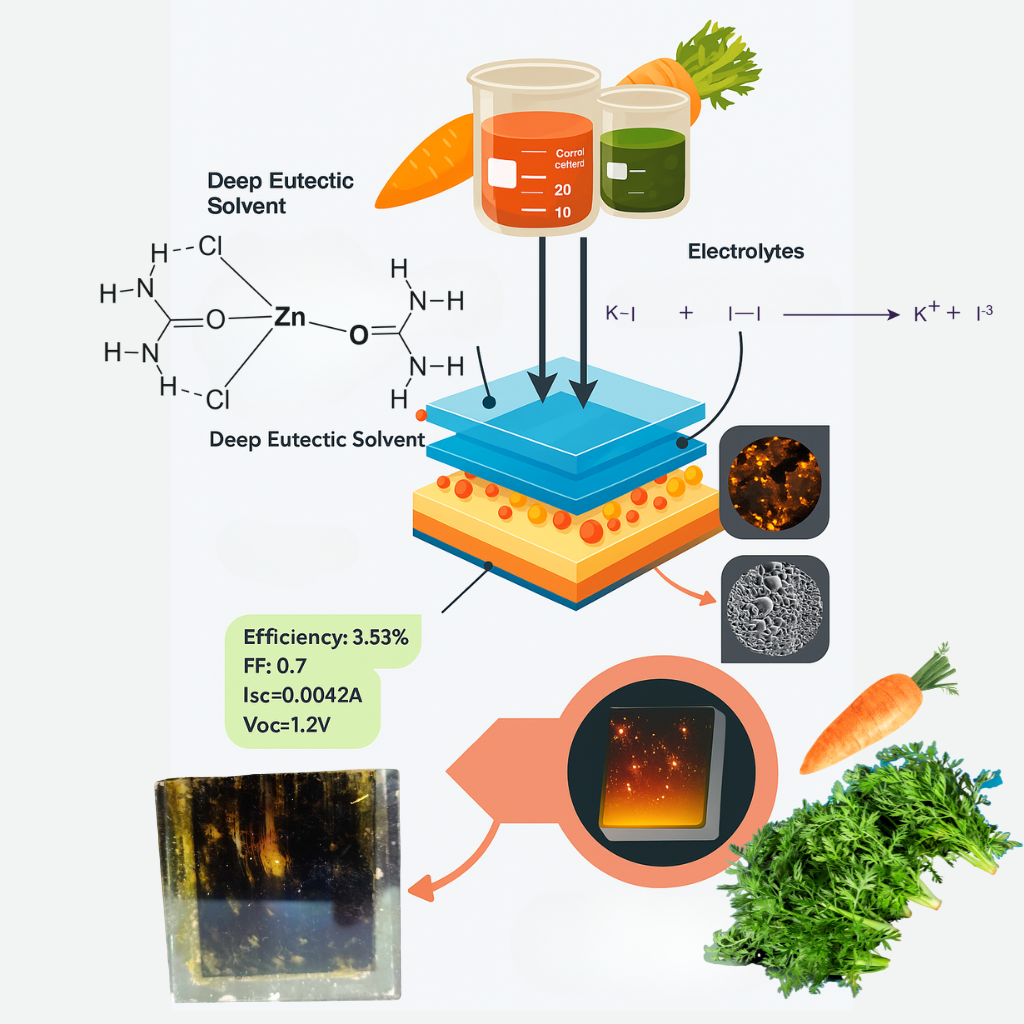
Downloads
References
T Ahmad and D Zhang. A critical review of comparative global historical energy consumption and future demand: The story told so far. Energy Reports 2020; 6, 1973-1991.
AS Al-Sumaiti and MMA Salama. Review on issues related to electric energy demand in distribution system for developing countries. In: Proceedings of the 3rd IET International Conference on Clean Energy Technologies, Kuching, Malaysia. 2014.
G Timilsina and KU Shah. Energy technologies for Sustainable Development Goal 7. In: AA Adenle, MR Chertow, EHM Moors and DJ Pannell (Eds.). Science, technology, and innovation for sustainable development goals: Insights from agriculture, health, environment, and energy. Oxford University Press, New York, 2020, p. 36-65.
UN Environment Programme. Goal 7: Affordable and clean energy, Available at: https://www.unep.org/explore-topics/sustainable-development-goals/why-do-sustainable-development-goals-matter/goal-7, accessed March 2025.
AN Esen, Z Duzgit, AO Toy and ME Günay. An overview of energy technologies for a sustainable future. In: A Bilge, A Toy and M Günay (Eds.). Springer proceedings in energy. Springer, New York, 2015.
PV Calzadilla and R Mauger. The UN’s new sustainable development agenda and renewable energy: The challenge to reach SDG7 while achieving energy justice. Journal of Energy & Natural Resources Law 2017; 36(2), 233-254.
F Santos, D Ivanou and A Mendes. The renaissance of monolithic dye-sensitized solar cells. Materials Today Communications 2022; 32, 104030.
NS Noorasid, F Arith, AN Mustafa, MA Azam, S Mahalingam, P Chelvanathan and N Amin. Current advancement of flexible dye-sensitized solar cell: A review. Optik 2022; 254, 168089.
K Prajapat, M Dhonde, K Sahu, P Bhojane, V Murty and PM Shirage. The evolution of organic materials for efficient dye-sensitized solar cells. Journal of Photochemistry and Photobiology C: Photochemistry Reviews 2023; 55, 100586.
BK Korir, JK Kibet and SM Ngari. A review on the current status of dye-sensitized solar cells: Toward sustainable energy. Energy Science & Engineering 2024; 12(8), 3188-3226.
AS Thomas. High-efficiency dye-sensitized solar cells: A comprehensive review. Computational and Experimental Research in Materials and Renewable Energy 2022; 5(1), 1.
S Yanagida, Y Yu and K Manseki. Iodine/iodide-free dye-sensitized solar cells. Accounts of Chemical Research 2009; 42, 1827-1838.
AE Anitha and M Dotter. A review on liquid electrolyte stability issues for commercialization of dye-sensitized solar cells (DSSC). Energies 2023; 16(13), 5129.
RAA Talip, WZN Yahya and MA Bustam. Ionic liquids roles and perspectives in electrolyte for dye-sensitized solar cells. Sustainability 2020; 12(18), 7598.
S Shalini, R Balasundaraprabhu, TS Kumar, N Prabavathy, S Senthilarasu and S Prasanna. Status and outlook of sensitizers/dyes used in dye-sensitized solar cells (DSSC): A review. International Journal of Energy Research 2016; 40(10), 1303-1320.
NGFC Mejica, NR Ramaraj and Y Unpaprom. Natural dye (chlorophyll, anthocyanin, carotenoid, flavonoid) photosensitizer for dye-sensitized solar cell: A review. Maejo International Journal of Energy and Environmental Communication 2022; 4(1), 12-22.
N Prabavathy, S Shalini, R Balasundaraprabhu, D Velauthapillai, S Prasanna and N Muthukumarasamy. Enhancement in the photostability of natural dyes for dye-sensitized solar cell (DSSC) applications: A review. International Journal of Energy Research 2017; 41(10), 1372-1396.
SA Abrol and C Bhargava. Sensitization of organic dyes to be used in the fabrication of DSSC. In: C Bhargava and A Sachdeva (Eds.). Nanotechnology. CRC Press, Boca Raton, 2020, p. 105-108.
J Kim, D Kim, J So and H Koo. Toward eco-friendly dye-sensitized solar cells (DSSCs): Natural dyes and aqueous electrolytes. Energies 2021; 15(1), 219.
A Sharma, R Sharma, RC Thakur and L Singh. An overview of deep eutectic solvents: Alternative for organic electrolytes, aqueous systems & ionic liquids for electrochemical energy storage. Journal of Energy Chemistry 2023; 82, 592-626.
D Julião, M Xavier and X Mascarenhas. Deep eutectic solvents: Viable sustainable electrolytes for supercapacitors. Materials Today Energy 2024; 42, 101432.
R Puttaswamy, C Mondal, D Mondal and D Ghosh. An account on the deep eutectic solvents-based electrolytes for rechargeable batteries and supercapacitors. Sustainable Materials and Technologies 2022; 33, e00477.
EA Yigit and YE Akansu. Investigation of deep eutectic solvent-based super dielectric electrolytes for supercapacitors. Energy Environment & Storage 2023; 3(3), 119-125.
H Tsai, M Kumar, B Vedhanarayanan, H Shen and T Lin. Urea-based deep eutectic solvent with magnesium/lithium dual ions as an aqueous electrolyte for high-performance battery-supercapacitor hybrid devices. Batteries 2023; 9(2), 69.
D Nguyen, TV Huynh, VS Nguyen, PD Cao, HT Nguyen, T Wei, PH Tran and PT Nguyen. Choline chloride-based deep eutectic solvents as effective electrolytes for dye-sensitized solar cells. RSC Advances 2021; 11(35), 21560-21566.
P Karnjanawipagul, W Nittayanuntawech, P Rojsanga and L Suntornsuk. Analysis of β-carotene in carrot by spectrophotometry. Mahidol University Journal of Pharmaceutical Sciences 2010; 37, 8-16.
A Ebadollahi-Natanzi and G Arab-Rahmatipour. A study on chlorophyll, total carotenoid and beta-carotene contents in carrot and the effect of climate on them. Journal of Medicinal Plants 2020; 19, 254-265.
S Pareek, NA Sagar, S Sharma, V Kumar, T Agarwal, GA González‐Aguilar and EM Yahia. Chlorophylls: Chemistry and biological functions. In: EM Yahia (Ed.). Fruit and vegetable phytochemicals: Chemistry and human health. Wiley Online Library, New Jersey, 2017, p. 269-284.
CS Klein and M Rodriguez-Concepcion. Carotenoids in carrot. In: C Chen (Ed.). Pigments in fruits and vegetables. Springer, New York, 2015, p. 217-228.
H Lian, S Hong, A Carranza, JD Mota-Morales and JA Pojman. Processing of lignin in urea-zinc chloride deepeutectic solvent and its use as a filler in a phenol-formaldehyde resin. RSC Advances 2015; 5(36), 28778-28785.
G Grandi, A Ienina and M Bardhi. Effective low-cost hybrid LED-halogen solar simulator. IEEE Transactions on Industry Applications 2014; 50(5), 3055-3064.
H Hardani, LM Angraeni, C Cari and A Supriyanto. Improved performance of dye-sensitized solar cells with TiO2 nanoparticles by using the carrot as a dye solar cell application. Journal of Fisika Flux 2019; 16(1), 61.
X Zhang, S Wang and Z Wang. Effect of metal-doping in TiO2 on fill factor of dye-sensitized solar cells. Applied Physics Letters 2011; 99(11), 113503.
H Hariyanto, M Rusdi, D Parenden, C Cipto and KA Rahangmetan. Dye-sensitized solar cell performance measurement analysis using Arduino board. E3S Web of Conferences 2021; 328, 07005.
N Taneja, P Gupta, M Gupta and Y Kumar. Deep eutectic solvent-based polymer electrolyte films for an electrochemical double-layer cell. Indian Science Journal of Research in Engineering and Management 2024; 08(06), 1-13.
A Adhitya, W Rahmalia, I Syahbanu, G Gusrizal and A Adhitiyawarman. Deep eutectic solvent (DES) based on choline chloride and mono-, di-, poly-ethylene glycol as KI/I2 electrolyte solvents on DSSC devices. Indonesian Journal of Chemistry 2023; 23(5), 1294.
HC Hassan, ZHZ Abidin, FI Chowdhury and AK Arof. A high efficiency chlorophyll sensitized solar cell with quasi solid PVA based electrolyte. International Journal of Photoenergy 2016; 2016(1), 3685210.
MA Ridwan, E Noor, MS Rusli and N Akhiruddin. Fabrication of dye-sensitized solar cell using chlorophylls pigment from sargassum. IOP Conference Series: Earth and Environmental Science 2018; 144, 012039.
Z Arifin, S Soeparman, D Widhiyanuriyawan and S Suyitno. Performance enhancement of dye-sensitized solar cells using a natural sensitizer. International Journal of Photoenergy 2017; 2017, 2704864.
J Pan, G Benkö, Y Xu, T Pascher, L Sun, V Sundström and T Polívka. Photoinduced electron transfer between a carotenoid and TiO2 nanoparticle. Journal of the American Chemical Society 2002; 124, 13949-13957.
S Meng, J Ren and E Kaxiras. Natural dyes adsorbed on TiO2 nanowire for photovoltaic applications: Enhanced light absorption and ultrafast electron injection. Nano Letters 2008; 8, 3266-3272.
S Kuwahara, S Taya, N Osada, Q Shen, T Toyoda and K Katayama. Effect of electrolyte constituents on the motion of ionic species and recombination kinetics in dye-sensitized solar cells. Physical Chemistry Chemical Physics 2014; 16, 5242.
Y Koyama, T Miki, X Wang and H Nagae. Dye-sensitized solar cells based on the principles and materials of photosynthesis: Mechanisms of suppression and enhancement of photocurrent and conversion efficiency. International Journal of Molecular Sciences 2009; 10, 4575-4622.
PRF Barnes, AY Anderson, M Juozapavicius, L Liu, X Li, E Palomares, A Forneli and BC O’Regan. Factors controlling charge recombination under dark and light conditions in dye sensitised solar cells. Physical Chemistry Chemical Physics 2011; 13, 3547-3558.
AP Abbott, D Boothby, G Capper, DL Davies and RK Rasheed. Deep eutectic solvents formed between choline chloride and carboxylic acids: Versatile alternatives to ionic liquids. Journal of the American Chemical Society 2004; 126(29), 9142-9147.
R Gautam, N Kumar and JG Lynam. Theoretical and experimental study of choline chloride-carboxylic acid deep eutectic solvents and their hydrogen bonds. Journal of Molecular Structure 2020; 1222, 128849.
H Srinivasan, VK Sharma, R Mukhopadhyay and S Mitra. Solvation and transport of lithium ions in deep eutectic solvents. Journal of Chemical Physics 2020; 153, 10.
MV Fedotova, AA Gribkov and VN Trostin. Specific structural features of concentrated aqueous solutions of potassium iodide in a wide temperature range. Russian Journal of General Chemistry 2005; 75(2), 186-193.
MB Pérez, MJDP Hamparsomian, RE Gonzalez, GI Denoya, DL Dominguez, K Barboza, M Iorizzo, PW Simon, SR Vaudagna and PF Cavagnaro. Physicochemical properties, degradation kinetics, and antioxidant capacity of aqueous anthocyanin-based extracts from purple carrots compared to synthetic and natural food colorants. Food Chemistry 2022; 387, 132893.
A Noor, M Hamdini, S Ramadina and Y Tiandho. Model dye-sensitized solar cell dan aplikasinya berdasarkan data temperatur harian: Studi kasus pangkalpinang (in Indonesian). Jurnal Pendidikan Fisika Dan Keilmuan 2020; 6(2), 131.
ZH Abdulrahman, DM Hachim and AN Al-Murshedi. Investigation of the thermal effect on the performance of natural dye-sensitized solar cells. AIP Conference Proceedings 2024; 3104, 100002.
Z Varga and E Racz. Influence of the temperature on the open-circuit voltage and short-circuit current of a yellow colorized dye-sensitized solar cell using correlation approach. International Symposium on Applied Computational Intelligence and Informatics 2021; 387, 132893.

Published
How to Cite
Issue
Section
License
Copyright (c) 2025 Walailak University

This work is licensed under a Creative Commons Attribution-NonCommercial-NoDerivatives 4.0 International License.





